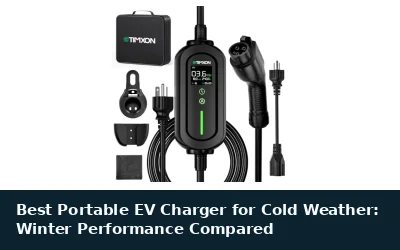
A portable electric vehicle supply equipment (EVSE) unit serves two vital roles: a reliable mobile backup for road trips and camping, or an accessible primary home charging station that avoids the expense of dedicated hardwired wallboxes. However, selecting the right portable EV charger requires navigating electrical constraints, vehicle acceptance rates, connector standards, and weatherproofing specifications.
In this guide, we evaluate 10 portable EV chargers spanning 16-amp travel cords to heavy-duty 40-amp high-output units. We analyze technical specifications, plug configurations, certified safety listings, and real-world utility to help you choose the right mobile charger for your vehicle and electrical setup.
Before you buy, it is worth reading Level 2 EV Charger Compatibility Guide and Best Portable EV Charger Under $300.
Quick Verdict: Finding the Right Charging Profile
Portable EV chargers divide cleanly into two mechanical and electrical classes based on input amperage and plug design:
- Everyday Travel & Standard Outlets (16-Amp Dual-Voltage): Units like the AIXINE Level 1&2 EV Charger and ELEGRP 16 Amp EV Charger utilize a NEMA 6-20 plug paired with a NEMA 5-15 adapter. Drawing a maximum of 16A at 240V (3.8 kW) or 12A at 120V (1.4 kW), they suit standard 15A and 20A household circuits without major electrical panel upgrades.
- High-Speed Mobile & Range Recovery (32-Amp to 40-Amp Level 2): Units such as the WOLFBOX 40A, ELEGRP 40A, and ChargeHere 32A utilize a heavy-duty NEMA 14-50 plug. Delivering between 7.7 kW and 9.6 kW, these models provide up to 37 miles of added range per hour on dedicated 40A or 50A circuits.

Pros
- Supports both Level 1 and Level 2 charging
- Includes connections for compatible 120V and 240V outlets
- Provides adjustable current and delayed-charging controls
- Offers J1772 compatibility for listed BEV and PHEV applications
- Includes ETL certification, FCC listing, and a stated two-year warranty
Cons
- Not compatible with Tesla vehicles or NACS connectors
Specifications
| Color | BLACK |
|---|---|
| Size | BLACK,SAE,J1772 |
| Dimensions | 2.2 x 3.03 x 9.17 inches |
| Weight | 7.7 Pounds |
| Product Group | Automotive Parts and Accessories |
Best For / Avoid If
Best for buyers prioritizing
- Supports both Level 1 and Level 2 charging
- Includes connections for compatible 120V and 240V outlets
- Provides adjustable current and delayed-charging controls
Consider another option if
- Not compatible with Tesla vehicles or NACS connectors

Pros
- Offers both Level 1 and Level 2 charging options
- Includes NEMA 6-20 and NEMA 5-15 connection options
- Provides up to 3.84kW output in Level 2 mode
- Includes automatic temperature-related power reduction and charging resumption
Cons
- Level 2 charging requires a dedicated NEMA 6-20 outlet
- The NEMA 5-15 connection must be manually adjusted to 12A
- Charging an 87kWh battery is listed as approximately 22.4 hours at Level 2 and over 60 hours at Level 1; actual time depends on the vehicle and circuit
Specifications
| Color | Black |
|---|---|
| Size | 16A J1772 Connector |
| Dimensions | 12 x 16 x 5 inches |
| Product Group | Automotive Parts and Accessories |
| Binding | Electronics |
Best For / Avoid If
Best for buyers prioritizing
- Offers both Level 1 and Level 2 charging options
- Includes NEMA 6-20 and NEMA 5-15 connection options
- Provides up to 3.84kW output in Level 2 mode
Consider another option if
- Level 2 charging requires a dedicated NEMA 6-20 outlet
- The NEMA 5-15 connection must be manually adjusted to 12A
- Charging an 87kWh battery is listed as approximately 22.4 hours at Level 2 and over 60 hours at Level 1; actual time depends on the vehicle and circuit

Pros
- Dual-voltage operation supports both 120V and 240V outlets
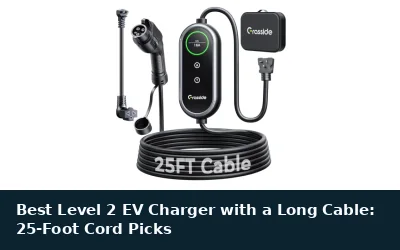
- Long 25-foot cable can reach vehicles in garages, driveways, and outdoor parking areas
- Adjustable current settings help match charging and electrical requirements
- Compatible with most North American J1772 EVs and PHEVs
Cons
- Tesla and other NACS-equipped vehicles require a compatible J1772 adapter
- The maximum 32A and 7.68kW charging specification applies to 240V NEMA 14-50 operation
- Charging controls use onboard buttons, with no Wi-Fi or mobile app specified
Specifications
| Color | black |
|---|---|
| Size | 32A |
| Weight | 10.3 Pounds |
| Product Group | Automotive Parts and Accessories |
| Binding | Tools & Home Improvement |
Best For / Avoid If
Best for buyers prioritizing
- Dual-voltage operation supports both 120V and 240V outlets
- Long 25-foot cable can reach vehicles in garages, driveways, and outdoor parking areas
- Adjustable current settings help match charging and electrical requirements
Consider another option if
- Tesla and other NACS-equipped vehicles require a compatible J1772 adapter
- The maximum 32A and 7.68kW charging specification applies to 240V NEMA 14-50 operation
- Charging controls use onboard buttons, with no Wi-Fi or mobile app specified
How We Chose These Portable EV Chargers
Rather than relying on unverified claims, CarTechTalk conducted an editorial evaluation of manufacturer engineering sheets, electrical schematics, certified testing laboratory marks (such as ETL and UL listings), and documented thermal safety features across available portable chargers.
Our evaluation criteria focused on five essential engineering benchmarks:
- Continuous Load Safety & Electrical Compliance: EV charging represents a continuous electrical load under the National Electrical Code (NEC Article 625), requiring equipment to draw no more than 80% of a circuit’s maximum rating. We verified whether chargers include current adjustment options to match various breaker capacities safely.
- Plug Architecture & Voltage Flexibility: We assessed whether units feature genuine dual-voltage capability (120V Level 1 and 240V Level 2) and provide proper plug configurations (NEMA 5-15, 6-20, or 14-50) without relying on uncertified third-party adapters.
- Connector Compatibility: Every evaluated model features an SAE J1772 connector, ensuring universal fitment for North American non-Tesla BEVs and PHEVs (and full Tesla/NACS compatibility via standard mechanical adapters).
- Cable Reach & Build Integrity: We evaluated cable lengths against standard parking configurations, along with ingress protection (IP ratings) against rain, dust, and temperature extremes.
- Onboard Controls & Scheduling: We favored units with tactile controls, informative status screens, and built-in delay timers that allow off-peak charging without requiring problematic Wi-Fi connections in outdoor driveways or parking garages.
Portable EV Charger Specifications Comparison
The table below summarizes verified manufacturer specifications across all 10 evaluated models. Where specific measurements or certifications were not officially provided in manufacturer documentation, they are listed as “Not provided.”
| Model | Max Current | Voltage Range | Primary Plug & Adapter | Cable Length | Weather Rating | Observed Price |
|---|---|---|---|---|---|---|
| AIXINE Level 1&2 EV Charger, Level 1 EV Charger | 16A (8/10/12/16A) | 120V–240V | NEMA 6-20 with 5-15 adapter | 25 ft (27 ft total) | IP67 | $118.99 |
| bokman Portable Level 1&2 EV Charger, 16A 20ft | 16A (6/8/10/12/16A) | 120V–240V | NEMA 6-20 with 5-15 adapter | 20 ft | IP65 | $99.99 |
| Toptoo Level 1+2 Portable EV Charger for Electric | 16A | 110V–240V | NEMA 6-20 with 5-15 adapter | – | – | $86.99 |
| WOLFBOX Portable Level 1&2 EV Charger 40amp | 40A (6A–40A) | 110V–240V | NEMA 14-50 with 6-20 & 5-15 | 25 ft | IP66 / NEMA 4 | $229.99 |
| ChargeHere Level 1 & Level 2 EV Charger | 32A (6A–32A) | 120V/240V | NEMA 14-50 with 5-15 adapter | 25 ft | IP66 | $184.99 |
| ELEGRP Level 1/2 EV Charger, 16 Amp | 16A (12A on 120V) | 110V–240V | NEMA 6-20 with 5-15 adapter | 25 ft | IP67 | $116.99 |
| TopAutoGear Portable EV Charger 16A Level 1&2 | 16A (8/10/12/16A) | 110V–240V | Dual-voltage adapter setup | 17 ft | IP54 | $75.94 |
| VEVOR Level 1&2 EV Charger, 16 Amp | 16A (12A/16A) | 120V–240V | NEMA 6-20 with 5-15 adapter | 25 ft | IP66 | $109.90 |
| ELEGRP Level 2 EV Charger 40Amp | 40A (16/20/24/32/40A) | 240V | NEMA 14-50 | 25 ft | IP67 | $209.99 |
| 16A Portable Level 1&2 EV Charger-ETL | 16A (12A on 120V) | 110V–240V | NEMA 6-20 with 5-15 adapter | – | – | $98.12 |
Compatibility and Electrical Buying Advice
Purchasing a portable EV charger requires understanding three core electrical compatibility factors before plugging into any wall receptacle.
1. The 80% Continuous Load Rule (NEC Article 625)
Electric vehicle charging is classified by the National Electrical Code as a continuous load, meaning maximum current draws can sustain for hours. Electrical safety standards require that continuous loads not exceed 80% of the circuit breaker’s rated capacity:
- 15-Amp Circuit (Standard NEMA 5-15 household outlet): Maximum safe continuous draw is 12 Amps (1.44 kW). Never set a portable charger to 16A on a standard 15A circuit.
- 20-Amp Circuit (NEMA 5-20 or 240V NEMA 6-20 outlet): Maximum safe continuous draw is 16 Amps (3.84 kW at 240V).
- 40-Amp Circuit: Maximum safe continuous draw is 32 Amps (7.68 kW at 240V).
- 50-Amp Circuit (NEMA 14-50 RV or stove outlet): Maximum safe continuous draw is 40 Amps (9.6 kW at 240V).
2. Plug Standards: NEMA 5-15 vs. 6-20 vs. 14-50
Portable chargers feature specific physical plugs that dictate where they can connect:
- NEMA 5-15: The ubiquitous 3-prong 120V household wall outlet. It adds approximately 3 to 5 miles of range per hour.
- NEMA 6-20: A 240V, 20A commercial/shop receptacle featuring one horizontal blade. It delivers 11 to 14 miles of range per hour. Most compact portable units come native with this plug and include a 5-15 adapter.
- NEMA 14-50: A heavy 4-prong 240V, 50A outlet commonly found in RV parks, generator panels, and dedicated home charging circuits. It delivers 25 to 37 miles of range per hour.
3. Vehicle Inlet Standards: J1772 vs. NACS (Tesla)
All ten chargers reviewed here utilize the North American standard SAE J1772 connector. This plug fits directly into every non-Tesla electric vehicle and plug-in hybrid sold in North America (including Ford, Chevrolet, Hyundai, Kia, BMW, and Nissan). If you drive a Tesla or a newer NACS-equipped vehicle, you can use any of these chargers simply by attaching the standard J1772-to-Tesla adapter that comes with the vehicle.
How to Choose the Best Portable EV Charger for Your Needs
Cable Length and Parking Practicality
Under NEC guidelines, 25 feet is the maximum allowable length for an EV charging cable to manage voltage drop and safety hazards. A 25-foot cord (featured on the AIXINE Level 1&2 EV Charger, Level 1 EV Charger, WOLFBOX Portable Level 1&2 EV Charger 40amp, and ChargeHere Level 1 & Level 2 EV Charger) allows you to back into a garage or pull straight into a driveway without straining the cable across the vehicle hood or trunk. If you park in a tight single-car garage, a 17-foot or 20-foot cord (such as the bokman Portable Level 1&2 EV Charger, 16A 20ft) is lighter and easier to coil into a trunk organizer.
Weatherproofing and Outdoor Durability
If you must charge outside in driveways or at unshaded campsites, check the IP (Ingress Protection) rating:
- IP54: Protects against dust and light water splashing. Adequate for indoor garages or covered carports.
- IP65 / IP66: Dust-tight and resistant to multi-directional water jets and heavy rain. Suitable for general outdoor driveway charging.
- IP67: Dust-tight and sealed against temporary water submersion up to 1 meter (featured on AIXINE and ELEGRP models), offering superior resistance against standing puddle immersion and heavy snow buildup.
Display Telemetry vs. Tactile Simplicity
While basic chargers rely on blinking LED patterns to report faults, models equipped with an LCD display (such as the ChargeHere Level 1 & Level 2 EV Charger and Toptoo Level 1+2 Portable EV Charger for Electric) provide real-time line voltage and operating temperature. Monitoring voltage sag is essential when plugging into unknown outdoor outlets; if line voltage drops significantly below 120V or 240V while pulling load, the circuit wiring may be compromised, signaling that you should reduce the charger’s amperage immediately.
Frequently Asked Questions
Can I plug a portable Level 2 EV charger into a regular household outlet?
Yes, provided the charger includes a NEMA 5-15 adapter and supports dual-voltage operation (110V/120V). When using a standard 120V household receptacle, you must manually or automatically limit the charging current to a maximum of 12A to comply with electrical safety standards.
Can I use an ordinary household extension cord with a portable EV charger?
No. Major EV manufacturers and electrical safety codes explicitly advise against using standard extension cords with portable EVSE units. Standard extension cords can overheat under sustained continuous loads, leading to dangerous voltage drop, melted plug housings, or electrical fire hazards. Always plug the charger directly into a verified wall receptacle.
Will a 40-amp portable charger charge my EV faster than a 16-amp charger?
Yes, assuming two conditions: your electrical supply circuit is rated for at least 50 amps (such as a 240V NEMA 14-50 outlet), and your vehicle’s onboard AC charger can accept 9.6 kW or more. A 40A charger can add up to 37 miles of range per hour, whereas a 16A charger on a 240V circuit adds approximately 11 to 14 miles per hour.
Are portable EV chargers safe to use in the rain and snow?
Portable chargers engineered with IP65, IP66, or IP67 ratings are sealed against rain and snow. However, while the control box and SAE J1772 connector handle wet conditions, the wall outlet connection itself must be enclosed in an in-use weatherproof receptacle cover (such as an outdoor bubble cover) when operating outdoors.
Final Verdict
Matching the best portable EV charger to your driving habits comes down to balancing outlet accessibility, cable reach, and charging speed:
- For maximum versatility across standard 120V outlets and 240V 20A shop circuits, the AIXINE Level 1&2 EV Charger, Level 1 EV Charger is the top 16-amp pick due to its 25-foot cable reach, multi-step current adjustment (8A to 16A), and IP67 weather resistance.
- For high-speed mobile charging on dedicated 50A circuits, the WOLFBOX Portable Level 1&2 EV Charger 40amp provides full 9.6 kW output, comprehensive NEMA adapters, and robust IP66/NEMA 4 protection.
- If independent UL listing is your primary safety requirement for 240V charging up to 32A, the ChargeHere Level 1 & Level 2 EV Charger delivers certified protection, a clear telemetry display, and wide vehicle compatibility.