
The best 30 amp rv power cords for most campers are the POWGRN 30 Amp RV Extension Cord 50 FT, which pairs a 50-foot reach with TT-30P and TT-30R connectors. That direct plug style suits a campsite or outlet with a matching TT-30 connection; choose a locking-end cord instead if your RV inlet requires L5-30R.



Match the cord to your RV inlet and campsite
A 30 amp cord is not automatically compatible with every 30 amp outlet. These products use two connector patterns: TT-30 and L5-30. The male plug, female end, and any adapter in the setup must match the outlet and the RV inlet. A cord with the wrong end will not become suitable just because its amperage label matches.
TT-30P is the male plug shown on the direct-connect cords here. Some products pair it with a TT-30R female end, while others terminate in an L5-30R locking connector. The L5-30R end is relevant when the RV connection calls for that locking pattern. Check the actual inlet and campground receptacle, not just the words “30 amp” on the cord.
Length is the next practical choice. A short lead is easier to manage when the pedestal sits close to the RV. A 50- or 100-foot cord can help when the power source is farther away, but extra length means more cord to carry, route, and coil. Select the shortest length that reaches the outlet without pulling the connections tight.
Best 30 amp RV power cords by campsite need
Best direct-connect choice for a long reach: POWGRN 30 Amp RV Extension Cord 50 FT
This cord pairs a TT-30P male plug with a TT-30R female connector, so it fits setups that use those matching ends rather than an L5-30 locking inlet. Its 50-foot length gives more reach than the shorter options, while the 10 AWG STW construction and stated 125-volt, 3,750-watt rating identify its intended 30 amp use. It also comes with a cable organizer.
The tradeoff is the non-locking TT-30R female end, which may not suit an RV inlet that requires L5-30R. Skip it if your connection specifically calls for a twist-lock end, or if a 50-foot cord would be unnecessary bulk at your usual sites.
Best 50-foot locking option: RVGUARD 30 Amp 50 Foot RV Power Extension Cord
RVGUARD’s 50-foot version uses TT-30P to L5-30R connectors, making it a candidate for setups that need a locking female end and a longer run. The product name also identifies an LED power indicator and cord organizer. Its length is useful when the pedestal is not close, though it adds storage and handling compared with a shorter lead.
Skip it if your RV inlet takes a TT-30R connection rather than L5-30R, or if you rarely need the additional reach. This is an extension cord, so the ends must match the rest of your power setup.
Best 25-foot locking cord: RVGUARD 30 Amp 25 Foot RV Power Extension Cord
This RVGUARD option keeps the L5-30R locking end and TT-30P plug but cuts the length to 25 feet. That is a more manageable choice for sites where a 50-foot run would leave excess cable to store. Its stated features include an LED power indicator and cord organizer.
The shorter reach is the clear limitation: it will not bridge a campsite gap that requires a longer run. Skip it if your regular setup puts the power pedestal farther away, or if the RV calls for a TT-30R female connection.
Best 30-foot locking cord: RVMATE 30 Amp 30 Feet RV Lockable Power Extension
RVMATE offers a middle length between 25 and 50 feet, with TT-30P to L5-30R connectors, an LED indicator, and a plug-in handle. That combination may suit owners who need some extra distance but do not want to store a full 50-foot cord.
Its 30-foot reach may still fall short at a distant pedestal, and the locking end rules it out for a TT-30R-only RV inlet. Skip it if either mismatch applies. The handle and indicator are convenience features, not a replacement for checking that the cord and receptacle are correctly connected.
Best 15-foot locking lead: ISLEWIRE 30 Amp 15 Feet RV Power Cord
At 15 feet, this is the shortest option in the group. Its TT-30P to L5-30R ends and LED power indicator suit a close outlet when the RV needs a locking female connector. Less length can mean less cable to coil and stow, making it a practical fit for a known, short connection.
That compact reach limits where it can be used. Skip it if you need an extension across a longer campsite or if your inlet uses TT-30R. Its short length is an advantage only when the outlet is within reach without straining the cord.
Best 50-foot cord with a grip handle: PlugSaf 50 FT 30 Amp RV Extension Cord Outdoor
PlugSaf specifies a 50-foot, 10 AWG cord with TT-30P and TT-30R connectors and a grip handle. The stated 125-volt and 3,750-watt rating aligns with the 30 amp RV use described in its name. This direct-connect layout may fit a camper that uses TT-30 at both connection points and needs a longer lead.
The TT-30R end is not the L5-30R locking style, so it is the wrong pick for an inlet that requires a twist-lock connector. Skip it if that is your connection pattern or if 50 feet is more cable than your storage space can comfortably accommodate.
Best 50-foot locking cord with 90-degree heads: Camco Power Grip 50-Ft 30 Amp RV Extension Cord
Camco specifies TT-30P and L5-30R connectors, 10-gauge copper wire, a 125-volt, 3,750-watt rating, and 90-degree heads. That connector pairing targets a locking-end setup, while the angled heads may be useful where a straight connector would project outward. The stated copper conductor material is a distinguishing specification.
This is a 50-foot cord with a higher price position than several other options in the group. Skip it if you do not need the long reach, the angled heads, or the L5-30R end. A less costly, shorter cord may make more sense for a consistently nearby pedestal.
What to consider before buying
Choose the connector before choosing the length
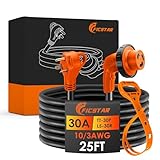
Start with the outlet and the RV inlet. The direct TT-30P to TT-30R cords in this group include POWGRN’s 50-foot model and PlugSaf’s 50-foot model. Several alternatives pair TT-30P with L5-30R: the RVGUARD 25- and 50-foot cords, RVMATE, ISLEWIRE, and Camco. Ficstar also has a TT-30P to L5-30R locking connection, with a 25-foot length and indicator lights.
Do not treat a plug adapter as a way to ignore electrical limits or connector fit. Follow the RV and campground instructions for the power connection. If your setup needs a different cord or adapter than the product names describe, choose a product that clearly matches that need rather than assuming a connector will fit.
Balance reach with storage and cord routing
A 15- or 25-foot cord is easier to justify when the outlet is normally close. At 30 feet, RVMATE provides an in-between option. Fifty-foot cords offer more reach, while CircleCord’s 100-foot model targets unusually long distances. Longer is not automatically better: excess cable requires more storage and can make routing around a campsite less tidy.
Keep the cord path in mind as well as straight-line distance. The cable must reach without stretching across a sharp edge, pulling at either connector, or creating a trip hazard. Follow product and campsite guidance for use and placement. A cord’s stated outdoor use does not mean every connection can be left exposed to standing water or handled while energized.
Understand what the rating does and does not tell you
Several product names state 10 AWG, 125 volts, and 3,750 watts. These are manufacturer-stated specifications, not a promise that every RV appliance can run at once. The actual load depends on the RV electrical system and what is operating. Use the RV manual and campground power instructions to stay within the permitted limits.
Some models advertise an LED power indicator or reverse-polarity lamp. These features can provide a visual cue, but they do not replace a properly wired supply, sound connections, or the RV’s electrical protection. If a cord, plug, or receptacle is damaged, unusually hot, or behaving abnormally, stop using it and seek qualified help rather than trying to repair an energized connection.
Who should skip these cords
Skip this group if your RV needs a different amperage, connector pattern, voltage, or power arrangement than the product names specify. These are 30 amp RV cords and extensions, not a universal fit for every trailer or campsite outlet. A buyer who needs a complete power cord assembly, a specific adapter, or a different electrical rating should look for that exact configuration and follow the vehicle and campground manuals.
For another type of campground power equipment, see CarTechTalk’s portable power station guide. A power station is not a substitute for matching an RV’s shore-power cord to its approved connection.
Final choice
For a common TT-30-to-TT-30 setup that needs 50 feet, POWGRN’s direct-connect cord is the clearest fit among these picks. If your RV requires L5-30R, choose by reach instead: ISLEWIRE for 15 feet, RVGUARD for 25 or 50 feet, or Camco when the 90-degree heads and stated copper wire matter to your setup. Check the connector pattern first, then buy only as much cord as your usual campsite requires.