Cars with start-stop systems need special batteries because they restart the engine repeatedly and must keep electrical systems running while it is off. The right replacement depends on the vehicle’s specified battery type, capacity, and fitment, not just whether the old battery can start the engine once.
- Start-stop operation adds repeated engine restarts and periods when the battery powers vehicle electronics.
- Many start-stop vehicles use an AGM or EFB battery, but the vehicle’s requirements decide which type fits.
- A standard flooded battery may not tolerate the same operating demands, even if its size and voltage appear to match.
- Battery monitoring and charging settings can matter after replacement. Follow vehicle-specific service instructions.
- Use a charger mode compatible with the battery chemistry and the vehicle’s connection procedure.
A conventional starter battery usually delivers a short burst of power to crank the engine, then receives charge while the engine runs. Start-stop systems add many more engine restarts during ordinary driving. At a traffic light, the engine may stop while the battery continues powering control modules, lights, climate functions, and other electrical loads.
That changes the battery’s work. It must support frequent starting, tolerate repeated discharge and recharge, and accept charge during the time the engine runs. A battery that handles occasional starting in a conventional vehicle may wear faster under this pattern.
Start-stop systems also rely on battery condition. Depending on vehicle design, the system may disable automatic stop when battery charge, temperature, cabin demand, or other operating conditions fall outside its allowed range. A disabled start-stop feature does not, by itself, prove the battery has failed.
What makes AGM and EFB batteries different?
Automakers commonly specify enhanced flooded batteries (EFB) or absorbed glass mat (AGM) batteries for start-stop applications. Both are lead-acid battery designs, but their construction and intended operating demands differ from those of a basic flooded starter battery.
An EFB is an improved flooded design used in some start-stop vehicles. AGM batteries hold electrolyte in glass-fiber separators and are used in many vehicles with higher electrical demands. These broad descriptions do not identify the correct replacement for any particular car. Vehicle design, battery location, electrical load, and charging strategy affect the required type.
| Battery type | What it means for the driver | Fitment rule |
|---|---|---|
| Standard flooded | Common in vehicles without the same repeated-cycling demands. It may not suit a start-stop application. | Use only if vehicle specifications allow it. |
| EFB | Built for greater cycling demands than a basic flooded starter battery. | Common in some start-stop vehicles. Match vehicle requirements. |
| AGM | Used in many start-stop systems, including some with heavier electrical loads. | Required in some vehicles. Do not substitute another type without approval. |
This table describes general battery categories, not a ranking or universal upgrade path. An AGM battery is not automatically the right choice wherever an EFB is fitted. The vehicle maker’s specification takes priority.
Can a regular battery replace a start-stop battery?
Usually, a basic flooded battery is not a safe assumption for a vehicle that specifies AGM or EFB. It may crank the engine at first, yet repeated cycling can shorten its service life or contribute to unreliable operation. The vehicle’s battery management system may also use charging behavior intended for a particular battery type.
Match more than the battery’s external dimensions. Check battery chemistry, voltage, capacity, cold-cranking rating, terminal layout, hold-down style, and venting needs against the vehicle’s requirements. A battery that fits in the tray can still be wrong electrically or physically.
Some vehicles require a battery registration or configuration procedure after replacement. That procedure tells the charging system a new battery has been installed or records battery details, depending on vehicle design. Other vehicles do not require it. Model year, engine, trim, and market can change the procedure, so use the service information for the exact vehicle.
How to check which battery your vehicle needs
- Identify the exact vehicle. Record model year, make, model, engine, and relevant trim details. Similar vehicles can use different battery specifications.
- Check the owner’s manual or service information. Look for battery chemistry, group or case size, capacity, and starting rating. Follow any replacement or battery-monitoring instructions.
- Inspect the installed battery label. Use it as a clue, not the only authority. A previous owner may have installed an incorrect battery.
- Check terminal position and venting. The cables must reach the correct posts, and the battery must suit its mounting location. Some trunk- or cabin-mounted batteries require venting arrangements.
- Ask whether registration is required. Use a qualified repair source or vehicle-specific service procedure if the process is unclear.
For example, if a vehicle’s documentation specifies AGM, a same-size EFB is not automatically an acceptable substitute. The chemistry requirement and any reset or registration procedure both matter. If specifications conflict, resolve that discrepancy before buying or installing a battery.
What happens when the wrong battery is installed?
A mismatched battery can wear out early, struggle to support repeated restarts, or cause start-stop operation to remain unavailable. Some vehicles may display a battery or charging warning. Electrical symptoms can also have causes unrelated to battery type, including a weak charge, poor connection, or charging-system fault.
Do not treat one warning message as proof that the battery needs replacement. A proper diagnosis may include testing battery condition and charging performance, inspecting connections, and checking vehicle-specific fault information. Clearing a warning or code does not repair the underlying fault.
Charging a start-stop battery
A suitable charger can maintain or recharge a start-stop battery, but its mode must match the battery chemistry. Use the charger maker’s instructions and the vehicle manual for connection points and charging procedure. Some vehicles specify designated jump-start or charging terminals rather than direct battery connections.
Do not assume every charger’s ordinary 12-volt mode suits every AGM or EFB battery. Check that the charger supports the battery type and follow its stated limits. For a closer look at charger mode differences, see NOCO GENIUS vs. Battery Tender: which charger fits your vehicle? For long storage periods, the winter battery maintainer guide explains the role of maintenance charging.
If a battery repeatedly loses charge, charging it again may not address the cause. Short trips, a parasitic electrical draw, a failing alternator, a loose connection, or a worn battery can produce similar symptoms. Testing helps distinguish those problems.
Common mistakes
- Choosing by size alone. Physical fit does not establish correct chemistry, capacity, or charging compatibility.
- Downgrading to a basic flooded battery. A lower-cost battery may not be built for the vehicle’s repeated cycling demands.
- Assuming AGM is always an upgrade. The vehicle may require a specific type and charging setup. Follow its specification.
- Ignoring battery registration. Some vehicles require a replacement procedure; others do not. Check instructions for the exact model year and configuration.
- Blaming every start-stop fault on the battery. System conditions, charging faults, and other electrical issues can also prevent automatic stops.
- Using an incompatible charger mode. Choose a mode that matches the battery type and follow connection instructions.
When to get professional help
Get qualified help if the replacement specification is unclear, the battery sits in a hard-to-access location, or vehicle instructions require registration you cannot perform. Seek diagnosis for repeated low-charge warnings, slow cranking, swollen or leaking battery cases, hot or damaged cables, or a charging warning while driving.
Lead-acid batteries can deliver high current and contain corrosive electrolyte. Avoid tools or jewelry that could bridge battery terminals. If the case is damaged, leaking, or unusually hot, do not continue charging or handling it; follow local emergency guidance and seek professional assistance.
Gear that can help
If you need battery chargers and maintainers or battery testers for this job, these picks already appear in our battery chargers and maintainers guides. Check the full guide for fit and who should skip each one.
Pros
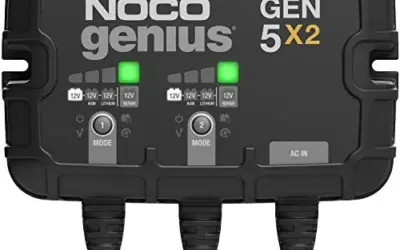
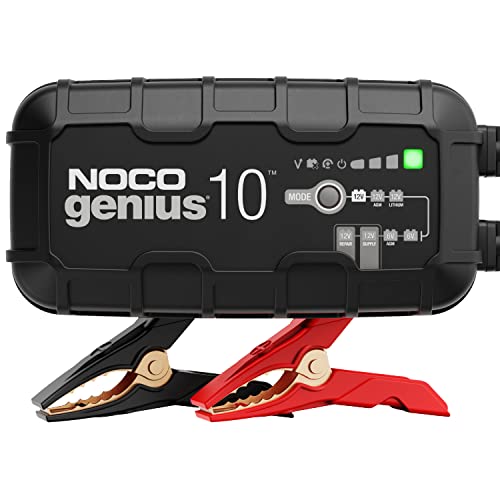
- Supports multiple lead-acid battery types, including AGM, Gel, SLA, VRLA, flooded, maintenance-free, and deep-cycle batteries
- Designed for a wide range of vehicles and equipment, including cars, motorcycles, boats, ATVs, tractors, trucks, SUVs, RVs, and lawn mowers
- Includes both battery clamps and integrated eyelet terminals
- Provides automatic maintenance charging with overcharge protection
Cons
- The listing lists support for LiFePO4 batteries specifically, rather than all lithium-ion battery types
- The charger is specified for 6V and 12V batteries only
Specifications
| Color | Black |
|---|---|
| Size | 10A |
| Dimensions | 4.41 x 4.48 x 9.1 inches |
| Weight | 3.99 Pounds |
| Product Group | Automotive Parts and Accessories |
| Binding | Electronics |
Best For / Avoid If
Best for buyers prioritizing
- Supports multiple lead-acid battery types, including AGM, Gel, SLA, VRLA, flooded, maintenance-free, and deep-cycle batteries
- Designed for a wide range of vehicles and equipment, including cars, motorcycles, boats, ATVs, tractors, trucks, SUVs, RVs, and lawn mowers
- Includes both battery clamps and integrated eyelet terminals
Consider another option if
- The listing lists support for LiFePO4 batteries specifically, rather than all lithium-ion battery types
- The charger is specified for 6V and 12V batteries only

Pros
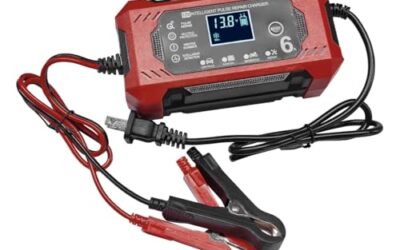
- Supports multiple 6V and 12V battery types
- Combines 15A charging with a maintain/float function
- Provides digital voltage and charge-status information
- Includes reverse hook-up protection
Cons
- The listing does not include dimensions, warranty information, or included accessories
Specifications
| Color | Black |
|---|---|
| Size | Battery Charger and Maintainer |
| Dimensions | 9.96 x 4.29 x 10.03 inches |
| Weight | 2.7 pounds |
| Product Group | Automotive Parts and Accessories |
| Binding | Automotive |
Best For / Avoid If
Best for buyers prioritizing
- Supports multiple 6V and 12V battery types
- Combines 15A charging with a maintain/float function
- Provides digital voltage and charge-status information
Consider another option if
- The listing does not include dimensions, warranty information, or included accessories

Pros
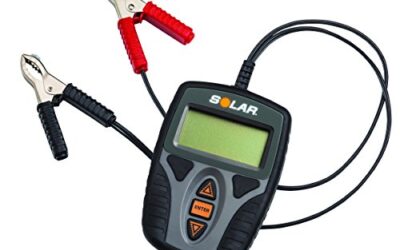
- Covers multiple battery condition and vehicle charging-system checks
- Supports several battery types and global rating standards
- Backlit black-and-white display has adjustable contrast
- Compatible with cars, trucks, boats, RVs, ATVs, lawnmowers, golf carts, and motorbikes over 30Ah
Cons
- Not compatible with lithium or non-12V batteries
- Not intended for motorcycles below 30Ah
Specifications
| Color | Red |
|---|---|
| Size | BA101 |
| Dimensions | 9.5 x 7 x 2 inches |
| Weight | 0.3125 Pounds |
| Product Group | Automotive Parts and Accessories |
| Binding | Automotive |
Best For / Avoid If
Best for buyers prioritizing
- Covers multiple battery condition and vehicle charging-system checks
- Supports several battery types and global rating standards
- Backlit black-and-white display has adjustable contrast
Consider another option if
- Not compatible with lithium or non-12V batteries
- Not intended for motorcycles below 30Ah
FAQ
Do all start-stop cars use AGM batteries?
No. Some use EFB batteries, while other vehicle designs specify AGM. Check the exact vehicle’s battery requirements.
Can I turn off start-stop to protect a standard battery?
Disabling the feature does not make an unapproved battery a suitable replacement. The vehicle’s charging strategy and battery specification still apply.
Why does start-stop stop working after battery replacement?
The battery may be undercharged, the wrong type, or not registered where the vehicle requires registration. Other operating conditions or faults can also disable the feature.
Can I charge an AGM or EFB battery with a regular charger?
Only if the charger’s instructions support that battery type and the connection method suits the vehicle. Use the correct mode and vehicle procedure.
Sources and further reading
- Battery Council International: Background on automotive batteries and battery care.