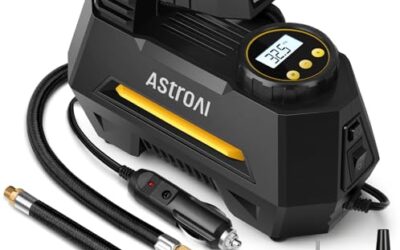
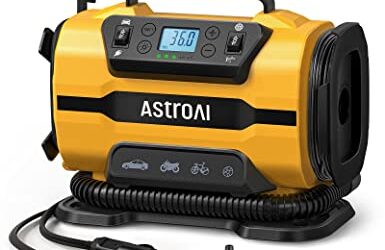
To convert psi to bar for tire inflation, divide the psi value by 14.5038; for example, 35 psi is about 2.41 bar. Use the vehicle’s recommended cold tire pressure as your target, not the maximum pressure molded on the tire sidewall.
- Formula: bar = psi ÷ 14.5038.
- Reverse formula: psi = bar × 14.5038.
- One bar equals about 14.5 psi, so quick estimates work for ordinary tire inflation.
- Check the vehicle placard or owner’s manual for the correct pressure and whether it applies to front, rear, or loaded tires.
Divide the pressure in pounds per square inch by 14.5038 to get pressure in bar. For a quick mental estimate, divide by 14.5. The precise factor helps when converting a value for a gauge or inflator, but a few hundredths of a bar usually represent a small pressure difference.
Example: 35 psi ÷ 14.5038 = 2.413 bar. A display that accepts hundredths can be set near 2.41 bar. If it only accepts tenths, 2.4 bar is the nearest tenth. Read the gauge again after inflation rather than assuming its setting matches the tire’s actual pressure.
| Pressure in psi | Pressure in bar | Approximate setting to nearest 0.1 bar |
|---|---|---|
| 30 psi | 2.07 bar | 2.1 bar |
| 32 psi | 2.21 bar | 2.2 bar |
| 35 psi | 2.41 bar | 2.4 bar |
| 36 psi | 2.48 bar | 2.5 bar |
| 40 psi | 2.76 bar | 2.8 bar |
Table values are conversions, not recommended pressures for any particular vehicle. Follow the vehicle’s pressure specification. If its target falls between a device’s available settings, use a gauge with enough resolution to set and check the specified pressure accurately.
Numbered steps for setting tire pressure with a bar inflator
- Find the vehicle’s recommended pressure. Check the tire information label, often on the driver’s door jamb, or consult the owner’s manual. The correct value can differ by axle, tire size, load, or vehicle configuration.
- Check whether the recommendation is for cold tires. Most vehicle pressure instructions specify a cold-tire reading. Check before driving or after the vehicle has been parked long enough for tires to cool. Driving warms tires and can raise the reading.
- Convert the target. Divide the listed psi by 14.5038. For 32 psi, the calculation is 32 ÷ 14.5038 = 2.206 bar, which rounds to 2.21 bar.
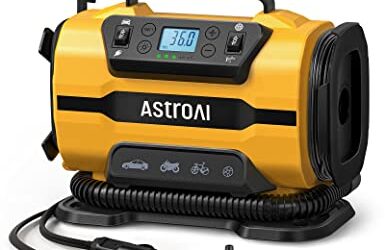
- Set the device’s unit and target. Select bar if the inflator offers a unit button, then enter the converted pressure. Some devices display bar but accept only limited increments. Check the screen before starting.
- Attach the hose and inflate. Follow the inflator instructions for connecting the chuck and operating the unit. Keep the hose connection secure, since escaping air can affect the reading.
- Check tire pressure with a gauge. Compare the actual reading with the vehicle’s target. Add air in short intervals if needed, then check again. If pressure is too high, release air carefully and recheck.
- Repeat for each tire using its correct target. Front and rear recommendations may differ. Some vehicles also specify another pressure for a particular load. Use the instructions that match how the vehicle is configured.
How to convert bar to psi
Multiply bar by 14.5038 to convert in the opposite direction. For example, 2.2 bar × 14.5038 = 31.91 psi, or about 31.9 psi. This is useful when an inflator displays bar but the vehicle placard gives pressure in psi.
Keep extra digits during the calculation, then round to match the gauge or inflator’s display. Rounding too early can shift the result, especially when converting small increments. Conversion changes the unit, not the tire’s actual pressure.
What pressure should you use?
Use the pressure specified by the vehicle maker for the tire and load in question. The placard or manual gives the practical target for that vehicle. The number molded on a tire sidewall generally identifies a tire limit or other tire information, not the routine inflation target for your vehicle.
Do not use a generic passenger-car value for every vehicle. A compact car, pickup, van, and vehicle carrying a specified load may have different requirements. Tire size and vehicle model year can also matter. If replacement tires differ from the original size, ask a qualified tire professional or consult the vehicle and tire maker’s guidance instead of assuming the original pressure automatically applies.
For more on correct pressure checks in cold weather, see CarTechTalk’s cold-weather tire pressure gauge guide. Drivers comparing gauge features can also read what digital tire pressure gauges with memory store.
Why cold tire pressure matters
Vehicle pressure recommendations generally refer to cold tires because driving heats the tire and air inside it. A warm-tire reading can be higher than the cold reading. Do not let air out of a warm tire simply to force its pressure down to the cold target. Check again when tires are cold, unless the vehicle manual gives specific instructions for the situation.
Cold conditions can also lower tire pressure. Check tires when the weather changes, using the vehicle’s specified target. A tire pressure monitoring system (TPMS) warning can alert you to a pressure issue, but it does not replace checking pressure with a gauge. Follow the owner’s manual for responding to a warning, especially if a tire looks damaged or loses air repeatedly.
Does rounding to tenths of a bar cause a problem?
It depends on the specified target and the tool’s resolution. A target of 32 psi converts to about 2.21 bar. Setting an inflator that only accepts tenths to 2.2 bar is close to that target, but the inflator’s displayed value and actual tire pressure may not match exactly. Check with a suitable pressure gauge after inflation.
Do not treat rounding as permission to ignore a noticeable mismatch. If the tool cannot get close to the vehicle’s target, use a more precise gauge or inflator. A digital gauge with a suitable range and readable increments can make checks easier, but gauge accuracy depends on the particular device and its condition.
Common mistakes when converting tire pressure
- Using the sidewall maximum as the target: Check the vehicle placard or manual for the recommended operating pressure.
- Multiplying instead of dividing: To convert psi to bar, divide by 14.5038. Multiply by that factor to convert bar to psi.
- Mixing up the display unit: Check whether the gauge reads psi, bar, or another unit before interpreting its number.
- Setting pressure from a warm reading: Tire temperature affects pressure. Follow the vehicle’s cold-pressure instructions.
- Assuming all four tires share one target: Front and rear values can differ, and some vehicles specify different pressures for certain loads.
- Trusting an inflator’s preset without checking: Preset and auto-shutoff features depend on the device. Verify final pressure with a gauge.
- Rounding before calculating: Use the full conversion factor first, then round to the display increments available.
When to get professional help
Ask a tire professional to inspect a tire that repeatedly loses pressure, has a visible puncture or bulge, or has damage near its sidewall. Do not rely on repeated inflation to make a damaged tire safe. Follow the vehicle manual and tire professional’s advice about whether the tire can be driven on or needs roadside assistance.
Seek help if you cannot identify the correct pressure for a replacement tire, the placard and manual appear to conflict, or your gauge readings vary widely between checks. A professional can assess the tire, valve, wheel, and pressure measurement. For general tire safety information, consult the NHTSA tire safety page.
Gear that can help
If you need tire inflators or tire pressure gauges for this job, these picks already appear in our tire inflators guides. Check the full guide for fit and who should skip each one.

Pros
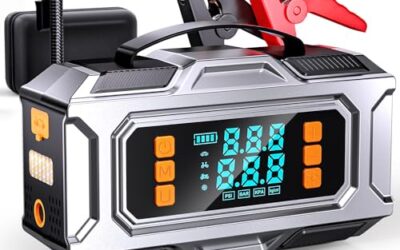
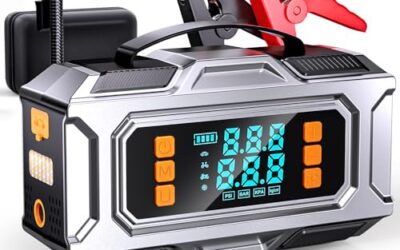
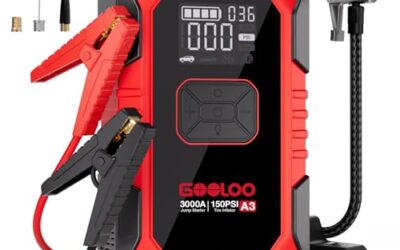
- Combines jump starting and cordless tire inflation in one portable unit
- Supports up to 150 PSI with automatic shut-off and selectable pressure units
- Includes five air nozzles and five inflation modes
- Provides stated support for more than 1,000 charge cycles
- Backed by an 18-month warranty
Cons
- The stated operating and storage temperature range is -4°F to 140°F, while charging is limited to 14°F to 113°F
- The unit should be recharged at least once every three months during long-term storage
Specifications
| Color | Red |
|---|---|
| Dimensions | 4.96 x 5.87 x 2.3 inches |
| Weight | 3.58 pounds |
| Product Group | Automotive Parts and Accessories |
Best For / Avoid If
Best for buyers prioritizing
- Combines jump starting and cordless tire inflation in one portable unit
- Supports up to 150 PSI with automatic shut-off and selectable pressure units
- Includes five air nozzles and five inflation modes
Consider another option if
- The stated operating and storage temperature range is -4°F to 140°F, while charging is limited to 14°F to 113°F
- The unit should be recharged at least once every three months during long-term storage
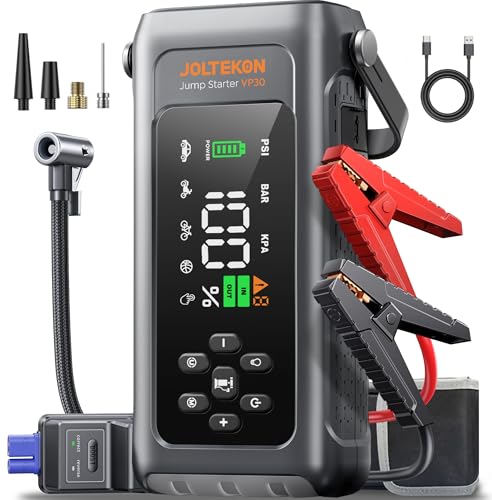
Pros
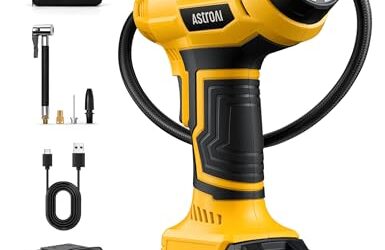
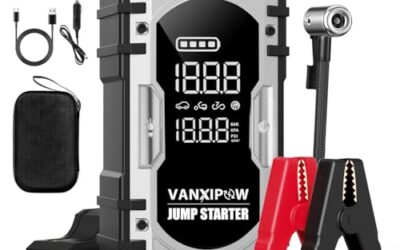
- Combines jump starting, tire inflation, lighting, and portable charging in one device
- Force-start function is specified for completely drained or low-voltage batteries
- Automatic shutoff helps prevent over-inflation
- Operating temperature is listed as -4°F to 140°F
Cons
- The product listing advises charging the unit every 2–3 months during extended storage
- Users are instructed to ensure the battery level exceeds 50% before vehicle startup
Specifications
| Dimensions | 7.88 x 1.97 x 3.78 inches |
|---|---|
| Weight | 2.645547144 pounds |
| Product Group | Automotive Parts and Accessories |
Best For / Avoid If
Best for buyers prioritizing
- Combines jump starting, tire inflation, lighting, and portable charging in one device
- Force-start function is specified for completely drained or low-voltage batteries
- Automatic shutoff helps prevent over-inflation
Consider another option if
- The product listing advises charging the unit every 2–3 months during extended storage
- Users are instructed to ensure the battery level exceeds 50% before vehicle startup

Specifications
| Color | Red |
|---|---|
| Dimensions | 5 x 3 x 8 inches |
| Weight | 1.28 Pounds |
| Product Group | Tools |
| Binding | Tools & Home Improvement |
FAQ
How many bar is 30 psi?
30 psi equals about 2.07 bar. Rounded to one decimal place, that is 2.1 bar.
How many psi is 2 bar?
2 bar equals about 29.0 psi, using 1 bar = 14.5038 psi.
Is 2.4 bar the same as 35 psi?
Not exactly. 2.4 bar is about 34.8 psi, while 35 psi is about 2.41 bar. The difference is small, but use the vehicle target and a gauge with suitable resolution.
Can I use a bar reading from any tire inflator?
You can use a bar-reading inflator if its range and display increments suit the vehicle’s target. Device accuracy and operation vary, so check final pressure with a suitable gauge and follow the inflator instructions.