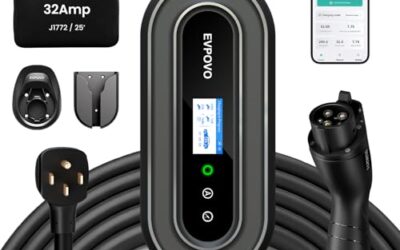
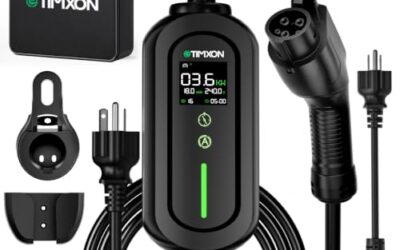
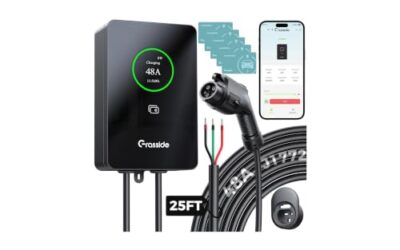
When electric vehicle drivers search for the best EV charger 240 volt aerovironment options, they typically face a common hurdle: AeroVironment’s pioneering residential EV charging division transitioned to Webasto, leaving many existing AeroVironment EVSE-RS and TurboCord owners looking for modern 240-volt Level 2 replacements. Whether your older 240V station has reached the end of its operational lifecycle or you need faster 32-amp to 40-amp charging speeds to accommodate modern battery packs, today’s market offers reliable, safety-certified 240V Level 2 alternatives that plug into standard NEMA 14-50 outlets.
For a closer look at a related choice, see Portable EV Charger Buying Guide, Best Level 2 EV Charger Under $700 and Best Portable EV Charger Under $200.
Quick Verdict
For drivers upgrading from older 16-amp or 30-amp hardware who want a premium, high-amperage connected wall unit, the ChargePoint HomeFlex Level 2 EV Charger J1772 delivers robust national app integration and flexible output. If you want a dedicated smart home station with extensive scheduling and an illuminated holster, the EVIQO Level 2 EV Charger J1772 40A NEMA 14-50 stands out. Meanwhile, drivers seeking budget-conscious, portable plug-and-play 240V units will find dependable current adjustment in the ELEGRP Level 2 EV Charger 40Amp and VEVOR Level 2 EV Charger.
How We Chose
To identify the strongest 240-volt Level 2 EV chargers capable of replacing legacy 240V charging equipment, we conducted an editorial evaluation of manufacturer-published technical specifications, electrical safety listings, and standard North American port compatibilities across 10 available market options. Our analysis focused on key technical criteria:
- Voltage and Electrical Input: All selected units require 220V–240V AC power, utilizing standard heavy-duty NEMA 14-50 supply plugs compatible with dedicated 40-amp or 50-amp residential circuits.
- Safety Certifications: We verified documented electrical testing marks, prioritizing equipment certified to UL standards (such as UL 2594) via recognized testing laboratories including ETL and UL.
- Charging Flexibility: We compared maximum current deliveries (ranging from 32A to 40A) and manual or app-driven amperage adjustments that prevent circuit overloading.
- Connector Standards: We evaluated native SAE J1772 fittings alongside native North American Charging Standard (NACS) hardware to serve both traditional EV/PHEV models and Tesla vehicles.

Pros
- Level 2 charging is described as up to 9 times faster than a 120V outlet
- J1772 connector supports non-Tesla EVs
- App enables charging management and smart-home connectivity
- Indoor and outdoor installation support
Cons
- Requires a 40A or 50A circuit and electrician installation
- Tesla vehicles require an adapter
- Charging speed depends on the vehicle
Specifications
| Color | Black |
|---|---|
| Size | 1 Pack |
| Dimensions | 11.19 x 7.06 x 7.07 inches |
| Weight | 13.8 pounds |
| Product Group | Automotive Parts and Accessories |
| Binding | Electronics |
Best For / Avoid If
Best for buyers prioritizing
- Level 2 charging is described as up to 9 times faster than a 120V outlet
- J1772 connector supports non-Tesla EVs
- App enables charging management and smart-home connectivity
Consider another option if
- Requires a 40A or 50A circuit and electrician installation
- Tesla vehicles require an adapter
- Charging speed depends on the vehicle

Pros
- Supports both 240V Level 2 and 120V Level 1 charging
- Five selectable current settings provide charging flexibility
- Long 25-foot cable and delayed charging feature support home-use convenience
- Product description states that over-voltage, over-current, and short-circuit protection are included
Cons
- Full 240V charging requires a dedicated 240V circuit and NEMA 14-50 connection
- Tesla vehicles require an adapter
- The product does not support vehicles using proprietary charging protocols
Specifications
| Color | Black |
|---|---|
| Size | 25FT |
| Dimensions | 15.55 x 13 x 5.9 inches |
| Product Group | Automotive Parts and Accessories |
Best For / Avoid If
Best for buyers prioritizing
- Supports both 240V Level 2 and 120V Level 1 charging
- Five selectable current settings provide charging flexibility
- Long 25-foot cable and delayed charging feature support home-use convenience
Consider another option if
- Full 240V charging requires a dedicated 240V circuit and NEMA 14-50 connection
- Tesla vehicles require an adapter
- The product does not support vehicles using proprietary charging protocols

Pros
- Supports charging up to 40A and 9.6 kW
- Long 25-foot cable provides extended reach
- Compatible with listed PHEV and BEV models using a J1772 connection
- IP67 rating and stated operating temperature range support outdoor use
Cons
- Requires a 240V NEMA 14-50 outlet
- Tesla vehicles require a separate NACS adapter
Specifications
| Color | Black |
|---|---|
| Size | 40A 25FT |
| Dimensions | 144 x 134 x 47 Inches |
| Weight | 13.2 Pounds |
| Product Group | Automotive Parts and Accessories |
| Binding | Automotive |
Best For / Avoid If
Best for buyers prioritizing
- Supports charging up to 40A and 9.6 kW
- Long 25-foot cable provides extended reach
- Compatible with listed PHEV and BEV models using a J1772 connection
Consider another option if
- Requires a 240V NEMA 14-50 outlet
- Tesla vehicles require a separate NACS adapter

Pros
- Long 25-foot charging cable provides extended reach
- WiFi app supports charging control, scheduling, current adjustment, and energy tracking
- J1772 connector is compatible with North American EV and PHEV models
- Weatherproof IP66/NEMA-4 enclosure is suited to indoor or outdoor charging locations
Cons
- Requires a dedicated 50A circuit and a 4-prong NEMA 14-50 outlet
- Tesla charging requires a separate J1772-to-NACS adapter, which is not included
- Smart app features require a 2.4 GHz WiFi network with internet access
Specifications
| Color | Black |
|---|---|
| Size | 40 |
| Dimensions | 4.724409444 x 6.299212592 x 1.968503935 inches |
| Product Group | Automotive Parts and Accessories |
| Binding | Electronics |
Best For / Avoid If
Best for buyers prioritizing
- Long 25-foot charging cable provides extended reach
- WiFi app supports charging control, scheduling, current adjustment, and energy tracking
- J1772 connector is compatible with North American EV and PHEV models
Consider another option if
- Requires a dedicated 50A circuit and a 4-prong NEMA 14-50 outlet
- Tesla charging requires a separate J1772-to-NACS adapter, which is not included
- Smart app features require a 2.4 GHz WiFi network with internet access

Pros
- High-power Level 2 charging support up to 40A and 9.6 kW
- NEMA 14-50 plug avoids hardwiring
- Supports a broad range of J1772 vehicles and plug-in hybrids
- Portable design with a 16-foot cable
- Multiple stated safety and efficiency certifications
Cons
- Not natively compatible with Tesla vehicles without an adapter
- Requires a compatible 240V NEMA 14-50 outlet
Specifications
| Color | Black |
|---|---|
| Size | 40A NEMA 14-50 |
| Product Group | Automotive Parts and Accessories |
| Binding | Electronics |
Best For / Avoid If
Best for buyers prioritizing
- High-power Level 2 charging support up to 40A and 9.6 kW
- NEMA 14-50 plug avoids hardwiring
- Supports a broad range of J1772 vehicles and plug-in hybrids
Consider another option if
- Not natively compatible with Tesla vehicles without an adapter
- Requires a compatible 240V NEMA 14-50 outlet

Pros
- Supports multiple current settings: 10A, 16A, 20A, 24A, 32A, and 40A
- Compatible with EVs and hybrids that use a standard J1772 connector
- Lists protection against leakage, grounding issues, overvoltage, undervoltage, overcurrent, overcharging, overheating, and short circuits
- Automatically shuts off when the vehicle is fully charged, according to the listing
Cons
- A J1772-to-Tesla adapter is required for Tesla vehicles and is not included
- The listing does not identify a specific vehicle make or model compatibility list
Specifications
| Color | Black |
|---|---|
| Size | 40A ev charger |
| Product Group | Automotive Parts and Accessories |
Best For / Avoid If
Best for buyers prioritizing
- Supports multiple current settings: 10A, 16A, 20A, 24A, 32A, and 40A
- Compatible with EVs and hybrids that use a standard J1772 connector
- Lists protection against leakage, grounding issues, overvoltage, undervoltage, overcurrent, overcharging, overheating, and short circuits
Consider another option if
- A J1772-to-Tesla adapter is required for Tesla vehicles and is not included
- The listing does not identify a specific vehicle make or model compatibility list

Pros
- Native NACS connector includes a button for opening the Tesla charging port
- Works with North American EV and PHEV models when used with a NACS-to-J1772 adapter
- Side reset button allows faults to be cleared without opening the charger or disconnecting power
- Supports scheduled charging and OTA firmware updates through the app
Cons
- Requires a dedicated 50A, 240V circuit and an EV-rated 4-prong NEMA 14-50 outlet
- NACS-to-J1772 adapter is not included for J1772 vehicles
- Smart app features require a 2.4 GHz WiFi network with internet access
Specifications
| Color | Black |
|---|---|
| Size | 40 |
| Dimensions | 15.354330693 x 15.354330693 x 10.629921249 Inches |
| Product Group | Automotive Parts and Accessories |
| Binding | Electronics |
Best For / Avoid If
Best for buyers prioritizing
- Native NACS connector includes a button for opening the Tesla charging port
- Works with North American EV and PHEV models when used with a NACS-to-J1772 adapter
- Side reset button allows faults to be cleared without opening the charger or disconnecting power
Consider another option if
- Requires a dedicated 50A, 240V circuit and an EV-rated 4-prong NEMA 14-50 outlet
- NACS-to-J1772 adapter is not included for J1772 vehicles
- Smart app features require a 2.4 GHz WiFi network with internet access

Pros
- Supports SAE-J1772 electric vehicles and plug-in hybrids
- Offers adjustable charging current for different charging requirements
- Includes a long 25-foot cable and delay timer
- Provides multiple listed electrical safety protections
Cons
- Tesla adapter is sold separately
- The product is recommended for use only in a dry environment with a properly grounded outlet
Specifications
| Size | 25FT |
|---|---|
| Product Group | Automotive Parts and Accessories |
Best For / Avoid If
Best for buyers prioritizing
- Supports SAE-J1772 electric vehicles and plug-in hybrids
- Offers adjustable charging current for different charging requirements
- Includes a long 25-foot cable and delay timer
Consider another option if
- Tesla adapter is sold separately
- The product is recommended for use only in a dry environment with a properly grounded outlet

Pros
- Long 25 ft cable supports flexible positioning in driveways or garages
- Portable design includes a carrying bag
- LCD display provides real-time charging information
- Offers multiple electrical protection features
- IP66-rated control box is designed for outdoor conditions
Cons
- A compatible NEMA 14-50 outlet is required
Specifications
| Color | black |
|---|---|
| Size | 40 Amp |
| Dimensions | 11.02 x 4.53 x 2.76 inches |
| Weight | 9.92 Pounds |
| Product Group | Automotive Parts and Accessories |
| Binding | Automotive |
Best For / Avoid If
Best for buyers prioritizing
- Long 25 ft cable supports flexible positioning in driveways or garages
- Portable design includes a carrying bag
- LCD display provides real-time charging information
Consider another option if
- A compatible NEMA 14-50 outlet is required
Direct Comparison of 240V EV Chargers
The following table compares key technical specifications across all 10 evaluated models. Note that pricing reflects current observations and is subject to change.
| Product Name | Max Output | Input Plug | Connector Standard | Cable Length |
|---|---|---|---|---|
| ChargePoint HomeFlex Level 2 EV Charger J1772 | Level 2 (up to 50A circuit) | NEMA 14-50 | SAE J1772 | – |
| EVIQO Level 2 EV Charger J1772 40A NEMA 14-50 | 40 Amps (9.6 kW) | NEMA 14-50 | SAE J1772 | 25 ft |
| EVIQO Level 2 EV Charger NACS 40A NEMA 14-50 | 40 Amps (9.6 kW) | NEMA 14-50 | Native NACS | 25 ft |
| ELEGRP Level 2 EV Charger 40Amp | 40 Amps (9.6 kW) | NEMA 14-50 | SAE J1772 | 25 ft |
| Lectron Level 2 EV Charger – ETL Certified, 240V | 40 Amps (9.6 kW) | NEMA 14-50 | SAE J1772 | 16 ft |
| AIMILER Level 2 Electric Vehicle (EV) | 32 Amps (7.68 kW) | NEMA 14-50 | SAE J1772 | 25 ft |
| VEVOR Level 2 EV Charger | 40 Amps (9.6 kW) | NEMA 14-50 | SAE J1772 | 25 ft |
| BETUMODA Level 2 EV Charger, 40 Amp 240V 9.6kW | 40 Amps (9.6 kW) | NEMA 14-50 | SAE J1772 | 25 ft |
| BETUMODA Level 2 EV Charger, 40A 25ft, 9.6kW | 40 Amps (9.6 kW) | NEMA 14-50 (w/ 5-15 adapter) | SAE J1772 | 25 ft |
| EVDANCE Level 2 EV Charger 40Amp | 40 Amps (9.6 kW) | NEMA 14-50 | SAE J1772 | 25 ft |
Compatibility and Buying Advice
When transitioning away from older 240-volt charging equipment, such as legacy AeroVironment hardware originally installed during early Nissan Leaf, BMW i3, or Ford Focus Electric rollouts, several electrical compatibility rules must be respected:
1. The 80% Continuous Load Rule
Under the National Electrical Code (NEC), EV charging is defined as a continuous load (operating for three hours or longer). Consequently, an electrical circuit can only be loaded up to 80% of its nominal breaker rating:
- 40-Amp Output Chargers: Require a dedicated 50-amp circuit breaker and properly sized wiring (typically 6 AWG copper).
- 32-Amp Output Chargers: Can safely run on a dedicated 40-amp circuit breaker (using 8 AWG copper wire).
- 16-Amp Output Chargers: Require a dedicated 20-amp circuit.
Many first-generation 240V AeroVironment home chargers operated at 30 amps on a 40-amp circuit. If you are replacing a 30A station on a 40-amp breaker without upgrading panel wiring, you must either choose a 32-amp EVSE (such as the AIMILER) or set your 40-amp adjustable charger (such as the ELEGRP, BETUMODA, or EVDANCE) down to 32 amps to avoid tripping the circuit breaker or creating a fire hazard.
2. Receptacle Quality and GFCI Interactions
All plug-in 240V models in this review utilize a 4-prong NEMA 14-50 plug. If you are installing a new receptacle, ensure an electrician installs an industrial-grade outlet (such as Bryant or Hubbell) rather than an inexpensive residential range outlet. EV charging subjects receptacles to prolonged high-heat cycles that can degrade standard-duty contacts. Furthermore, because modern EVSE units contain built-in ground-fault protection (CCID), pairing them with an external GFCI breaker can occasionally cause nuisance tripping.
3. J1772 vs. NACS Connectors
The universal SAE J1772 connector fits nearly every non-Tesla electric vehicle and plug-in hybrid sold in North America prior to 2025. Tesla vehicles can readily charge from J1772 connectors using the adapter included with the vehicle. If you drive a Tesla or a newer NACS vehicle and want to eliminate adapters entirely, choosing a native NACS station like the EVIQO Level 2 EV Charger NACS 40A NEMA 14-50 streamlines daily plug-in convenience.
How to Choose the Right 240V Charger
Narrow your decision based on your specific residential environment:
- Evaluate Panel Capacity First: Inspect your main service panel. If your home has 100-amp service with limited spare amperage, a unit with adjustable steps (such as 16A/24A/32A) allows you to throttle demand safely.
- Decide Between Smart vs. Basic Controls: If your local utility offers time-of-use (TOU) discounts, smart chargers with Wi-Fi scheduling (ChargePoint or EVIQO) automate charging during low-rate midnight hours. If your EV already has built-in scheduling in its dashboard, a simple manual delay charger (VEVOR or ELEGRP) provides all the utility you need for less cost.
- Measure Garage Distance: Standard 25-foot cables easily reach the opposite side of a garage or driveway. If your outlet is mounted directly beside your charge port, a shorter 16-foot cable like the Lectron keeps walkways clear.
Frequently Asked Questions
Can I plug a 40-amp EV charger into a standard clothes dryer outlet?
No. Standard modern clothes dryer outlets use a 30-amp NEMA 14-30 receptacle, whereas 40-amp EV chargers require a 50-amp NEMA 14-50 receptacle. The prong patterns differ intentionally to prevent high-draw appliances from overloading lower-rated wiring.
Do I need an electrician to install a plug-in 240V EV charger?
If you already have a dedicated 240V NEMA 14-50 receptacle installed on a 40A or 50A breaker, installation is plug-and-play. However, if no dedicated 240V outlet exists, a licensed electrician must install the circuit, breaker, and receptacle according to local electrical codes.
Why are AeroVironment home chargers hard to find?
AeroVironment sold its efficient energy systems division to Webasto in 2018. Webasto now manufactures and services that charging portfolio. Consequently, drivers searching for AeroVironment 240-volt chargers are best served by modern J1772 or NACS Level 2 replacements that meet current UL standards.
Final Verdict
Replacing an older 240-volt home charging setup does not require purchasing discontinued legacy hardware. If budget permits and you want industry-leading network support with seamless app scheduling, the ChargePoint HomeFlex Level 2 EV Charger J1772 is the premier fixed station. If you want smart connectivity on a dedicated 50-amp breaker at a mid-tier price point, choose the EVIQO Level 2 EV Charger J1772 40A NEMA 14-50 (or its native NACS counterpart for Tesla). For drivers seeking straightforward, cost-effective, and portable 240V replacements, the ELEGRP Level 2 EV Charger 40Amp and VEVOR Level 2 EV Charger provide reliable high-speed charging without unnecessary software complexity.