Why EV charging slows down after 80 percent usually comes down to battery protection: as the pack fills, the vehicle reduces charging power to control voltage, temperature, and cell balance. This slowdown is normal on many DC fast chargers, but its timing and severity vary by vehicle, battery temperature, charger, and software.
- Charging power often falls gradually as the battery approaches a high state of charge.
- “80 percent” is a useful rule of thumb, not a universal cutoff point.
- Cold or hot battery conditions, charger limits, and shared station power can slow charging earlier.
- Compare charging behavior under similar conditions before treating one slow session as a fault.
Most EVs use a charging profile that changes power during a session. At a low state of charge, the battery can often accept high power. As it fills, the vehicle reduces the rate to keep individual cells within their operating limits. That drop is called charging taper.
The battery management system (BMS) monitors battery conditions and controls how much power the pack can accept. Near full charge, cell voltage rises, and the available margin for adding energy shrinks. Reducing current helps avoid pushing cells beyond their limits and gives the system room to manage differences between cells.
The taper can start before 80 percent or continue well beyond it. A vehicle may charge quickly through one part of the battery range, then slow in stages. The exact curve depends on the model, model year, battery chemistry and size, temperature, software, and charging equipment. Two EVs at the same charger may show different charging speeds.
That is why a charger’s advertised peak power does not tell you how long a session will take. Peak power is a possible high point under suitable conditions, not a promise that the vehicle will hold that rate from low charge to full.
Why the vehicle tapers charging power
Battery voltage rises as the pack fills
As cells take on energy, their voltage increases. Near the top of the charge range, the vehicle has less room to keep adding current at a high rate. Taper reduces the stress of charging at high voltage and helps the pack approach its target without exceeding cell limits.
Cell balancing takes more care near full
Cells in a battery pack do not always reach the same state at precisely the same time. The BMS may reduce power near a high state of charge so it can manage differences among cells. This is one reason the last part of a charge can take much longer than the middle portion.
Drivers do not need to balance cells manually. Follow the vehicle’s charging instructions, and do not assume that a slow final segment means the battery is damaged.
Temperature can limit charging speed
A battery that is too cold or too hot may accept power more slowly. The vehicle may warm or cool the pack, but conditioning takes time and can use energy. A cold-soaked EV may charge slowly at first, then gain speed as its battery reaches a more suitable temperature. Hot conditions or repeated high-power charging can also lead the vehicle to limit power.
Some vehicles can precondition the battery before a fast-charge stop, often when the driver selects a charging station in the built-in navigation system. Availability and behavior depend on vehicle model year, software, and route-planning system. Check the owner’s manual for your EV’s procedure.
Other reasons a charging session may slow early
| What you notice | Possible reason | What to check |
|---|---|---|
| Low power from the start | Cold battery, charger limit, or vehicle limit | Battery temperature, charger display, and vehicle charging screen |
| Power falls while other stalls are busy | Station may share power across chargers | Whether the site identifies paired or shared-power stalls |
| One session is slower than usual | Different starting charge, temperature, or charger conditions | Compare sessions with similar starting charge and weather |
| Charging repeatedly stops or reports an error | Possible connector, station, vehicle, or account issue | Read the displayed message and follow the station’s support process |
Charging speed also depends on the connector and charging system the vehicle supports. A DC fast charger cannot make a car accept more power than its onboard systems allow. Likewise, the vehicle may reduce power if the charging station cannot supply its requested rate. Connector types and charging capability vary across vehicles, model years, and markets.
On DC fast charging, the charger supplies direct current to the battery under the vehicle’s control. On Level 2 AC charging, the vehicle’s onboard charger converts incoming AC power for the battery. AC charging is usually much slower, and the 80-percent taper may be less noticeable because the charging rate is lower to begin with. The exact behavior still depends on the vehicle and its charge settings.
How to tell normal taper from a possible problem
Start with the vehicle’s charging screen and the charger display. Note state of charge, power, battery temperature if shown, and any warning or error message. Compare the reading with the vehicle’s expected charging behavior in its manual or in-car help. A single session is hard to judge without knowing the battery temperature, starting charge, and station conditions.
- Check the starting charge. A session that begins at a higher percentage may taper sooner than one that begins lower.
- Consider the battery temperature. Cold weather, a hot battery, or a short drive before charging can affect power.
- Read both displays. The vehicle and charger may show different measures, such as battery power versus power delivered at the station.
- Check the station conditions. If a nearby stall is occupied or the station indicates shared power, the site may limit output.
- Compare another suitable session. If practical, use a different compatible charger and compare under similar conditions.
- Follow any warning message. Record its wording and contact the vehicle maker or charging-network support if it repeats.
Do not judge charging health by comparing your session with another driver’s peak-power screenshot. Their battery size, state of charge, temperature, vehicle software, and charger may differ. A useful comparison holds as many of those factors steady as possible.
Should you charge past 80 percent?
Charge past 80 percent when the extra range is useful, such as before a long drive or when another charger is far away. The tradeoff is time: the final portion can take much longer per added mile than charging from a lower state of charge. On a road trip, stopping at a lower percentage and charging again may take less total time, but route length, charger access, weather, and vehicle efficiency matter.
For everyday charging, use the charge limit recommended for your vehicle and battery type. Some EVs allow different limits for routine use and trips. Those settings are not identical across manufacturers, and battery guidance can vary by model year and software. The owner’s manual takes priority over general rules of thumb.
For home charging basics, see the U.S. Department of Energy’s guide to charging electric vehicles at home. It explains home charging options and considerations; it does not replace vehicle-specific battery guidance.
Common mistakes
- Expecting peak power throughout the session. Peak rate describes a possible maximum, not a constant rate from empty to full.
- Treating 80 percent as a fixed cutoff. Taper depends on vehicle design and conditions, so the change may begin earlier or later.
- Blaming the charger without checking the car. The vehicle can request less power because of battery temperature, state of charge, or its own limits.
- Comparing different charging sessions as if conditions match. Starting charge, battery temperature, station power, and vehicle configuration can all change the result.
- Assuming a slow final segment means a failing battery. Taper is expected behavior on many EVs. Repeated unusual behavior alongside warnings deserves further diagnosis.
When to get professional help
Contact the vehicle maker, dealer, or a qualified EV technician if charging repeatedly stops, warning messages appear, the charge limit cannot be changed as expected, or charging remains unusually slow across compatible stations and varied conditions. Share the vehicle model year, software version if available, charger type, starting and ending charge, temperature conditions, and exact message. Those details help separate normal taper from a vehicle, connector, or charging-network fault.
Stop using a connector or charging station if you notice physical damage, smoke, burning odor, or unusual heat. Follow the station’s emergency instructions and the vehicle manual. Do not handle damaged charging equipment or attempt high-voltage repairs yourself.
Gear that can help
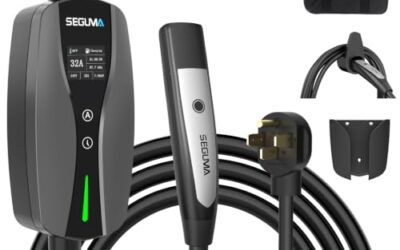
If you need EV chargers for this job, these picks already appear in our EV chargers guides. Check the full guide for fit and who should skip each one.

Pros
- Supports both 240V Level 2 and 120V Level 1 charging
- Five selectable current settings provide charging flexibility
- Long 25-foot cable and delayed charging feature support home-use convenience
- Product description states that over-voltage, over-current, and short-circuit protection are included
Cons
- Full 240V charging requires a dedicated 240V circuit and NEMA 14-50 connection
- Tesla vehicles require an adapter
- The product does not support vehicles using proprietary charging protocols
Specifications
| Color | Black |
|---|---|
| Size | 25FT |
| Dimensions | 15.55 x 13 x 5.9 inches |
| Product Group | Automotive Parts and Accessories |
Best For / Avoid If
Best for buyers prioritizing
- Supports both 240V Level 2 and 120V Level 1 charging
- Five selectable current settings provide charging flexibility
- Long 25-foot cable and delayed charging feature support home-use convenience
Consider another option if
- Full 240V charging requires a dedicated 240V circuit and NEMA 14-50 connection
- Tesla vehicles require an adapter
- The product does not support vehicles using proprietary charging protocols

Pros
- Long 25-foot charging cable provides extended reach
- WiFi app supports charging control, scheduling, current adjustment, and energy tracking
- J1772 connector is compatible with North American EV and PHEV models
- Weatherproof IP66/NEMA-4 enclosure is suited to indoor or outdoor charging locations
Cons
- Requires a dedicated 50A circuit and a 4-prong NEMA 14-50 outlet
- Tesla charging requires a separate J1772-to-NACS adapter, which is not included
- Smart app features require a 2.4 GHz WiFi network with internet access
Specifications
| Color | Black |
|---|---|
| Size | 40 |
| Dimensions | 4.724409444 x 6.299212592 x 1.968503935 inches |
| Product Group | Automotive Parts and Accessories |
| Binding | Electronics |
Best For / Avoid If
Best for buyers prioritizing
- Long 25-foot charging cable provides extended reach
- WiFi app supports charging control, scheduling, current adjustment, and energy tracking
- J1772 connector is compatible with North American EV and PHEV models
Consider another option if
- Requires a dedicated 50A circuit and a 4-prong NEMA 14-50 outlet
- Tesla charging requires a separate J1772-to-NACS adapter, which is not included
- Smart app features require a 2.4 GHz WiFi network with internet access

Pros
- Offers both Level 1 and Level 2 charging options
- Includes NEMA 6-20 and NEMA 5-15 connection options
- Provides up to 3.84kW output in Level 2 mode
- Includes automatic temperature-related power reduction and charging resumption
Cons
- Level 2 charging requires a dedicated NEMA 6-20 outlet
- The NEMA 5-15 connection must be manually adjusted to 12A
- Charging an 87kWh battery is listed as approximately 22.4 hours at Level 2 and over 60 hours at Level 1; actual time depends on the vehicle and circuit
Specifications
| Color | Black |
|---|---|
| Size | 16A J1772 Connector |
| Dimensions | 12 x 16 x 5 inches |
| Product Group | Automotive Parts and Accessories |
| Binding | Electronics |
Best For / Avoid If
Best for buyers prioritizing
- Offers both Level 1 and Level 2 charging options
- Includes NEMA 6-20 and NEMA 5-15 connection options
- Provides up to 3.84kW output in Level 2 mode
Consider another option if
- Level 2 charging requires a dedicated NEMA 6-20 outlet
- The NEMA 5-15 connection must be manually adjusted to 12A
- Charging an 87kWh battery is listed as approximately 22.4 hours at Level 2 and over 60 hours at Level 1; actual time depends on the vehicle and circuit
Readers weighing these picks also look at Portable EV Charger Buying Guide, How To Read An EV Charging Session Receipt and How To Stop An Ev Charging Session Safely.
FAQ
Does every EV slow down at exactly 80 percent?
No. The slowdown is gradual and varies by vehicle, battery condition, temperature, and charger. Eighty percent is a common reference point, not a universal trigger.
Why does my EV charge slowly even below 80 percent?
A cold or hot battery, low station output, shared charger power, or the vehicle’s own charging limit can reduce speed below that point. Check the vehicle and charger displays, then compare another session under similar conditions.
Will charging to 100 percent damage my EV?
Do not apply one rule to every battery or vehicle. Use the charge limit and routine charging guidance in your owner’s manual, and charge higher when needed for a trip if your vehicle’s instructions allow it.
Does a faster charger prevent taper?
No. A higher-capacity station cannot override the vehicle’s battery limits or charging curve. It can only supply power within the limits of both the station and the EV.
Sources and further reading
- Charging Electric Vehicles at Home (Alternative Fuels Data Center): An overview of home charging equipment, charging levels, and setup considerations.