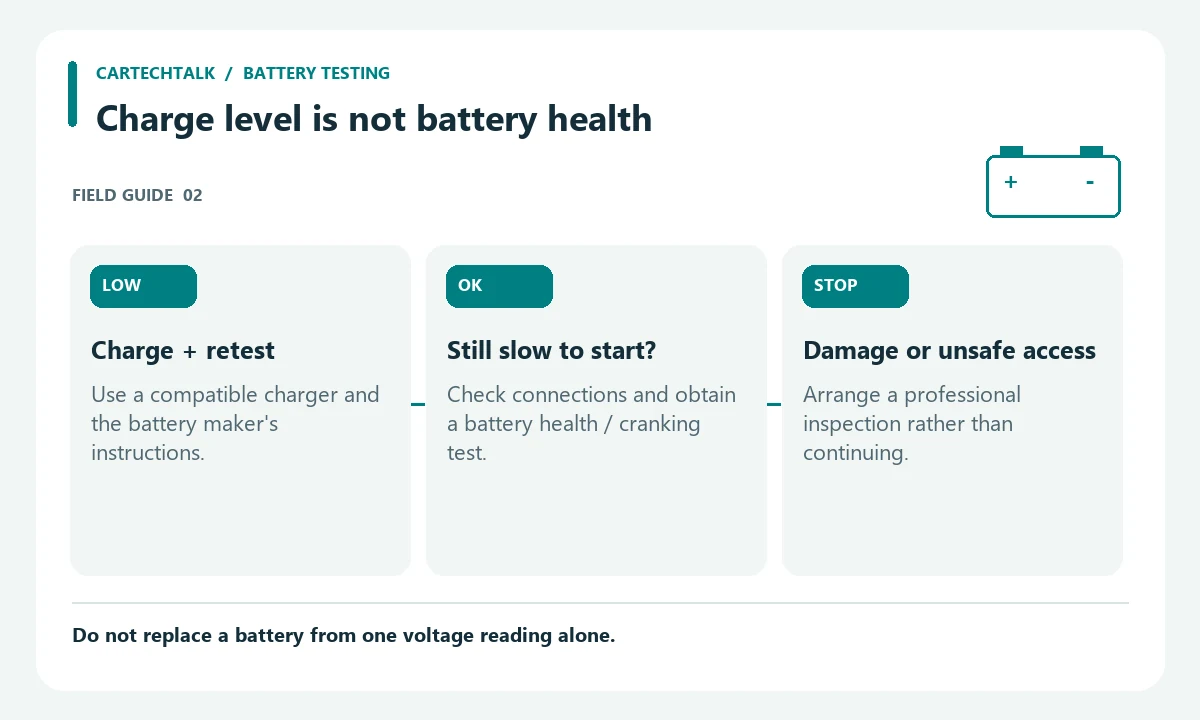
To test a conventional 12V car battery, inspect it for damage, measure its resting voltage with a suitable multimeter, and use a battery health or load test when you need to assess starting capability. A voltage reading tells you about charge; it does not, by itself, prove that a battery can crank an engine.
This overview helps you decide which test to use. For the detailed meter procedure, see testing a car battery with a multimeter. Follow your vehicle, battery and test-equipment instructions whenever they differ from a general guide.
Before you start: identify the battery and inspect it
Confirm that you are working on the vehicle’s 12V auxiliary or starter battery. This guide is not a procedure for a hybrid or EV traction battery, a 24V system or a damaged battery. AGM, flooded lead-acid and lithium batteries have different charging and testing requirements.
Stop if the battery is leaking, swollen, cracked, frozen, unusually hot or giving off a strong odor. Keep sparks and flames away, wear appropriate eye protection, remove metal jewelry and arrange professional help if access is unsafe. Do not open a sealed battery.
Choose the test that answers your question
| Question | Useful check | What it cannot establish alone |
|---|---|---|
| Is the battery charged? | Resting DC-voltage measurement | Available cranking capacity or remaining service life |
| Can it support starting? | Battery health, conductance or specified load test | The cause of every starting-system fault |
| Why does charge disappear overnight? | Battery evaluation followed by a parasitic-draw diagnosis if needed | Whether the alternator or an accessory is at fault from one reading |
Measure resting voltage safely
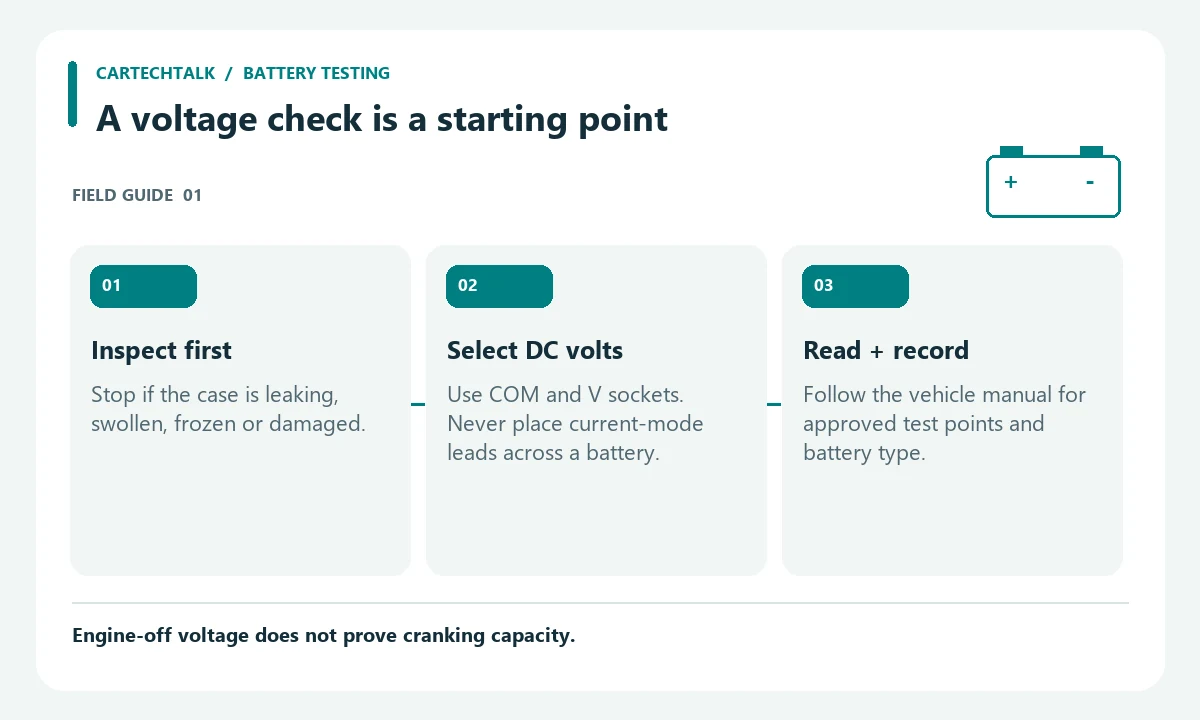
- Park safely, switch off the engine and accessories, and allow the battery to rest as directed by the manufacturer. A recent drive or charge can leave surface charge that affects the reading.
- Use a suitable meter with intact leads. Put the black lead in COM and the red lead in the voltage socket. Select DC volts and an appropriate range. Never connect a meter in current mode across the battery.
- Use the battery terminals or designated remote test points specified for the vehicle. Connect red to positive and black to negative without allowing a probe or tool to bridge the terminals.
- Record the reading, battery type, temperature and whether the battery was recently charged. You do not ordinarily disconnect a battery simply to measure voltage across its approved test points; follow vehicle-specific instructions.
A fully charged, rested 12V lead-acid battery is commonly around 12.6V, with variation by construction and conditions. Use the battery maker’s reference rather than treating one decimal value as a universal pass/fail limit. A lower reading can mean the battery needs charging, not necessarily replacement.
When to charge, retest or request a health test
If charge is low and the battery is otherwise safe to charge, use a compatible charger and retest according to its instructions. If starting remains slow with adequate charge, check the connections and obtain a proper battery and starting-system evaluation.
A load tester applies an actual load; a conductance tester uses a different measurement method. If you plan to buy one, our guide to auto battery testers explains how the two types differ. Enter the correct chemistry, rating standard and battery rating when the tester asks. Follow that tester’s specified load, duration and temperature compensation. Do not apply a universal 15 to 30 second test or a fixed voltage threshold to every battery and instrument.
What if the battery tests well but the car still will not start?
Loose or corroded connections, a starter fault or a charging-system problem can produce similar symptoms. If charge repeatedly falls while parked, read why battery voltage drops overnight. If the warning light stays on or charging is suspected, use the alternator testing guide. Avoid improvised current tests or bypassing fuses.
Frequently asked questions
Can a battery show normal voltage and still be bad?
Yes. Resting voltage does not demonstrate how the battery behaves under starting load. Request a health test if symptoms persist.
Should I replace a battery below 12.4V?
Not from that number alone. Evaluate its state of charge, condition and test results using the manufacturer’s criteria.
Do I need a new charger to test it?
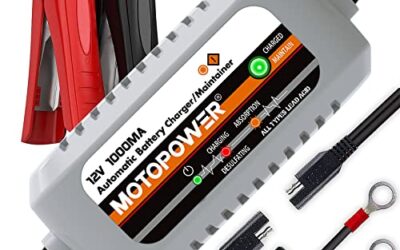
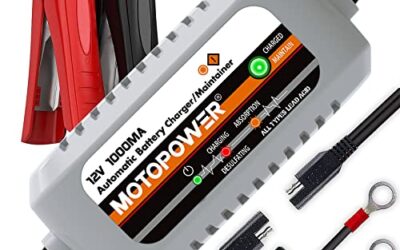
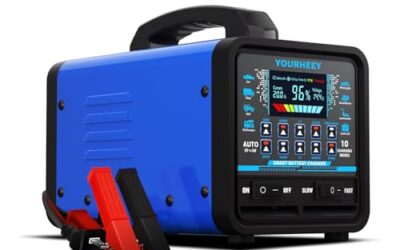
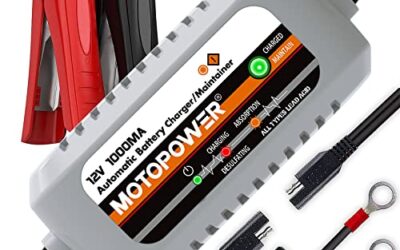
No. A charger and a diagnostic meter do different jobs. Charging may be needed before a valid health test, but it is not itself proof of battery condition.
Equipment relevant to this guide
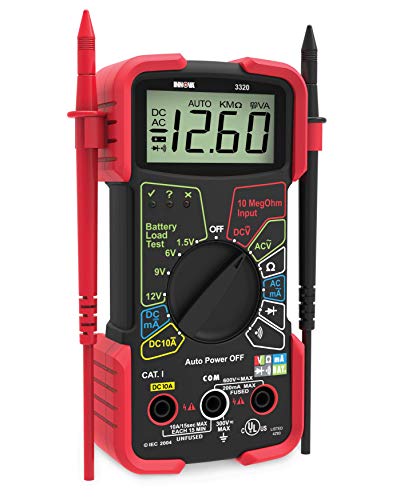
The multimeter is for voltage measurements; the battery analyzer is for supported battery and starting/charging checks. Confirm chemistry, voltage and rating compatibility before use. Neither instrument makes damaged batteries safe to handle.
Pros
- Auto-ranging eliminates the need to manually select the measurement range
- 10 MegOhm input impedance is specified for automotive and electrical use
- Large display and color-coded LEDs support easier status checking
- UL certification is listed
Cons
- The listing does not list specific measurement ranges or functions beyond those described
- The size specification lists 20 Inch, while the dimensions are listed as 2 x 10 x 5 Inches
Specifications
| Color | Red & Black |
|---|---|
| Size | 20 Inch |
| Dimensions | 2 x 10 x 5 Inches |
| Weight | 0.5 Pounds |
| Product Group | Automotive Parts and Accessories |
| Binding | Automotive |
Best For / Avoid If
Best for buyers prioritizing
- Auto-ranging eliminates the need to manually select the measurement range
- 10 MegOhm input impedance is specified for automotive and electrical use
- Large display and color-coded LEDs support easier status checking
Consider another option if
- The listing does not list specific measurement ranges or functions beyond those described
- The size specification lists 20 Inch, while the dimensions are listed as 2 x 10 x 5 Inches

Pros
- Covers multiple battery condition and vehicle charging-system checks
- Supports several battery types and global rating standards
- Backlit black-and-white display has adjustable contrast
- Compatible with cars, trucks, boats, RVs, ATVs, lawnmowers, golf carts, and motorbikes over 30Ah
Cons
- Not compatible with lithium or non-12V batteries
- Not intended for motorcycles below 30Ah
Specifications
| Color | Red |
|---|---|
| Size | BA101 |
| Dimensions | 9.5 x 7 x 2 inches |
| Weight | 0.3125 Pounds |
| Product Group | Automotive Parts and Accessories |
| Binding | Automotive |
Best For / Avoid If
Best for buyers prioritizing
- Covers multiple battery condition and vehicle charging-system checks
- Supports several battery types and global rating standards
- Backlit black-and-white display has adjustable contrast
Consider another option if
- Not compatible with lithium or non-12V batteries
- Not intended for motorcycles below 30Ah