To prevent a dead battery while a car is parked, start with a healthy, fully charged battery, remove electrical loads, and check for drain before storage. Short parking periods need little preparation, but several weeks or months call for a maintenance charger, battery disconnect, or regular charging plan.
Key takeaways
- Turn off lights, climate controls, chargers, and aftermarket electronics before locking the car.
- Check battery age, terminal condition, resting voltage, and charging voltage.
- Use a battery maintainer only when its voltage, connector, chemistry, and installation match your vehicle.
- Do not rely on starting the car for a few minutes. Short idle periods may add little charge.
- Modern vehicles can drain power through alarm systems, keyless entry, telematics, and control modules.
- Hybrid and EV parking procedures differ from those for gasoline and diesel vehicles.
Why a parked car battery goes dead
Turning off an engine does not turn off every electrical system. The body control module, alarm, keyless entry receiver, memory settings, radio security system, and telematics unit can continue using a small amount of power. Some vehicles also wake control modules at intervals to check sensors or communicate with an app.
A healthy 12-volt battery can usually support normal standby draw for a period of time. Battery capacity falls with age, heat, cold, repeated deep discharge, and long periods below full charge. A weak battery may fail after one night even though the vehicle showed no warning before parking.
Extra loads create more risk. Common examples include a dashcam parking mode, GPS tracker, aftermarket alarm, USB adapter, illuminated running board, trunk light, glovebox light, and hardwired audio equipment. A door, hood, or liftgate switch that fails to report closed can also keep a vehicle awake.
How to prevent a dead battery while a car is parked
1. Remove every avoidable load
Before leaving, switch off headlights, interior lights, seat heaters, defrosters, fans, and audio equipment. Unplug phone chargers, portable refrigerators, inverters, and other accessories from 12-volt outlets. Some outlets remain powered after ignition shutdown, depending on vehicle model and model-year.
Check the trunk, glovebox, vanity mirrors, and rear passenger area for lights that remain on. Close every door, hood, and liftgate firmly. If the vehicle uses a manual security system, lock it according to the owner manual. An unlocked vehicle may keep some systems active, while repeated keyless-entry activity can wake the car.
2. Park with a charged battery
A battery should reach full charge before long parking. Driving a short distance may not replace energy used during starting, especially in cold weather or with lights, heated seats, and the defroster running. An external charger can bring the battery to full charge more effectively than a short drive.
Use a charger setting that matches battery chemistry. Common 12-volt types include flooded lead-acid, AGM, and EFB batteries. A charger made for one battery type may not use the correct charging profile for another. Read the battery label and vehicle manual before connecting equipment.
3. Inspect terminals and cables
Loose or corroded terminals increase resistance. That can reduce starting power and prevent proper charging. With the vehicle off, inspect positive and negative terminals, the body ground connection, and the engine ground strap. Do not short a metal tool across battery terminals.
Clean corrosion only with safe procedures from the vehicle or battery manual. Wear eye protection and avoid sparks near a battery. Some vehicles need radio codes, window initialization, steering-angle calibration, or other procedures after battery power is disconnected.
4. Choose a storage method
| Parking period | Practical approach | Limit |
|---|---|---|
| Several hours to a few days | Remove loads and lock the vehicle normally. | A weak battery can still fail quickly. |
| About one to several weeks | Fully charge the battery and inspect for accessories or abnormal drain. | Keyless entry and telematics may continue using power. |
| Several weeks to months | Use a compatible maintainer, approved battery disconnect, or scheduled charging plan. | Disconnecting power can erase settings or disable alarms and tracking. |
| Seasonal storage | Clean terminals, charge fully, protect the vehicle, and monitor battery condition. | Temperature, battery age, and vehicle electronics change storage needs. |
Using a battery maintainer
A battery maintainer supplies a controlled charge as voltage falls. It differs from a basic charger that may keep charging at a fixed rate. A suitable maintainer can remain connected during storage, but it must match the battery voltage and chemistry.
Connect it in a dry, ventilated location with a stable power source. Route cables away from belts, fans, exhaust parts, hinges, and sharp edges. Follow the charger instructions for direct battery connection or approved under-hood charging points. Some vehicles place the battery in the trunk or under a seat and provide separate charging terminals.
Do not place a lead-acid battery in a sealed space while charging unless the vehicle and charger instructions allow that setup. Charging can produce gas. Keep sparks, cigarettes, flames, and hot work away from the battery.
A maintainer cannot fix a battery with an internal failure, severe sulfation, a shorted cell, or a charging-system fault. It can also mask a parasitic drain if the charger supplies enough current to offset it. A vehicle that needs constant external charging needs diagnosis.
Should you disconnect the battery?
Disconnecting the negative cable can reduce standby drain, but it is not suitable for every vehicle. It may disable the alarm, remote access, tracking, automatic liftgate functions, and memory settings. Some vehicles require a battery sensor to remain connected. Electric vehicles and hybrids may have separate procedures for their 12-volt battery and high-voltage system.
Never disconnect or service high-voltage battery components without training and vehicle-specific instructions. The 12-volt battery in a hybrid or EV can still cause injury, but it is not the same system as the high-voltage traction battery.
If the manual permits a battery disconnect, secure the cable so it cannot touch the terminal. Do not use a disconnect switch that bypasses battery monitoring unless the vehicle instructions support it. A poor connection can create heat, voltage loss, or a no-start condition.
How to check for a weak battery or parasitic drain
Start with the easiest checks. Look for dim interior lights, slow cranking, repeated jump starts, battery warning messages, and settings that reset. A battery may show normal voltage at rest and still lack enough capacity to start an engine.
- Let the vehicle sit with the engine off for the time stated in its manual. Some modules need time to enter sleep mode.
- Measure resting voltage with a suitable digital multimeter. Surface charge can make a recently charged battery look stronger than it is.
- Check charging voltage with the engine running only when the vehicle manual permits this test. Smart charging systems can vary voltage, so one reading does not prove the alternator is healthy.
- Test the battery under load with a battery tester or have a shop test it. Capacity and starting performance matter more than voltage alone.
- Measure parasitic draw only with the correct meter setup and a vehicle-specific procedure. Opening doors or waking modules during testing can create a false reading.
Do not place a multimeter in current mode across the battery terminals. That can create a short circuit and damage the meter or vehicle. Current testing also may interrupt systems that need to sleep, and some vehicles require a memory-saving power supply during diagnosis.
Starting the car during storage
Starting a parked vehicle for a few minutes is not a reliable charging plan. The starter may use more energy than a short idle period replaces. Repeated short running can also add moisture to engine oil and exhaust components, depending on temperature and operating time.
If the vehicle manual supports periodic operation, drive long enough for the engine and charging system to reach normal operation. Follow local rules for idling and never run an engine in a closed garage. A maintainer is usually more predictable for a vehicle that remains parked.
Special cases: dashcams, trackers, and keyless vehicles
Dashcams with parking mode can use power for hours or days. Their low-voltage cutoff may protect the battery, but cutoff accuracy and installation quality vary. Set the cutoff according to the camera instructions and vehicle battery type. A cutoff does not replace a healthy battery.
Trackers, aftermarket alarms, remote starters, and cellular modules can create constant or repeated draw. Remote-start systems may also wake the vehicle or run its climate controls. Have the installer check current draw if the battery dies after adding equipment.
Keyless vehicles can wake when the key fob remains close to the car. Do not store the fob beside the vehicle overnight if the manual warns about this behavior. Some key fobs offer a sleep mode, while others require a specific button sequence. The correct method depends on fob design and model-year.
Common mistakes
- Assuming a new battery cannot be defective or undercharged.
- Leaving a USB adapter connected because no phone is attached.
- Using a charger for AGM or lithium batteries on a different battery type.
- Disconnecting the battery without checking electronic reset procedures.
- Running the engine briefly instead of charging the battery fully.
- Testing parasitic draw before all vehicle modules enter sleep mode.
- Ignoring a battery warning light because the engine still starts.
- Leaving a vehicle parked with a dashcam or tracker connected without checking its cutoff settings.
When to get professional help
Get a technician involved when a fully charged battery goes dead overnight, the vehicle needs repeated jump starts, or a battery warning light appears. Professional testing can separate battery failure from alternator faults, wiring problems, module wake-ups, and accessory drain.
Seek professional service for hybrids, EVs, vehicles with battery monitoring systems, and cars with batteries in difficult locations. Ask for a battery health test, charging-system test, and parasitic-draw diagnosis. Clearing a warning code does not repair the fault that caused it.
Replace a battery only after checking fitment. Group size, terminal position, reserve capacity, cold-cranking rating, battery chemistry, and registration procedures can vary by vehicle model-year. Some vehicles need a scan-tool battery registration after replacement.
Gear that can help
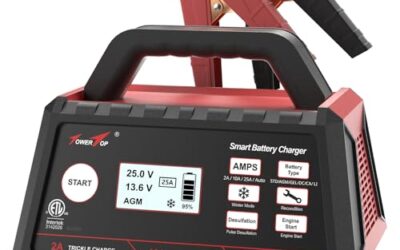
If you need battery chargers and maintainers or battery testers for this job, these picks already appear in our battery chargers and maintainers guides. Check the full guide for fit and who should skip each one.

Pros
- Supports multiple lead-acid battery types, including AGM, Gel, SLA, VRLA, flooded, maintenance-free, deep-cycle, marine, and powersport batteries
- Compatible with LiFePO4 lithium-ion batteries
- Designed for use with cars, motorcycles, lawn mowers, ATVs, UTVs, tractors, trucks, SUVs, RVs, boats, and other listed vehicles
Cons
- Only 6V and 12V battery support is specified
- Force Mode is required to charge batteries that have reached zero volts
Specifications
| Color | Black |
|---|---|
| Size | 5A |
| Dimensions | 4.61 x 3.43 x 7.95 inches |
| Weight | 1.59 pounds |
| Product Group | Automotive Parts and Accessories |
| Binding | Electronics |
Best For / Avoid If
Best for buyers prioritizing
- Supports multiple lead-acid battery types, including AGM, Gel, SLA, VRLA, flooded, maintenance-free, deep-cycle, marine, and powersport batteries
- Compatible with LiFePO4 lithium-ion batteries
- Designed for use with cars, motorcycles, lawn mowers, ATVs, UTVs, tractors, trucks, SUVs, RVs, boats, and other listed vehicles
Consider another option if
- Only 6V and 12V battery support is specified
- Force Mode is required to charge batteries that have reached zero volts

Pros
- Compatible with multiple 12V lead-acid battery types.
- Temperature compensation is designed to help prevent overcharging in hot weather and undercharging in cold weather.
- Direct-mount format supports an onboard, under-the-hood charging setup.
- Includes a Force Mode for charging completely discharged batteries down to zero volts.
Cons
- Designed for 12V lead-acid batteries; other battery chemistries are not identified in the listing.
- The 2A charging rate is specified for this model.
- Installation requires securing the mounting bracket with self-tapping screws.
Specifications
| Color | Black |
|---|---|
| Size | 2A |
| Dimensions | 5 x 2.3 x 1.5 Inches |
| Weight | 0.73 Pounds |
| Product Group | Automotive Parts and Accessories |
| Binding | Electronics |
Best For / Avoid If
Best for buyers prioritizing
- Compatible with multiple 12V lead-acid battery types.
- Temperature compensation is designed to help prevent overcharging in hot weather and undercharging in cold weather.
- Direct-mount format supports an onboard, under-the-hood charging setup.
Consider another option if
- Designed for 12V lead-acid batteries; other battery chemistries are not identified in the listing.
- The 2A charging rate is specified for this model.
- Installation requires securing the mounting bracket with self-tapping screws.

Pros
- Combines an engine code reader and battery tester in one device
- Provides live data, freeze-frame information, and I/M readiness status
- Supports battery health, cranking, and charging system evaluation
- No app, computer, or setup is required for operation
Cons
- Does not support ABS, SRS, or transmission systems
- Not compatible with EVs
Specifications
| Color | yellow |
|---|---|
| Dimensions | 3.2 x 1.18 x 5 Inches |
| Weight | 0.6393405598 pounds |
| Product Group | Automotive Parts and Accessories |
| Binding | Unknown Binding |
Best For / Avoid If
Best for buyers prioritizing
- Combines an engine code reader and battery tester in one device
- Provides live data, freeze-frame information, and I/M readiness status
- Supports battery health, cranking, and charging system evaluation
Consider another option if
- Does not support ABS, SRS, or transmission systems
- Not compatible with EVs
FAQ
How long can a car sit before its battery dies?
There is no fixed time for every vehicle. Battery age, temperature, standby draw, accessories, and charge level change the result. A healthy car may sit for weeks, while a weak battery or abnormal drain may fail overnight.
Should I disconnect the negative terminal during vacation?
Only when the vehicle manual permits it and you accept lost settings or disabled functions. A compatible battery maintainer is often better for long storage, provided safe power and correct charging support are available.
Does driving recharge a dead battery?
Driving can recharge some energy, but alternator output and drive time vary. A deeply discharged or damaged battery may need an external charger or replacement. Alternators are not a substitute for battery testing.
Can a dashcam drain a car battery?
Yes. Parking mode can draw power while the vehicle is off. Use an approved hardwire kit with a suitable low-voltage cutoff, then monitor whether the battery still loses charge.
Do EVs need battery protection while parked?
EVs still use a 12-volt system for many vehicle functions. Follow the model-specific parking and charging instructions. Do not work on high-voltage components without qualified training.
Sources and further reading
- Battery Council International (Battery Council International): Battery care and safety information for vehicle owners.