To avoid overloading a car power outlet, add every device’s current draw, compare the total with the vehicle’s outlet rating, and stop using any setup that causes heat, odor, fuse failure, or loose connections. Check the owner’s manual because outlet limits vary by vehicle, model year, connector, ignition state, and circuit design.
Most 12-volt outlets support small electronics, but they are not automatically suitable for high-power appliances. A phone charger may use little current while an air compressor, seat heater, cooler, or power inverter can use much more. The outlet, wiring, fuse, and alternator or battery all limit what the circuit can handle.
Key takeaways
- Read the vehicle manual for outlet voltage and amp limits.
- Add current draw from every device sharing one outlet or circuit.
- Use watts divided by volts to estimate current when only wattage appears.
- Keep continuous loads below the circuit limit, especially in older vehicles.
- Stop for hot plugs, melted plastic, burning odor, flickering power, or repeated fuse failure.
- Do not replace a blown fuse with a larger fuse.
Why car power outlets overload
A car power outlet is a branch circuit. Power leaves the battery or charging system, passes through wiring and a fuse, and reaches a socket or USB module. The fuse protects wiring from excessive current. The outlet itself also has a contact rating, and its connector may become the weak point.
Older vehicles often use a cigarette-lighter-style socket. Many newer vehicles use 12-volt accessory sockets, USB-A ports, USB-C ports, or built-in power inverters. These ports can look similar while supporting different loads. A USB-C port may provide more charging power than a basic USB-A port, but its output still depends on the vehicle’s hardware and software.
Overload happens when current stays above what the fuse, wiring, connector, or outlet can safely carry. A brief startup surge can also trip protection even when an appliance’s normal running draw looks acceptable. Motors in compressors and coolers often create this type of surge.
Check your vehicle’s outlet rating first
Start with the owner’s manual. Search for terms such as accessory socket, power outlet, cigar lighter, USB port, inverter, and maximum load. Some vehicles label an outlet with an amp rating or watt limit. Others provide separate limits for front, rear, cargo-area, and console outlets.
Model-year changes matter. A 2024 vehicle may use a different fuse or outlet module than a similar 2018 trim. Hybrid and electric vehicles may also manage accessory power differently from gasoline vehicles. Their 12-volt system still needs protection, even though the high-voltage battery powers the vehicle’s drive system.
Check whether outlet power stays on with the ignition off. A live outlet can drain the 12-volt battery if a device remains connected while parked. An outlet that switches off with the vehicle may still power a device during accessory mode. That behavior depends on vehicle programming.
Do not treat a printed value on an adapter as the vehicle’s rating. An adapter may say 120 watts, but the socket may support less. The lower limit controls the setup.
Calculate total load before connecting devices
Current is the key number for a 12-volt circuit. Add current values for every device connected to the same outlet or circuit. If a device lists watts instead of amps, divide watts by volts:
Current in amps = watts divided by volts
Use the voltage shown for the device or vehicle. A 120-watt inverter on a 12-volt outlet needs about 10 amps before conversion losses. A real setup may draw more because inverters waste some energy as heat. A 12-volt compressor marked 8 amps can demand a higher startup current.
USB chargers often list output watts, not input current. Their input draw can rise while converting vehicle voltage to phone or tablet charging voltage. A multi-port charger may share its rated output across ports rather than provide full power to every port at once.
| Device type | What to check | Why it matters |
|---|---|---|
| Phone or tablet charger | Input current and total port output | Usually light load, but several ports add together |
| Dash camera | Operating draw and parking-mode behavior | May keep draining the battery after parking |
| Air compressor | Running amps and startup surge | Motor startup can trip a fuse |
| Cooler or heated blanket | Continuous wattage and duty cycle | Long use creates sustained heat and battery load |
| Power inverter | Continuous and peak ratings | High AC loads can exceed the socket quickly |
Use one load calculation for the whole circuit
Several outlets may share one fuse. A front socket and rear socket can look separate while drawing from the same protected circuit. The manual or fuse-box diagram may identify the shared circuit. If it does not, do not assume each outlet gets the full fuse rating.
Example: A phone charger draws 2 amps, a dash camera draws 1 amp, and a small cooler draws 6 amps. Together, they draw about 9 amps. If all three use outlets protected by one 10-amp fuse, the margin is small. Startup demand, warm connectors, wiring condition, and measurement error can push the circuit into trouble.
Do not plan to operate continuously at the fuse’s exact rating. A fuse rating protects the circuit, but it is not a promise that every connector can run at that load indefinitely. Continuous heat raises resistance and can damage a weak socket before the fuse opens.
Inspect plugs, sockets, and adapters
Physical condition matters as much as the math. A loose plug can create resistance at its contact points. Resistance produces heat, and heat can deform plastic or discolor metal. A dirty socket can cause poor contact and intermittent power.
- Turn off the vehicle and unplug devices.
- Look for melted plastic, dark marks, corrosion, bent contacts, or debris.
- Check whether the plug fits firmly without excessive movement.
- Inspect the cable near the plug for cuts, crushed sections, or exposed conductors.
- Reconnect one device and watch for heat during normal use.
Do not spray cleaner into a powered outlet. Remove debris only with the vehicle off and the connector accessible. A damaged socket may need replacement rather than a different adapter.
Choose adapters and inverters by input load
Power strips for 12-volt sockets multiply connections, not available power. A three-port adapter still receives power through one socket and one circuit. Add every connected device before using it.
Power inverters need two ratings: continuous output and peak output. Continuous output describes what the inverter can provide during normal operation. Peak output covers short startup demand. Neither rating increases the vehicle outlet’s limit. A large inverter may require direct battery wiring with a separate fuse, not a dashboard socket.
High-current appliances deserve special care. Air compressors, refrigerators, heated clothing, seat heaters, and cooking devices can run for long periods. Some may work briefly but overheat the plug or wiring during extended use. Follow vehicle and device manuals for direct-wiring requirements.
USB-C adds another compatibility limit. USB Power Delivery can negotiate different voltage and current levels, but only when the vehicle port, cable, and device support the needed profile. A USB-C shape alone does not prove high-power charging. Phone OS versions and device firmware can affect charging behavior, but they do not change the vehicle fuse rating.
Watch for overload symptoms
Some symptoms point to a simple fuse failure. Others indicate a dangerous connection problem.
- Outlet stops working: Check the vehicle fuse and ignition state. A blown fuse identifies excess current or a fault, not the exact cause.
- Plug feels hot: Unplug the device and stop using that socket until the plug and outlet receive inspection.
- Burning odor or melted plastic: Turn off power immediately. Do not reconnect the device.
- Power cuts out under load: Suspect overload, startup surge, weak contact, or an adapter fault.
- Flickering charger: Check plug fit, cable damage, socket contamination, and shared circuit load.
- Fuse fails again: Stop replacing fuses. A short, damaged device, or wiring fault may remain.
A fuse replacement can restore power, but it does not repair the fault that opened the fuse. Use the same fuse type and rating specified by the vehicle. A larger fuse can let wiring overheat before protection operates.
Simple decision tree for safe outlet use
- Does the manual give an outlet limit? Use that value. If the manual gives separate limits, apply the limit for that outlet.
- Do all devices show current or wattage? Convert wattage to current and include inverter losses and startup demand.
- Do outlets share one fuse? Add their loads together. Treat the lowest known limit as controlling.
- Does total load approach the limit? Remove a device or use a properly installed circuit rated for the load.
- Does any plug or socket get hot? Stop use and inspect the connection.
- Does the fuse fail repeatedly? Leave the circuit off and seek diagnostic help.
Common mistakes
Assuming every 12-volt outlet supports the same load
Outlet ratings differ by vehicle, trim, location, and model year. Rear cargo outlets may have a different fuse from front console outlets.
Using the fuse number as normal operating capacity
A fuse rating gives circuit protection. It does not guarantee safe continuous operation at that exact current through an aging socket or loose plug.
Counting only the device’s output watts
Chargers and inverters consume input power while converting voltage. Their vehicle-side draw can exceed the output value shown on the device.
Ignoring startup current
Motors and compressors can demand more current when starting. That brief surge can open a fuse or shut down an adapter.
Using a bigger fuse
A larger fuse can expose wiring to dangerous heat. Use the specified replacement or have the circuit diagnosed.
Leaving devices connected while parked
Parking cameras, trackers, coolers, and chargers can drain the 12-volt battery when an outlet remains live. Check the vehicle’s accessory-power behavior.
When to get professional help
Get an automotive technician involved after repeated fuse failure, melted plastic, smoke, burning odor, damaged wiring, or heat at a plug. Professional diagnosis may require circuit testing, voltage-drop checks, connector inspection, and current measurement under load.
Seek help before adding a direct-battery circuit for an inverter, compressor, refrigerator, or other high-current device. The circuit needs correct wire size, fuse placement, routing, grounding, and protection from abrasion. Vehicle-specific installation matters because modern cars may include airbag wiring, battery sensors, body control modules, and high-voltage systems.
Do not probe unknown connectors or high-voltage components on hybrid and electric vehicles. Their 12-volt accessory circuit is separate from the traction system, but orange high-voltage cables and related components require trained service procedures.
Gear that can help
If you need power inverters for this job, these picks already appear in our power inverters guides. Check the full guide for fit and who should skip each one.

Pros
- Combines AC outlets with USB-C and USB-A charging ports
- 65W USB-C PD output supports charging compatible devices
- 30-inch power cord provides additional reach inside a vehicle
- Automatic cooling fan activates at an internal temperature of 113°F (45°C)
Cons
- The product advises connecting only one high-power device at a time
- Using the 65W USB-C PD port together with an AC socket may exceed the vehicle socket's limit
Specifications
| Color | Red |
|---|---|
| Product Group | Electronics |
Best For / Avoid If
Best for buyers prioritizing
- Combines AC outlets with USB-C and USB-A charging ports
- 65W USB-C PD output supports charging compatible devices
- 30-inch power cord provides additional reach inside a vehicle
Consider another option if
- The product advises connecting only one high-power device at a time
- Using the 65W USB-C PD port together with an AC socket may exceed the vehicle socket's limit
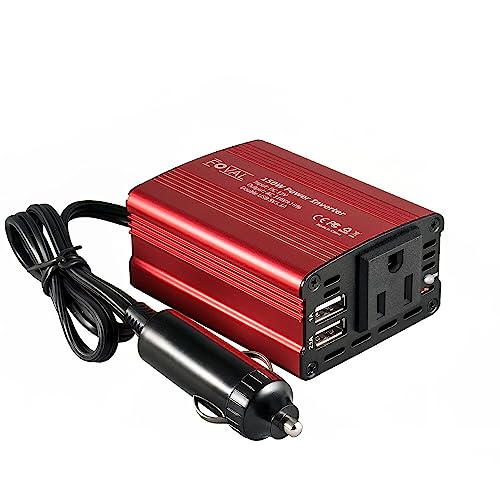
Pros
- Combines one AC outlet with two USB charging ports
- Supports simultaneous charging of most phones and tablets through the USB ports
- Compact and lightweight design at 8 oz+
- Includes multiple stated protection features and a cooling fan
Cons
- The 150W continuous output limits use with devices requiring more power
- Requires a vehicle cigarette lighter or 12V DC power connection
Specifications
| Color | Classic Red |
|---|---|
| Dimensions | 3.7 x 2.5 x 1.5 inches |
| Weight | 0.49824471212 pounds |
| Product Group | Automotive Parts and Accessories |
| Binding | Electronics |
Best For / Avoid If
Best for buyers prioritizing
- Combines one AC outlet with two USB charging ports
- Supports simultaneous charging of most phones and tablets through the USB ports
- Compact and lightweight design at 8 oz+
Consider another option if
- The 150W continuous output limits use with devices requiring more power
- Requires a vehicle cigarette lighter or 12V DC power connection

Pros
- Multiple AC and USB charging options support simultaneous device charging
- 30W PD USB-C port is specified for fast charging compatible phones and some laptops
- Dedicated AC control can help avoid leaving the AC outlets powered when they are not needed
- Supports a range of stated use cases including road trips, camping, outdoor work, and emergency backup
Cons
- The stated 400W output limits use to devices within that power level
Specifications
| Color | Black |
|---|---|
| Size | 400W-PD30BK |
| Product Group | Lawn & Patio |
| Binding | Electronics |
Best For / Avoid If
Best for buyers prioritizing
- Multiple AC and USB charging options support simultaneous device charging
- 30W PD USB-C port is specified for fast charging compatible phones and some laptops
- Dedicated AC control can help avoid leaving the AC outlets powered when they are not needed
Consider another option if
- The stated 400W output limits use to devices within that power level
FAQ
Can I plug several chargers into one car outlet?
Yes, if their combined input load stays within the vehicle outlet and shared circuit limits. A multi-port adapter does not increase available power.
How many watts can a 12-volt car outlet handle?
There is no universal answer. The vehicle manual, fuse rating, outlet design, and model year control the limit. Use the lowest applicable rating.
Will a blown outlet fuse damage my car?
A fuse opening can protect wiring from excess current. Repeated failure points to a continuing fault, short, damaged device, or overload that needs diagnosis.
Can a power inverter run a laptop?
Often, but check inverter input draw, continuous output, startup behavior, and the vehicle outlet limit. A laptop charger may work while a printer, heater, or appliance exceeds the circuit.
Can a USB-C car charger overload a phone?
Normal USB Power Delivery negotiation limits charging to supported profiles. The charger still adds load to the vehicle circuit, and poor cables or damaged ports can create separate problems.
Sources and further reading
- Check for Recalls (NHTSA): Use this page to check safety recalls by vehicle identification number or vehicle details.
- Charging Electric Vehicles at Home (Alternative Fuels Data Center): Review electrical planning concepts that also help explain why circuit ratings matter.