To maintain a jump starter in winter, follow its manual for storage temperature, charge level, and cold-weather charging limits. Keep it dry, inspect its cables and clamps, and warm it safely before use if its instructions allow.
- Battery chemistry and model determine safe storage and charging temperatures.
- Cold can reduce available output, so a fully charged pack may still perform less well outside.
- Do not charge a lithium jump starter below its stated minimum temperature.
- Check charge level, case condition, clamps, and cables before winter travel.
- Use a jump starter only with a vehicle voltage and battery type it supports.
Winter care depends on the jump starter’s battery chemistry, temperature limits, and charging instructions. Portable units often use lithium-ion or lead-acid batteries, and neither chemistry has one universal storage or charging rule. The model’s manual takes priority over general advice.
Before cold weather arrives, find the manual or manufacturer’s support page. Look for storage temperature, operating temperature, charging temperature, recommended storage charge, and inspection instructions. These ranges can differ even between models using the same battery chemistry.
Also check vehicle compatibility. A jump starter meant for a 12-volt vehicle is not automatically suitable for a 24-volt truck, and support for a specific engine or battery type varies. Follow both the jump-starter instructions and vehicle owner’s manual.
Winter care checklist
| Check | What to do | Why it matters |
|---|---|---|
| Temperature limits | Read storage, use, and charging limits in the manual. | One limit may not apply to all three activities. |
| Charge level | Charge or top up on the schedule the manual gives. | Stored charge can decline over time, leaving less reserve for an emergency. |
| Storage location | Keep the unit dry and within its approved temperature range. | Extreme cold, heat, and moisture can affect the battery or electronics. |
| Clamps and cables | Check for cracks, corrosion, loose connections, or damaged insulation. | Damaged leads can prevent a safe, reliable connection. |
| Vehicle fit | Match voltage and battery type to the vehicle and pack instructions. | A connector fitting physically does not prove electrical compatibility. |
1. Store the jump starter within its temperature limits
Choose a dry storage place that stays inside the temperature range in the manual. A garage or vehicle cabin can become much colder or hotter than expected, so do not assume either location suits every pack. Avoid damp areas and places where the unit could be crushed or exposed to metal objects that might bridge its terminals.
If you keep the pack in a vehicle, check whether its manual allows that storage temperature. Some manufacturers set different limits for operation and storage. A pack may tolerate a temperature during storage that is outside its permitted range for charging or jump-starting.
Do not leave a jump starter on a heater, against an engine, or in direct sun to warm it. Rapid or uneven heating can damage the case or battery. Move it to a dry indoor space and let it approach room temperature naturally when the manual calls for warming.
2. Maintain charge according to the manual
Check the displayed charge before winter and at intervals recommended by the maker. Recharge the unit using its approved input and cable. Some models call for periodic top-ups; the timing and target charge are not the same for every device.
For lithium jump starters, charging below the stated minimum temperature can damage cells. If the pack has been in a freezing vehicle, do not plug it in immediately unless its instructions explicitly allow charging at that temperature. Bring it indoors and wait until it reaches the manual’s permitted charging range.
Lead-acid jump starters also need model-specific care. Their charging and storage instructions differ from lithium units, so do not apply a lithium pack’s charging routine to a lead-acid model. Use only a charger the manufacturer approves.
If the pack has no clear charge indicator or behaves differently than usual, stop relying on it for emergency starting until you can follow the manufacturer’s troubleshooting advice. A dashboard light or display can show charge status, but it cannot prove that the unit will start every compatible vehicle in severe cold.
3. Inspect cables, clamps, and case
Before storing the unit and before taking it on a winter trip, inspect its case, cables, clamps, ports, and supplied accessories. Look for a cracked case, exposed wire, loose clamp, corrosion, moisture, or a port that does not hold its connector securely.
Do not use a unit with damaged cables, swollen casing, leakage, unusual heat, or a burnt smell. Do not open the battery pack or attempt a repair unless the manufacturer provides a procedure intended for users. Keep clamps from touching each other or conductive objects while connected to the pack.
Keep the manual with the unit or save an accessible copy on your phone. In cold weather, instructions for clamp order, indicator lights, and safety features can matter. Procedures vary, so do not substitute a sequence from another model.
4. Warm and use the unit safely
Cold can reduce the power a battery can deliver. If the jump starter has been stored in freezing conditions, check its operating-temperature instructions before use. If the manual permits warming, bring it into a sheltered, dry place and let it warm naturally. Do not use an open flame, hot water, or a high-heat appliance.
Place the vehicle and jump starter where both manuals allow operation. Check the vehicle battery voltage and connection points, then attach clamps in the order specified by the instructions. Many modern vehicles have designated jump-start terminals; the battery may be difficult to reach or managed by vehicle electronics. The owner’s manual takes priority over a generic clamp diagram.
If the pack reports a connection error, reverse polarity, or another fault, disconnect and recheck only as its instructions direct. Do not bypass protection features. Stop if the vehicle battery is cracked, leaking, frozen, or visibly damaged. A jump starter is not a repair for a failed battery or an underlying charging-system fault.
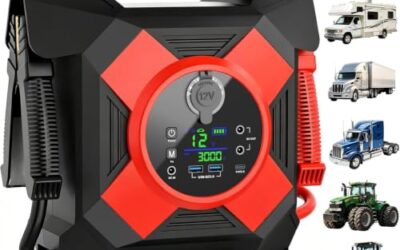
For more on cold-weather emergency equipment, see our guides to jump starters for winter emergencies and jump starters with tire inflators for winter driving. Drivers with larger gas or diesel vehicles can also read our guide to truck jump starters.
Common mistakes
- Charging a cold pack right away: Charging limits can be lower than storage or operating limits. Warm the unit only as its manual directs.
- Assuming full charge means full cold-weather output: Cold can reduce available power even when the display shows a high charge.
- Leaving the pack in a vehicle without checking limits: Cabin and trunk temperatures can move outside a model’s approved storage range.
- Using a charger that happens to fit: Connector fit does not establish the correct voltage, current, or charging method.
- Trying to start an unsupported vehicle: Voltage, engine requirements, and battery type affect compatibility. Check both manuals.
- Ignoring damage or warnings: A fault light, damaged clamp, swollen case, or unusual heat calls for stopping, not bypassing protection.
When to get professional help
Contact the jump-starter maker or a qualified battery service professional if the unit will not charge within its stated temperature range, repeatedly displays a fault, has physical damage, or becomes unusually hot. Do not open a sealed pack or test its internal cells without a manufacturer-approved procedure.
Get vehicle service if a compatible, correctly connected jump starter cannot start the vehicle, or if the vehicle repeatedly needs a boost. A weak vehicle battery, charging-system problem, poor connection, or another fault may be responsible. Repeated jumping does not identify which part failed.
Gear that can help
If you need jump starters for this job, these picks already appear in our jump starters guides. Check the full guide for fit and who should skip each one.

Pros
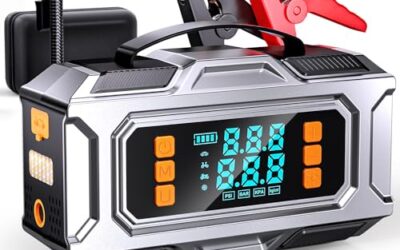
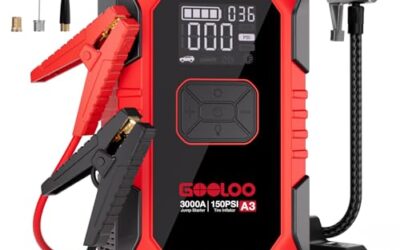
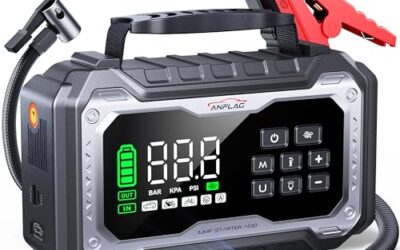
- Combines jump starting and cordless tire inflation in one portable unit
- Supports up to 150 PSI with automatic shut-off and selectable pressure units
- Includes five air nozzles and five inflation modes
- Provides stated support for more than 1,000 charge cycles
- Backed by an 18-month warranty
Cons
- The stated operating and storage temperature range is -4°F to 140°F, while charging is limited to 14°F to 113°F
- The unit should be recharged at least once every three months during long-term storage
Specifications
| Color | Red |
|---|---|
| Dimensions | 4.96 x 5.87 x 2.3 inches |
| Weight | 3.58 pounds |
| Product Group | Automotive Parts and Accessories |
Best For / Avoid If
Best for buyers prioritizing
- Combines jump starting and cordless tire inflation in one portable unit
- Supports up to 150 PSI with automatic shut-off and selectable pressure units
- Includes five air nozzles and five inflation modes
Consider another option if
- The stated operating and storage temperature range is -4°F to 140°F, while charging is limited to 14°F to 113°F
- The unit should be recharged at least once every three months during long-term storage

Pros
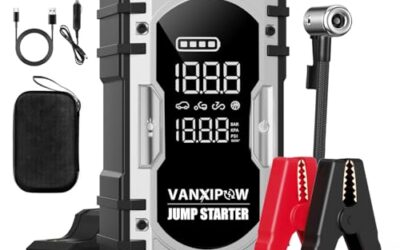
- High 1000-amp peak rating for a compact 2.5-pound jump starter
- Stated compatibility with 12V vehicles and engines up to 6.0L gas or 3.0L diesel
- Built-in spark-proof and reverse-polarity protection
- Adds power-bank and flashlight functionality for emergency use
Cons
- The stated engine compatibility is limited to up to 6.0L gas and 3.0L diesel
- The listed warranty period is one year
Specifications
| Color | Gray |
|---|---|
| Size | 1000 Amps |
| Dimensions | 6.5748031429 x 3.149606296 x 7.7165354252 Inches |
| Weight | 2.4 Pounds |
| Product Group | Automotive Parts and Accessories |
| Binding | Automotive |
Best For / Avoid If
Best for buyers prioritizing
- High 1000-amp peak rating for a compact 2.5-pound jump starter
- Stated compatibility with 12V vehicles and engines up to 6.0L gas or 3.0L diesel
- Built-in spark-proof and reverse-polarity protection
Consider another option if
- The stated engine compatibility is limited to up to 6.0L gas and 3.0L diesel
- The listed warranty period is one year
Frequently asked questions
Can I leave a jump starter in my car during winter?
Only if its manual permits the vehicle’s likely storage temperatures. A parked vehicle can become very cold, and acceptable storage limits vary by model and battery chemistry.
Should I charge a lithium jump starter in freezing weather?
Do not charge it below the minimum temperature in its manual. If it is colder than that limit, move it indoors and let it warm naturally before charging, unless its manufacturer gives different instructions.
Does a full charge guarantee a winter start?
No. Cold can reduce battery output, and vehicle condition, engine requirements, connection quality, and pack compatibility also affect starting. A charge display is not a performance guarantee.
How often should I recharge a stored jump starter?
Follow the model’s storage and maintenance schedule. Recharge intervals and recommended storage charge vary, so a universal timetable could leave one unit undercharged or conflict with another’s instructions.
Sources and further reading
- Battery Council International: Find general information about batteries and battery care.