To store a lithium jump starter in summer, keep it in a cool, dry place out of direct sun, and follow its manual for storage charge and temperature limits. A parked vehicle can get much hotter than the outdoor air, so do not treat a glove box or trunk as a safe long-term storage spot.
- Check the jump starter’s manual for separate storage, charging, and operating temperature ranges.
- Store the unit away from heat, moisture, direct sun, and items that could damage its case or clamps.
- Use the charge level and check interval specified by its manufacturer. Do not assume every lithium pack uses the same guidance.
- Do not charge or use a pack that is hot, swollen, leaking, cracked, or giving off an unusual odor.
Why summer heat matters for lithium jump starters
Lithium batteries age faster when stored hot. Heat can also push a pack beyond its allowed temperature range, where use or charging may be unsafe. The amount of risk depends on the pack’s cell chemistry, design, condition, and temperature limits. A lithium-ion pack and a lithium iron phosphate pack, often called LiFePO4, may have different specifications. Do not apply one model’s limits to another.
Heat exposure does not always cause an obvious failure. A pack can appear normal while losing capacity over time. A unit left in a hot car may also be too warm to charge or use when you need it. Check the manual for the allowed temperatures and let the pack return to an approved range before charging or operating it.
Outdoor temperature does not tell you the temperature inside a closed vehicle. A vehicle parked in the sun can become much hotter than the air around it. Shade may reduce direct sun on the vehicle, but it does not make a parked cabin a dependable cool-storage location.
How to store a lithium jump starter in summer
- Read the manual and label. Find the specified storage temperature, storage charge level, charging range, and any maintenance schedule. If the manual gives separate limits for charging and storage, use the correct limit for each activity. The device’s exact model matters more than general advice for lithium batteries.
- Choose a cool, dry indoor location. Use a place that stays within the unit’s storage range and away from direct sun, heaters, hot pipes, and damp areas. Avoid attics, sheds, or garages if they regularly exceed the manual’s limit. A temperature-controlled indoor space is a better choice when available.
- Set the charge level according to the manual. Some makers specify a partial charge for long-term storage; others give different instructions. Do not assume that full charge or near-empty storage is right for every jump starter. If the manual gives no storage charge guidance, ask the manufacturer rather than guessing from advice for a different battery or device.
- Disconnect accessories and secure the clamps. Unplug USB devices, charging cables, and other accessories. Store clamps so their metal jaws cannot touch each other or conductive objects. Keep the unit in its case if the case protects it from dust or accidental contact, but do not wrap it in material that traps heat or moisture.
- Check the pack on the schedule the manual gives. Lithium packs can lose charge while stored, and a low charge may affect later use. If the manual sets a check or recharge interval, follow it. Use only the approved charging method and charger, and charge only when the unit is within its permitted temperature range.
- Inspect it before putting it back into service. Look for a cracked case, swelling, leakage, corrosion, damaged cables, or loose clamps. Check the displayed charge and follow the maker’s readiness procedure. Do not jump a vehicle with a damaged or abnormal pack.
Where should you keep the jump starter?
For summer storage, choose the location by temperature, moisture, and physical protection, not by convenience alone. A bedroom closet or interior storage cabinet may work if it stays within the manual’s limits and remains dry. A garage may be suitable only if its temperature stays within those limits. Avoid locations near fuel, open flames, or other hazards, and keep the pack out of reach of children.
| Location | Summer storage guidance |
|---|---|
| Cool indoor cabinet | Often the better choice if it stays dry and within the maker’s storage temperature range. |
| Attached garage | Use only if its actual conditions stay within the unit’s stated limits. A garage can become hot. |
| Parked car, glove box, or trunk | Avoid for long-term storage. Cabin temperatures can exceed the outdoor temperature and the pack’s allowed range. |
| Direct sun, shed, or attic | Avoid if the location heats up, gets damp, or falls outside the storage limits. |
If you carry a jump starter for emergencies, the storage advice still matters. A unit kept in a car may face repeated heat exposure through summer. If that is your only practical option, check the manual for vehicle-storage limits and consider another way to carry or store the unit. For planning emergency equipment, see our guide to jump starters for stored vehicles.
Storage temperature is not charging temperature
A jump starter may have different permitted ranges for storage, charging, and operation. Meeting its storage limit does not automatically mean it is safe to charge at that temperature. Likewise, a unit that can operate within a broad range may still have a narrower charging range.
After bringing a pack in from a hot car or outdoor area, let it cool naturally in a dry place before charging. Do not use a refrigerator, freezer, ice pack, or direct airflow to force a fast temperature change. Follow the manual’s temperature guidance and do not charge a pack that remains outside its allowed charging range.
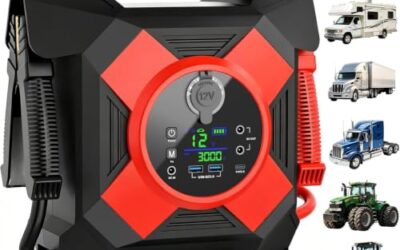
Charging connectors and vehicle connections also vary. Use the charger and cables supplied or approved for the specific jump starter. For vehicle use, check the jump starter’s voltage and connection instructions against the vehicle manual. A unit meant for a 12-volt vehicle is not automatically suitable for a different electrical system. Our truck jump starter guide covers why vehicle and pack requirements matter when selecting emergency equipment.
What if the pack gets hot, swells, or will not charge?
A warm pack after use may need time to cool, but unusual heat during storage or charging calls for caution. Stop charging or using it if the case becomes unusually hot, swells, leaks, smells unusual, or shows cracks. Do not squeeze, open, puncture, or attempt to repair the battery. Keep it away from people and combustible materials if you can do so safely, then contact the manufacturer for handling and disposal instructions.
If the pack only seems warm because it was left in a hot location, move it to a dry, shaded area and allow it to cool naturally. Do not assume it is safe to charge just because the outside feels cooler. Follow the manual’s temperature limits. If damage or abnormal behavior remains, stop using it.
A jump starter that will not charge may have several causes, including temperature protection, a depleted or aging battery, a faulty cable, or a charger problem. Check the manual’s indicators and approved charging steps. Do not bypass a protection feature or try an unapproved charger. If the pack remains unresponsive or shows a fault, contact the manufacturer or a qualified service provider.
Common mistakes
- Leaving it in the car all summer. A trunk or glove box does not prevent heat buildup. Remove the pack for storage when practical.
- Using a generic temperature or charge rule. Battery chemistry, electronics, and maker instructions differ. Use the limits for the exact model.
- Charging it while hot. Let it return to its permitted charging range first. Do not cool it with ice or a freezer.
- Storing it fully depleted or assuming it needs a full charge. Use the manual’s storage instructions rather than a rule from another battery product.
- Ignoring swelling, damage, or odor. These signs call for stopping use, not testing the pack with a vehicle.
- Letting clamps touch metal items. Secure the clamps and cables to reduce accidental contact and damage.
When to get professional help
Stop using the jump starter and contact its manufacturer or a qualified battery service provider if the pack is swollen, cracked, leaking, unusually hot, or producing an unusual odor. Do the same if it repeatedly reports a fault, will not accept an approved charge, or has damaged clamps or cables. Do not open the case or replace internal cells yourself.
If a damaged lithium pack is smoking, hissing, or burning, move away and contact emergency services. Do not handle or transport a pack showing signs of active failure. For other battery questions, the Battery Council International offers general battery information. For seasonal jump starter planning, see our cold-weather jump starter guide.
Gear that can help
If you need jump starters for this job, these picks already appear in our jump starters guides. Check the full guide for fit and who should skip each one.
Pros
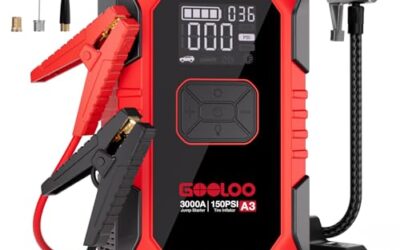
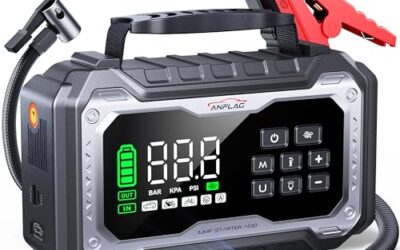
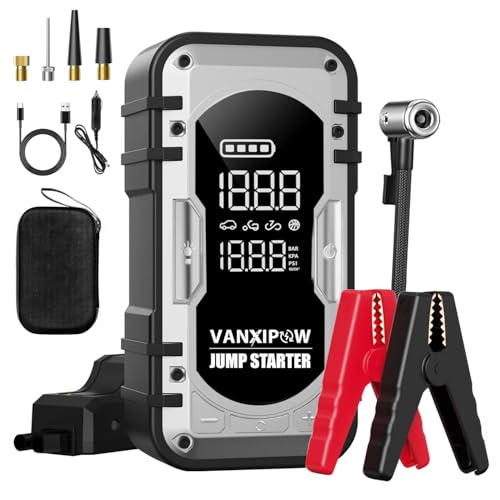
- Combines jump-starting, tire inflation, emergency lighting, and USB charging in one device
- Listed compatibility covers a broad range of 12V vehicles and engines up to 9.0L gas or 8.0L diesel
- Stated weight of 615 grams supports portable use
- LCD screen displays battery level, inflation mode, and real-time tire pressure
Cons
- The air pump should not be used continuously and requires cooling when it becomes seriously hot
- The product has one USB output port
Specifications
| Color | black silver |
|---|---|
| Dimensions | 6.9 x 2.3 x 3.5 Inches |
| Weight | 1.873929227 pounds |
| Product Group | Automotive Parts and Accessories |
Best For / Avoid If
Best for buyers prioritizing
- Combines jump-starting, tire inflation, emergency lighting, and USB charging in one device
- Listed compatibility covers a broad range of 12V vehicles and engines up to 9.0L gas or 8.0L diesel
- Stated weight of 615 grams supports portable use
Consider another option if
- The air pump should not be used continuously and requires cooling when it becomes seriously hot
- The product has one USB output port

Pros
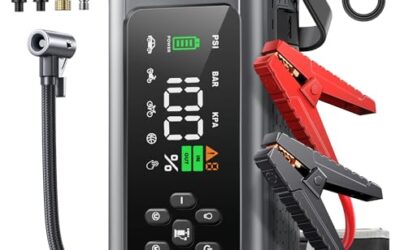
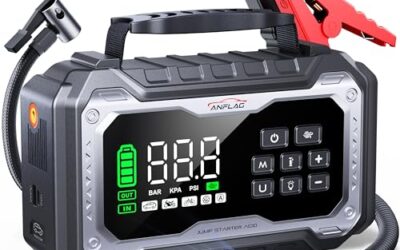
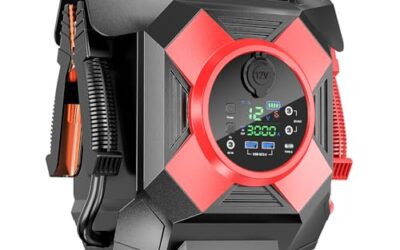
- Combines jump-starting, tire inflation, high-volume air movement, device charging, and emergency lighting in one unit
- Supports a wide stated range of vehicle applications, including gas engines and diesel engines up to 14.0L
- Includes automatic tire-pressure shut-off and five inflation presets
- Comes with jumper cables, an extended air hose, four air nozzles, a USB-A to USB-C cable, instructions, and a carrying case
Cons
- The unit weighs 4.85 lb
- The manufacturer recommends charging the device every 4-5 months if it remains idle
Specifications
| Color | Black |
|---|---|
| Dimensions | 9.1338582584 x 2.7952755877 x 5.4330708606 inches |
| Weight | 2.8439631798 pounds |
| Product Group | Automotive Parts and Accessories |
Best For / Avoid If
Best for buyers prioritizing
- Combines jump-starting, tire inflation, high-volume air movement, device charging, and emergency lighting in one unit
- Supports a wide stated range of vehicle applications, including gas engines and diesel engines up to 14.0L
- Includes automatic tire-pressure shut-off and five inflation presets
Consider another option if
- The unit weighs 4.85 lb
- The manufacturer recommends charging the device every 4-5 months if it remains idle
FAQ
Can I leave a lithium jump starter in my car during summer?
It is better to remove it for long-term storage. A parked car can become much hotter than outdoor air, and the unit may exceed its storage or charging limits. Follow the manual if it gives vehicle-storage guidance.
Should I store my jump starter fully charged?
Use the charge level specified by the maker. Storage guidance varies by model, so neither full charge nor partial charge is a universal rule.
How often should I recharge a stored jump starter?
Follow the manual’s check and recharge schedule. If it gives no interval, ask the manufacturer for guidance for that model instead of applying a schedule from another pack.
Can I charge a jump starter right after bringing it in from a hot car?
Wait until it is within its approved charging temperature range. Let it cool naturally in a dry place, and check the manual before connecting a charger.
Is a warm jump starter dangerous?
Warmth after use can differ from unusual heat during storage or charging. Stop using the pack if it becomes unusually hot, swells, leaks, cracks, or smells unusual. Follow the maker’s safety instructions.