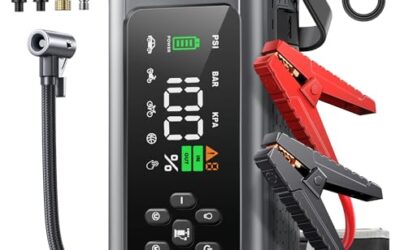
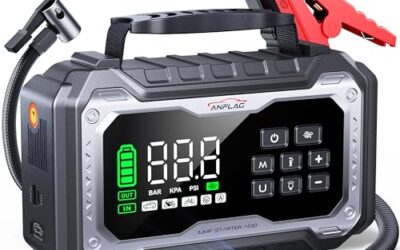
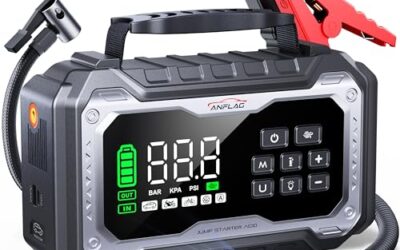
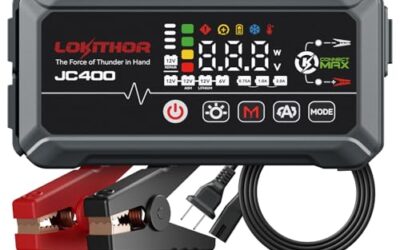
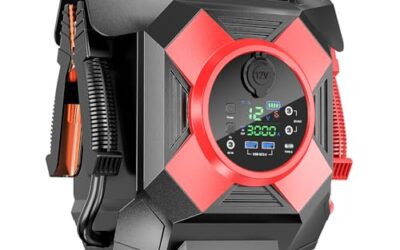
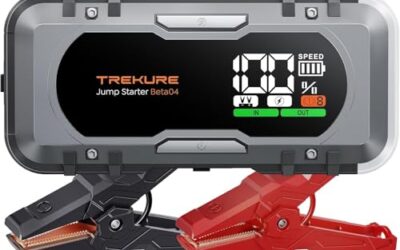
The best commercial jump pack for many fleet and roadside jobs is the Clore Automotive Jump-N-Carry JNC1224 3400/1700, because it supports both 12V and 24V systems and uses long, heavy-gauge cables. That makes it a practical fit for crews that service mixed-voltage vehicles, though its listed peak current is lower than several lithium models here. Match pack voltage to vehicle voltage first, then weigh repeat-start needs, storage, and charging.

Pros
- High listed current output for heavy-duty 12V vehicles and equipment
- Supports diesel engines up to 50L according to the product listing
- Combines jump-starting, device charging, diagnostics, and emergency lighting in one unit
- IP65-rated ABS+PC housing is described as waterproof and dustproof, with drop and shock resistance
Specifications
| Color | RED |
|---|---|
| Product Group | Automotive Parts and Accessories |
Best For / Avoid If
Best for buyers prioritizing
- High listed current output for heavy-duty 12V vehicles and equipment
- Supports diesel engines up to 50L according to the product listing
- Combines jump-starting, device charging, diagnostics, and emergency lighting in one unit

Pros
- Supports two voltage modes: 12V and 24V
- High listed peak-amp ratings for both operating modes
- Includes long 46-inch #2 AWG welding cable leads
- Built-in automatic charging is included
Specifications
| Color | Red |
|---|---|
| Size | 3400 Amp 12/24V |
| Dimensions | 14.8 x 18.5 x 16.6 inches |
| Weight | 40 Pounds |
| Product Group | Automotive Parts and Accessories |
| Binding | Automotive |
Best For / Avoid If
Best for buyers prioritizing
- Supports two voltage modes: 12V and 24V
- High listed peak-amp ratings for both operating modes
- Includes long 46-inch #2 AWG welding cable leads

Pros
- 18,000A starting power supports heavy-duty vehicles including semi-trucks, motorhomes, buses, tractors, and boats
- Self-heating function is specified for operation in temperatures as low as -22°F
- Safety features include spark-proof protection, reverse polarity protection, and automatic shutoff when clamps are removed
- LiFePO4 battery construction is specified for longer life than traditional lead-acid jump starters
Cons
- Weight is 19.84 pounds
- Dimensions measure 5.51 x 13 x 13.19 inches
Specifications
| Dimensions | 5.51 x 13 x 13.19 inches |
|---|---|
| Weight | 19.84 pounds |
| Product Group | Automotive Parts and Accessories |
Best For / Avoid If
Best for buyers prioritizing
- 18,000A starting power supports heavy-duty vehicles including semi-trucks, motorhomes, buses, tractors, and boats
- Self-heating function is specified for operation in temperatures as low as -22°F
- Safety features include spark-proof protection, reverse polarity protection, and automatic shutoff when clamps are removed
Consider another option if
- Weight is 19.84 pounds
- Dimensions measure 5.51 x 13 x 13.19 inches
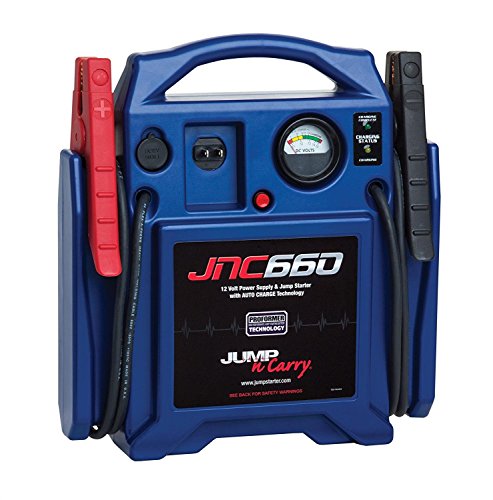
Pros
- High 1700-amp peak rating
- Long 46-inch cables with heavy-duty #2 AWG construction
- Built-in voltmeter provides charge-status information
- DC outlet supports powering 12V accessories
Specifications
| Color | Blue |
|---|---|
| Size | One Size |
| Dimensions | 16.3 x 14.1 x 5.1 inches |
| Weight | 18 Pounds |
| Product Group | Automotive Parts and Accessories |
| Binding | Automotive |
Best For / Avoid If
Best for buyers prioritizing
- High 1700-amp peak rating
- Long 46-inch cables with heavy-duty #2 AWG construction
- Built-in voltmeter provides charge-status information
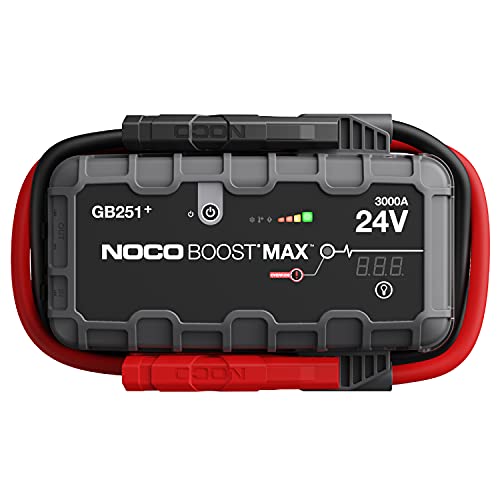
Pros
- High stated output for large gas and diesel engines
- Spark-proof and reverse-polarity protection are specified for 24V connections
- Combines jump-starting capability with a power bank and multi-mode flashlight
- Includes a 1-year warranty and multiple charging accessories
Cons
- Engine compatibility is specified up to 32L
- The product weighs 15 lb
- The listing lists a 1-year warranty
Specifications
| Color | Gray |
|---|---|
| Size | 3000A |
| Dimensions | 19.49 x 14.17 x 10.51 Inches |
| Weight | 13.6466140178 Pounds |
| Product Group | Automotive Parts and Accessories |
| Binding | Automotive |
Best For / Avoid If
Best for buyers prioritizing
- High stated output for large gas and diesel engines
- Spark-proof and reverse-polarity protection are specified for 24V connections
- Combines jump-starting capability with a power bank and multi-mode flashlight
Consider another option if
- Engine compatibility is specified up to 32L
- The product weighs 15 lb
- The listing lists a 1-year warranty
Commercial jump pack picks by job
These recommendations suit different work patterns, not one universal winner. Product specifications and performance statements below come from the product descriptions. CarTechTalk may earn a commission from qualifying purchases through links on this page. That does not change the fit criteria: choose a pack that matches the vehicle’s electrical system and the demands of the job.
- Best for mixed 12V and 24V service: Clore Automotive Jump-N-Carry JNC1224 3400/1700.
- Best for frequent commercial starts: CARLBROS CB40 Heavy Duty Jump Starter, which claims a rapid recharge cycle for repeated jobs.
- Best for long standby between uses: birvsw Heavy Duty Truck Jump Starter:12V 30000A, a 12V-only pack whose description claims standby power beyond three years.
- Best for a compact 24V lithium pack: NOCO Boost Max GB251: 3000A UltraSafe Jump Starter.
- Best lower-cost 12V shop unit: Clore Automotive Jump-N-Carry JNC660 1700 Peak Amp.
For a semi-truck-specific comparison, see our guide to jump starters for semi trucks. A diesel engine’s size alone does not settle compatibility: system voltage, battery condition, connection procedure, and the pack’s documented limits all matter.
Recommended commercial jump packs
Clore Automotive Jump-N-Carry JNC1224 3400/1700
This is the clearest choice for a shop, service truck, or fleet that encounters both 12V and 24V equipment. Clore lists 3,400 peak amps in 12V mode and 1,700 in 24V mode. Its 46-inch No. 2 AWG welding cable leads give the operator more reach than a very short lead set, while industrial-grade Hot Jaw clamps serve repeated vehicle connections.
The built-in automatic charging feature suits a shared shop unit that returns to a charging point after use. The tradeoff is that its listed starting-current figures trail the higher peak claims of the lithium options. Skip it if your work is exclusively 12V and you want lithium portability or a listed power bank; this model’s supplied features focus on starting and charging, not extra USB functions.
CARLBROS CB40 Heavy Duty Jump Starter
The CB40 targets roadside operators and fleet staff who may need several starts in succession. Its description lists 12V and 24V operation, a LiFePO4 battery, and a 40-second recharge claim after a successful jump when cables remain connected. It also claims a 25-minute recharge from empty to full. Those manufacturer claims make recharge workflow a key reason to consider it, but they are not a promise that every vehicle or job will follow the same cycle.
CARLBROS lists an 18,000-amp peak figure, a 39-inch cable set, and a 19.84-pound weight. Its description also claims operation down to minus 22°F and a 0.3-volt battery detection threshold. The stated cold limit is warmer than the birvsw’s claimed minus 40°F limit, and the cable reach may not suit every layout. Skip the CB40 if your work requires longer leads, colder stated operating conditions, or a lighter pack. Its 500-lumen light and USB ports add utility, but do not replace a dedicated work light or charger for a crew with heavier power needs.
birvsw Heavy Duty Truck Jump Starter:12V 30000A
This pick targets 12V commercial equipment and long intervals between charging. The description lists 30,000 peak amps, 3,000 rated amps, and up to 20 starts per full charge. It also claims standby power beyond three years and a four-hour full recharge with the included 57W charger. For a remote truck or equipment cab, that combination may reduce routine charging attention if the claims match the unit’s actual storage conditions and use.
Its hard boundary is voltage: this is a 12V pack, not a 12V/24V model. Do not choose it for 24V starting just because the engine is large. The description also lists a 64,000mAh capacity, USB-C and USB-A outputs, an LCD, and an IP65 shell rating. Those extras add cab and roadside utility, but the pack’s $899 observed position is premium. Skip it if your fleet needs 24V capability or cannot justify a dedicated high-cost 12V unit. Its product description includes strong cold-weather and zero-volt starting claims; treat those as manufacturer claims, not universal outcomes for damaged or failed batteries.
NOCO Boost Max GB251: 3000A UltraSafe Jump Starter
The GB251 is a compact lithium choice for 24V commercial equipment. NOCO lists 3,000 amps and compatibility with gas and diesel engines up to 32L, including Class 8 trucks, buses, and vocational equipment. Its 15-pound listed weight may suit a technician who moves a pack between vehicles rather than leaving a heavier unit in one bay. The maker also lists spark-proof and reverse-polarity protection, a 600-lumen light, and a power bank.
At the premium end of this group, its strongest practical case is a portable 24V unit with a three-hour recharge claim and included protective case. The description lists a one-year warranty. Its 3,000-amp figure is far below the highest peak figures claimed by some competitors, so do not compare amperage alone across products or assume it will cover every difficult start. Skip it if your shop wants 12V/24V switching in one unit, needs the highest listed peak-current figure, or prioritizes a lower purchase cost.
Clore Automotive Jump-N-Carry JNC660 1700 Peak Amp
The JNC660 is the budget-oriented choice for a 12V shop, service van, or equipment owner who wants a straightforward lead-acid jump pack. Clore lists a 22Ah Proformer battery, 1,700 peak amps, and 46-inch No. 2 AWG cables. A built-in voltmeter shows the pack’s charge status, and its DC outlet can power 12V accessories. Those basics suit a work area where the pack can be recharged and checked as part of routine tool storage.
Its main limitation is its 12V-only format, so it cannot serve a 24V vehicle. The listed battery capacity and design also make it a different ownership proposition from compact lithium packs: it is a conventional battery-based unit, and charge status deserves attention before a job. Skip it if you need 24V starts, a lithium pack, or rapid recharge claims for frequent back-to-back calls. For a simpler everyday vehicle option, see our guide to automotive battery jump starters.
How to choose a commercial jump pack
Start with system voltage
Voltage is the first filter, not peak amperage. The JNC1224 and CB40 list both 12V and 24V operation. The birvsw and JNC660 are listed as 12V models, while the NOCO GB251 is listed as a 24V pack. A 24V machine needs a pack meant for 24V use; do not connect a 12V-only model based on a large amp figure or engine-size claim. Follow the vehicle and pack instructions for connection and operation.
If your fleet includes both voltage systems, a dual-voltage unit can reduce the number of packs staff must choose between. That convenience does not make the models identical: the JNC1224 and CB40 have different power sources, recharge claims, cable lengths, and added functions. Record vehicle voltage in fleet procedures so a rushed roadside call does not become a voltage mismatch.
Match pack to job frequency and storage
For several starts in a shift, recharge time and repeat-use claims deserve attention. The CB40 description emphasizes rapid recharge, while the JNC1224 lists built-in automatic charging. For a pack stored for long periods, the birvsw description claims extended standby, but stored equipment still needs an inspection and charging routine that follows its manual. A pack’s claimed standby interval is not a substitute for checking its status before dispatch.
Consider where the pack lives and who carries it. The NOCO’s listed 15-pound weight gives it a stated portability advantage over the CB40’s 19.84 pounds, though their voltage and output claims differ. The JNC660 lists long leads, and the JNC1224 has a similar listed cable length. Compare that reach with battery location and clamp access on vehicles in your fleet; cable length can affect where the pack must sit during a start.
Read peak-current claims in context
Peak-amp numbers look easy to compare but do not establish a universal ranking. The descriptions use different products, battery types, voltage modes, engine limits, and starting claims. For example, the birvsw’s 30,000-amp peak figure applies to a 12V product, while the NOCO’s 3,000-amp claim is for a 24V lithium pack. Those figures alone cannot prove which one will start a particular engine in poor battery condition or extreme weather.
Use the manufacturer’s stated voltage and vehicle limits as the initial compatibility screen. Then compare cable reach, recharge method, storage needs, and any cold-weather claim relevant to your work. If a vehicle has a damaged battery, unusual electrical fault, or manufacturer-specific jump procedure, a booster may not be the right fix. Stop and use qualified service when the vehicle manual or conditions call for it.
Who should skip these commercial jump packs
Do not buy any of these as a substitute for a battery charger, battery maintainer, or diagnosis of a recurring no-start problem. A jump pack supplies starting assistance; it does not establish why a battery discharged or confirm that the charging system works. If your main need is routine battery care, compare purpose-built options in our battery chargers and testers section. Drivers who only need occasional help with a passenger car may also find a smaller consumer jump starter easier to store and carry.
Verdict: choose voltage before features
For mixed 12V and 24V service, the Clore JNC1224 is the most straightforward fit because its listed modes cover both systems. Choose the CB40 when its rapid-recharge claims fit a high-turnover workflow, or the NOCO GB251 when a compact 24V lithium pack matters more than dual-voltage use. The birvsw is a specialized 12V option for buyers who value its stated standby and cold-weather claims; the JNC660 keeps the 12V choice simpler and more budget-focused.
Before buying, compare pack voltage with each vehicle, then check the vehicle manual for approved jump points and procedures. For more background on battery care, Battery Council International offers battery information for consumers and industry. Keep the selected pack charged according to its instructions, and make its condition part of the fleet’s normal equipment checks.