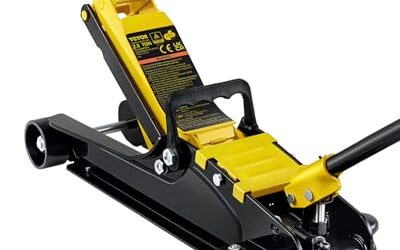
Choose an automotive floor jack by checking the vehicle’s approved lifting procedure, the load to be lifted, saddle clearance, maximum lift height and access to the lifting point. Capacity alone does not establish compatibility. A jack raises a vehicle; suitable jack stands support it for work. This is a research-based buying guide, not a hands-on test.
Start with the vehicle manual, not a tonnage shortcut
Find the designated lifting and support points for the exact model and year. An emergency roadside jacking point is not automatically an approved central lifting point for a workshop floor jack. If the owner’s manual does not describe the procedure you intend to use, obtain the manufacturer’s service instructions or ask a qualified technician.
Record the vehicle’s loaded condition and the jack requirements specified by the manufacturer. Do not assume every axle carries 60 or 75 percent of the vehicle’s weight. Weight distribution, accessories and cargo vary. Never exceed the jack’s rated capacity, and do not treat a higher tonnage as permission to use an unapproved lifting point.
For a separate explanation of ratings, see the floor jack capacity guide. If you cannot establish a safe procedure and load, stop rather than calculate a guessed allowance from curb weight.
The five measurements to check before buying
| Check | What to compare | Why it matters |
|---|---|---|
| Minimum saddle height | Jack specification against clearance at the approved lifting point, including an approved adapter | A low body panel or a flat tire can prevent access. |
| Maximum saddle height | Usable lift range against the vehicle’s lifting and stand-placement procedure | Capacity does not tell you whether the jack reaches high enough. |
| Chassis reach | Distance to the lifting point and clearance along the entire jack body | A low saddle may fit while the frame or pump housing does not. |
| Saddle and adapter fit | Vehicle-approved contact shape and jack manufacturer’s adapter instructions | An unsuitable pad can slip or damage a reinforced seam. |
| Working space | Handle travel, caster movement and room for stands | The jack must move as its lifting arm changes angle. |
Use the dimensions for the exact model number, not an average for a category. Two jacks advertised as low-profile or three-ton can have different frames, lifting ranges and adapter requirements. Plan a trial fit without loading the jack before committing to a maintenance task.
Steel, aluminum or a hybrid frame?
A steel jack can be a practical choice when it stays on a smooth garage floor. An aluminum or hybrid model may be easier to transport, but compare actual tool weight, handles, dimensions and service support. Material alone does not prove durability, safety or suitability for commercial use. Do not assume all aluminum jacks are weaker or that all steel jacks are built to the same standard.
Rapid-lift or dual-pump systems can reduce unloaded pumping. They do not increase the stated load rating. Read the model’s operating instructions for the release mechanism and lowering control, particularly if the garage leaves little room behind the handle.
Examples of automotive jacks, not a universal recommendation
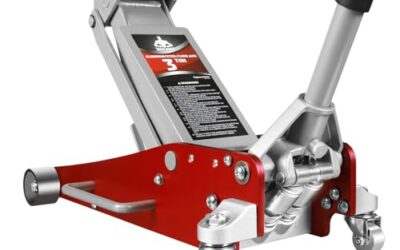
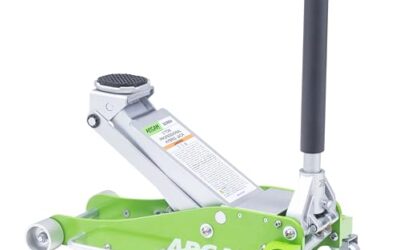
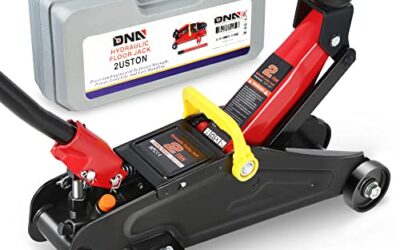
The listings below are automotive hydraulic floor jacks. They replace unrelated flooring installation tools, house-support jacks and jack-pad-only listings previously attached to this guide. Check the current listing, exact model manual, rated capacity, lift range and vehicle compatibility before purchase. Neither example is suitable for every car or truck, and neither substitutes for jack stands.
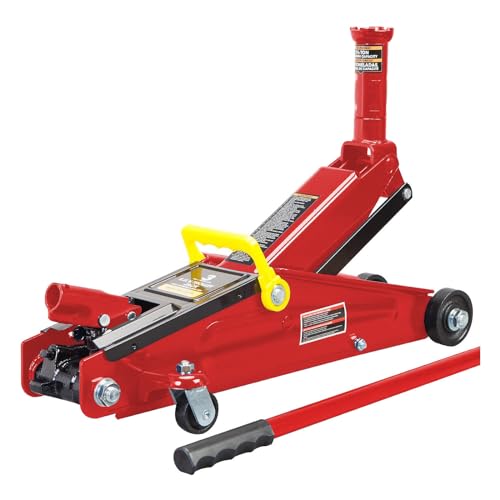
Pros
- High 20-7/8-inch maximum lift height for SUVs and extended-height trucks
- 6,000-pound capacity is listed for cars, trucks, vans, and SUVs
- 360-degree swivel casters support maneuverability
- Includes a limited one-year manufacturer warranty
Cons
- The listed minimum lifting height is 5-7/8 inches, so lower-clearance compatibility is not established
- The manufacturer warranty is limited to one year
- The listing does not include a detailed specifications array
Best For / Avoid If
Best for buyers prioritizing
- High 20-7/8-inch maximum lift height for SUVs and extended-height trucks
- 6,000-pound capacity is listed for cars, trucks, vans, and SUVs
- 360-degree swivel casters support maneuverability
Consider another option if
- The listed minimum lifting height is 5-7/8 inches, so lower-clearance compatibility is not established
- The manufacturer warranty is limited to one year
- The listing does not include a detailed specifications array

Pros
- Supports standard cars, SUVs, minivans, and standard pickup trucks
- Provides a wide lift range for the listed vehicle applications
- Includes overload protection and a rotating saddle
- Meets ANSI/ASME PASE safety standards
Cons
- Not suitable for lifted vehicles, heavy-duty trucks, or RVs
- The 63.8-lb steel construction may be difficult to move
- Single-piston design may require more strokes than the brand's dual-piston model
Specifications
| Color | Multi color |
|---|---|
| Dimensions | 26.4 x 14.2 x 8.3 Inches |
| Weight | 63.9 Pounds |
| Product Group | Automotive Parts and Accessories |
Best For / Avoid If
Best for buyers prioritizing
- Supports standard cars, SUVs, minivans, and standard pickup trucks
- Provides a wide lift range for the listed vehicle applications
- Includes overload protection and a rotating saddle
Consider another option if
- Not suitable for lifted vehicles, heavy-duty trucks, or RVs
- The 63.8-lb steel construction may be difficult to move
- Single-piston design may require more strokes than the brand's dual-piston model
For a narrower comparison, use the floor jack and stand combination guide. Assess each stand’s rating and locking instructions separately; a package does not establish vehicle fit.
Safety conditions that a purchase cannot solve
- Use the jack only on a hard, level surface that meets its instructions. Do not improvise with plywood, blocks or plates to make unsuitable ground acceptable.
- Follow the vehicle’s instructions for parking, transmission position, wheel chocking and lifting points. Never lift an occupied vehicle.
- Inspect the jack before use. Remove a damaged, leaking, unstable or abnormally operating jack from service.
- Never get under a vehicle supported only by a hydraulic jack. Position appropriately rated stands at approved support points and follow the specified lowering procedure before working beneath it.
- Do not use an improvised extension, stacked pad or unapproved saddle adapter to obtain more height.
- Keep hands and feet clear of moving components and the lowering load. If you cannot place stands safely without entering an unsupported area, stop and obtain professional assistance.
These points do not replace the vehicle or equipment manual. EV battery enclosures, underbody shields, suspension components and cosmetic body panels are not lifting points unless the vehicle manufacturer explicitly designates them.
Check manuals and service support before paying
Download the manual for the exact jack model before buying. Check the rated capacity and units, minimum and maximum height, inspection requirements, warranty and availability of approved replacement parts. A seller’s reference to a safety standard is not a guarantee that every example is undamaged or correctly operated. Do not infer certification or overload protection from a generic product title.
Confirm that a replacement seal kit or service center is available if repairability matters to you. Return policy also matters: the advertised saddle height may be adequate while the jack body cannot reach a recessed lifting point on your vehicle.
Maintenance is model-specific
Use only the hydraulic fluid and service procedure specified by the jack manufacturer. Filler location, correct fill level, bleeding sequence and storage instructions differ. Do not loosen an unfamiliar screw or remove a plug under load. Do not adjust a factory-set overload valve. If the jack drops, creeps, fails to lift or shows leakage, take it out of service and consult the manufacturer rather than using it to diagnose a fault with a vehicle raised.
The guide to adding floor-jack oil explains preparation and limitations, but the exact model manual controls the procedure.
Frequently asked questions
Is a three-ton jack automatically right for an SUV?
No. Verify the required capacity, approved lifting procedure, saddle clearance, reach and lift height for that SUV. The vehicle category and jack rating alone cannot establish fit.
Can I use a jack pad instead of a jack stand?
No. A compatible saddle pad protects or adapts a contact point; it does not provide independent support. Use the support equipment required by the vehicle and equipment instructions.
Are house floor jacks or flooring jacks suitable?
No. Building support posts, flooring installation tools and automotive hydraulic floor jacks have different intended uses. Search results sharing the words “floor jack” are not interchangeable products.
Should I buy the highest-capacity jack I can afford?
Not without checking dimensions and handling. A heavier jack may be difficult to move, too tall to enter or unable to reach the approved point. Buy equipment that satisfies all of the vehicle and equipment requirements.
Sources and scope
Manufacturer instructions establish the operating limits. Consult the Torin floor-jack owner’s manual and Torin jack-stand manual for examples of separate lifting and supporting instructions. These manuals illustrate the distinction; they do not apply to every product shown above. Always obtain the manual supplied for your exact equipment.