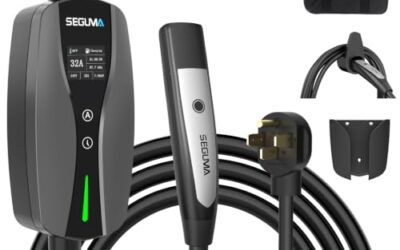
For an EVIQO NACS EV charger review, the EVIQO Level 2 EV Charger NACS 40A NEMA 14-50 is the clearest fit for Tesla drivers with a compatible 240V outlet. Its native NACS connector, adjustable 6–40A current, and 25-foot cable suit home charging, but its plug-in setup depends on a dedicated 50A circuit and the correct outlet.

Pros
- Native NACS connector includes a button for opening the Tesla charging port
- Works with North American EV and PHEV models when used with a NACS-to-J1772 adapter
- Side reset button allows faults to be cleared without opening the charger or disconnecting power
- Supports scheduled charging and OTA firmware updates through the app
Cons
- Requires a dedicated 50A, 240V circuit and an EV-rated 4-prong NEMA 14-50 outlet
- NACS-to-J1772 adapter is not included for J1772 vehicles
- Smart app features require a 2.4 GHz WiFi network with internet access
The EVIQO Level 2 EV Charger is a wall-mounted, plug-in charging station rated for up to 40A at 240V. It uses an EV-rated 4-prong NEMA 14-50 outlet on a dedicated 50A circuit and includes a 25-foot charging cable.
The native NACS connector supports Tesla Model S, Model 3, Model X, Model Y, and other vehicles using the NACS standard. North American EV and PHEV models with J1772 ports require a NACS-to-J1772 adapter, which is not included.
App features include start and stop controls, adjustable 6-40A current settings, charging reminders, consumption and cost tracking, scheduled charging, and OTA firmware updates. App features require a 2.4 GHz WiFi network with internet access.
The enclosure is rated IP66/NEMA 4 and the product is listed as UL, ETL, FCC, and Energy Star certified. Additional features include a fluorescent connector holster, side reset button, a 3-year manufacturer warranty, and U.S.-based customer support.
Specifications
| Color | Black |
|---|---|
| Size | 40 |
| Dimensions | 15.354330693 x 15.354330693 x 10.629921249 Inches |
| Product Group | Automotive Parts and Accessories |
| Binding | Electronics |
Detailed Review
Key features:
- Native NACS connector supports Tesla Model S, Model 3, Model X, Model Y, and other NACS vehicles
- 40A maximum output on a dedicated 50A, 240V circuit
- 25-foot charging cable provides extended reach across a garage or driveway
- Smartphone app supports start and stop controls, 6-40A current settings, charging reminders, and consumption and cost tracking
- IP66/NEMA 4 weatherproof enclosure is designed for outdoor exposure to rain, snow, heat, and dust
- Fluorescent holster is designed to improve connector visibility in low-light conditions
Best For / Avoid If
Best for buyers prioritizing
- Native NACS connector includes a button for opening the Tesla charging port
- Works with North American EV and PHEV models when used with a NACS-to-J1772 adapter
- Side reset button allows faults to be cleared without opening the charger or disconnecting power
Consider another option if
- Requires a dedicated 50A, 240V circuit and an EV-rated 4-prong NEMA 14-50 outlet
- NACS-to-J1772 adapter is not included for J1772 vehicles
- Smart app features require a 2.4 GHz WiFi network with internet access
Who should consider this EVIQO NACS charger
This charger makes the most sense for a driver who has a North American Tesla, a suitable NEMA 14-50 receptacle, and a home parking spot within cable reach. EVIQO lists compatibility with Model S, Model 3, Model X, Model Y, and other vehicles using NACS. The native connector can also open a Tesla charge port using its built-in button.
For a non-Tesla EV or plug-in hybrid with a J1772 inlet, the charger needs a NACS-to-J1772 adapter. That adapter is not included, so the vehicle’s inlet and adapter needs affect the real purchase decision. Do not assume an adapter included with the car will work for every charging situation. Check the vehicle and adapter makers’ guidance for AC charging compatibility.
What the 40A plug-in setup means at home
EVIQO specifies up to 40A output on a dedicated 50A, 240V circuit. The charger plugs into a four-prong NEMA 14-50 outlet, a connector style also used for some ranges and RV hookups. Similar-looking outlets do not prove that a particular receptacle or circuit is suitable. The product description specifically warns against using a dryer outlet.
“No electrician” is a product description, not permission to install or use an unsuitable circuit. A plug-in charger still depends on correct household wiring, an appropriate receptacle, and a circuit that supports the charger’s stated requirements. If the outlet’s rating, condition, or circuit assignment is uncertain, have a qualified electrician assess the installation before charging. Do not use an extension cord or an improvised adapter unless the charger and vehicle manufacturers explicitly permit that arrangement.
The 40A maximum is not a promise that every vehicle will draw 40A. Actual AC charging depends on the vehicle’s onboard charger, its settings, and the available electrical supply. The EVIQO app lets the owner set current from 6A to 40A. That control can help match charging to a suitable lower current, but it does not make an unsuitable outlet or circuit safe.
A plug-in connection can appeal to renters or homeowners who already have the correct receptacle. It also makes the outlet part of the ownership equation: the charger cannot deliver its intended use if the garage only has a different outlet or an undersized circuit. For a hardwired installation, note that the listed input cable is 37 inches, but the available description does not establish that every installation can use that cable length or configuration. Compare the installation options with an electrician rather than assuming the plug-in model can be hardwired without changes.
Cable reach, weather, and app controls
The charging cable is 25 feet long, giving more reach across a garage or driveway than a short cable. Measure the route from the planned mounting location to the vehicle’s charge port, including the path around doors, parked cars, and trip hazards. A long cable cannot solve a poor mounting position, and it should not be stretched across a walking route where it may be damaged.
EVIQO lists an IP66/NEMA 4 enclosure and describes the unit as weatherproof for rain, snow, heat, and dust. That rating supports considering an outdoor location, but it does not remove the need to follow the installation instructions. The outlet, plug connection, cable storage, and mounting location also matter. Protect the connector from standing water and physical damage, and store it in its holster when not charging.
The 2.4 GHz Wi-Fi app can start or stop charging, adjust current, schedule charging, and track consumption and cost. Those features depend on an internet-connected 2.4 GHz network reaching the charger. A garage or basement with weak signal can limit remote controls and app reporting, even though basic charging may not require app access. The description also lists over-the-air firmware updates and off-peak scheduling. Savings depend on the driver’s electricity rate plan and charging schedule, so scheduling alone does not guarantee a lower bill.
The side reset button offers a way to clear faults without opening the unit or disconnecting power, according to the product description. That is a convenience, not a substitute for diagnosing a recurring fault. If a fault returns, charging stops unexpectedly, or the outlet or plug shows damage, stop using the charger and follow the manual or seek qualified electrical help.
Tradeoffs to weigh before buying
The strongest limitation is the fixed NACS connector. Tesla owners can use it directly, but a J1772 vehicle needs a separate compatible adapter. That adds cost and another item to keep track of. Drivers who regularly charge different connector types should compare the total setup, not just the charger itself.
The 50A circuit and NEMA 14-50 outlet are another firm boundary. A home with only a 120V receptacle, a different 240V outlet, or no suitable circuit cannot use this model as intended without electrical work. Its plug-in format is convenient only when the home setup matches. If electrical work is needed, include that expense and installation planning in the decision.
Smart functions also rely on Wi-Fi. Drivers who want remote scheduling or energy tracking need dependable 2.4 GHz coverage at the charging location. A weak signal can make app features frustrating. The fluorescent holster is intended to make the connector easier to spot in low light, but it does not address cable placement or make an unsafe route safer.
The product description claims UL, ETL, FCC, and Energy Star certifications. Buyers should confirm that the exact model and installation instructions match their intended use. Certification names do not replace checking the home circuit, connector fit, and local installation requirements.
Is 40A enough for your charging routine?
A 40A Level 2 charger can suit overnight home charging, but the outcome depends on the car and its charging limits. Battery size, the vehicle’s onboard AC charging capability, starting charge level, and charging losses all affect time. The product description says it can fully recharge most EVs overnight; treat that as the manufacturer’s general claim, not a guarantee for every battery or schedule.
Think about the daily energy you need, rather than relying on a single advertised charging time. A driver who arrives home with a modest daily commute may need much less energy than someone replenishing a large battery from a low state of charge. Our explainer on estimating home EV charging time covers the variables that shape that calculation. Charging can also slow as a battery nears full, as explained in why EV charging often slows after 80 percent.
If your home needs a higher-current hardwired charger, compare the installation and output requirements rather than assuming this plug-in model is interchangeable. CarTechTalk’s WOLFBOX WE50 hardwired charger review covers a different installation category. The choice is not only about amperage: the electrical service, wiring path, and vehicle’s AC charging limit all matter.
Who should skip this charger
Skip the EVIQO if your vehicle uses J1772 and you do not want to buy and manage a compatible adapter, or if your home lacks a suitable NEMA 14-50 outlet and dedicated circuit. It is also a poor fit if you need a hardwired setup as the primary plan, cannot get 2.4 GHz Wi-Fi to the charger but depend on app controls, or need a cable longer than 25 feet.
Some drivers should buy nothing in this guide: anyone who has not confirmed the vehicle’s AC connector and home electrical setup. First identify the vehicle inlet and charging limit, then ask an electrician to assess the circuit and installation location if needed. If neither the charger’s connector nor its power requirements match, look for a Level 2 EVSE with the correct connector and installation type instead.
Verdict: a focused NACS choice, not a universal fit
The EVIQO Level 2 EV Charger NACS 40A NEMA 14-50 is a practical candidate for a Tesla household with a proper 50A, 240V NEMA 14-50 circuit and enough cable reach. Its adjustable current, app scheduling, weather-rated enclosure, and native NACS plug give that buyer useful home-charging features. The same model is less straightforward for J1772 drivers because an adapter is extra, and it is unsuitable for homes without the specified electrical setup.
Make the decision in this order: match connector to vehicle, match charger requirements to the home circuit, check cable reach, then decide whether Wi-Fi controls matter. If those conditions fit, this EVIQO model merits consideration. If any one fails, choose a charger that matches the car and installation rather than adapting around a mismatch.
Sources and further reading
- Charging Electric Vehicles at Home (Alternative Fuels Data Center): Overview of home charging options and installation considerations.
- Procurement and Installation for EV Charging Infrastructure (Alternative Fuels Data Center): Guidance on planning and installing EV charging infrastructure.