To estimate home EV charging time, divide the energy your vehicle needs by the charging power it can accept. You need the vehicle’s usable battery capacity, its current and target charge levels, and the charging setup’s power; the result is an estimate, not a guaranteed finish time.
Key takeaways
- Calculate the energy needed from battery capacity and the difference between current and target state of charge.
- Use the lowest applicable limit: EVSE output, electrical circuit capacity, or vehicle onboard charger capacity.
- Divide kilowatt-hours needed by kilowatts delivered for an ideal-time estimate.
- Allow for charging losses, temperature, power sharing, and slower charging near a full battery.
- Use the vehicle manual and qualified electrical help for vehicle limits and home wiring decisions.
What information do you need?
Home charging time depends on energy added to the battery and the rate at which the car can accept that energy. Check the owner’s manual, vehicle display, EVSE label, and electrical installation records for the details below.
- Usable battery capacity: Use the vehicle’s usable capacity when available. Advertised gross capacity may include energy the driver cannot access, so it can overstate the amount needed.
- Current and target state of charge: State of charge, or SOC, is the battery’s charge level shown as a percentage. A target below 100% usually requires less energy than a full charge.
- Charging power: Find the EVSE’s output in kilowatts, or calculate approximate AC power from voltage and current. The vehicle’s onboard charger also limits how much AC power it can accept.
- Charging conditions: Cold or hot battery temperatures, power sharing, and charging near the upper end of the battery can change the rate.
EVSE means electric vehicle supply equipment, often called a home charger. It controls and supplies power, but the vehicle’s onboard charger converts incoming AC power for the battery and sets another limit.
How to estimate home EV charging time
- Find usable battery capacity. Use the capacity figure for your exact vehicle and model year when available. Battery capacity and usable capacity can differ, and the value can vary across trims.
- Subtract current SOC from target SOC. For example, a planned charge from 30% to 80% means adding 50 percentage points, or 0.50 of usable capacity.
- Calculate energy needed. Multiply usable capacity in kWh by the SOC difference as a decimal. A 50-percentage-point increase uses an estimated 0.50 times usable capacity.
- Find the charging power limit. Use the lowest applicable power limit among the EVSE, the vehicle’s onboard charger, and the electrical circuit. If the EVSE offers a setting below its maximum, use that setting.
- Divide energy by power. Divide estimated kWh needed by kW delivered. The answer is ideal charging time in hours; real charging generally takes longer.
- Adjust expectations for conditions. Battery temperature, charging behavior near the target, and shared circuit power can extend the session. The car’s app or display may give a more useful live estimate once charging begins.
Worked example: estimate a partial charge
Suppose an EV has 75 kWh of usable capacity and needs to charge from 30% to 80%. The SOC difference is 0.50, so the estimated energy needed is 75 kWh × 0.50, or 37.5 kWh.
If the vehicle can accept the full 7.2 kW supplied by the home setup, the ideal calculation is 37.5 kWh ÷ 7.2 kW, or about 5.2 hours. This is arithmetic, not a promise of session time. Charging losses mean grid energy and battery energy are not identical, and the vehicle may reduce power under some conditions.
If the vehicle’s onboard charger accepts less power than the EVSE can supply, use the vehicle limit instead. For example, an EVSE’s higher rating cannot make a car charge faster than its onboard charger allows.
Estimate power from voltage and current
For AC charging, approximate power by multiplying voltage by current and dividing by 1,000. Use the charging voltage and current that apply to the actual setup. This gives approximate input power in kilowatts, not a guaranteed battery charging rate.
A 240-volt supply at 30 amps works out to 7.2 kW before losses, using 240 × 30 ÷ 1,000. The EV may receive less because its onboard charger, EVSE settings, or circuit limits can reduce the rate.
Do not use an outlet’s faceplate or breaker label alone to decide that a setup can support continuous EV charging. Circuit requirements depend on installation details and applicable electrical rules. Have a qualified electrician assess the circuit and installation.
Why actual home charging time can differ
EVSE rating is not the only limit
The EVSE communicates available current, while the vehicle’s onboard charger determines how much AC power it can use. A higher-powered home unit can still charge an EV at a lower rate if the car has a lower AC charging limit.
Charging slows near the target on some vehicles
Charging power can change during a session, particularly as the battery approaches a high state of charge. The exact behavior depends on vehicle design, battery conditions, and charging controls. An estimate based on one fixed power level is less reliable for predicting the final portion of a charge.
Temperature and power sharing matter
A battery that is too cold or hot may accept power at a reduced rate. Some home charging equipment also shares available power with another vehicle or adjusts output to suit the installation. Check the EVSE settings and vehicle’s charge display for the active session.
Model year and connector compatibility matter
Charging capability can vary by vehicle model, trim, and model year. Connector type and adapter support also depend on the vehicle, EVSE, and region. Check the vehicle manual and charging equipment instructions for approved AC charging connections; a connector fit alone does not establish charging compatibility.
Level 1 and Level 2: practical difference
Level 1 home charging typically uses a standard 120-volt outlet and adds energy at a lower rate. It may suit drivers with modest daily energy needs and long parking periods. Level 2 uses 208- or 240-volt AC equipment and can provide more power, subject to the vehicle and circuit limits.
To compare the two for your routine, calculate the energy you need to replace on a typical day, then divide by the power each setup can actually deliver. For details about home charging equipment and installation planning, see the Alternative Fuels Data Center guide to charging electric vehicles at home and its EV charging infrastructure procurement and installation resource. CarTechTalk’s home EV charger setup guide can help with the next equipment question.
Common mistakes
- Using gross battery capacity: If the figure includes inaccessible reserve capacity, calculated energy can be too high.
- Dividing by the EVSE’s advertised maximum without checking the car: The onboard charger or circuit may cap power below that rating.
- Assuming the same rate from start to finish: Charging power can change with battery temperature and state of charge.
- Confusing kW and kWh: kW measures power, or charging rate. kWh measures energy, or battery capacity and energy added.
- Planning every session to 100%: Use the charge target recommended for your driving needs and vehicle manual. Do not assume every EV needs a full charge each night.
- Treating a rough estimate as an electrical installation check: Time arithmetic cannot establish whether a home circuit is suitable.
When to get professional help
Contact a qualified electrician if you need a new circuit, hardwired EVSE, panel assessment, or help with a breaker that trips during charging. Stop using equipment that is damaged, unusually hot, or showing signs of electrical trouble, and follow its safety instructions.
Contact the vehicle dealer or manufacturer’s support channel if the car repeatedly charges below its stated capability, displays a charging fault, or cannot use an expected connector or adapter. A time estimate alone cannot identify whether the cause is the vehicle, EVSE, circuit, or charging conditions.
Gear that can help
If you need EV chargers for this job, these picks already appear in our EV chargers guides. Check the full guide for fit and who should skip each one.

Pros
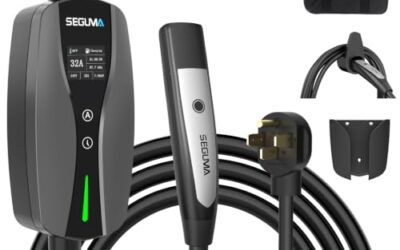
- Supports multiple current settings: 10A, 16A, 20A, 24A, 32A, and 40A
- Compatible with EVs and hybrids that use a standard J1772 connector
- Lists protection against leakage, grounding issues, overvoltage, undervoltage, overcurrent, overcharging, overheating, and short circuits
- Automatically shuts off when the vehicle is fully charged, according to the listing
Cons
- A J1772-to-Tesla adapter is required for Tesla vehicles and is not included
- The listing does not identify a specific vehicle make or model compatibility list
Specifications
| Color | Black |
|---|---|
| Size | 40A ev charger |
| Product Group | Automotive Parts and Accessories |
Best For / Avoid If
Best for buyers prioritizing
- Supports multiple current settings: 10A, 16A, 20A, 24A, 32A, and 40A
- Compatible with EVs and hybrids that use a standard J1772 connector
- Lists protection against leakage, grounding issues, overvoltage, undervoltage, overcurrent, overcharging, overheating, and short circuits
Consider another option if
- A J1772-to-Tesla adapter is required for Tesla vehicles and is not included
- The listing does not identify a specific vehicle make or model compatibility list

Pros
- Supports both 240V Level 2 and 120V Level 1 charging
- Five selectable current settings provide charging flexibility
- Long 25-foot cable and delayed charging feature support home-use convenience
- Product description states that over-voltage, over-current, and short-circuit protection are included
Cons
- Full 240V charging requires a dedicated 240V circuit and NEMA 14-50 connection
- Tesla vehicles require an adapter
- The product does not support vehicles using proprietary charging protocols
Specifications
| Color | Black |
|---|---|
| Size | 25FT |
| Dimensions | 15.55 x 13 x 5.9 inches |
| Product Group | Automotive Parts and Accessories |
Best For / Avoid If
Best for buyers prioritizing
- Supports both 240V Level 2 and 120V Level 1 charging
- Five selectable current settings provide charging flexibility
- Long 25-foot cable and delayed charging feature support home-use convenience
Consider another option if
- Full 240V charging requires a dedicated 240V circuit and NEMA 14-50 connection
- Tesla vehicles require an adapter
- The product does not support vehicles using proprietary charging protocols

Pros
- Long 25-foot charging cable provides extended reach
- WiFi app supports charging control, scheduling, current adjustment, and energy tracking
- J1772 connector is compatible with North American EV and PHEV models
- Weatherproof IP66/NEMA-4 enclosure is suited to indoor or outdoor charging locations
Cons
- Requires a dedicated 50A circuit and a 4-prong NEMA 14-50 outlet
- Tesla charging requires a separate J1772-to-NACS adapter, which is not included
- Smart app features require a 2.4 GHz WiFi network with internet access
Specifications
| Color | Black |
|---|---|
| Size | 40 |
| Dimensions | 4.724409444 x 6.299212592 x 1.968503935 inches |
| Product Group | Automotive Parts and Accessories |
| Binding | Electronics |
Best For / Avoid If
Best for buyers prioritizing
- Long 25-foot charging cable provides extended reach
- WiFi app supports charging control, scheduling, current adjustment, and energy tracking
- J1772 connector is compatible with North American EV and PHEV models
Consider another option if
- Requires a dedicated 50A circuit and a 4-prong NEMA 14-50 outlet
- Tesla charging requires a separate J1772-to-NACS adapter, which is not included
- Smart app features require a 2.4 GHz WiFi network with internet access
Before you buy, it is worth reading How To Calculate Home EV Charging Electricity Use and How To Read An EV Charging Session Receipt.
FAQ
How long does it take to charge an EV at home?
It depends on energy needed and power delivered. Divide kWh needed by kW delivered for an ideal estimate, then account for charging losses and changes in rate.
Can I estimate charging time from miles added?
Miles alone give a rough estimate because energy use varies with the vehicle, speed, weather, and driving conditions. Battery SOC and usable capacity give a more direct calculation.
Will a higher-power home charger always charge faster?
No. The vehicle’s onboard charger, circuit, and EVSE settings can each limit power. The lowest applicable limit sets the maximum AC charging rate.
Does a 240-volt charger charge twice as fast as a 120-volt outlet?
Not necessarily. Voltage is only one part of the power calculation; current limits, vehicle capability, and charging conditions also affect the rate.
Sources and further reading
- Charging Electric Vehicles at Home (Alternative Fuels Data Center): Explains home charging options and considerations for charging at home.
- Procurement and Installation for EV Charging Infrastructure (Alternative Fuels Data Center): Covers planning and installation topics for EV charging infrastructure.