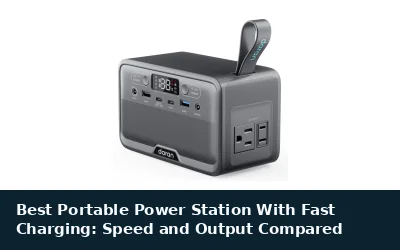

ALLWEI Portable Power Station 300W earns top recommendation for most buyers shopping under $200. Manufacturer specifications confirm durable LiFePO4 battery chemistry rated for 3,000 cycles, 300W continuous output with 600W surge capacity, integrated 60W USB-C Power Delivery, and dual AC plus solar wall recharge capability that restores battery capacity in 2 to 2.5 hours. Buyers seeking maximum watt-hour capacity for DC equipment instead find strong value in EnginStar Portable Power Station 300W 296Wh Solar, which provides 296Wh capacity alongside regulated 12V and 24V DC outputs.

Pros
- Compact 8.15 x 5.83 x 3.90-inch form factor with a built-in handle
- Multiple output types accommodate AC, USB, and DC devices
- Pure sine wave AC output is listed for the 110V outlets
- Built-in lighting adds lantern and emergency signaling functions
Cons
- Solar panel is not included
- The 300W continuous output limits use with higher-power appliances
- Listed recharge times are up to 6 hours from a wall outlet and 8 hours with a 12V car adapter
The MARBERO M823 is a portable power station with a 237Wh lithium battery, 300W continuous output, and 375W peak output. It measures 8.15 x 5.83 x 3.90 inches and weighs 4.6 pounds.
- AC output: Two 110V AC wall outlets
- USB output: Two USB-A QC3.0 ports rated up to 18W, two USB-A ports rated up to 15W, and one USB-C PD port rated up to 18W
- DC output: One DC port rated at 12-16.8V, 10A, with a 14A maximum
- Lighting: Two LED lights, including a top light with two brightness levels and a side light with three brightness levels plus steady, twinkling, and SOS modes
- Charging: Wall charging is listed at up to 6 hours, 12V car-adapter charging at up to 8 hours, and solar charging supports a 16.4-24V, 2.7A maximum solar input. Solar panel sold separately.
- Safety features: Battery Management System with voltage and temperature control, plus short-circuit and overload shutoff features
Specifications
| Color | Brick Red |
|---|---|
| Dimensions | 8.15 x 3.9 x 5.83 inches |
| Weight | 4.6 Pounds |
| Product Group | Lawn & Patio |
| Binding | Tools & Home Improvement |
Verify the current product variation before purchase; specifications may change.
Detailed Review
What stands out in the currently available product data:
- 237Wh battery capacity in a 4.6-pound portable design
- Two AC wall outlets with 300W output and 375W peak capacity
- Includes USB-A QC3.0, USB-A, USB-C PD, and DC output ports
- USB-C port provides up to 18W PD output
- Two built-in LED lights with adjustable brightness and SOS or twinkling modes
- Supports wall, 12V car-adapter, and compatible solar-panel charging
Best For / Avoid If
Best for buyers prioritizing
- Compact 8.15 x 5.83 x 3.90-inch form factor with a built-in handle
- Multiple output types accommodate AC, USB, and DC devices
- Pure sine wave AC output is listed for the 110V outlets
Consider another option if
- Solar panel is not included
- The 300W continuous output limits use with higher-power appliances
- Listed recharge times are up to 6 hours from a wall outlet and 8 hours with a 12V car adapter

Pros
- Pure sine wave AC output is specified for sensitive devices such as laptops
- Multiple output types support simultaneous charging of several devices
- Battery management features include voltage and temperature control, short-circuit protection, overcharge protection, and overload protection
- Includes both a home charger and a car charging cable
Cons
- Solar panel is not included
- The listing provides two different dimension sets: 9 x 5.5 x 7.5 inches and 9.1 x 5 x 7 inches
- The stated service period is limited to 12 months
The EnginStar Portable Power Station has a listed 296Wh capacity and 300W AC output. It includes two 110V pure sine wave AC outlets, regulated 12V/24V DC outputs, USB charging at up to 5V/3.1A, and an 18W USB-C port. The listing states that the unit can charge phones, laptops, cameras, CPAP devices, drones, mini-fridges, and car vacuum cleaners.
Charging options include a wall outlet, a 12V vehicle socket, or a compatible 12–25V solar panel. The solar panel is not included. Maximum charging speed is listed as 65W, with an advertised recharge time of 80% in 2 hours. The package includes the power station, user manual, home charger, and car charger cable. The listed weight is 6.5 pounds. Dimensions are given as both 9 x 5.5 x 7.5 inches and 9.1 x 5 x 7 inches in the published product data.
Specifications
| Color | Black |
|---|---|
| Size | 300W |
| Dimensions | 9.1 x 5 x 7 inches |
| Product Group | Lawn & Patio |
Verify the current product variation before purchase; specifications may change.
Detailed Review
What stands out in the currently available product data:
- 296Wh battery capacity with 300W AC output
- Two 110V pure sine wave AC outlets
- Regulated 12V/24V DC outputs for compatible DC appliances
- Includes USB charging at 5V/3.1A maximum and 18W USB-C output
- Supports wall, 12V vehicle, and compatible 12–25V solar-panel charging
- 65W maximum charging speed with a stated 80% recharge time of 2 hours
Best For / Avoid If
Best for buyers prioritizing
- Pure sine wave AC output is specified for sensitive devices such as laptops
- Multiple output types support simultaneous charging of several devices
- Battery management features include voltage and temperature control, short-circuit protection, overcharge protection, and overload protection
Consider another option if
- Solar panel is not included
- The listing provides two different dimension sets: 9 x 5.5 x 7.5 inches and 9.1 x 5 x 7 inches
- The stated service period is limited to 12 months

Pros
- Compact and portable design for camping, road trips, RV use, and blackout backup
- Multiple output types can charge devices through AC and DC connections
- Pure sine wave AC output is provided through two 110V outlets
- Built-in protection includes overload, over-discharge, overcharge, overheating, and short-circuit safeguards
Cons
- Designed for devices below 300W and may not support electric grills, induction cookers, microwaves, refrigerators, or heaters
- Solar panel is sold separately
- The source recommends periodic battery recharging and storage at 40% to 70% charge in a dry environment
The EnginStar portable power station has a 296Wh lithium battery, a 300W power rating, and dimensions of 9 x 5.5 x 7.5 inches. It weighs 6.5 pounds and includes two 110V pure sine wave AC outlets, three USB outputs including one 18W USB-C port, one 12V car port, one 12V DC port, and one 24V DC 5.5 x 2.1mm barrel port.
Charging options include an AC wall adapter, a car charger, and a 12-25V solar panel sold separately. The source lists a full AC recharge time of seven hours. The power station includes overload, over-discharge, overcharge, overheating, and short-circuit protection.
Package contents include the rechargeable power station, user manual, home charger, and car charger cable. The listed service period is 12 months from the purchase date. The source states that the unit supports devices below 300W and may not support high-demand appliances such as electric grills, induction cookers, microwaves, refrigerators, or heaters.
Specifications
| Color | Green |
|---|---|
| Size | 300W |
| Dimensions | 9 x 5.5 x 7.5 inches |
| Weight | 6.5 Pounds |
| Product Group | Lawn & Patio |
| Binding | Tools & Home Improvement |
Verify the current product variation before purchase; specifications may change.
Detailed Review
What stands out in the currently available product data:
- 296Wh lithium battery capacity in a 9 x 5.5 x 7.5-inch, 6.5-pound enclosure
- Two 110V pure sine wave AC outlets provide AC power output
- Eight total outputs include AC, USB, USB-C, 12V car, 12V DC, and 24V DC barrel ports
- Supports AC wall charging, 12-25V solar-panel charging, and car charging
- USB-C output provides up to 18W
- Includes a home charger, car charger cable, user manual, and 12-month limited service period
Best For / Avoid If
Best for buyers prioritizing
- Compact and portable design for camping, road trips, RV use, and blackout backup
- Multiple output types can charge devices through AC and DC connections
- Pure sine wave AC output is provided through two 110V outlets
Consider another option if
- Designed for devices below 300W and may not support electric grills, induction cookers, microwaves, refrigerators, or heaters
- Solar panel is sold separately
- The source recommends periodic battery recharging and storage at 40% to 70% charge in a dry environment

Pros
- LiFePO4 battery chemistry and a stated 3,000-cycle charge-discharge rating
- Multiple output and recharging options for portable and emergency use
- Includes a 5-year warranty and stated 24/7 customer service
Cons
- The solar panel is sold separately
- The 300W continuous output rating limits it to devices within that power range
- The published specifications list two different sets of dimensions: 9 x 4.7 x 7.8 inches and 9.25 x 5 x 6.81 inches
The ALLWEI portable power station provides a 256Wh capacity, 300W continuous output, and 600W peak surge capacity through a pure sine wave AC outlet. Its LiFePO4 battery is listed with 3,000 charge-discharge cycles, and the built-in battery management system provides six-layer protection.
Output connections include one AC outlet, two DC5521 ports, one 12V car cigarette lighter port, one USB-A port with 18W fast charging, and one USB-C PD port rated up to 60W. The unit supports AC wall charging, 12V car charging, solar charging with a 100W solar panel, and dual AC-plus-solar charging. The solar panel is sold separately.
The power station weighs 6.4 pounds and includes a three-level LED light with SOS mode. Supplied accessories include an AC cable, a DC car cable, and a user manual. The source data lists the dimensions as both 9 x 4.7 x 7.8 inches and 9.25 x 5 x 6.81 inches.
Detailed Review
What stands out in the currently available product data:
- 256Wh LiFePO4 battery with a stated 3,000 charge-discharge cycle rating
- 300W continuous output and 600W peak surge capacity with a pure sine wave AC outlet
- Six output ports, including USB-C PD up to 60W and USB-A fast charging up to 18W
- Supports AC wall, 12V car, solar, and dual AC-plus-solar recharging
- Built-in MPPT controller for solar charging
- Pass-through charging allows the station and connected devices to charge at the same time
Best For / Avoid If
Best for buyers prioritizing
- LiFePO4 battery chemistry and a stated 3,000-cycle charge-discharge rating
- Multiple output and recharging options for portable and emergency use
- Includes a 5-year warranty and stated 24/7 customer service
Consider another option if
- The solar panel is sold separately
- The 300W continuous output rating limits it to devices within that power range
- The published specifications list two different sets of dimensions: 9 x 4.7 x 7.8 inches and 9.25 x 5 x 6.81 inches
Budget Power Station Evaluation Criteria
Portable power stations under $200 serve specific power requirements. Units in this budget segment provide between 237Wh and 296Wh storage capacity with 300W continuous AC inverters. Hardware differences dictate long-term durability, appliance compatibility, and recharge speed.
Battery Chemistry: LiFePO4 Versus Lithium-Ion
Battery chemistry defines operational lifespan. Standard lithium-ion batteries found in budget generators offer 1,000 charge cycles before capacity degrades below 80 percent. Lithium iron phosphate (LiFePO4) cells deliver 3,000 cycles before equivalent degradation occurs. Buyers using power stations daily for mobile work or frequent off-grid travel gain substantial cost advantages from LiFePO4 cells. Occasional emergency users who charge hardware twice annually experience less degradation divergence across chemical types.
Inverter Architecture: Pure Sine Wave Output
All featured units incorporate pure sine wave inverters delivering 110V AC electricity. Modified sine wave inverters produce blocky harmonic electrical waveforms that cause hums, overheat power supplies, or damage sensitive brushless motors. Pure sine wave output matches domestic utility power. Sensitive loads such as CPAP machines, laptop power bricks, camera battery docks, and drone battery bays operate safely on pure sine wave flow.
Surge Capacity Versus Continuous Limits
Motors demand brief surge current during startup. Continuous inverter ratings represent steady-state capacity. Sub-$200 hardware caps continuous draw at 300W. Surge tolerance varies between 375W and 600W across models. Units exceeding peak limits enter immediate protective shutdown through internal battery management systems.
Detailed Reviews: Best Portable Power Stations Under $200
ALLWEI Portable Power Station 300W
ALLWEI Portable Power Station 300W delivers advanced battery chemistry and connectivity in this pricing tier. The unit sells at observed price $128.99, establishing lowest cost among compared options while carrying superior core components.
Manufacturer documentation specifies 256Wh capacity driven by LiFePO4 cells. Battery cells retain health through 3,000 cycles, translating to multi-year service life under daily cycling. AC output handles 300W continuous load with 600W peak surge tolerance. Port selection features single 110V AC port, dual DC5521 barrel ports, single 12V car cigarette lighter port, 18W USB-A quick-charge port, and 60W USB-C Power Delivery port. Fast 60W USB-C port recharges modern laptops directly without bulky AC adapters. Unit weighs 6.4 pounds and measures 9.25 by 5 by 6.81 inches. Recharging flexibility stands out: standard AC wall charging finishes in 3.5 to 4 hours, 12V vehicle charging takes 3.5 to 4 hours, 100W solar panel input completes charge in 4 to 5 hours, and combined dual charging (AC plus solar) drops full replenishment time down to 2 to 2.5 hours. Manufacturer lists pass-through charging capability and 5-year warranty protection.
Drawback: Single AC outlet requires external splitters if running multiple 110V wall plugs simultaneously.
Avoid if: Setup requires running two separate household AC plugs at once without splitters, or continuous storage demands exceed 256Wh.
EnginStar Portable Power Station 300W 296Wh Solar
EnginStar Portable Power Station 300W 296Wh Solar targets field operators needing higher capacity and dual-voltage DC output. Unit retails at observed price $149.99.
Manufacturer documentation confirms 296Wh battery capacity alongside ETL safety certification. Unit measures 9 by 5.5 by 7.5 inches and weighs 6.5 pounds. Inverter provides two 110V pure sine wave AC outlets supporting 300W continuous load. Port array houses eight total outputs: two AC ports, two regulated DC ports offering switchable 12V and 24V stability, fast-charging USB ports (5V/3.1A max), and 18W USB-C port. Regulated DC circuits ensure devices like 12V portable compressor refrigerators and 24V medical CPAP machines receive flat, steady voltage as internal battery cells discharge. Standard lithium-ion battery cells carry 1,000-cycle endurance rating. Recharging takes 65W input, reaching 80 percent charge in 2 hours via wall socket, car 12V outlet, or compatible 12V to 25V solar panels. Package includes home AC charger, 12V car cable, and 12-month limited warranty.
Drawback: USB-C port caps output at 18W, lacking wattage needed to charge modern USB-C laptops directly without standard AC adapter bricks.
Avoid if: Primary usage involves high-power USB-C laptop charging without carrying factory AC wall adapters, or cycle demands exceed standard lithium-ion longevity limits.
EnginStar Solar Generator
EnginStar Solar Generator offers robust DC connectivity configurations for vehicle overlanding and mobile camping. Unit sells at observed price $146.99.
Manufacturer data lists 296Wh capacity (equivalent to 80,000mAh at cell level) matching UL battery safety standards. Dimensions measure 9 by 5.5 by 7.5 inches. Physical interface delivers eight output connections: two pure sine wave 110V AC sockets, three USB ports including one 18W USB-C connection, one 12V cigarette lighter car port, one 12V DC barrel port, and one dedicated 24V DC 5.5×2.1mm barrel port. Dedicated 24V barrel output eliminates need for external DC voltage step-up converters when powering specialized medical electronics or communication gear. Inverter powers loads up to 300W continuous. Recharging through AC wall socket requires 7 hours for full replenishment. Device accepts 12V to 25V solar panel input and 12V automotive charging. Manufacturer includes home charger, car charger cable, and 12-month service coverage.
Drawback: Wall adapter charging requires 7 hours to complete full battery restoration, creating slow turnaround during short stopovers.
Avoid if: Fast off-grid turnaround times are necessary, or intended devices exceed strict 300W cutoff thresholds.
Portable Power Station 300W MARBERO 237Wh Camping
Portable Power Station 300W MARBERO 237Wh Camping represents most compact, transportable design in group. Observed retail price sits at $134.99.
Manufacturer specifications document compact cuboid chassis measuring 8.15 by 5.83 by 3.90 inches with physical weight of 4.6 pounds. Lightweight footprint makes device suitable for backpack transport and vehicle glove-box storage. Internal lithium battery holds 237Wh capacity (64,000mAh at 3.7V). Hardware provides dual 110V AC wall outlets supporting 300W continuous power and 375W peak surge. Output connections include two QC3.0 USB-A ports (up to 18W), two standard USB-A ports (15W max), one 18W USB-C Power Delivery port, and one 12V to 16.8V DC port (10A continuous, 14A max). Integrated chassis lighting includes two distinct LED lantern arrays: top-mounted lantern with two brightness levels, plus side-mounted lighting strip featuring three brightness levels and emergency SOS flashing modes. Recharging through wall adapter requires 6 hours, while 12V car adapter charging takes 8 hours. Solar recharging accepts DC 16.4V to 24V at 2.7A maximum. Battery management system provides active thermal and short-circuit protections.
Drawback: Lowest storage capacity among compared models at 237Wh, paired with slow 8-hour car charging recharge rate.
Avoid if: Power demands require multi-night off-grid endurance, or vehicle charging windows are shorter than 8 hours.
Side-by-Side Specification Comparison
Direct technical metrics help identify hardware best matching specific gear requirements. Below table outlines manufacturer-listed specifications across all four models.
| Model | Observed Price | Capacity | Continuous AC Output | Peak Surge Output | Battery Chemistry | Weight | Warranty / Service |
|---|---|---|---|---|---|---|---|
| ALLWEI Portable Power Station 300W | $128.99 | 256Wh | 300W | 600W | LiFePO4 (3,000 cycles) | 6.4 lbs | 5 Years |
| Portable Power Station 300W MARBERO 237Wh Camping | $134.99 | 237Wh | 300W | 375W | Lithium-ion | 4.6 lbs | Not provided |
| EnginStar Solar Generator | $146.99 | 296Wh | 300W | Not provided | Lithium-ion (1,000 cycles) | 6.5 lbs | 12 Months |
| EnginStar Portable Power Station 300W 296Wh Solar | $149.99 | 296Wh | 300W | Not provided | Lithium-ion (1,000 cycles) | 6.5 lbs | 12 Months |
Port Configurations and Power Delivery
Output ports dictate device versatility. While all four units supply 110V pure sine wave electricity, DC connections diverge sharply across models.
USB-C High-Wattage Protocols
Laptops, tablets, and modern smartphones rely on USB Power Delivery standards. EnginStar units and MARBERO model cap USB-C output at 18W. An 18W output trickle-charges mobile phones and small tablets efficiently. However, modern laptops such as MacBooks and high-end PC ultrabooks require between 45W and 65W to operate while maintaining battery charge. Using 18W USB-C ports on these laptops results in slow charging or net battery drain during active computing. Operating those computers on EnginStar or MARBERO models requires plugging original AC power bricks into 110V wall sockets, converting DC battery power to AC and back to DC, which loses 15 to 20 percent efficiency through inverter conversion. ALLWEI incorporates 60W USB-C Power Delivery port natively, powering laptops through direct DC pathways without inverter activation.
Regulated DC Barrel Outputs
Unregulated DC ports drop voltage as lithium cells discharge. A 12V portable refrigerator connected to unregulated DC port might experience voltage falling from 12.6V down to 10.5V. When refrigerator low-voltage protection circuits detect dropping voltage, compressor shutoff occurs prematurely even when power station holds 40 percent remaining charge. EnginStar Portable Power Station 300W 296Wh Solar incorporates regulated DC circuitry delivering stable 12V and 24V supply lines regardless of internal cell state. Users operating mobile refrigeration units or 24V CPAP setups avoid phantom shutoffs on regulated systems.
Real-World Appliance Runtime Calculations
Usable watt-hours differ from nominal nameplate capacity. Inverter circuits consume internal overhead running cooling fans and conversion logic. Real-world efficiency runs between 80 and 85 percent on AC loads, and 85 to 90 percent on native DC outputs.
CPAP Machine Power Consumption
CPAP machines present standard medical off-grid power applications. Standard CPAP machine without heated humidification draws between 30W and 45W. Running machine through 110V pure sine wave AC port delivers between 5.5 and 7 hours runtime on 296Wh EnginStar station (calculated: 296Wh multiplied by 0.85 efficiency divided by 40W average draw equals 6.2 hours). Running machine via native DC 12V or 24V barrel cable eliminates inverter conversion loss, reducing power consumption to approximately 15W to 25W. On native DC connection, 296Wh EnginStar station powers CPAP unit between 10 and 15 hours, safely covering full night of sleep.
Portable Vehicle Refrigerators
Vehicle 12V compressor coolers pull between 35W and 50W when compressor cycles active. When ambient temperatures moderate and cabinet maintains insulation, compressor duty cycle hovers near 30 to 40 percent, yielding average continuous draw of 15W per hour. ALLWEI 256Wh station powers 12V cooler approximately 14 to 16 hours on DC cigarette lighter socket. EnginStar 296Wh units extend runtimes up to 17 to 19 hours under identical thermal conditions.
Field Electronics and Mobile Gear
Standard smartphone batteries hold roughly 12Wh to 15Wh capacity. Any station in this category provides 15 to 20 full smartphone recharges. Drone flight batteries holding 40Wh recharge 5 to 6 times. Typical 60Wh laptop battery recharges 3.5 to 4 times on 296Wh power station, or roughly 3 times on ALLWEI 256Wh unit.
Solar Recharging Capabilities and Limitations
All featured units operate as solar generators when paired with external solar panels. Panels remain separate purchases and do not ship in retail packages.
Voltage Tolerances and Panel Matching
Exceeding input voltage ratings triggers over-voltage protection circuits or destroys internal charge controllers. EnginStar stations accept solar input voltages between 12V and 25V. MARBERO model requires panels delivering between 16.4V and 24V with 2.7A current limits. ALLWEI incorporates built-in MPPT (Maximum Power Point Tracking) controller optimized for standard 100W solar panels. Panels with open-circuit ratings (Voc) exceeding 25V must not connect to these budget stations. Standard 100W portable folding solar panels operating at 18V working voltage (Vmp) align cleanly with all four stations.
Recharging Timelines in Field Conditions
Real-world solar capture falls below panel laboratory ratings due to atmospheric haze, sun angle, and ambient heat. High-efficiency 100W solar panel typically delivers 65W to 75W real-world output during clear midday sunlight. ALLWEI unit replenishes full capacity in 4 to 5 hours under optimal solar conditions. EnginStar stations require roughly 5 to 6 hours under equivalent sunlight. MARBERO unit, capped at 2.7A input, replenishes across 6 to 7 hours of direct sun exposure.
Who Should Skip Sub-$200 Power Stations
Budget power stations under $200 provide reliable low-draw current but fail completely when applied to high-demand appliances. Buyers intending to run following devices must avoid sub-$200 power stations:
- Heating and cooking appliances: Electric griddles, hot plates, induction cookers, electric kettles, and standard microwaves draw between 800W and 1,800W. All four featured units cut off power instantly upon detecting loads above 300W.
- Motor-driven power tools: Circular saws, reciprocating saws, and large workshop air compressors exhibit heavy inductive startup spikes exceeding 1,200W, instantly tripping 375W to 600W surge thresholds.
- Full-size residential refrigerators: Home refrigerators require heavy compressor startup surge current (often 1,000W to 1,500W surge) that overwhelms budget inverters.
- Space heaters and hair dryers: Pure resistive heating coils pull 1,500W continuously.
Buyers operating heavy appliances must skip 300W hardware entirely. Correct equipment category requires 1,000W to 2,000W continuous inverter ratings paired with minimum 1,000Wh battery storage capacity.
Safety, Storage, and Battery Longevity Guidelines
Maintaining lithium battery stations requires specific operating habits to avoid capacity loss or premature cell failure.
Temperature Limits
Manufacturer guidelines recommend operating and storing battery stations between 40 degrees Fahrenheit and 100 degrees Fahrenheit (4 degrees Celsius to 35 degrees Celsius). Never leave power stations inside closed vehicle interiors parked in direct summer sunlight, where cabin temperatures exceed 130 degrees Fahrenheit. Excessive heat accelerates cell degradation and triggers thermal cutoffs. Avoid charging lithium batteries in sub-freezing temperatures below 32 degrees Fahrenheit (0 degrees Celsius), as charging cold cells can cause internal lithium plating and permanent capacity degradation.
Long-Term Storage Protocols
Storing lithium power stations at zero percent capacity causes cells to enter deep-discharge sleep states, frequently rendering packs incapable of accepting charge. Storing stations continuously at 100 percent state of charge under warm ambient conditions strains cell chemistry. Manufacturer maintenance procedures outline following storage steps:
- Discharge or charge battery pack to approximately 40 to 70 percent capacity prior to seasonal storage.
- Store station in dry environment away from moisture and direct sunlight.
- Retrieve unit every 2 to 3 months to inspect cell level, cycling and recharging battery back to recommended storage threshold.
For related guidance on this topic, see Best Portable Power Station for Car Camping and Best Portable Power Station Under $750.
Final Purchase Recommendation
Choosing right portable power station under $200 depends on specific runtime, weight, and port requirements:
Select ALLWEI Portable Power Station 300W for primary all-round camping, road trip, and emergency duties. Superior LiFePO4 battery chemistry delivering 3,000 cycles, 60W USB-C Power Delivery, 600W surge tolerance, and fast dual AC plus solar recharging make unit clearest technical value under $200 budget limits.
Select EnginStar Portable Power Station 300W 296Wh Solar or EnginStar Solar Generator when application prioritizes maximum capacity (296Wh) and specialized 12V or 24V regulated DC barrel connections for running CPAP medical equipment or mobile refrigeration units without external voltage converters.
Select Portable Power Station 300W MARBERO 237Wh Camping exclusively when packing weight takes absolute priority. Weighing 4.6 pounds with built-in multi-mode LED lanterns, device serves foot travel, hiking base camps, and localized emergency lighting where low carry weight outweighs slower recharge speeds.