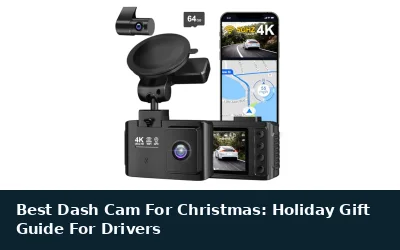
Finding the right vehicle camera on Amazon means sorting through dozens of models with varying sensor hardware, channel configurations, and wiring requirements. Whether you need a discreet front-facing unit, complete dual-channel road recording, or multi-angle interior coverage for rideshare driving, identifying reliable hardware before purchase is critical. In this guide, we break down ten top-rated choices across different configurations and price points, detailing exact technical capabilities, mounting formats, and storage requirements.
Before you buy, it is worth reading Best Front And Rear Dash Cam Cameras, Best Dashcam and Best Dash Cam With Multiple Cameras.
Quick Verdict: Leading Picks by Use Case
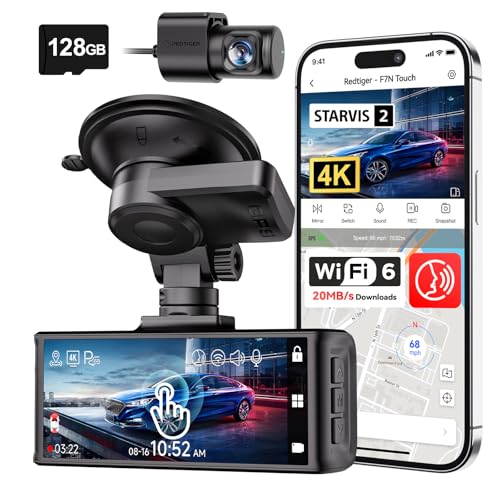
- Best Dual-Channel with Touchscreen: REDTIGER 4K STARVIS 2 Dashcam Front Rear – Combines a Sony STARVIS 2 front sensor, voice commands, and responsive touch controls.
- Best Budget Dual-Channel: Dash Cam Front and Rear: 4K+2.5K Dual Channel Dash – Offers 4K front and 2.5K rear recording at an accessible entry price.
- Best Compact Stealth / Screen-Free: Garmin Dash Cam™ Mini 3, Ultracompact 1080p HD – Key-sized footprint featuring an integrated Garmin Clarity polarizing filter.
- Best 3-Channel for Rideshare & Hot Climates: 70mai 4K Dash Cam Front and Rear Inside – Triple-lens protection featuring Wi-Fi 6, switchable interior IR LEDs, and a temperature-resilient supercapacitor.
- Best Full 360-Degree 4-Channel Coverage: Icesky 4K Dash Cam Front and Rear Left Right – Captures front, rear, and both vehicle flanks simultaneously with fast Wi-Fi 6 downloads.
How We Chose
Our editorial evaluation examined manufacturer-documented technical specifications, power architectures, optical components, and hardware configurations. We assessed each device across five primary criteria:
- Optical Hardware and Sensor Pedigree: We analyzed aperture ratings, stated image sensors (such as Sony STARVIS 2), wide dynamic range (WDR/HDR) implementations, and lens fields of view. Note that advertised resolution alone does not guarantee legible license plates; exposure control, motion blur suppression, dynamic range in high-contrast headlight glare, and video compression bitrates dictate practical legibility.
- Power Source Architecture: We categorized units by their internal power reserve, specifically supercapacitors versus standard lithium-ion batteries, to assess performance in high-heat summer environments and long-term parking surveillance.
- Channel Count and Cabin Coverage: We mapped out coverage tradeoffs between single (front), dual (front/rear), triple (front/cabin/rear), and quadruple (front/rear/left/right) setups, accounting for wiring complexity and cable routing.
- Connectivity and Media Transfer: We evaluated Wi-Fi protocols (2.4GHz, 5GHz, and Wi-Fi 6), companion mobile app ecosystems, and integrated GPS logging for route and speed verification.
- Included Accessories and Total Cost of Ownership: We checked whether memory cards were included, verified maximum microSD card expansion capacity, and verified separate accessory requirements such as hardwire kits.

Pros
- Four-camera coverage records the front, rear, and both sides of the vehicle
- A 64GB memory card is included for immediate recording
- GPS and 5GHz Wi-Fi support app-based video management and location tracking
- The G-sensor automatically locks footage when sudden shakes or collisions are detected
Cons
- The parking monitoring function requires a separately purchased hardwire kit
Specifications
| Color | Gold |
|---|---|
| Dimensions | 1.5 x 2.2 x 6.3 inches |
| Product Group | Electronics |
Best For / Avoid If
Best for buyers prioritizing
- Four-camera coverage records the front, rear, and both sides of the vehicle
- A 64GB memory card is included for immediate recording
- GPS and 5GHz Wi-Fi support app-based video management and location tracking
Consider another option if
- The parking monitoring function requires a separately purchased hardwire kit

Pros
- Small form factor can provide a discreet windshield-mounted camera
- Wide field of view and 1080p recording are specified for bright and low-light conditions
- Voice control supports English, German, French, Spanish, Italian, and Swedish
- Optional Vault features support online clip storage, sharing, and remote live view
Cons
- Vault storage, live view, and parking guard require a paid subscription and additional connection or power conditions
- Nonpaid users can only view and download files when near the dash cam
- Use of the device may be regulated or prohibited in some jurisdictions
Specifications
| Color | Black |
|---|---|
| Dimensions | 2 x 0.8 x 1.3 inches |
| Weight | 0.06875 Pounds |
| Product Group | Wireless |
| Binding | Electronics |
Best For / Avoid If
Best for buyers prioritizing
- Small form factor can provide a discreet windshield-mounted camera
- Wide field of view and 1080p recording are specified for bright and low-light conditions
- Voice control supports English, German, French, Spanish, Italian, and Swedish
Consider another option if
- Vault storage, live view, and parking guard require a paid subscription and additional connection or power conditions
- Nonpaid users can only view and download files when near the dash cam
- Use of the device may be regulated or prohibited in some jurisdictions
Pros
- High-resolution 4K front and 1080P rear recording
- Multiple control options, including voice commands, touchscreen, and physical buttons
- Built-in GPS and wireless smartphone connectivity
- Includes a 128GB card and supports automatic loop recording
- Includes an 18-month guarantee and 24/7 customer support
Cons
- Parking monitoring requires a separate hardwire kit
- Rear camera resolution is limited to 1080P compared with the 4K front camera
Specifications
| Color | Black |
|---|---|
| Dimensions | 2.362204722 x 1.2598425184 x 3.8188976339 inches |
| Weight | 0.25 pounds |
| Product Group | Wireless |
| Binding | Electronics |
Best For / Avoid If
Best for buyers prioritizing
- High-resolution 4K front and 1080P rear recording
- Multiple control options, including voice commands, touchscreen, and physical buttons
- Built-in GPS and wireless smartphone connectivity
Consider another option if
- Parking monitoring requires a separate hardwire kit
- Rear camera resolution is limited to 1080P compared with the 4K front camera

Pros
- High-resolution 4K front and 1080P rear recording
- STARVIS 2 sensor with WDR and HDR features for varied lighting conditions
- Supercapacitor design is specified as more heat-resistant than a lithium battery
- Includes an 18-month warranty and customer support
Cons
- A hardwire kit is needed for the listed parking modes
Specifications
| Color | black |
|---|---|
| Size | F7NP-128GB SD Card |
| Dimensions | 3.7401574765 x 1.46062991977 x 0.79133858187 inches |
| Weight | 0.25 Pounds |
| Product Group | Electronics |
| Binding | Electronics |
Best For / Avoid If
Best for buyers prioritizing
- High-resolution 4K front and 1080P rear recording
- STARVIS 2 sensor with WDR and HDR features for varied lighting conditions
- Supercapacitor design is specified as more heat-resistant than a lithium battery
Consider another option if
- A hardwire kit is needed for the listed parking modes
Feature Comparison Table
The table below summarizes verified manufacturer specifications across all ten models. Where data was not specified in official manufacturer documentation, it is listed as “Not provided.”
| Model | Channels | Front Resolution | GPS | Wi-Fi Band | Included Card | Screen Size |
|---|---|---|---|---|---|---|
| REDTIGER 4K STARVIS 2 Dashcam Front Rear | 2-CH | 4K UHD | Built-in | 5.8GHz | 128GB | Touchscreen |
| Dash Cam Front and Rear: 4K+2.5K Dual Channel Dash | 2-CH | 4K UHD | Built-in | 5GHz | 64GB | 2.0-inch IPS |
| galphi 4K Dash Cam Front, 5GHz WiFi | 1-CH | 4K UHD | – | 5GHz | 32GB | None (Screen-free) |
| 70mai 4K Dash Cam Front and Rear Inside | 3-CH | 4K UHD | Built-in (5-mode) | Wi-Fi 6 | 64GB | Integrated display |
| Dash Cam Front and Rear Inside 3 Channel | 3-CH | 4K UHD | – | Wi-Fi | 32GB | Integrated display |
| 4K Dash Cam Front and Rear | 3-CH | 4K UHD | Built-in | 5.8GHz / 2.4GHz | 128GB | 3.16-inch IPS |
| REDTIGER F7NP 4K Dash Cam Front Rear | 2-CH | 4K UHD | Built-in | 5.8GHz | Yes (capacity not specified) | Integrated display |
| XYGCACO 4 Channel 360° Dash Cam Front and Rear | 4-CH | 4K UHD | Built-in | 5GHz | 64GB | 3.0-inch IPS |
| Garmin Dash Cam™ Mini 3, Ultracompact 1080p HD | 1-CH | 1080P HD | Via App | Wi-Fi / Bluetooth | Not included | None (Screen-free) |
| Icesky 4K Dash Cam Front and Rear Left Right | 4-CH | 4K UHD | Built-in | 5.8GHz Wi-Fi 6 | 128GB | 3.0-inch IPS |
Compatibility and Buying Advice: How to Choose
Before buying any vehicle camera on Amazon, understand how channel configurations, memory cards, power sources, and local regulations impact everyday ownership.
1. Channel Configurations and Cable Routing Tradeoffs
- Single-Channel (Front-Only): Easiest setup. Requires tucking one power cable along the windshield headliner down to an auxiliary 12V or USB port. However, it leaves rear collisions and side impacts unmonitored.
- Dual-Channel (Front and Rear): Captures tailgating, rear-end impacts, and backing incidents. Requires routing a long coaxial or USB-C video cable through the headliner, side trim pillars, and rear tailgate weatherstripping. Avoid obstructing side curtain airbags during installation.
- Three-Channel (Front, Cabin, Rear): Adds an inward-facing camera. Ideal for rideshare drivers needing evidence of passenger interactions, vandalism, or in-cabin disturbances. Cabin cameras require infrared (IR) LEDs to capture clear black-and-white video in dark interiors.
- Four-Channel (360° Perimeter): Covers front, rear, driver side, and passenger side windows. Excellent for hit-and-run monitoring and tight city parking, but increases cable clutter, windshield footprint, and write demands on the memory card.
2. Video Quality: Why Resolution Alone Is Not Enough
A camera labeled “4K” may still produce unreadable license plates if its image processing cannot handle dynamic road environments. Key factors determining plate legibility include:
- Dynamic Range (HDR/WDR): High Dynamic Range hardware balances bright headlights and dark street environments, preventing reflective license plates from washing out into blank white rectangles.
- Sensor Size and Brand: Premium image sensors, such as Sony STARVIS 2, offer higher signal-to-noise ratios in low-light settings compared to generic optical sensors.
- Lens Polarization: Polarizing filters (like the Garmin Clarity lens on the Garmin Mini 3) cut dashboard glare reflected on the inside of the windshield.
3. Memory Card Management and Dash Cam Storage
Dash cams constantly overwrite data via loop recording, subjecting flash memory to extreme write cycles. To avoid corrupted files and camera reboot loops:
- Select High-Endurance Cards: Standard consumer microSD cards are not rated for continuous overwriting. Use cards labeled “High Endurance” or “Max Endurance” featuring TLC or MLC flash memory.
- Format Regularly: Format the card inside the camera every 4 to 8 weeks to clear out non-critical event locks and maintain write speeds.
- Understand Loop Recording and G-Sensors: When an impact occurs, the G-sensor moves that video segment to a protected folder. If the sensor sensitivity is set too high, rough roads and potholes will fill the card with locked files, preventing new loop recording until manually formatted.
4. Power Delivery, Parking Mode, and Battery Drain
Understanding how your vehicle delivers power is essential when setting up parking monitoring:
- Switched vs. Always-On Outlets: Many vehicle 12V accessory sockets turn off when the ignition is switched off. However, some domestic and European vehicles supply continuous 12V power to the socket. Leaving a dash cam plugged into an unswitched outlet will discharge the starter battery over time.
- Supercapacitors vs. Lithium Batteries: Lithium batteries can swell, degrade, or fail when exposed to hot windshields in direct sunlight. Supercapacitors hold only enough charge to safely save the last file when power is cut, providing significantly higher thermal stability and extended lifespans.
- Hardwire Kits and Low-Voltage Cutoffs: To use 24-hour parking surveillance safely, install a dedicated hardwire kit tied into the vehicle fuse box (one accessory circuit, one constant 12V battery circuit, and ground). Ensure the kit includes a built-in low-voltage cutoff switch (typically 11.8V or 12.0V) to prevent vehicle battery drain.
5. Privacy and Legal Considerations
Dash cam installation laws vary by jurisdiction. Many regions prohibit mounting devices within the windshield wiper sweep or direct driver field of vision; mounting behind or beside the rearview mirror generally complies with visibility regulations. For three-channel and interior-recording cameras, two-party consent wiretapping laws may require notifying passengers that audio and video are being recorded inside the vehicle.
Frequently Asked Questions
Do dash cams record continuously when the car is turned off?
Only if wired for parking surveillance. Standard 12V auxiliary cables power down with the vehicle ignition. Continuous or motion-activated parking recording requires a dedicated hardwire kit connected to a constant 12V fuse or a standalone dash cam battery pack.
Can I use any microSD card in a 4K dash cam?
No. Multi-channel 4K dash cams generate substantial data streams requiring U3 or V30 write speeds. Standard consumer cards fail quickly under continuous write cycles. Always choose a dedicated high-endurance microSD card to prevent video corruption.
What is the benefit of a supercapacitor over a standard battery?
Supercapacitors offer far wider operating temperature ranges (typically 14°F to 140°F or wider) and do not degrade, swell, or pose thermal runaway hazards like lithium-ion batteries when subjected to direct summer sunlight on a windshield.
Why does my dash cam stop recording or say the SD card is full?
While loop recording automatically overwrites unlocked clips, sudden bumps can trigger the G-sensor to lock files into an emergency folder. Over time, protected event clips fill the memory card, leaving no space for new loop footage. Lowering the G-sensor sensitivity and periodically formatting the card resolves this issue.
Final Verdict
The ideal vehicle camera setup depends on your route conditions, parking environment, and cabin surveillance requirements:
- If you prioritize balanced front and rear video with a responsive touchscreen and modern STARVIS 2 sensor hardware, the REDTIGER 4K STARVIS 2 Dashcam Front Rear is a well-rounded choice.
- For rideshare drivers operating in hot summer climates, the 70mai 4K Dash Cam Front and Rear Inside provides essential cabin IR monitoring, fast Wi-Fi 6 offloading, and supercapacitor reliability.
- If zero windshield clutter and discreet operation are your main priorities, the screen-free Garmin Dash Cam™ Mini 3, Ultracompact 1080p HD delivers reliable front-end video backed by an integrated polarizing lens.
Before purchasing, check whether your vehicle requires an optional hardwire kit for parking monitoring, and verify that you have a compatible high-endurance memory card ready for reliable everyday operation.