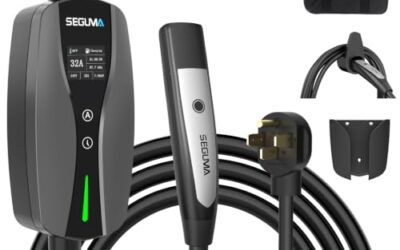
The EVIQO Level 2 EV charger review points to a practical fit for drivers who have a compatible 240V NEMA 14-50 outlet and want app controls: EVIQO Level 2 EV Charger J1772 40A NEMA 14-50. It delivers up to 40A on a dedicated 50A circuit, and its 25-foot charging cable can reach farther across a garage than a short lead. Its main limitation is that it needs the right outlet and electrical circuit, not just any 240V receptacle.

Pros
- Long 25-foot charging cable provides extended reach
- WiFi app supports charging control, scheduling, current adjustment, and energy tracking
- J1772 connector is compatible with North American EV and PHEV models
- Weatherproof IP66/NEMA-4 enclosure is suited to indoor or outdoor charging locations
Cons
- Requires a dedicated 50A circuit and a 4-prong NEMA 14-50 outlet
- Tesla charging requires a separate J1772-to-NACS adapter, which is not included
- Smart app features require a 2.4 GHz WiFi network with internet access
The EVIQO Level 2 EV Charger is a plug-in 240V charging station with a maximum output of 40A, a SAE J1772 connector, a 37-inch NEMA 14-50 input cable, and a 25-foot charging cable. The unit requires a dedicated 50A circuit and a 4-prong NEMA 14-50 outlet.
Its smartphone app supports start/stop control, current settings from 6A to 40A, charging schedules, reminders, and consumption or cost tracking. App features require a 2.4 GHz WiFi network with internet access. The charger is listed as compatible with North American EV and PHEV models and can be used with Tesla vehicles when paired with a J1772-to-NACS adapter, which is not included.
The enclosure is rated IP66/NEMA-4 for weather protection, and the product listing identifies UL, ETL, FCC, and Energy Star certifications. Additional features include a fluorescent connector holster, a side reset button, and remote software updates.
Specifications
| Color | Black |
|---|---|
| Size | 40 |
| Dimensions | 4.724409444 x 6.299212592 x 1.968503935 inches |
| Product Group | Automotive Parts and Accessories |
| Binding | Electronics |
Detailed Review
Key features:
- Provides up to 40A output on a dedicated 50A, 240V circuit
- Includes a 25-foot charging cable and 37-inch NEMA 14-50 input cable
- Supports start/stop control, current settings from 6A to 40A, scheduling, and consumption tracking through a smartphone app
- Works with North American EV and PHEV models using a J1772 connector
- IP66/NEMA-4 weatherproof enclosure is listed with UL, ETL, FCC, and Energy Star certifications
- Includes a fluorescent holster for higher-visibility connector storage
Best For / Avoid If
Best for buyers prioritizing
- Long 25-foot charging cable provides extended reach
- WiFi app supports charging control, scheduling, current adjustment, and energy tracking
- J1772 connector is compatible with North American EV and PHEV models
Consider another option if
- Requires a dedicated 50A circuit and a 4-prong NEMA 14-50 outlet
- Tesla charging requires a separate J1772-to-NACS adapter, which is not included
- Smart app features require a 2.4 GHz WiFi network with internet access
EVIQO Level 2 EV Charger J1772 40A NEMA 14-50 review
Best for: A home EV owner with a compatible J1772 vehicle, a properly installed NEMA 14-50 outlet, and a reason to schedule or monitor charging by phone. The charger connects to the vehicle through a J1772 plug and uses a 14-50 plug at the outlet end.
Skip it if: Your charging spot lacks a suitable 14-50 receptacle, your electrical setup cannot support the required dedicated circuit, or you need a charger that connects directly to a Tesla NACS inlet. The product information calls for a dedicated 50A, 240V circuit and says Tesla drivers need a separate J1772-to-NACS adapter, which is not included.
CarTechTalk may earn a commission from qualifying purchases made through links in this article. That does not change the compatibility requirements or the tradeoffs described here.
EVIQO lists adjustable charging current from 6A to 40A, controlled through its smartphone app. That range gives a household a way to reduce the charger’s selected current when a vehicle or home charging plan calls for less than maximum output. It does not increase the vehicle’s own charging limit: the car and charger both affect the power the vehicle accepts.
The maker says the unit can fully recharge most EVs overnight. Treat that as a broad manufacturer claim, not a promise for every battery or starting charge level. Battery size, vehicle charging limits, selected current, and charging conditions affect elapsed time. For a practical estimate using your vehicle’s needs, see how to estimate home ev charging time.
Outlet, circuit, and vehicle compatibility
The 14-50 plug is a key purchase boundary. EVIQO calls for an EV-grade, four-prong NEMA 14-50 outlet on a dedicated 50A, 240V circuit. A dryer outlet is not an acceptable substitute just because it may look similar. Outlet shape alone does not establish that the receptacle, wiring, breaker, or installation suits this charger.
Before ordering, compare the vehicle’s charge-port connector with the charger’s J1772 connector. The product description says it works with North American EVs and plug-in hybrids that use J1772. For Tesla, it requires a J1772-to-NACS adapter, sold separately. Check that any adapter is appropriate for the vehicle and charging use; the charger itself does not change connector standards.
Plug-in installation does not mean the electrical work can be skipped. The listed setup still depends on a suitable outlet and circuit. If the outlet is new, its rating is uncertain, or the existing circuit serves other equipment, have a qualified electrician assess the installation and local requirements before charging. Do not adapt a dryer receptacle or use an extension arrangement as a substitute for the specified setup.
That distinction matters for ownership cost. A driver who already has an appropriate outlet may avoid having an electrician hardwire a wall unit, but a household without one may need electrical work before the charger is usable. The product’s “no electrician” wording describes its plug-in form, not a guarantee that every home is ready for installation.
Charging reach and everyday placement
The input cable is listed at 37 inches, while the vehicle charging cable measures 25 feet. That reach can help when the outlet sits at one side of a garage or when the vehicle parks in different positions. Measure the actual route from outlet to charge port, including the path around obstacles. A cable that reaches only when stretched across a walkway can create a trip hazard or strain the connection.
The unit is wall-mounted and includes a holster for storing its connector. The new holster is described as fluorescent and intended to glow after exposure to natural or artificial light. That can make the storage point easier to spot in dim conditions, though its glow depends on exposure and does not replace adequate garage lighting.
The enclosure is described by EVIQO as IP66 and NEMA 4 weatherproof, with UL, ETL, FCC, and Energy Star certifications. Those are manufacturer-listed claims. Weather resistance can matter for an outdoor mounting location, but it does not remove the need to follow installation instructions, protect the outlet connection as required, and choose a location suited to the equipment. Ask an electrician about any outdoor installation details that depend on local code or the property.
App controls, WiFi, and charging schedules
The app supports start and stop controls, current selection from 6A to 40A, charging reminders, and consumption and cost tracking. It also offers charging schedules, which may help owners shift charging to off-peak hours when their utility plan has time-based rates. Savings are not automatic: they depend on the rate plan, schedule, charging needs, and whether the vehicle follows the intended timing.
App functions require a 2.4 GHz WiFi network with internet access. A home network that offers only 5 GHz, has weak signal in the garage, or cannot reach a basement installation may limit remote controls and tracking. The product description mentions an enhanced WiFi antenna, but that does not establish signal quality in every building. Check network coverage at the planned mounting point before relying on app scheduling.
EVIQO also lists remote software updates and a side reset button that lets the owner restart the unit without opening its enclosure or unplugging it. These features may make routine control and recovery more convenient. They do not replace the charger’s installation instructions or professional service if the unit, outlet, or circuit shows a fault.
What the 40A rating means for a home
Maximum output is not the same as guaranteed vehicle charging speed. The charger can supply up to 40A when used with the specified circuit, but the vehicle’s onboard charger and battery-management settings can limit how much power it accepts. The car may also reduce charging power under some conditions. Compare the charger’s output with the vehicle’s AC charging limit before paying for capacity the car cannot use.
Current adjustment is useful when the owner wants to set a lower level, but it should not be treated as a way to compensate for an unsuitable outlet or undersized circuit. Follow the charger instructions and have a qualified electrician determine whether the home circuit and receptacle meet the required setup. If the home needs a permanent hardwired installation or a higher-current unit, compare other formats such as the WOLFBOX WE50 hardwired home charger, while checking its installation requirements separately.
Charging may slow as a battery approaches a high state of charge, and heat can also affect charging behavior. The charger’s maximum rating therefore cannot predict a fixed time to a full battery. CarTechTalk explains these factors in why EV charging slows down after 80 percent and how hot weather affects EV charging speed.
Who should buy it, and who should keep looking
This EVIQO is a sensible shortlist choice for a driver whose vehicle accepts J1772 charging, whose parking spot can accommodate a wall-mounted unit, and whose home already has or can support the required 14-50 setup. The long vehicle cable, adjustable current, and scheduled app control address concrete home-charging needs. Its value depends on those needs, not on the feature list alone.
It is a weaker fit for someone who needs a direct NACS connector, does not have reliable 2.4 GHz WiFi but expects app features to work, or cannot install the specified outlet and circuit. Tesla owners should include the cost and compatibility of a separate adapter in their decision. A buyer who mainly wants basic charging and does not need app scheduling may also prefer to compare simpler chargers, provided they meet the vehicle and electrical requirements.
Do not buy any charger in this guide if you cannot establish that your vehicle connector and home electrical setup match the charger. Start with the vehicle manual and a qualified electrician, then compare units that suit the confirmed connector, circuit, mounting location, and cable reach. This avoids paying for a charger that cannot be safely or conveniently used at your home.
Verdict
EVIQO Level 2 EV Charger J1772 40A NEMA 14-50 makes most sense for a J1772 vehicle owner with a suitable 14-50 outlet and a reason to use app scheduling or current control. Its 25-foot charging cable adds useful placement flexibility, while the separate Tesla adapter and 2.4 GHz WiFi requirement narrow its fit. The decisive check is the home circuit: if the specified outlet and dedicated circuit are not ready, factor in electrical work before choosing this plug-in charger.
Sources and further reading
- Charging Electric Vehicles at Home (Alternative Fuels Data Center): Guidance on home charging equipment and installation considerations.
- Procurement and Installation for EV Charging Infrastructure (Alternative Fuels Data Center): Information on planning and installing EV charging infrastructure.