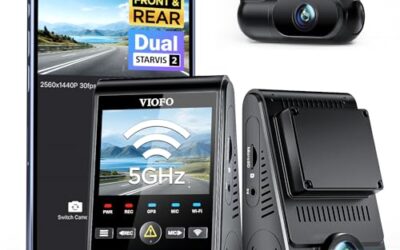
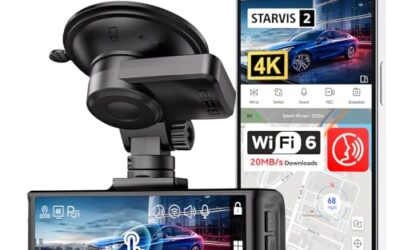
For drivers comparing a Blackvue dash cam with these available alternatives, VIOFO A229 Plus Dash Cam Front and Rear is the better fit for most buyers who want front and rear coverage at a lower price tier. It records both channels at 1440p and offers HDR, GPS, voice control, and three parking modes; choose VIOFO A229 Pro 4K HDR Dash Cam Front and Rear if sharper front-camera resolution matters more than cost.

Pros
- Dual STARVIS 2 sensors are specified for both front and rear recording
- Front and rear HDR recording is supported
- Includes multiple satellite positioning systems and 5GHz Wi-Fi
- Provides three selectable 24-hour parking-mode options
- Rear and interior camera designs are described as compact for flexible installation
Cons
- The front camera's 1440P 60fps mode is unavailable when HDR is enabled
- A microSD card is not included
- The HK4 hardwire cable required for the listed parking modes must be purchased separately
Specifications
| Color | A229 Plus 2CH |
|---|---|
| Dimensions | 2.362204722 x 3.8582677126 x 1.7716535415 inches |
| Product Group | Wireless |
Best For / Avoid If
Best for buyers prioritizing
- Dual STARVIS 2 sensors are specified for both front and rear recording
- Front and rear HDR recording is supported
- Includes multiple satellite positioning systems and 5GHz Wi-Fi
Consider another option if
- The front camera's 1440P 60fps mode is unavailable when HDR is enabled
- A microSD card is not included
- The HK4 hardwire cable required for the listed parking modes must be purchased separately
Pros
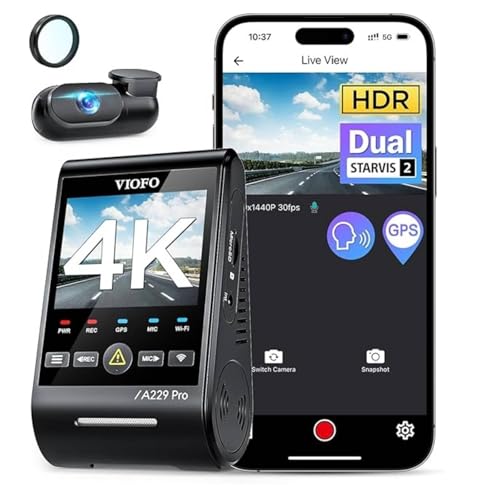
- Dual-channel 4K/2K coverage with a dedicated STARVIS 2 sensor for each camera
- HDR on both front and rear channels, which the manufacturer states supports license plate readability in high-contrast scenes
- 5GHz Wi-Fi and the VIOFO app allow wireless configuration, video previews, and file sharing
- Multi-constellation GPS support (GPS, BEIDOU, GALILEO, GLONASS) adds vehicle location, speed, and timestamp data to recordings
- Supercapacitor design eliminates batteries and is rated for 5°F to 149°F operation
Cons
- No microSD card is included; storage must be purchased separately
- Parking modes require the HK4 Acc hardwire kit, which is not included in the package (sold separately)
- Standard 6-meter rear cable may not reach in larger vehicles; longer 8M/10M cables are offered only through VIOFO's official website
Best For / Avoid If
Best for buyers prioritizing
- Dual-channel 4K/2K coverage with a dedicated STARVIS 2 sensor for each camera
- HDR on both front and rear channels, which the manufacturer states supports license plate readability in high-contrast scenes
- 5GHz Wi-Fi and the VIOFO app allow wireless configuration, video previews, and file sharing
Consider another option if
- No microSD card is included; storage must be purchased separately
- Parking modes require the HK4 Acc hardwire kit, which is not included in the package (sold separately)
- Standard 6-meter rear cable may not reach in larger vehicles; longer 8M/10M cables are offered only through VIOFO's official website
Both VIOFO cameras are dual-channel systems, so each records the road ahead and behind. Neither product description identifies a cabin camera. Rideshare drivers who need interior footage should choose a three-channel model instead, rather than treating rear coverage as cabin coverage.
| Model | Front and rear resolution | HDR | GPS | Parking modes |
|---|---|---|---|---|
| VIOFO A229 Plus Dash Cam Front and Rear | 1440p front and rear, front up to 60 fps | Front and rear | GPS, BeiDou, Galileo, GLONASS | Auto event detection, time lapse, low bitrate |
| VIOFO A229 Pro 4K HDR Dash Cam Front and Rear | 2160p front, 1440p rear | Front and rear | GPS, BeiDou, Galileo, GLONASS | Auto event detection, time lapse, low bitrate |
VIOFO lists 5 GHz Wi-Fi and app control for both models. The descriptions do not identify supported phone platforms, maximum memory-card capacity, included card, field of view, screen, mount type, or transfer speed. Those omissions matter if you have a specific phone, storage card, windshield layout, or cable route in mind.
CarTechTalk may earn a commission from qualifying purchases through links on this page. The recommendations below reflect the features and tradeoffs described for each camera, not a guarantee that either will capture every plate or event.
VIOFO A229 Plus: lower-cost front and rear coverage
Best for: Drivers who want two-channel coverage, HDR on both cameras, and parking options without paying for a 4K front channel. Both cameras record at 1440p. The front camera can reach 60 fps with HDR off, which gives drivers a choice between higher frame rate and HDR operation.
The product description says dual STARVIS 2 IMX675 sensors and HDR help manage dark and bright areas. That is a manufacturer claim, not a promise of readable plates in every scene. Resolution alone cannot establish plate legibility: motion, exposure, glare, compression, distance, and lighting also affect recorded detail.
GPS data can add location, speed, and time information during playback. Four satellite systems are supported, while 5 GHz Wi-Fi and VIOFO app access allow video preview, downloads, and settings changes. The phone operating systems and exact wireless transfer rates are not identified, so buyers should check those details if app access is a deciding factor.
Parking options include buffered auto event detection, time lapse, and low-bitrate recording. The buffered event mode saves 15 seconds before and 30 seconds after a detected event, according to the product description. The HK4 hardwire cable is sold separately. The description does not document low-voltage protection, so do not assume parking operation will protect a vehicle battery from discharge.
Tradeoff: The front camera cannot record 1440p at 60 fps while HDR is enabled. Its front resolution is also lower than the Pro’s 4K front channel. Skip this model if 4K front recording is your priority, or if you need a cabin camera or a confirmed maximum card capacity before purchase.
VIOFO A229 Pro: 4K front detail priority
Best for: Drivers who want a 4K front channel while keeping 1440p rear recording. The Pro pairs an IMX678 front sensor with an IMX675 rear sensor, and its HDR feature applies to both channels. The manufacturer describes HDR as balancing bright highlights and shadows; actual plate readability still depends on scene conditions and recording settings.
GPS can place location, speed, and timestamp information alongside video playback. The camera supports 5 GHz Wi-Fi and VIOFO app control. Its listed features include loop recording and automatic event locking after detected shaking or collision, helping protect selected clips from routine overwrite. Event protection is not a substitute for promptly saving important footage elsewhere.
Parking choices match the Plus: buffered auto event detection, time lapse, and low bitrate. The description says event clips include 15 seconds before and 30 seconds after detection. An HK4 ACC hardwire cable is not included. Low-voltage protection is not documented in the published description, so owners should not assume the camera can manage battery cutoff on its own.
Tradeoff: The Pro costs more and still records the rear channel at 1440p, not 4K. Skip it if you do not value the higher front resolution enough to justify its premium position, or if your priority is interior recording, confirmed phone compatibility, or a stated storage limit.
Choose by footage priorities, not resolution alone
For routine front and rear incident recording, the Plus provides the more economical route to two 1440p channels. For buyers who prioritize front-camera detail, the Pro’s 2160p front resolution is the clear differentiator. Neither specification proves a particular distance for reading a license plate, and neither description supplies a shared field-of-view figure for a direct coverage comparison.
HDR can help cameras handle bright and dark areas in one scene, but it does not remove motion blur or guarantee a usable plate image. On the Plus, enabling HDR means giving up the front camera’s 60 fps mode. Consider your likely driving conditions and preference for frame rate versus HDR rather than assuming one setting wins in every situation.
Both systems add a rear camera and cable to installation. Route the rear cable so it does not interfere with driver controls, visibility, or vehicle safety equipment. Vehicle layouts differ, so follow vehicle and camera instructions; seek a qualified installer if routing near airbags or trim feels uncertain. The published descriptions do not specify cable length for the Plus. The Pro includes a 6-meter rear cable, with longer 8- or 10-meter cables available through VIOFO’s official site according to its description.
Parking recording, power, and storage tradeoffs
Each model offers three parking modes, but parking surveillance needs a suitable power plan. The Plus requires a separately purchased HK4 hardwire cable for the described parking setup; the Pro’s HK4 ACC hardwire cable is not included. The published descriptions do not establish low-voltage cutoff behavior or give an external battery option. Confirm the correct wiring and battery-protection approach for your vehicle before leaving a camera active while parked.
A vehicle’s 12V or USB outlet may switch off with ignition or remain live, depending on vehicle design. A live outlet can keep a camera powered after parking, but it can also draw from the starter battery. Do not assume outlet behavior or safe parking duration. Review vehicle instructions and consider a qualified installation if hardwiring is unfamiliar.
Neither product description states maximum supported card capacity or whether a memory card is included. Do not buy a card based on a guessed capacity. Check current VIOFO guidance for the camera, and favor an endurance-rated microSD card intended for repeated recording cycles. Format the card using the camera’s recommended process and interval. Loop recording replaces older footage as storage fills; event-locked clips may remain protected and reduce usable space, so review and back up important files.
For more on storage capacity and card selection, see our guide to two-channel dash cams that accept 256GB cards. For installation choices, our article on dash cams with hardwire kits covers related power setups.
Who should skip both cameras
Skip both if you need cabin footage, a confirmed screen or mount style, a specific field of view, or a guaranteed phone-app match before buying. The available descriptions do not answer those fit questions. Look for a three-channel camera when interior coverage is required, or a model with clearly documented app support and storage capacity when those are purchase requirements.
Neither listing identifies an included memory card, so budget for a suitable card if one is not bundled with the package you buy. The parking modes also require careful power planning. Drivers who cannot hardwire and whose vehicle outlet turns off with ignition should look for a camera with a documented alternative parking-power solution.
Verdict: which VIOFO fits your Blackvue search?
Choose VIOFO A229 Plus Dash Cam Front and Rear for a lower-cost dual-channel setup with 1440p recording, dual-channel HDR, GPS, and three parking modes. Choose VIOFO A229 Pro 4K HDR Dash Cam Front and Rear if 4K front recording is the feature that justifies spending more, while 1440p rear coverage meets your needs. Both require attention to card selection and parking power, and neither is the right fit for buyers who need cabin video.
A dash cam records useful context, but footage quality and event preservation depend on conditions, settings, storage, and power. Follow local rules on recording audio and people, and avoid treating this guide as jurisdiction-specific legal advice. For a broader view of front, rear, and cabin configurations, see our guide to 4K dash cams with GPS and multiple camera views.