The portable power station 3000w category favors UDPOWER S2400 for most buyers because its 2,083Wh LiFePO4 battery pairs with 2,400W rated output, 3,000W peak output, fast AC charging, and a lighter 41 lb body. EBL 2400W Portable Power Station LiFePO4 Battery makes more sense for buyers who value a lower price position, 12-device operation, and a 55 lb unit with a 2,400W maximum output.
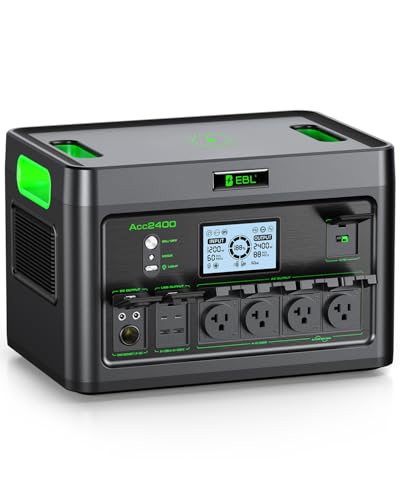
Pros
- High 2400W output supports listed devices such as electric kettles, hair dryers, coffee makers, and power tools
- Multiple port types support charging and powering up to 12 devices at once
- LiFePO4 battery chemistry and built-in protection cover overcharging, over-discharging, short circuits, and high temperatures
- Display shows remaining battery and operating status
Cons
- Listed weight is 54 to 55 pounds, which limits portability compared with smaller power stations
- Large 2400W output rating comes with a 1843.2Wh battery capacity, limiting runtime for high-wattage devices
- Dimensions measure 16.93 x 11.8 x 11.02 inches, requiring dedicated storage or transport space
Specifications
| Color | Grey |
|---|---|
| Size | 2400W |
| Dimensions | 16.93 x 11.8 x 11.02 inches |
| Weight | 54 Pounds |
| Product Group | Lawn & Patio |
| Binding | Electronics |
Best For / Avoid If
Best for buyers prioritizing
- High 2400W output supports listed devices such as electric kettles, hair dryers, coffee makers, and power tools
- Multiple port types support charging and powering up to 12 devices at once
- LiFePO4 battery chemistry and built-in protection cover overcharging, over-discharging, short circuits, and high temperatures
Consider another option if
- Listed weight is 54 to 55 pounds, which limits portability compared with smaller power stations
- Large 2400W output rating comes with a 1843.2Wh battery capacity, limiting runtime for high-wattage devices
- Dimensions measure 16.93 x 11.8 x 11.02 inches, requiring dedicated storage or transport space

Pros
- High 2083Wh capacity handle heavy appliance loads up to 2400W
- Fast 1.3-hour AC wall recharge via 1600W input
- Long-life LiFePO4 chemistry rated past 4000 cycles
- Sub-10ms UPS automatic transfer speed protect electronics
Cons
- 41-pound weight limit one-handed mobility
- Solar charging input limit set to 440W max
Specifications
| Color | Grey |
|---|---|
| Dimensions | 15.8 x 9.5 x 10.1 inches |
| Weight | 41 pounds |
| Product Group | BISS |
Best For / Avoid If
Best for buyers prioritizing
- High 2083Wh capacity handle heavy appliance loads up to 2400W
- Fast 1.3-hour AC wall recharge via 1600W input
- Long-life LiFePO4 chemistry rated past 4000 cycles
Consider another option if
- 41-pound weight limit one-handed mobility
- Solar charging input limit set to 440W max
A 3,000W label can describe peak output, not continuous output. That distinction matters. UDPOWER S2400 lists 2,400W rated output and 3,000W peak output. EBL 2400W Portable Power Station LiFePO4 Battery lists 2,400W output, but its published specifications do not identify a 3,000W peak rating.
For a refrigerator, coffee maker, microwave, heater, or power tool, check both running demand and startup demand. Motors and compressors can draw more power when starting. A station that handles ordinary running demand can still shut down if startup demand exceeds its peak limit. Product labels alone cannot predict every appliance result.
Both units use LiFePO4 battery chemistry and support home backup, camping, road trips, and jobsite use. Neither replaces a permanently installed transfer switch or whole-home generator. Connect only loads allowed by product instructions, and keep indoor use, ventilation, moisture, extension cords, and outlet loading within those instructions.
UDPOWER S2400: strongest fit for lighter emergency backup
UDPOWER S2400 suits buyers who need high output with less lifting. Its 41 lb weight and 15.8 by 9.5 by 10.1 inch size make transport easier than a 55 lb alternative. That difference matters for RV storage, campsite setup, tailgate use, and moving the unit between a vehicle and home.
The unit has 2,083Wh capacity, 2,400W rated output, and 3,000W peak output. The capacity can support several smaller devices or a high-draw appliance for a limited period. Actual runtime depends on appliance demand, conversion losses, battery condition, and operating conditions, so capacity does not equal usable AC hours.
UDPOWER lists six AC outlets, two USB-C ports, four USB-A ports, two DC5521 ports, one car port, and one solar input. The 15-device layout fits a group camping setup or a backup arrangement with several small electronics. Port count helps only when connected devices stay within total output limits.
AC charging is listed at 1,600W, with a claimed 0% to 100% recharge time of 1.3 hours. Solar input supports up to 440W and works with the UDPOWER 210W solar panel. Solar results depend on sunlight, panel position, temperature, and connected load. A solar panel option does not mean continuous output during poor weather.
The manufacturer lists more than 4,000 charge cycles and up to 15 years of use for its LiFePO4 battery. Those figures are claims about battery life under stated conditions, not a promise of equal service for every owner. Storage temperature, charge habits, load size, and maintenance affect battery aging.
UPS operation is listed at 0.01 seconds or less. That feature may help keep sensitive electronics powered during an outage, but it does not make every computer, server, medical device, or motor load suitable for this unit. Follow equipment instructions before treating it as a backup source.
Best for: RV users, campers, and homeowners who want a lighter unit, a 3,000W peak rating, fast AC recharge, and optional solar input.
Drawback: Its 2,400W rated output is below the 3,000W peak figure, so sustained loads near 3,000W are outside its normal rated output.
Who should skip it: Skip UDPOWER S2400 if you need a continuous 3,000W AC rating, a permanently wired home backup system, or documented compatibility with specialized equipment.
EBL 2400W Portable Power Station: lower-cost high-output option
EBL 2400W Portable Power Station LiFePO4 Battery targets buyers who want 2,400W output and many connection points without moving to a larger generator system. Its 1,843.2Wh battery is smaller than UDPOWER S2400’s 2,083Wh capacity, so the EBL may provide less runtime for the same load.
EBL lists four AC ports, two USB-A ports, two fast-charging USB-C ports, one car port, two DC ports, and one wireless charging panel. The company says the station can power 12 devices at once. That layout suits phones, cameras, laptops, drones, camping lights, and small appliances, provided combined demand stays below the unit’s output limits.
The published specifications name electric kettles, hair dryers, coffee makers, and power tools among compatible high-wattage equipment. Compatibility still depends on each device’s running and startup demand. A hair dryer or kettle can consume substantial energy quickly, which reduces available runtime even when output remains within limits.
EBL describes a 0.1-second emergency power mode for blackout backup. That is slower than UDPOWER’s listed 0.01-second UPS changeover. Sensitive computers and storage devices may respond differently to an interruption, so use equipment-specific guidance before relying on either unit for critical files.
The battery uses LiFePO4 cells. EBL claims more than 3,500 charge-discharge cycles and a service life of more than 10 years. A battery protection system covers overcharging, over-discharging, short circuits, and high temperatures according to the published product description. Protection features reduce certain risks, but they do not remove the need for dry placement, correct connections, and safe charging.
Dual-side handles support transport, but the 55 lb weight makes this unit a less convenient choice for frequent lifting. It measures 16.9 by 11.8 by 11 inches. That footprint may fit home backup storage or a work vehicle, while the weight can matter more than the extra ports during regular travel.
Best for: Home users and crews who prefer a lower price position, 12-device operation, wireless charging, and a 2,400W output rating.
Drawback: Its 1,843.2Wh capacity is lower than UDPOWER’s 2,083Wh capacity, while its 55 lb weight is higher.
Who should skip it: Skip EBL 2400W Portable Power Station LiFePO4 Battery if frequent carrying matters, if you need a stated 3,000W peak rating, or if longer runtime is more valuable than lower purchase cost.
Portable power station specifications that change ownership
| Feature | EBL 2400W Portable Power Station LiFePO4 Battery | UDPOWER S2400 Portable Power Station |
|---|---|---|
| Battery capacity | 1,843.2Wh | 2,083Wh |
| Rated output | 2,400W | 2,400W |
| Peak output | 2,400W maximum output listed | 3,000W |
| Battery chemistry | LiFePO4 | LiFePO4 |
| AC outlets | 4 | 6 |
| USB ports | 2 USB-A, 2 USB-C | 4 USB-A, 2 USB-C |
| Weight | 55 lb | 41 lb |
| Solar input | Up to 440W | |
| UPS changeover claim | 0.1 seconds | 0.01 seconds or less |
Capacity is the first ownership question. A larger watt-hour figure can support a given load longer, but AC conversion and appliance behavior reduce practical runtime. Compare capacity only after checking the type of load. A laptop and LED light are easier loads than a heater, kettle, or compressor.
Output is the second question. Both stations list 2,400W rated output. UDPOWER adds a 3,000W peak figure, which may help with short startup demand. That peak value should not be treated as a continuous operating rating.
Weight changes how often a station gets used. The lighter UDPOWER model is easier to carry to a campsite or move during an outage. EBL’s extra weight may matter less when the unit stays in one room or a work vehicle.
How to match either unit to vehicle and home use
For road trips, prioritize weight, port layout, and the devices carried. Both stations include a car port, but the published information does not establish vehicle-specific charging behavior or charging-cable compatibility. Do not assume a car port can power every 12V accessory or recharge the station at a particular speed.
For RV use, list every load that may run together. Add running demand, then account for startup demand from compressors or motors. Six AC outlets can make UDPOWER convenient for several plugged-in devices, but outlet count does not increase total wattage.
For home outages, separate short backup from whole-home power. These stations can support selected devices such as laptops, lights, phones, and some small appliances. They are not a substitute for a professionally installed electrical backup system. Never connect a portable power station to a home wall outlet to energize house wiring unless a qualified installation and approved equipment make that connection safe.
For jobsites, inspect tool demand before purchase. A tool with a large startup surge may behave differently from a resistive load such as a light. Keep both units dry, protect them from impact, and follow manufacturer charging and storage directions.
Who should not buy either portable power station
Neither pick fits buyers who need permanent whole-home backup, a documented continuous 3,000W output, an integrated fuel generator, or a product selected for medical life-support equipment. Those buyers should look at professionally installed battery backup, a generator system sized for the home, or equipment approved by the device manufacturer and an electrician.
Buyers who only need phone charging during travel may also be paying for capacity they will rarely use. A smaller power bank can be easier to carry. Buyers who need long operation for heating or cooling should calculate energy use first, because high-wattage appliances can drain either battery quickly.
Final verdict: which 3000W portable power station fits?
Choose UDPOWER S2400 when mobility, longer listed battery capacity, six AC outlets, solar input, fast AC charging, and a 3,000W peak rating matter most. Its 2,400W rated output still defines normal sustained AC use.
Choose EBL 2400W Portable Power Station LiFePO4 Battery when a lower price position, 12-device operation, wireless charging, and a 2,400W output fit better than low weight or longer listed capacity. Its 55 lb body makes it better suited to stationary backup than frequent carrying.
For either purchase, start with a load list. Identify running watts, startup demand, desired runtime, charging source, transport needs, and safe placement. That process gives a better answer than choosing from the largest watt number on a box.
Related reading: Expandable Portable Power Station, Best Portable Power Station for Overlanding and Best Portable Power Station for Refrigerator.