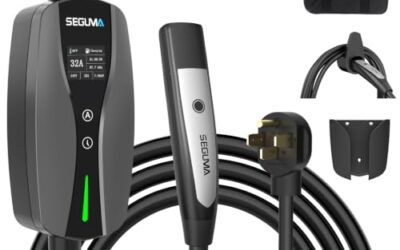
Before buying a used EV charging cable, check its connector fit, equipment type, electrical rating, safety markings, and physical condition. A cable with the wrong plug or damaged insulation can be unusable or unsafe, even if it looks like a match.
- Identify whether seller offers a charging cable alone or a complete portable EVSE with control box and wall plug.
- Match vehicle-side connector to your EV, accounting for model year and any approved adapter.
- Check current and voltage ratings against vehicle, EVSE, and power source limits.
- Reject equipment with heat damage, exposed conductors, cracked housings, or altered wiring.
- Test charging only with permission, using a suitable outlet or station and following both manuals.
What kind of used charging cable are you buying?
“Charging cable” can mean a cord with plugs at both ends, or a complete portable EVSE. These are not interchangeable descriptions. An EVSE controls and monitors AC charging between a power source and vehicle; its cable is only one part of that equipment.
A portable EVSE usually has a power-source plug, a control box on the cord, and a vehicle connector. If listing shows only a cord, it may be a cable for an AC charging station rather than a unit that can plug into household power. Ask for clear photos of every end and the control unit before arranging a purchase.
Most home and public AC charging uses a cable or EVSE that connects an AC source to the vehicle’s onboard charger. DC fast-charging equipment is different: its power-conversion hardware is generally part of the charging station. A loose cable intended for a DC fast charger is not a home charging solution.
Check connector compatibility with your vehicle
Compare the vehicle connector with the charging cable’s vehicle-end plug. In the United States, J1772 and NACS are common AC charging connector types. Which one fits depends on vehicle make, model year, equipment, and any supported adapter. A plug that looks close is not a fit.
Check the vehicle manual or automaker’s charging guidance for the connector and adapter combinations supported by your exact model year. Charging access can change across model years, including as manufacturers adopt NACS. Do not assume that another vehicle from the same brand uses the same inlet.
An adapter can bridge certain connector differences, but it does not make every combination compatible. Check that the vehicle or charging-equipment maker supports the specific adapter and use case. A DC fast-charging adapter does not automatically work for AC charging, or vice versa.
Also check the source-side plug if buying a portable EVSE. A household plug, a higher-voltage outlet plug, and a public-station connector serve different setups. Never use an improvised adapter or extension cord to make a plug fit. For home charging context, see the Alternative Fuels Data Center guide to charging electric vehicles at home.
Read ratings as limits, not promises
Find the voltage and current ratings on the EVSE label or manufacturer documentation. The vehicle, EVSE, and electrical circuit all affect charging power. Charging is limited by the lowest applicable capacity, so a higher-rated cable cannot make a vehicle charge faster than its onboard charger or circuit allows.
Check that the rating covers your intended use. A cable rated for less current may still charge a particular vehicle, but charging can take longer or the EVSE may limit current. Do not infer the rating from cable thickness, plug shape, or a seller’s estimate.
For a portable EVSE, inspect the power-source plug and its rating too. The outlet and branch circuit must be suitable for the equipment and charging load. A plug adapter does not increase a circuit’s capacity. If you are unsure whether an outlet or circuit can support charging, ask a qualified electrician rather than testing it under load.
Check the label for a recognized testing laboratory mark and identify the maker and model. Look up the manual for that exact model to understand its intended use, limits, and indicator lights. A certification mark is useful evidence about the equipment, but it does not establish that a used unit remains undamaged.
Inspect cable, plugs, and control box
Inspect the full cord in good light, including sections near both plugs and where the cable enters the control box. Look for cuts, flattened areas, deep kinks, crushed spots, exposed wire, repairs, or tape covering damage. Any conductor damage or unexplained repair is reason to decline the cable.
Check both connector housings for cracks, looseness, bent or corroded contacts, dirt, or signs of melting. Look at the control box for a cracked case, loose strain relief, missing labels, water intrusion, or altered wiring. A worn exterior can hide electrical damage, so appearance alone cannot establish safe operation.
Ask whether the equipment was exposed to water, vehicle impact, overheating, or repeated cable run-over. Ask how it was stored and whether it came from a known vehicle or charging setup. Treat vague answers as uncertainty, not proof of a defect; walk away if the seller cannot show the equipment clearly or allow reasonable inspection.
Use this pre-purchase checklist
- Identify the item. Establish whether it is a complete EVSE or a cable intended for a charging station.
- Match the plugs. Compare vehicle and source connectors with your exact vehicle and intended charging location.
- Check the ratings. Read voltage and current labels, then compare them with vehicle, EVSE, outlet, and circuit limits.
- Inspect condition. Reject damaged cable, plugs, housings, missing labels, and altered parts.
- Check model details. Get maker and model information, then find its manual and intended-use limits.
- Request a controlled demonstration. If possible, have seller show the unit charging a compatible vehicle from an appropriate source. Do not touch exposed contacts or use questionable wiring.
- Set terms before payment. Agree on a return window and what happens if unit fails a compatible charging test.
A successful demonstration is useful, but it only shows operation in that setup at that time. It does not prove the cable will work with every vehicle, outlet, adapter, or charging station.
When should you pass on a used cable?
Pass if connector type or equipment identity is unclear, safety labels are unreadable, ratings do not suit your use, or the cord or housing shows damage. Also pass if seller proposes rewiring, bypassing a control box, or using an adapter that the relevant equipment makers do not support.
Be cautious with equipment that has no identifiable maker or model. Without those details, you cannot check intended use or operating instructions. A low purchase price does not resolve uncertainty about electrical condition or compatibility.
Compare the used item with a new unit from a reputable source if warranty coverage, support, or a known return process matters to you. CarTechTalk’s EV charger buying guide covers home-charging setup considerations. The right comparison is not price alone; it is whether the used unit fits your car and charging location, with acceptable condition and recourse if it fails.
Common mistakes
- Buying by connector photo alone. Similar-looking plugs may serve different charging standards or use cases.
- Confusing cable with EVSE. A cable for a station may not include the control equipment needed to connect to household power.
- Assuming higher rating means faster charging. Vehicle and electrical supply limits can reduce charging rate.
- Using an improvised adapter. A physical fit does not establish electrical compatibility.
- Trusting a brief charge demonstration as a guarantee. It cannot show long-term condition or compatibility with a different setup.
- Ignoring model-year changes. Connector and adapter support can vary between model years and vehicle configurations.
When to get professional help
Ask a qualified electrician to assess an outlet, circuit, or home installation when you are uncertain about its suitability for EV charging. Do not open plugs, splice cable, replace internal parts, or test damaged equipment. Stop using a cable that becomes unusually hot, smells burnt, shows arcing, or repeatedly interrupts charging; follow the vehicle and EVSE manuals and arrange inspection or replacement.
If vehicle reports a charging fault, the cable is only one possible cause. Vehicle inlet, EVSE, supply, and charging station can also contribute. Check the manuals and try a known-compatible charging source only if equipment appears undamaged. Seek service if fault persists.
Gear that can help
If you need EV chargers for this job, these picks already appear in our EV chargers guides. Check the full guide for fit and who should skip each one.

Pros
- Supports multiple current settings: 10A, 16A, 20A, 24A, 32A, and 40A
- Compatible with EVs and hybrids that use a standard J1772 connector
- Lists protection against leakage, grounding issues, overvoltage, undervoltage, overcurrent, overcharging, overheating, and short circuits
- Automatically shuts off when the vehicle is fully charged, according to the listing
Cons
- A J1772-to-Tesla adapter is required for Tesla vehicles and is not included
- The listing does not identify a specific vehicle make or model compatibility list
Specifications
| Color | Black |
|---|---|
| Size | 40A ev charger |
| Product Group | Automotive Parts and Accessories |
Best For / Avoid If
Best for buyers prioritizing
- Supports multiple current settings: 10A, 16A, 20A, 24A, 32A, and 40A
- Compatible with EVs and hybrids that use a standard J1772 connector
- Lists protection against leakage, grounding issues, overvoltage, undervoltage, overcurrent, overcharging, overheating, and short circuits
Consider another option if
- A J1772-to-Tesla adapter is required for Tesla vehicles and is not included
- The listing does not identify a specific vehicle make or model compatibility list

Pros
- Supports both 240V Level 2 and 120V Level 1 charging
- Five selectable current settings provide charging flexibility
- Long 25-foot cable and delayed charging feature support home-use convenience
- Product description states that over-voltage, over-current, and short-circuit protection are included
Cons
- Full 240V charging requires a dedicated 240V circuit and NEMA 14-50 connection
- Tesla vehicles require an adapter
- The product does not support vehicles using proprietary charging protocols
Specifications
| Color | Black |
|---|---|
| Size | 25FT |
| Dimensions | 15.55 x 13 x 5.9 inches |
| Product Group | Automotive Parts and Accessories |
Best For / Avoid If
Best for buyers prioritizing
- Supports both 240V Level 2 and 120V Level 1 charging
- Five selectable current settings provide charging flexibility
- Long 25-foot cable and delayed charging feature support home-use convenience
Consider another option if
- Full 240V charging requires a dedicated 240V circuit and NEMA 14-50 connection
- Tesla vehicles require an adapter
- The product does not support vehicles using proprietary charging protocols

Pros
- Long 25-foot charging cable provides extended reach
- WiFi app supports charging control, scheduling, current adjustment, and energy tracking
- J1772 connector is compatible with North American EV and PHEV models
- Weatherproof IP66/NEMA-4 enclosure is suited to indoor or outdoor charging locations
Cons
- Requires a dedicated 50A circuit and a 4-prong NEMA 14-50 outlet
- Tesla charging requires a separate J1772-to-NACS adapter, which is not included
- Smart app features require a 2.4 GHz WiFi network with internet access
Specifications
| Color | Black |
|---|---|
| Size | 40 |
| Dimensions | 4.724409444 x 6.299212592 x 1.968503935 inches |
| Product Group | Automotive Parts and Accessories |
| Binding | Electronics |
Best For / Avoid If
Best for buyers prioritizing
- Long 25-foot charging cable provides extended reach
- WiFi app supports charging control, scheduling, current adjustment, and energy tracking
- J1772 connector is compatible with North American EV and PHEV models
Consider another option if
- Requires a dedicated 50A circuit and a 4-prong NEMA 14-50 outlet
- Tesla charging requires a separate J1772-to-NACS adapter, which is not included
- Smart app features require a 2.4 GHz WiFi network with internet access
Next step: How to Inspect an EV Charging Cable Safely and Best EV Charging Cable Organizer for Winter Storage.
FAQ
Can I buy a used EV charging cable without its control box?
Only if you know the cable’s intended equipment and connector standards. A loose cable may be intended for a charging station and may not function as a portable EVSE.
Does a J1772 cable work with every EV?
No. Vehicle inlets, model years, charging standards, and supported adapters differ. Check the exact vehicle manual and approved adapter guidance.
Can a higher-amp cable make charging faster?
Not by itself. Charging rate remains limited by the vehicle’s onboard charger, EVSE, power source, and circuit.
Is a cable safe if it charges during a quick test?
A successful test supports that it worked in that setup at that time. It cannot rule out hidden damage or prove compatibility with your own setup.
Sources and further reading
- Charging Electric Vehicles at Home (Alternative Fuels Data Center): Explains home charging equipment and setup considerations.
- Procurement and Installation for EV Charging Infrastructure (Alternative Fuels Data Center): Covers planning and installation factors for EV charging equipment.