
Finding the best universal battery charger means balancing the specific battery chemistries, physical cell sizes, and power inputs you rely on daily. While standard household electronics run primarily on cylindrical AA and AAA cells, automotive diagnostic gear, emergency flashlights, remote key fobs, and specialized field equipment frequently demand C, D, 9V, or high-drain lithium-ion cells like 18650s. A single versatile charging station simplifies battery maintenance, protects cell cycle life, and eliminates the clutter of dedicated single-chemistry wall warts.
We analyzed technical specifications, bay counts, input power types, display readouts, and safety circuitry across nine popular multi-cell charging models. Whether you need a high-capacity household hub for Ni-MH cells, a multi-chemistry dock that handles LiFePO4 and Li-ion, or an ultra-compact USB-powered travel unit, this guide outlines the best options based on documented capabilities and realistic charging limitations.

Pros
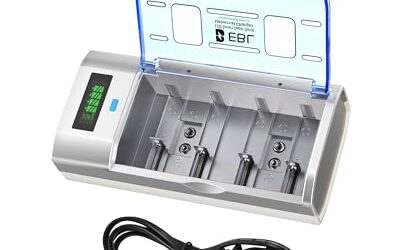
- Supports multiple rechargeable battery sizes in one charger
- Independent charging slots allow mixed-size battery combinations
- Includes a discharge function for Ni-MH and Ni-Cd batteries
- Provides LCD status information and automatic safety shutoff features
Cons
- Compatibility is specified for Ni-MH and Ni-Cd batteries; other rechargeable chemistries are not listed
- Charging times are listed as up to 3 hours for AA/AAA and up to 10 hours for C/D/9V batteries
- Battery polarity must be aligned with the charger markings for proper operation
Specifications
| Dimensions | 7.88 x 2.32 x 5.52 inches |
|---|---|
| Product Group | Wireless |
Best For / Avoid If
Best for buyers prioritizing
- Supports multiple rechargeable battery sizes in one charger
- Independent charging slots allow mixed-size battery combinations
- Includes a discharge function for Ni-MH and Ni-Cd batteries
Consider another option if
- Compatibility is specified for Ni-MH and Ni-Cd batteries; other rechargeable chemistries are not listed
- Charging times are listed as up to 3 hours for AA/AAA and up to 10 hours for C/D/9V batteries
- Battery polarity must be aligned with the charger markings for proper operation

Pros
- Supports five standard rechargeable battery sizes
- Offers automatic shutoff after charging
- Provides a charging-status LED indicator
- Includes a built-in adapter and detachable cord
Cons
- Compatible with NiMH batteries only
- Charging times may vary depending on the NiMH battery
- Charging capacity is limited to 1 or 2 9V batteries or 2 or 4 AA, AAA, C, or D batteries at a time
Specifications
| Color | silver |
|---|---|
| Size | 1 COUNT |
| Dimensions | 2.84 x 5.08 x 11.58 inches |
| Weight | 0.06 pounds |
| Product Group | Electronics |
| Binding | Electronics |
Best For / Avoid If
Best for buyers prioritizing
- Supports five standard rechargeable battery sizes
- Offers automatic shutoff after charging
- Provides a charging-status LED indicator
Consider another option if
- Compatible with NiMH batteries only
- Charging times may vary depending on the NiMH battery
- Charging capacity is limited to 1 or 2 9V batteries or 2 or 4 AA, AAA, C, or D batteries at a time

Pros
- Independent charging channels allow 1 to 4 batteries to be charged freely
- Supports both 1.2V Ni-MH/Ni-CD and 1.5V rechargeable AA or AAA batteries
- Compact design is listed at 3.66 x 2.48 x 1.18 inches and 65g
- Individual LCD displays show charging status for each slot
Cons
- The listing does not identify a specific model number beyond the ASIN
Specifications
| Color | Black |
|---|---|
| Dimensions | 5.58 x 1.18 x 4.04 Inches |
| Product Group | Electronics |
Best For / Avoid If
Best for buyers prioritizing
- Independent charging channels allow 1 to 4 batteries to be charged freely
- Supports both 1.2V Ni-MH/Ni-CD and 1.5V rechargeable AA or AAA batteries
- Compact design is listed at 3.66 x 2.48 x 1.18 inches and 65g
Consider another option if
- The listing does not identify a specific model number beyond the ASIN
Pros
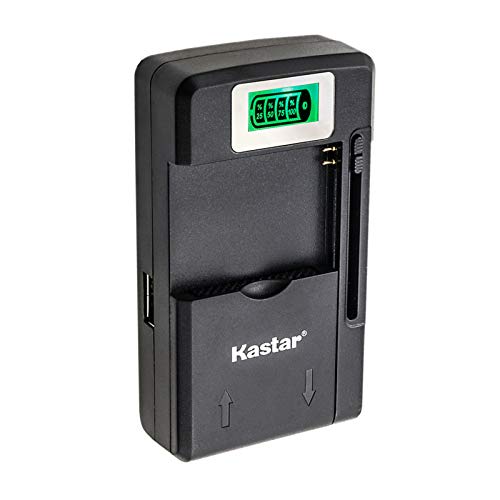
- Wide AC 100–240V input range
- Provides charging-status information through an LCD display
- Includes USB charging and multi-protection circuitry
- Compact travel-oriented design with a fold-out US plug
Cons
- Only works with batteries that have exposed side-edge contacts
- Not compatible with recessed pins, USB-charged batteries, or connector-specific battery layouts
Specifications
| Color | Black |
|---|---|
| Dimensions | 4.1 x 2.3 x 1 inches |
| Weight | 0.14991433816 pounds |
| Product Group | Camera |
| Binding | Unknown Binding |
Best For / Avoid If
Best for buyers prioritizing
- Wide AC 100–240V input range
- Provides charging-status information through an LCD display
- Includes USB charging and multi-protection circuitry
Consider another option if
- Only works with batteries that have exposed side-edge contacts
- Not compatible with recessed pins, USB-charged batteries, or connector-specific battery layouts
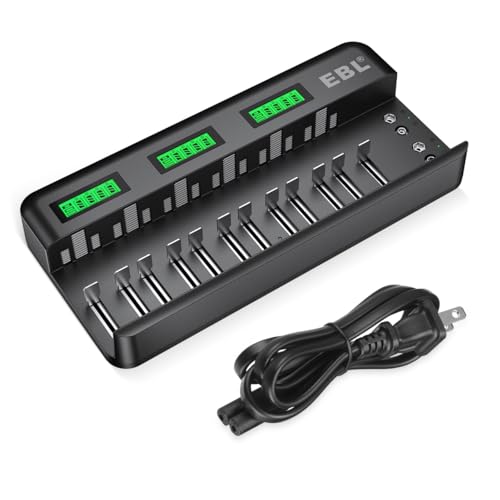
Pros
- Charges multiple supported battery sizes at the same time
- Does not require AA, AAA, C or D batteries to be charged in pairs
- Provides separate status displays for standard rechargeable batteries and 9V batteries
- Includes several listed protection and battery-detection functions
Cons
- The listing identifies support for Ni-MH and Ni-CD rechargeable batteries only
- The LCD display coverage is specified for AA, AAA, C and D batteries, while 9V status uses LEDs
Specifications
| Color | Neutral |
|---|---|
| Size | 12+2 Bay |
| Dimensions | 10.62 x 1.88 x 5.19 inches |
| Product Group | Wireless |
Best For / Avoid If
Best for buyers prioritizing
- Charges multiple supported battery sizes at the same time
- Does not require AA, AAA, C or D batteries to be charged in pairs
- Provides separate status displays for standard rechargeable batteries and 9V batteries
Consider another option if
- The listing identifies support for Ni-MH and Ni-CD rechargeable batteries only
- The LCD display coverage is specified for AA, AAA, C and D batteries, while 9V status uses LEDs

Pros
- Broad battery compatibility across several chemistries and sizes
- Four independent bays can monitor each battery separately
- LCD display provides voltage, current, and time information for each slot
- Offers two charge current settings: 500mA and 1000mA
- Lists multiple safety protections, including short circuit and reverse polarity protection
Cons
- Specifications field is not listed beyond the listed feature summary
Best For / Avoid If
Best for buyers prioritizing
- Broad battery compatibility across several chemistries and sizes
- Four independent bays can monitor each battery separately
- LCD display provides voltage, current, and time information for each slot
Consider another option if
- Specifications field is not listed beyond the listed feature summary

Pros
- Supports multiple rechargeable battery sizes, including 9V
- Allows single-battery or mixed-battery charging
- Offers both Micro USB and USB Type C input options
- Provides individual NiMH battery charging-status information on the LCD
Cons
- The charger is USB powered, and an AC adapter is not listed in the listing
- Compatibility is specified for rechargeable NiMH and NiCD batteries
Specifications
| Color | Black |
|---|---|
| Size | 5-Bay Charger without Batteries |
| Dimensions | 5.2 x 2.2 x 7.5 inches |
| Weight | 0.6 pounds |
| Product Group | Electronics |
| Binding | Electronics |
Best For / Avoid If
Best for buyers prioritizing
- Supports multiple rechargeable battery sizes, including 9V
- Allows single-battery or mixed-battery charging
- Offers both Micro USB and USB Type C input options
Consider another option if
- The charger is USB powered, and an AC adapter is not listed in the listing
- Compatibility is specified for rechargeable NiMH and NiCD batteries

Pros
- Automatic charging stop when the battery reaches full charge
- Built-in safety cutout and overcharge protection circuit
- LCD screen indicates connection and full charge
- USB port included
Cons
- Batteries are not included
Specifications
| Color | Black |
|---|---|
| Dimensions | 3.9 x 2.2 x 1 inches |
| Weight | 0.15 pounds |
| Product Group | Wireless |
| Binding | Wireless Phone Accessory |
Best For / Avoid If
Best for buyers prioritizing
- Automatic charging stop when the battery reaches full charge
- Built-in safety cutout and overcharge protection circuit
- LCD screen indicates connection and full charge
Consider another option if
- Batteries are not included
Affiliate disclosure: CarTechTalk may earn an affiliate commission on qualifying purchases made through links on our site at no additional cost to you. Pricing and product availability are subject to change.
How We Chose the Best Universal Battery Chargers
Our editorial evaluation examined documented manufacturer technical manuals, electrical specifications, charging currents, bay layouts, and integrated safety systems across nine market models. Rather than conducting unverified lab testing, CarTechTalk prioritized the following objective parameters:
- Chemistry Compatibility: We verified whether the device natively supports standard Nickel-Metal Hydride (Ni-MH) and Nickel-Cadmium (Ni-CD) cells (1.2V nominal), modern 1.5V regulated rechargeable lithium cells, or raw cylindrical lithium-ion chemistries (Li-ion, LiFePO4, IMR) operating at 3.2V to 3.7V nominal.
- Form Factor and Slot Versatility: We evaluated sliding contact rails, bay cutouts, and spring-loaded terminals designed to accommodate standard household sizes (AA, AAA, C, D, 9V) up to 72mm long lithium-ion cylindrical cells.
- Independent Channel Architecture: We penalized outdated serial pairing designs that force batteries to be charged in matched sets of two or four, prioritizing individual bay monitoring via Microcontroller Units (MCU).
- Safety and Termination Logic: We assessed documented protection mechanisms, including negative delta-voltage (-ΔV) termination, zero-volt activation, reverse-polarity detection, short-circuit cutoffs, and over-temperature sensors.
- Power Input Flexibility: We noted whether units utilize standard AC wall plugs for maximum bench speed or USB-C/Micro-USB 5V inputs for portable automotive or power-bank use.
Comparison Table: Specifications and Verified Features
The table below summarizes the key manufacturer-documented specifications, supported cell categories, bay counts, and display types for all nine models. Current prices represent observed market values and may fluctuate.
| Model | Primary Supported Chemistries | Bay Count / Configuration | Display Type | Observed Price |
|---|---|---|---|---|
| EBL Universal Smart with Discharge | Ni-MH, Ni-CD (1.2V) | 4 Bay (AA/AAA/C/D) + 2 Bay (9V) | LCD Display | $18.99 |
| Keenstone 18650 Battery Charger | Li-ion, LiFePO4, IMR, Ni-MH, Ni-CD | 4 Independent Bays | Detailed LCD (V, mA, h) | $29.99 |
| Tenergy TN486U 5-Bay Charger | Ni-MH, Ni-CD (1.2V) | 4 Bay (AA/AAA/C/D) + 1 Bay (9V) | Detailed LCD Display | $32.99 |
| Energizer Recharge Universal | Ni-MH (1.2V) | 4 Bay (AA/AAA/C/D) + 2 Bay (9V) | LED Light Bar | $41.41 |
| EBL Universal Charger (1.5V/1.2V) | 1.2V Ni-MH/Ni-CD & 1.5V Li-ion | 4 Independent Bays (AA/AAA) | 4-Slot LCD Display | $12.59 |
| Kastar Mini Travel Charger | Removable Camera Li-ion Packs | 1 Clamp Slot + 1 USB Port | 4-Level LCD (25–100%) | $6.92 |
| Senyulian 12 Bays 18650 Charger | Li-ion, LiFePO4, IMR, Ni-MH, Ni-CD | 12 Independent Bays (Up to 72mm) | Central Backlit LCD | $39.99 |
| EBL 12+2 Bay Universal Charger | Ni-MH, Ni-CD (1.2V) | 12 Bay (AA/AAA/C/D) + 2 Bay (9V) | LCD Screen + LED for 9V | $51.99 |
| Sfmn® 2016 Mobile Universal | Removable Smartphone Li-ion | 1 Clamp Slot + 1 USB Port | LCD Connection Display | $9.99 |
Compatibility and Buying Advice: Matching Chemistries and Slots
The term “universal” is widely used in battery marketing, but no single charger can safely or physically accept every rechargeable battery in existence. Selecting the right unit requires understanding three core engineering constraints:
1. Chemistry Voltage Requirements
Connecting a battery to a charger with incompatible termination logic creates severe hazards, ranging from ruined cell longevity to fire:
- Nickel Chemistries (1.2V nominal): Ni-MH and older Ni-CD cells terminate via negative delta-voltage (-ΔV) or temperature rise (dT/dt). Chargers designed exclusively for these cells (such as the Energizer Universal or Tenergy TN486U) cannot charge bare 3.7V lithium-ion cells.
- Cylindrical Lithium-ion (3.6V–3.7V nominal): Raw cells like 18650, 21700, and 26650 use Constant Current / Constant Voltage (CC/CV) charging algorithms, terminating precisely at 4.2V. They require advanced multi-chemistry docks like the Keenstone or Senyulian.
- Lithium Iron Phosphate (LiFePO4, 3.2V nominal): LiFePO4 cells terminate lower, typically at 3.65V. Subjecting them to standard 4.2V Li-ion charging overcharges and permanently destroys the cell. Only dedicated multi-chemistry chargers with manual or automatic LiFePO4 detection should be used.
- Regulated 1.5V Rechargeable Lithium Cells: These modern AA and AAA replacements contain internal step-down circuitry. Standard chargers fail to read their true internal cell voltage; you must use a charger specifically engineered for 1.5V lithium cells, such as the EBL 3rd Generation model.
2. Physical Cell Length and Protected Terminals
When buying a multi-bay charger for cylindrical lithium cells (like the Senyulian 12-bay or Keenstone), verify the maximum bay length. While bare, unprotected 18650 cells measure exactly 65mm in length, cells equipped with internal safety circuits or button tops often extend to 69mm or 71mm. Chargers limited to 67mm slots will physically reject protected cells.
Readers weighing these picks also look at Car Battery Charger Buying Guide, Best Battery Charger For Household Batteries and Best Battery Charger for NiMH Batteries by Slots and Chemistry.
Frequently Asked Questions
Can a universal battery charger recharge non-rechargeable alkaline batteries?
No. Standard alkaline, heavy-duty, or disposable lithium primary batteries cannot be recharged. Attempting to charge non-rechargeable batteries leads to chemical leakage, corrosive gas venting, terminal damage, or fire. Quality chargers like the EBL 12+2 and EBL Smart series integrate non-rechargeable cell detection that automatically trips an error warning and terminates charging.
Why do some chargers require batteries to be charged in pairs?
Older or lower-cost charging circuits wire two battery bays in series on a single channel to reduce manufacturing costs. In a paired configuration, the charger monitors total combined voltage rather than individual cell status. If one battery has lower capacity or higher internal resistance, it risks severe overcharging while the other undercharges. For maximum battery cycle life, select chargers with documented independent channel monitoring.
Is a USB-powered battery charger as fast as an AC wall plug charger?
Generally, no. A 5V/2A USB input provides a theoretical maximum of 10 watts of input power. When split across four large C or D cells, each slot receives a modest trickle (often 300mA to 600mA). Chargers powered directly by an internal AC power supply draw substantially more current from the wall, allowing them to replenish large-capacity batteries significantly faster.
Final Verdict: Which Universal Battery Charger Should You Choose?
Choosing the best universal battery charger comes down to identifying which battery types dominate your gear closet or workbench:
- Choose the EBL Universal Smart Battery Charger with Discharge if you want an affordable, well-protected household charger for standard AA, AAA, C, D, and 9V Ni-MH batteries with an active refresh discharge cycle.
- Choose the Keenstone 18650 Battery Charger if your equipment relies on cylindrical lithium-ion, LiFePO4, and high-drain electronics alongside standard rechargeable household cells.
- Choose the EBL 12+2 Bay Universal Rechargeable Battery if you manage a high-volume fleet of household devices and require continuous, simultaneous batch charging.
- Choose the Tenergy TN486U if your priority is portability and the ability to recharge household batteries from USB-C ports in vehicles or field stations.