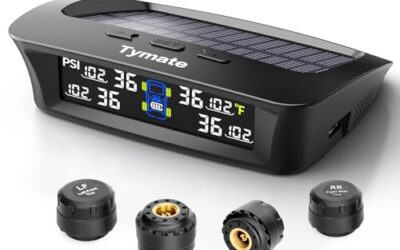
Best tire pressure monitoring system for christmas shoppers should start with the Flydew 6-Wheel RV TPMS with Custom Pressure because its six-tire coverage, adjustable 0 to 144 PSI range, solar charging, and lower price fit many RV and towing gifts. Choose GUTA GT30 Trailer Tire Pressure Monitoring System instead when the recipient needs more than six sensors or manages a larger trailer setup.

Pros
- Customizable pressure alert thresholds across full 0-144 PSI range
- Color LCD display adjust brightness automatically for day and night conditions
- Pre-coded sensors screw on external valve stems with hex nuts
Cons
- Display screen resolution and battery capacity not detailed
Specifications
| Size | 2.5 inches-6 Sensors |
|---|---|
| Dimensions | 3.93700787 x 2.755905509 x 1.181102361 inches |
| Product Group | Automotive Parts and Accessories |
Best For / Avoid If
Best for buyers prioritizing
- Customizable pressure alert thresholds across full 0-144 PSI range
- Color LCD display adjust brightness automatically for day and night conditions
- Pre-coded sensors screw on external valve stems with hex nuts
Consider another option if
- Display screen resolution and battery capacity not detailed

Pros
- High pressure capacity supports heavy RV and trailer applications
- Sensors use standard user-replaceable CR2032 coin batteries
- Monitor includes motion sensor sleep mode to preserve internal battery
- Sensors program prior to tire installation
Cons
- Manufacturer specifies metal valve stems; rubber stems not recommended
- Optional signal booster for long distance interference not included
- Provided listing contains zero reviews for field evaluation
Best For / Avoid If
Best for buyers prioritizing
- High pressure capacity supports heavy RV and trailer applications
- Sensors use standard user-replaceable CR2032 coin batteries
- Monitor includes motion sensor sleep mode to preserve internal battery
Consider another option if
- Manufacturer specifies metal valve stems; rubber stems not recommended
- Optional signal booster for long distance interference not included
- Provided listing contains zero reviews for field evaluation
Which Christmas gift fits the vehicle?
| System | Best fit | Sensor coverage | Pressure range | Power approach |
|---|---|---|---|---|
| Flydew 6-Wheel RV TPMS with Custom Pressure | RV owners, dually trucks, and trailers needing six-tire monitoring | Six tires | 0 to 144 PSI | Solar and USB-C monitor charging, replaceable CR1632 sensor batteries |
| GUTA GT30 Trailer Tire Pressure Monitoring System | Large RV and trailer owners needing many sensors | Up to 10 displayed at once, with support for viewing up to 46 tires | Up to 188 PSI | Rechargeable monitor, replaceable CR2032 sensor batteries |
Flydew makes the simpler Christmas recommendation for a six-tire rig. It covers the common six-wheel RV or towing layout without asking the buyer to pay for a larger sensor network. Its solar panel can help keep the monitor powered during daylight travel, while USB-C charging covers storage or low-light conditions.
GUTA fits a different owner. Its display can show up to 10 tires on one page, and the listing says the system can view up to 46 tires without pressing a button. That capacity matters for large vehicle combinations, spare sensor sets, or owners who manage several trailer sections. It also reaches a higher pressure ceiling, which suits some heavy-duty applications.
Flydew 6-Wheel RV TPMS with Custom Pressure
Best for: RV owners, dually drivers, and trailer users who need six tire positions with custom alert limits.
Flydew monitors six tires and covers pressure from 0 to 144 PSI. The listing says its sensors update data in 0.3 seconds, while the LCD refreshes every six seconds. For a driver, that combination means pressure and temperature information stays visible during a trip instead of waiting for a manual gauge check at every stop.
Custom thresholds give this system a useful advantage for towing. The owner can set limits across the stated pressure range rather than relying only on one fixed alert rule. That helps when front, rear, trailer, and heavy-load tires use different target pressures. The system also lists high-pressure, low-pressure, high-temperature, sensor-disconnect, low-battery, rapid-air-leak, and sensor-fault warnings.
The monitor uses solar and USB-C charging. Solar power suits daytime travel, while USB-C gives the owner a backup during indoor storage or cloudy conditions. Sensors use replaceable CR1632 batteries, so replacement does not require discarding each sensor.
Installation follows a defined sequence. The owner powers on the monitor, installs hex nuts, mounts pre-coded sensors in positions 1 through 6, and tightens the nuts counterclockwise. The product instructions call for a soapy-water check after installation. That step matters because external valve-cap sensors can create an air leak when the seal or valve stem is unsuitable.
The auto-brightness color LCD adjusts for daylight and nighttime viewing. That can reduce the need to change screen settings during a long drive. A three-year warranty is listed, along with Amazon-message support and a stated typical reply time of 24 hours.
Skip it if the recipient needs more than six active tire positions or pressure above 144 PSI. GUTA offers broader tire capacity and a higher pressure ceiling. Also skip Flydew when the vehicle uses valve stems or a layout that cannot accept the listed external sensor arrangement. The listing does not establish fitment for every RV, truck, or trailer, so vehicle layout remains the buyer’s responsibility.
GUTA GT30 Trailer Tire Pressure Monitoring System
Best for: owners of large RVs, trailers, or multi-section vehicle combinations who need more than six tire positions.
GUTA displays up to 10 tires on one page and can show data for up to 46 tires without a button press. The screen switches between front trailer and rear sections. That layout suits a driver who wants a broad view of a long combination rather than cycling through a small number of sensors.
The system handles pressure up to 188 PSI and temperature up to 185 degrees Fahrenheit. Those limits give it more room for heavy-duty setups than Flydew’s 144 PSI ceiling. The buyer still needs to match those limits to the vehicle’s tire and wheel specifications. A higher monitoring range does not change the correct cold-inflation pressure printed by the vehicle, trailer, or tire manufacturer.
GUTA uses wireless programming before sensor installation. The owner can assign the anti-theft sensors first, then install them in their positions. After pairing, the current pressure becomes the reference point. Alarm limits use a range from 25 percent above reference pressure to 15 percent below it. This approach can simplify setup for a large group of tires, but the reference pressure must come from a correct inflation setting.
Alerts cover high and low pressure, high temperature, fast leaks, missing sensor signals, and low sensor batteries. Visual and audio warnings give the driver two ways to notice a change. The sensors transmit status signals at five-minute intervals while under pressure. The monitor can run for 12 to 14 days after a four-hour full charge, according to the listing, then enters power-saving mode after 15 minutes without motion or vibration.
Sensor batteries are listed with a life of up to four years and use replaceable CR2032 cells. The product listing recommends metal valve stems and does not recommend rubber valve stems. That limitation matters for gift buyers because a system that cannot suit the recipient’s valve stems creates an installation problem before the first trip.
Skip it if the recipient owns a six-tire rig and wants a smaller, lower-cost system. GUTA’s larger sensor capacity may add expense and setup work that a basic RV does not need. Skip it too when the vehicle uses rubber valve stems, because the listing recommends metal stems for reliable use. A signal booster can be added for distance or electromagnetic interference, which may create another purchase and installation task.
Pressure alerts matter more than Christmas packaging
A TPMS gift helps most when the owner sets alerts around correct tire pressures. The driver should start with the vehicle, RV, trailer, or tire maker’s cold-inflation guidance. Neither system replaces a physical pressure check before departure. A display can show a sensor reading, but it cannot correct low pressure, a damaged tire, a leaking valve, or an overloaded trailer.
Temperature alerts also need context. Heat can rise during travel because of load, speed, outside conditions, braking, or tire problems. Treat an alert as a reason to stop safely and inspect the vehicle, not as proof of one specific fault. A driver should avoid handling a visibly damaged or severely overheated tire and seek qualified roadside help.
External cap sensors add convenience, but they also add parts to each valve stem. Check that each cap is tight, that seals remain in good condition, and that the valve stem supports the sensor. The Flydew instructions call for a soapy-water check. GUTA’s recommendation for metal valve stems gives an even clearer compatibility boundary.
What to check before buying during Christmas
- Count active tire positions. Six positions suit Flydew. GUTA gives access to a much larger sensor network. Count truck, RV, trailer, and any monitored spare positions before ordering.
- Check pressure requirements. Flydew covers 0 to 144 PSI. GUTA reaches 188 PSI. Use the vehicle’s required cold pressure, not the system’s maximum, as the buying reference.
- Inspect valve stems. GUTA recommends metal valve stems and warns against rubber valve stems. Confirm the recipient’s setup before gifting either external-sensor system.
- Match charging habits. Flydew combines solar and USB-C charging. GUTA uses a rechargeable monitor with a stated 12 to 14-day runtime after full charging. A frequent traveler may value solar backup, while a storage-focused owner may prefer a rechargeable display.
- Plan sensor battery replacement. Flydew uses CR1632 cells. GUTA uses CR2032 cells. Keep the correct replacement type available and follow each product’s installation instructions.
- Consider display workload. Flydew focuses on six tire positions. GUTA can show up to 10 on one page and view up to 46. More coverage helps large combinations but can add pairing and position-management work.
- Review return timing. Christmas gifts may sit unopened. Keep order records and packaging until the recipient confirms sensor fit, display operation, and vehicle coverage.
For winter preparation, pair a TPMS gift with a reliable pressure gauge. The guide to the best tire pressure gauge for winter commuting covers the manual check that should accompany electronic monitoring. Drivers who travel in cold conditions may also benefit from the best tire inflator for winter emergencies, especially when a low-pressure reading appears away from home.
Who should skip both Christmas picks?
Do not buy either system for someone with a normal passenger car if the gift requires factory-integrated monitoring, internal sensors, or a different vehicle interface. These products are presented for RVs, trailers, heavy-duty trucks, and towing layouts. The listings do not establish passenger-car fitment, vehicle-model compatibility, or compatibility with every valve stem.
Also skip both systems when the recipient will not install external sensors, replace sensor batteries, set alert limits, and inspect pressure before travel. A TPMS display cannot replace correct inflation, tire inspection, load control, or safe roadside decisions. Look for a vehicle-specific system with confirmed fitment and installation support instead.
Final Christmas recommendation
Flydew is the better gift for the common six-tire RV, dually, or trailer owner. Its six-sensor layout matches that use case, its 0 to 144 PSI range covers the stated heavy-duty target, and solar plus USB-C charging reduces dependence on one power method. Custom limits and multiple warning types give the recipient useful control, but the buyer must still confirm sensor and valve-stem fit.
GUTA earns the recommendation for larger combinations. Up to 10 tires can appear on one page, the system can view up to 46 tires, and its 188 PSI ceiling supports a broader heavy-duty range. That extra capacity makes sense only when the recipient needs it. Metal valve stems, a possible signal booster, and more involved sensor programming make it a poor gift for a simple six-tire setup.
Choose by tire count first, valve-stem type second, and pressure range third. Christmas timing matters less than giving the right system for the vehicle already in the driveway.