
For buyers needing reliable off-grid electricity with superior thermal stability, the Jackery Explorer 1000 v2 Portable Power stands out as the most capable choice for running high-draw appliances due to its 1,070Wh capacity and 1,500W continuous output. Those managing lighter loads, such as small electronics or roadside emergency gear, will find balanced portability in compact units such as the Jackery Explorer 300 Portable Power Station,292Wh or the budget-oriented DARAN Portable Power Station 89.6Wh LiFePO4. Selecting the best portable power station with LiFePO4 batteries requires aligning continuous watt ratings and watt-hour capacities with specific device electrical requirements.

Pros
- LiFePO4 battery chemistry and a claimed 3,500-plus cycle lifespan
- Multiple output options for phones, laptops, cameras, and other devices within the 100W limit
- Fanless operation is specified for quieter use
- Supports charging from wall power, USB-C, a car, or a solar panel
Cons
- Solar panel and charging cable are not included
- Output is limited to devices within 100W
- Specific solar charging input details are not provided
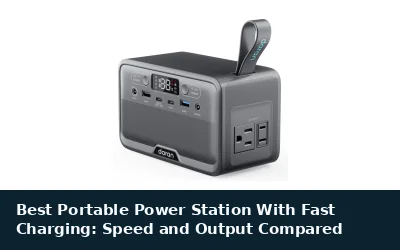
The Daran portable power station uses an 89.6Wh LiFePO4 battery and is rated for 100W output with a 200W peak rating. It measures 6.5 × 3.3 × 4 inches and weighs 2.54 pounds.
Output connections include two AC sockets, two USB-C ports rated at 45W and 15W, two USB-A ports rated at 18W and 15W, and DC5521 ports rated at 60W. The unit supports AC wall charging, USB-C PD charging, car charging, and solar charging. The solar panel and cable are not included.
Additional features include a display for operating status and remaining power, fanless operation, a four-level LED flashlight with steady and SOS modes, and a battery management system with 12 listed safety protections. The product is specified for devices within 100W.
Specifications
| Color | Advanced Gray |
|---|---|
| Dimensions | 3.3 x 6.5 x 4 inches |
| Weight | 2.54 pounds |
| Product Group | Lawn & Patio |
Verify the current product variation before purchase; specifications may change.
Detailed Review
What stands out in the currently available product data:
- 89.6Wh LiFePO4 battery with a claimed 3,500-plus life cycles
- 100W output with 200W peak power rating
- Seven output ports, including two AC sockets, two USB-C ports, two USB-A ports, and DC5521 ports
- USB-C PD charging supports up to 45W on one USB-C port
- Supports AC, USB-C, car, and solar charging methods
- Compact 2.54-pound design with a soft ergonomic handle
Best For / Avoid If
Best for buyers prioritizing
- LiFePO4 battery chemistry and a claimed 3,500-plus cycle lifespan
- Multiple output options for phones, laptops, cameras, and other devices within the 100W limit
- Fanless operation is specified for quieter use
Consider another option if
- Solar panel and charging cable are not included
- Output is limited to devices within 100W
- Specific solar charging input details are not provided

Pros
- High 1,500W AC output with a 3,000W surge peak
- Multiple AC, USB, and DC charging ports
- LFP battery rated for over 4,000 charge cycles
- App-controlled charging modes and power management
Cons
- Solar panels are not included
- The one-hour charging mode must be enabled in the Jackery App before charging
- Solar charging is compatible only with Jackery solar panels
The Jackery Explorer 1000 v2 is a portable power station with a 1,070Wh capacity, 1,500W AC output, and a 3,000W surge peak. It measures 12.87 x 8.82 x 9.72 inches and weighs 23.8 pounds.
Connectivity includes two USB-C ports, one USB-A port, one DC car port, and three pure sine wave AC ports. The unit also includes LED lights and 100W USB-C power delivery.
The LFP battery is specified to maintain over 70% of its original capacity after 4,000 charge cycles. The Jackery App provides one-hour emergency charging, 30 dB quiet overnight charging, and energy efficiency modes. The standard full-charge mode takes 1.7 hours, while one-hour charging must be enabled in the app before each charge. Solar panels are not included, and the product is compatible only with Jackery solar panels for solar charging.
Included items are the Explorer 1000 v2 and a user manual.
Specifications
| Color | black |
|---|---|
| Dimensions | 12.87 x 8.82 x 9.72 inches |
| Weight | 23.8 Pounds |
| Product Group | Lawn & Patio |
| Binding | Electronics |
Verify the current product variation before purchase; specifications may change.
Detailed Review
What stands out in the currently available product data:
- 1,070Wh battery capacity with 1,500W AC output and 3,000W surge peak
- LFP battery rated to maintain over 70% capacity after 4,000 charge cycles
- One-hour charging mode available through the Jackery App
- Two USB-C ports, one USB-A port, one DC car port, and three pure sine wave AC ports
- 100W USB-C power delivery for charging compatible devices without power adapters
- 23.8-pound design with a foldable handle
Best For / Avoid If
Best for buyers prioritizing
- High 1,500W AC output with a 3,000W surge peak
- Multiple AC, USB, and DC charging ports
- LFP battery rated for over 4,000 charge cycles
Consider another option if
- Solar panels are not included
- The one-hour charging mode must be enabled in the Jackery App before charging
- Solar charging is compatible only with Jackery solar panels
Pros
- LiFePO4 battery chemistry and a stated 3,000-cycle charge-discharge rating
- Multiple output and recharging options for portable and emergency use
- Includes a 5-year warranty and stated 24/7 customer service
Cons
- The solar panel is sold separately
- The 300W continuous output rating limits it to devices within that power range
- The published specifications list two different sets of dimensions: 9 x 4.7 x 7.8 inches and 9.25 x 5 x 6.81 inches
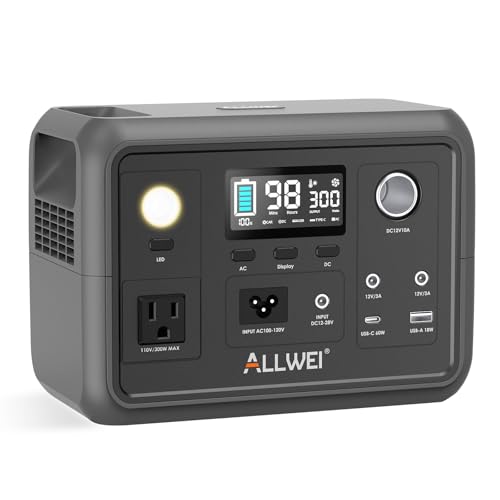
The ALLWEI portable power station provides a 256Wh capacity, 300W continuous output, and 600W peak surge capacity through a pure sine wave AC outlet. Its LiFePO4 battery is listed with 3,000 charge-discharge cycles, and the built-in battery management system provides six-layer protection.
Output connections include one AC outlet, two DC5521 ports, one 12V car cigarette lighter port, one USB-A port with 18W fast charging, and one USB-C PD port rated up to 60W. The unit supports AC wall charging, 12V car charging, solar charging with a 100W solar panel, and dual AC-plus-solar charging. The solar panel is sold separately.
The power station weighs 6.4 pounds and includes a three-level LED light with SOS mode. Supplied accessories include an AC cable, a DC car cable, and a user manual. The source data lists the dimensions as both 9 x 4.7 x 7.8 inches and 9.25 x 5 x 6.81 inches.
Detailed Review
What stands out in the currently available product data:
- 256Wh LiFePO4 battery with a stated 3,000 charge-discharge cycle rating
- 300W continuous output and 600W peak surge capacity with a pure sine wave AC outlet
- Six output ports, including USB-C PD up to 60W and USB-A fast charging up to 18W
- Supports AC wall, 12V car, solar, and dual AC-plus-solar recharging
- Built-in MPPT controller for solar charging
- Pass-through charging allows the station and connected devices to charge at the same time
Best For / Avoid If
Best for buyers prioritizing
- LiFePO4 battery chemistry and a stated 3,000-cycle charge-discharge rating
- Multiple output and recharging options for portable and emergency use
- Includes a 5-year warranty and stated 24/7 customer service
Consider another option if
- The solar panel is sold separately
- The 300W continuous output rating limits it to devices within that power range
- The published specifications list two different sets of dimensions: 9 x 4.7 x 7.8 inches and 9.25 x 5 x 6.81 inches

Pros
- Multiple power outputs support AC, USB-C, USB-A, and 12V car-port devices
- LiFePO4 battery chemistry is rated for more than 4,000 charge cycles
- Portable 7.1-pound design with an integrated handle
- Supports solar charging with compatible Jackery panels
Cons
- Solar panel is not included
- Delivery requires a physical address; orders cannot be delivered to only a PO Box
- The published data does not specify operating-system requirements or vehicle compatibility
The Jackery Explorer 300 is a portable power station with a 292Wh capacity, 300W rated output, and 600W peak surge capacity. Its connections include two AC outlets, one 100W USB-C PD port, two USB-A ports, and one 120W car port.
The unit measures 9.1 inches long by 5.2 inches wide by 7.8 inches high and weighs 7.1 pounds. It uses LiFePO4 battery chemistry rated for over 4,000 charge cycles before reaching 70% capacity.
With a compatible 100W Jackery solar panel, the Explorer 300 can reach 80% capacity in approximately 2.8 hours. A 40W portable panel can reach 80% capacity in approximately 7.5 hours. The package includes the power station, an AC adapter, a car charger cable, and a user guide. The solar panel is not included.
Specifications
| Color | E300 |
|---|---|
| Size | 9.1"L x 5.2"W x 7.8"H |
| Dimensions | 9.09842518757 x 5.20078739627 x 7.79921259047 Inches |
| Weight | 7.1 Pounds |
| Product Group | Lawn & Patio |
| Binding | Automotive |
Verify the current product variation before purchase; specifications may change.
Detailed Review
What stands out in the currently available product data:
- 292Wh capacity with 300W rated output and 600W peak surge capacity
- Includes two AC outlets, a 100W USB-C PD port, two USB-A ports, and a 120W car port
- Weighs 7.1 pounds and includes an integrated carrying handle
- Uses LiFePO4 battery chemistry rated for over 4,000 charge cycles before reaching 70% capacity
- Reaches 80% capacity in approximately 2.8 hours with a 100W Jackery solar panel
- Includes an AC adapter, car charger cable, and user guide
Best For / Avoid If
Best for buyers prioritizing
- Multiple power outputs support AC, USB-C, USB-A, and 12V car-port devices
- LiFePO4 battery chemistry is rated for more than 4,000 charge cycles
- Portable 7.1-pound design with an integrated handle
Consider another option if
- Solar panel is not included
- Delivery requires a physical address; orders cannot be delivered to only a PO Box
- The published data does not specify operating-system requirements or vehicle compatibility
CarTechTalk earns affiliate commissions from qualifying purchases through links on this site. Retail pricing changes over time, so verify current figures directly before purchasing.
Understanding LiFePO4 Chemistry for Portable Vehicle and Camp Power
Lithium iron phosphate (LiFePO4 or LFP) battery chemistry differs substantially from standard nickel cobalt manganese (NCM) cells. While conventional lithium formulations often deliver higher initial energy density per pound, they degrade considerably faster, frequently showing capacity loss after 500 to 800 charge cycles. In contrast, the manufacturer specifications for the units reviewed here document lifespans ranging from 3,000 to over 4,000 cycles before battery health drops to 70 or 80 percent of original capacity. For someone using a unit weekly, this translates to over a decade of operational utility.
Thermal stability serves as another critical advantage in automotive and mobile applications. Vehicle interiors experience extreme temperature fluctuations throughout changing seasons. LiFePO4 cells maintain a significantly higher thermal runaway threshold than older chemistry types, drastically reducing fire hazards when stored or operated in warm environments. While these cells add slightly more weight relative to capacity, the structural stability, safety profile, and prolonged cycle life make LFP the preferred standard for mobile auxiliary electricity.
Power Output and Storage Specifications Across Models
| Model | Capacity | AC Continuous Output | Surge Output | Cycle Life Rating | Unit Weight |
|---|---|---|---|---|---|
| DARAN Portable Power Station 89.6Wh LiFePO4 | 89.6Wh | 100W | 200W | 3,500+ cycles | 2.54 lbs |
| Jackery Explorer 1000 v2 Portable Power | 1,070Wh | 1,500W | 3,000W | 4,000 cycles to 70% | 23.8 lbs |
| ALLWEI Portable Power Station 300W | 256Wh | 300W | 600W | 3,000 cycles | 6.4 lbs |
| Jackery Explorer 300 Portable Power Station,292Wh | 292Wh | 300W | 600W | 4,000 cycles to 70% | 7.5 lbs |
Detailed Reviews: Four Dedicated LFP Power Stations
Jackery Explorer 1000 v2 Portable Power: High Output for Extended Camping
The Jackery Explorer 1000 v2 Portable Power functions as a comprehensive mobile power hub capable of supporting demanding appliances. With a manufacturer-rated continuous inverter output of 1,500W and a 3,000W surge threshold, this model handles refrigeration units, small air conditioners, electric skillets, and power tools. Its 1,070Wh storage capacity bridges the gap between simple gadget charging and residential emergency backup or extended off-grid overland travel.
Recharging versatility remains a strong focal point. The manufacturer lists an emergency one-hour fast charge from empty to 100 percent when activated via the companion Jackery mobile app, alongside a standard 1.7-hour default mode intended to optimize long-term cell health. Output connections include three pure sine wave AC ports, two USB-C ports (including a 100W Power Delivery port), a USB-A port, and a standard 12V DC car socket. Integrated ChargeShield 2.0 software manages cell balance, thermal limits, and charging speeds.
Drawback: Solar panel compatibility is restricted strictly to proprietary Jackery solar panels according to manufacturer guidelines, eliminating the option to plug in generic third-party MC4 arrays without specialized adapters.
Avoid if: You only need to recharge mobile phones and lightweight drones on weekend day trips, as carrying a 23.8-pound unit adds unnecessary mass and cost.
ALLWEI Portable Power Station 300W: Balanced Mid-Range Workhorse
For outdoor enthusiasts and road-trippers requiring moderate electrical capacity without high physical weight, the ALLWEI Portable Power Station 300W provides a balanced 256Wh LFP capacity. Its 300W pure sine wave inverter (with 600W surge capacity) safely accommodates sensitive medical gear like portable CPAP machines, mid-tier laptops, camera gear, and 12V car refrigerators. At 6.4 pounds, the unit remains manageable inside a packed trunk or gear crate.
Connection options span six simultaneous outputs: one AC outlet, two DC5521 ports, one standard 12V car cigarette lighter receptacle, one 18W USB-A port, and a 60W USB-C Power Delivery port. The internal battery management system incorporates six-layer protection protocols against short circuits and over-voltage. The manufacturer notes that pass-through charging is fully supported, allowing the power station to receive power from an alternating wall current or solar panel while concurrently dispensing power to connected consumer devices.
Drawback: The wall charging input requires approximately 3.5 to 4 hours to reach capacity using single-source AC charging, lacking the sub-two-hour standalone wall charging speeds seen in premium platforms.
Avoid if: Your gear includes high-draw heating elements, coffee makers, hair dryers, or power tools that require more than 300W of sustained continuous electrical draw.
Jackery Explorer 300 Portable Power Station,292Wh: Compact Durability Pick
The Jackery Explorer 300 Portable Power Station,292Wh refines the small-format category by pairing a 292Wh capacity with upgraded LiFePO4 cells rated for over 4,000 charge cycles before dropping to 70 percent capacity. Weighing 7.5 pounds, it incorporates an integrated carrying handle suited for mobile base camps, hunting setups, and photography excursions where space inside the vehicle remains at a premium.
Port selection accommodates six devices across dual AC outlets delivering 300W continuous output (600W peak surge), a 100W USB-C Power Delivery connection, two USB-A ports, and a regulated 120W DC car port. Solar charging efficiency is documented at roughly 2.8 hours when paired with an optional 100W Jackery solar panel in ideal solar exposure. The inclusion of pure sine wave circuitry ensures delicate microelectronics, audio equipment, and medical equipment operate without harmonic interference.
Drawback: The purchase price per watt-hour sits notably higher than comparable 250Wh to 300Wh entry-level competitors in the small-box generator segment.
Avoid if: You run high-draw appliances or need continuous multi-day off-grid power for heavy electronics without regular access to recharging inputs.
DARAN Portable Power Station 89.6Wh LiFePO4: Ultralight Pocket Power Bank
The DARAN Portable Power Station 89.6Wh LiFePO4 targets mobile professionals, day hikers, and minimalist travelers who want an actual AC outlet in a handheld footprint. Weighing 2.54 pounds with dimensions of 6.5 by 3.3 by 4 inches, it matches the size profile of a compact handheld lantern while housing an 89.6Wh LFP battery rated by the manufacturer for over 3,500 lifecycle charges. The small battery size stays under the standard 100Wh threshold commonly referenced for airline carry-on regulations.
Despite its pocket-sized build, it supplies seven total outputs, including two AC sockets limited to 100W combined output (200W peak), two USB-C ports (45W and 15W), two USB-A ports, and a DC5521 terminal. It features a fanless, silent architecture ideal for quiet tents or bedside laptop operation. Four charging methods are supported: AC wall fast charging, two-way USB-C Power Delivery charging, 12V automotive input, and low-wattage solar input. Recharging from zero to 80 percent is documented at approximately 1.5 hours.
Drawback: The strict 100W continuous inverter maximum prevents running appliances like blenders, full-size electric cool boxes, or rapid battery chargers for large drones.
Avoid if: You need an emergency home-backup generator to keep medical equipment running over long multi-day grid blackouts.
Evaluation Framework: Inverter Output versus Stored Capacity
Evaluating portable power stations requires separating electrical storage capacity from continuous inverter wattage. Storage capacity, measured in watt-hours (Wh), determines how long an appliance can run. Continuous inverter output, measured in watts (W), dictates whether an appliance will power on at all. A high-wattage appliance connected to a power station with insufficient inverter output will trip the internal overload breaker regardless of how many watt-hours remain in the battery reserve.
For example, a 1,200W portable induction burner requires a station like the Jackery Explorer 1000 v2 Portable Power because its 1,500W inverter supports that load. Attempting to run that same burner on a 300W station results in an immediate safety shutdown. Conversely, low-draw equipment such as 45W car coolers or 65W laptop bricks will run happily on smaller inverters, where stored watt-hours simply establish the overall runtime before recharging becomes necessary.
Solar Charging and Vehicle Alternator Input Realities
Replenishing a power station in off-grid environments relies on solar inputs or direct 12V vehicle charging. While solar input provides quiet, zero-emission replenishment, rated solar inputs represent theoretical maximums under optimal sunlight. In actual field conditions, panel angle, atmospheric haze, and ambient heat reduce solar production. Units equipped with Maximum Power Point Tracking (MPPT) controllers, such as the ALLWEI Portable Power Station 300W, actively modulate input voltage to capture the highest possible wattage during changing weather conditions.
Charging directly from a vehicle cigarette lighter or 12V accessory port offers a reliable alternative during transit. However, standard 12V vehicle sockets typically deliver between 90W and 120W (roughly 8 to 10 amps at 12 volts). Charging an 89.6Wh unit like the DARAN model through a vehicle takes roughly an hour, whereas fully recharging a 1,070Wh battery via a standard 12V car outlet can take 10 to 12 hours of continuous driving. Drivers frequently running larger batteries often pair vehicle transit charging with auxiliary solar setups to maintain adequate daily power levels.
Who Should Not Buy a Portable LiFePO4 Power Station
Readers seeking continuous, whole-house emergency backup during multi-day municipal power grid failures should not buy any of the four portable units covered here. Running home heating systems, large well pumps, 240V clothes dryers, or central air conditioning demands heavy-duty dual-fuel stationary generators or permanent residential battery systems offering capacities exceeding 5,000Wh to 10,000Wh. Similarly, ultralight backpackers tracking every ounce across high-mileage trails will find dedicated slim power banks without internal AC inverters far more space-efficient and weight-efficient than standalone inverter stations.
Selection Guide by Practical Use Case
Selecting the best portable power station with LiFePO4 batteries comes down to your primary operating environment:
- Overland Vehicles and Extended Camping: Choose the Jackery Explorer 1000 v2 Portable Power for its 1,500W AC capability, 1,070Wh capacity, and rapid app-managed charging routines that keep heavy appliances functioning smoothly.
- Weekend Road Trips and CPAP Operation: The ALLWEI Portable Power Station 300W provides a balanced 256Wh capacity, pass-through charging, and six diverse output ports at an accessible price point.
- Mobile Field Work and Compact Travel: The Jackery Explorer 300 Portable Power Station,292Wh offers a proven 4,000-cycle LFP platform with 100W USB-C output in an easily stowed 7.5-pound frame.
- Minimalist Mobile Power and Tech Commuting: The DARAN Portable Power Station 89.6Wh LiFePO4 delivers an ultralight 2.54-pound footprint with true AC socket access for basic laptop and drone battery recharging.
For related guidance on this topic, see Best Portable Power Station for Car Camping and Best Portable Power Station With Fast Charging.