When searching for the best battery tester for all batteries, buyers often expect a single tool capable of evaluating everything from a tiny hearing aid button cell to a heavy-duty truck battery. In practice, electrical testing physics divides battery testers into two distinct engineering categories: low-voltage household cell checkers (designed for 1.2V to 9V consumer chemistries) and high-current 12V automotive diagnostic analyzers (designed for 100 to 2000 CCA lead-acid starter batteries). Evaluating household dry cells requires measuring nominal resting voltage or light resistive loads, whereas automotive starter batteries demand dynamic conductance analysis to measure internal resistance, cranking amperage, and alternator charging circuits.
Understanding this fundamental technical division is the key to finding the right tool. Below, we break down ten verified options across both categories, detailing their manufacturer-documented specifications, supported chemistries, display mechanisms, and practical operating boundaries.
If you are still comparing options, see Best Battery Tester For Household Batteries, Battery Tester For Button Batteries and Best Battery Tester for Testing Power Chair Batteries.
Quick Verdict
For household battery management across disposable alkaline and rechargeable NiMH cells, the La Crosse 911-65557-INT Portable Digital Battery provides the most flexible consumer option, featuring selectable voltage thresholds (1.2V, 1.5V, and 3.0V) and an adjustable sliding contact bay. If your inventory includes specialized cylindrical photo cells such as CR123A or CR2, the Dlyfull Battery Tester for AA AAA C D 9V offers dedicated multi-format slots paired with an LCD readout, though the manufacturer explicitly limits it to non-rechargeable chemistries. For basic household drawer sorting where budget is paramount, simple passive analog meters like the Battery Tester Checker, Universal Small Battery deliver instant good/low/replace needle readings without requiring internal operating batteries.
For vehicle starter batteries, the ANCEL BA101 Car Battery Tester delivers robust diagnostic capabilities across standard flooded, AGM, GEL, and EFB lead-acid batteries rated from 100 to 2000 CCA, complete with cranking and charging system tests. Motorists seeking real-time voltage wave output to inspect alternator ripple will find the MOTOPOWER MP0515A 12V Car Battery Tester well-equipped, while the TOPDON BT100 12V Car Battery Tester offers dedicated diode-level charging analysis in a ruggedized hand-held format.

Pros
- Broad compatibility with several household battery sizes
- Supports both standard and rechargeable batteries
- Color-coded pointer display is designed for quick reading
- Compact design can fit in a pocket
Cons
- The product should be stored in a dry place at room temperature
- The battery should be removed when the tester is not in use
Specifications
| Color | Red |
|---|---|
| Size | 2 |
| Dimensions | 4 x 1 x 0.393700787 inches |
| Weight | 0.02 Pounds |
| Product Group | Tools |
| Binding | Unknown Binding |
Best For / Avoid If
Best for buyers prioritizing
- Broad compatibility with several household battery sizes
- Supports both standard and rechargeable batteries
- Color-coded pointer display is designed for quick reading
Consider another option if
- The product should be stored in a dry place at room temperature
- The battery should be removed when the tester is not in use

Pros
- Covers several common household battery types
- Simple status display with green, yellow, and red zones
- Does not require a separate power source
Cons
- Tests battery voltage and does not directly measure capacity precisely
- Test times should be kept short to avoid unnecessary battery drain
Specifications
| Color | 2Pcs |
|---|---|
| Dimensions | 4.13 x 1.57 x 0.78 Inches |
| Weight | 0.000625 pounds |
| Product Group | BISS |
| Binding | Misc. |
Best For / Avoid If
Best for buyers prioritizing
- Covers several common household battery types
- Simple status display with green, yellow, and red zones
- Does not require a separate power source
Consider another option if
- Tests battery voltage and does not directly measure capacity precisely
- Test times should be kept short to avoid unnecessary battery drain

Pros
- Covers several common household battery sizes
- Provides an intuitive color-coded battery status display
- Lightweight design weighs 70g
- Does not require a built-in power supply, according to the listing covered
Specifications
| Color | Black |
|---|---|
| Size | Small |
| Product Group | BISS |
Best For / Avoid If
Best for buyers prioritizing
- Covers several common household battery sizes
- Provides an intuitive color-coded battery status display
- Lightweight design weighs 70g
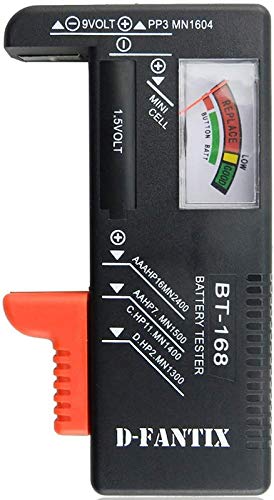
Pros
- Covers several common household battery sizes and types
- Operates using the battery being checked
- Simple analog display with color-coded status zones
- Compact and lightweight for convenient storage or carrying
Cons
- The tester does not directly detect battery capacity precisely
- The analog display provides status ranges rather than a precise capacity reading
Specifications
| Color | Black |
|---|---|
| Size | small |
| Dimensions | 6.692913379 x 3.93700787 x 1.3779527545 inches |
| Weight | 0.110231131 Pounds |
| Product Group | BISS |
| Binding | Misc. |
Best For / Avoid If
Best for buyers prioritizing
- Covers several common household battery sizes and types
- Operates using the battery being checked
- Simple analog display with color-coded status zones
Consider another option if
- The tester does not directly detect battery capacity precisely
- The analog display provides status ranges rather than a precise capacity reading

Pros
- Broad compatibility with common cylindrical and button cell batteries
- LCD display provides three battery-condition categories
- Compact, pocket-friendly design with an anti-slip finish
- AAA battery is included
Cons
- Not powered by a rechargeable battery
- Not intended for testing rechargeable batteries
Specifications
| Color | Black |
|---|---|
| Size | Small |
| Dimensions | 5.2 x 3.46 x 0.94 inches |
| Weight | 0.2535316013 pounds |
| Product Group | Home Improvement |
| Binding | Electronics |
Best For / Avoid If
Best for buyers prioritizing
- Broad compatibility with common cylindrical and button cell batteries
- LCD display provides three battery-condition categories
- Compact, pocket-friendly design with an anti-slip finish
Consider another option if
- Not powered by a rechargeable battery
- Not intended for testing rechargeable batteries
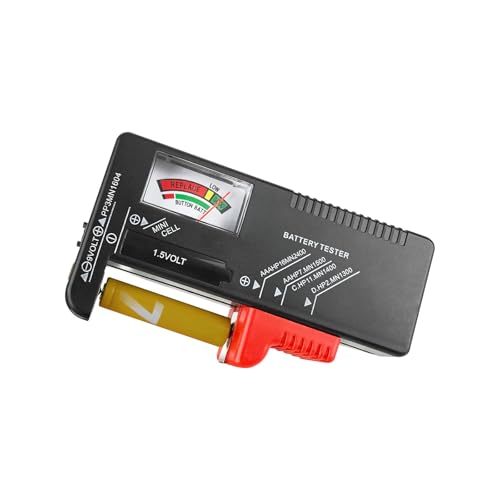
Pros
- Broad compatibility with common household and button cell battery types
- Color-coded status display is intended to be easy to read
- Compact, lightweight ABS design supports portable use
- Designed to provide results almost instantly
Cons
- The listing advises storing the tester in a dry place at room temperature
- The listing advises removing the battery when testing is not needed
Specifications
| Color | Red |
|---|---|
| Size | 1 |
| Dimensions | 4 x 1 x 0.393700787 inches |
| Weight | 0.02 Pounds |
| Product Group | Tools |
| Binding | Unknown Binding |
Best For / Avoid If
Best for buyers prioritizing
- Broad compatibility with common household and button cell battery types
- Color-coded status display is intended to be easy to read
- Compact, lightweight ABS design supports portable use
Consider another option if
- The listing advises storing the tester in a dry place at room temperature
- The listing advises removing the battery when testing is not needed
How We Chose
To identify the best battery tester options across varied consumer and automotive applications, we evaluated the manufacturer-published specifications of ten distinct diagnostic tools. Our editorial analysis focused on technical compatibility, testing methodologies, display ergonomics, safety mechanisms, and long-term utility without relying on simulated lab claims.
- Supported Formats and Chemistries: We cataloged the exact cell formats handled by each unit, separating multi-chemistry household checkers (alkaline, NiMH, lithium coin cells) from dedicated 12V vehicle analyzers (flooded lead-acid, AGM flat plate/spiral, GEL, and EFB).
- Measurement Method: We distinguished between basic passive open-circuit/light-load voltmeters and dynamic conductance load testers capable of calculating Cold Cranking Amps (CCA), internal resistance, State of Health (SOH), and State of Charge (SOC).
- Tester Power Source: We examined whether units rely on the test battery for parasitic operating power, require separate internal batteries, or draw directly from vehicle battery terminals.
- Display Clarity: We assessed readouts ranging from three-zone analog deflection needles (Replace/Low/Good) to segmented LCD bars, backlit monochrome screens, and full-color 320×240 LCD graphic interfaces.
- Safety Protections: For automotive testers, we verified the presence of reverse polarity protection, spark-proof clamping, short-circuit protection, and overvoltage safeguards.
Battery Tester Comparison
The table below summarizes verified manufacturer specifications across all ten reviewed battery testers. Prices represent observed retail figures at the time of publication.
| Product | Target Battery Class | Display Type | Tester Power Source | Observed Price |
|---|---|---|---|---|
| La Crosse 911-65557-INT Portable Digital Battery | Household (1.2V, 1.5V, 3V, 9V) | Digital LCD / LED indicator | Battery under test | $15.99 |
| ANCEL BA101 Car Battery Tester | 12V Automotive Lead-Acid (100–2000 CCA) | Backlit Monochrome LCD | Vehicle battery (12V) | $37.99 |
| Battery Tester Checker, Universal Small Battery | Household (1.5V, 9V, Button Cells) | Analog Needle (3-color) | Battery under test | $5.99 (2-Pack) |
| VTECHOLOGY 2Pcs Battery Tester for AA AAA C D 9V | Household (1.5V, 9V, Button Cells) | Analog Needle (3-color) | Battery under test | $6.99 (2-Pack) |
| Battery Tester for AA AAA C D 9V | Household (1.5V, 9V, Button Cells) | Analog Needle (3-color) | Battery under test | $7.69 |
| D-FantiX Battery Tester for AAA AA C D 9V | Household (1.5V, 9V, Button Cells) | Analog Needle (3-color) | Battery under test | $7.99 |
| TOPDON BT100 12V Car Battery Tester | 12V Automotive Lead-Acid (100–2000 CCA) | Backlit LCD + 3 Status LEDs | Vehicle battery (12V) | $51.99 |
| Dlyfull Battery Tester for AA AAA C D 9V | Household & Specialty Cylindrical (1.5V, 3V, 6V, 9V) | Segmented LCD Bar Display | 1x AAA battery (included) | $18.99 |
| Battery Tester Checker, Universal Small Battery | Household (1.5V, 9V, Button Cells) | Analog Needle (3-color) | Battery under test | $4.90 |
| MOTOPOWER MP0515A 12V Car Battery Tester | 12V Automotive Lead-Acid (100–2000 CCA) | 3.0-inch Color LCD (240×320) | Vehicle battery (12V) | $31.99 |
Compatibility and Buying Advice
Because no single retail tester handles both 1.5V button cells and 2000 CCA automotive batteries safely, buyers must identify their primary testing objective before purchasing. Review the technical distinctions below:
Household Battery Checkers: Voltage vs. Capacity
Most sub-$10 household testers are passive voltmeters. When an alkaline battery discharges, its open-circuit voltage drops from approximately 1.6V down toward 1.0V. A passive analog checker measures this voltage level across a tiny load resistor to determine whether the cell falls into the green, yellow, or red zone.
However, voltage alone does not tell the whole story. A depleted cell can show decent surface voltage until placed under an active load in a high-drain device (such as a motorized toy or wireless game controller). For households managing both rechargeable (NiMH) and standard alkaline cells, choose an adjustable unit like the La Crosse 911-65557-INT Portable Digital Battery to avoid false “replace” readings on 1.2V rechargeable chemistries.
12V Automotive Battery Analyzers: Conductance Testing
Automotive 12V starter batteries cannot be properly evaluated with a simple voltmeter. A dying 12V car battery will often show 12.4V at rest, yet drop below 8V when attempting to deliver 400 amps to a starter motor. Dedicated diagnostic tools like the ANCEL BA101 Car Battery Tester, TOPDON BT100 12V Car Battery Tester, and MOTOPOWER MP0515A 12V Car Battery Tester utilize AC conductance testing algorithms. By sending a small test signal through the lead-acid plates, they calculate:
- Cold Cranking Amps (CCA): Comparing measured CCA against the factory rating on the battery label.
- Internal Resistance (mΩ): Detecting sulfation or plate degradation that restricts current flow.
- Cranking Voltage Drop: Measuring lowest cranking voltage during engine turnover.
- Alternator Diode Ripple: Checking for damaged rectifier diodes that bleed AC voltage into vehicle electronics.
How to Choose the Right Battery Tester
Select your tester using this targeted decision framework:
- Identify Your Dominant Use Case: If you are testing household remote controls, smoke alarms, toys, and flashlights, pick a multi-format consumer checker. If you are dealing with sluggish vehicle starts, RV deep-cycle banks, or boat batteries, you need a 12V automotive conductance analyzer.
- Check Chemistry Compatibility: If you use 1.2V NiMH rechargeable cells, verify that your household tester explicitly supports them. Note that models like the Dlyfull Battery Tester for AA AAA C D 9V specifically prohibit testing rechargeable cells.
- Inspect Battery Size Slots: If your household relies on specialty camera or smart-home cells (CR123A, CR2, 2CR5), select a specialized multi-bay digital model rather than standard BT-168 analog sliders.
- Evaluate Automotive Battery Rating: Ensure automotive testers support your battery’s CCA rating (most units here cover 100 to 2000 CCA) and specific lead-acid construction (regular flooded, AGM flat, AGM spiral, GEL, or EFB).
Frequently Asked Questions
Can one battery tester test both household AA batteries and car batteries?
No. Consumer household battery checkers are designed for low voltages (1.2V to 9V) and fractional-amp loads. Automotive battery testers are engineered specifically for 12V lead-acid systems and require heavy-duty copper clamps to measure internal conductance and high cranking currents (up to 2000 CCA). Attempting to connect a household tester to a 12V automotive battery will cause electrical damage and potential safety hazards.
Why does my rechargeable AA battery show in the yellow “low” zone on an analog tester?
Standard disposable alkaline AA batteries have a nominal resting voltage of 1.5V when new. Rechargeable Nickel-Metal Hydride (NiMH) batteries operate at a nominal 1.2V even when 100% charged. Standard analog checkers calibrated only for 1.5V alkaline curves interpret 1.2V as low or depleted. Testers with selectable voltage ranges, such as the La Crosse 911-65557-INT Portable Digital Battery, prevent this misdiagnosis.
Do battery testers require their own batteries to operate?
Most analog household testers and 12V automotive analyzers are passive; they draw the tiny amount of operating power they need directly from the battery under test. However, certain advanced digital household checkers, such as the Dlyfull Battery Tester for AA AAA C D 9V, utilize an internal AAA battery to run their LCD logic and prevent parasitic drain on delicate photo lithium cells.
Can I test lithium-ion vehicle starter batteries with these 12V testers?
None of the 12V automotive testers reviewed here (ANCEL BA101 Car Battery Tester, TOPDON BT100 12V Car Battery Tester, MOTOPOWER MP0515A 12V Car Battery Tester) support 12V automotive lithium starter chemistries. Their conductance algorithms and safety profiles are calibrated specifically for lead-acid variants (flooded, AGM, GEL, and EFB).
Final Verdict
The term “all batteries” covers two distinct practical realities. For household drawers filled with loose AA, AAA, 9V, and coin cells, the La Crosse 911-65557-INT Portable Digital Battery is the most adaptable choice thanks to its 1.2V/1.5V/3V voltage selector, while passive analog options like the Battery Tester Checker, Universal Small Battery remain reliable low-cost options for basic sorting. On the automotive side, the ANCEL BA101 Car Battery Tester provides dependable 100–2000 CCA lead-acid diagnostics, and the MOTOPOWER MP0515A 12V Car Battery Tester delivers helpful real-time waveform visualization for troubleshooting vehicle charging systems.