Why Does My Car Inverter Keep Beeping
Your car inverter is beeping to signal a fault condition in your vehicle’s DC to AC power conversion system. This is a critical safety feature designed to alert drivers to potential issues that could lead to system failure or damage. Common causes include overheating, low battery voltage, overload, or internal component faults. Understanding these reasons is key to diagnosing and resolving the problem without causing further harm to your vehicle.
In the context of EV charging and automotive power, inverters are essential for powering various systems, from air conditioning to electric motors in hybrids and full EVs. The beep serves as an immediate warning, but it doesn’t always mean the inverter is completely broken; it often indicates a condition that needs attention before it escalates.
Key Takeaways
- Beeps are safety alerts for specific faults like overheating or low voltage.
- Start with simple checks like battery connections and ventilation.
- Consider your vehicle’s voltage and model year for compatibility.
- Professional help may be needed if issues persist.
Understanding Your Car Inverter
In vehicles, the inverter converts direct current (DC) from the battery or battery pack to alternating current (AC) for use in AC-powered equipment. This is particularly important in electric vehicles where the traction inverter manages power to the motor, and in charging systems where inverters may be used for portable power or home charging setups adapted for vehicles.
The system is designed with multiple protection mechanisms, including beep indicators for when parameters exceed safe limits. These limits depend on the specific inverter model and vehicle integration. For example, in a 12V vehicle system, the inverter might beep if voltage drops below 11.8V or rises above 14.4V. In higher voltage systems like 48V or 400V in EVs, the thresholds are proportionally different.
Common Causes of Beeping
Overheating
Overheating is a frequent culprit. Inverters produce heat due to power conversion losses, and if the internal heatsink or fan is compromised, or if the vehicle is in a hot environment, the temperature sensor triggers the beep.
This can happen during extended use, such as running the AC on high while the engine is off in a parked car, or during fast charging sessions. Vehicle model-year compatibility is important because newer models have better cooling systems, but compatibility with aftermarket inverters may vary. Always ensure the inverter is not enclosed in a poorly ventilated area and consider the ambient temperature when operating the vehicle.
Low Voltage
Low voltage is another common reason. When the battery voltage is too low, the inverter may beep to prevent damage from operating at reduced efficiency or risk of shutdown.
Explain: In a typical 12V system, this might occur if the alternator is not charging the battery properly, or if accessories are drawing too much current. In EVs, it could relate to battery management system issues. Measure voltage at the battery terminals using a multimeter to diagnose. Note that phone apps for monitoring may have firmware that affects alert thresholds. Compatibility limits vary by region and connector type, such as standard OBD or specific EV charging ports.
High Voltage
High voltage can also cause beeping if the system detects overvoltage, which might happen from faulty charging or solar input if using a vehicle-integrated inverter.
Details on how it affects components, potential for damage, etc. This issue is more common in higher voltage systems and can be influenced by the specific connector used for charging or power output. Always verify the voltage rating matches your vehicle model year to avoid compatibility problems.
Overload
Overload occurs when the inverter is asked to provide more power than its rated capacity, leading to a beep and possible shutdown.
Examples: Running too many devices simultaneously, or in EVs, sudden high torque demands. The rated capacity is usually specified in the vehicle manual or inverter documentation. Reducing the load by disconnecting non-essential accessories can often stop the beep immediately.
Short Circuit or Fault
Internal short circuits or component failures trigger beeps as a protective measure.
Possible causes include damaged wiring, water ingress, or manufacturing defects. This requires careful inspection of connections and may involve checking for corrosion or loose terminals.
Troubleshooting Checklist
- Verify battery connections are secure and corrosion-free.
- Check for proper airflow around the inverter.
- Inspect for any visible damage or loose wires.
- Monitor voltage levels with a multimeter.
- Ensure the inverter is not being used beyond its rated limits.
Decision tree: If beeping stops after check, fine. If not, proceed to next level. This systematic approach helps isolate the issue efficiently.
Comparison of Inverter Beep Causes
| Cause | Typical Voltage Range | Vehicle Compatibility | Action |
|---|---|---|---|
| Overheating | Depends on model | Check model year for cooling specs | Improve ventilation |
| Low Voltage | Below 11.8V for 12V | Older vs newer vehicles differ | Charge battery |
| Overload | Within 10% of rating | Check inverter rating | Reduce load |
| High Voltage | Above 14.4V for 12V | Regional standards vary | Check charging source |
Common Mistakes
- Assuming the beep is normal and ignoring it
- Not checking connections before troubleshooting
- Ignoring regional voltage standards
- Using incompatible aftermarket inverters
When to Get Professional Help
If the beeping continues after basic troubleshooting, or if you notice other symptoms like unusual noises, loss of power, or warning lights, it’s time to consult a professional mechanic or automotive technician. This could indicate a more serious issue with the inverter or related electrical components that requires diagnostic tools and possibly replacement.
Gear that can help
If you need power inverters for this job, these picks already appear in our power inverters guides. Check the full guide for fit and who should skip each one.

Pros
- Pure sine wave output is specified for devices requiring careful protection
- Offers both AC outlets and USB charging ports
- Includes a built-in 40-amp fuse and multiple protection functions
- The listing identifies compatibility with Tesla and other new energy vehicles
Cons
- Continuous output is limited to 300W, with 700W available only as peak power
- The listing lists the input range as 12-17V in the title and 11-17V in the feature copy
Specifications
| Color | Black |
|---|---|
| Size | 300W Pure Sine Wave Power Inverter |
| Dimensions | 8.1 x 5.3 x 2.6 inches |
| Weight | 1.4 pounds |
| Product Group | Automotive Parts and Accessories |
| Binding | Electronics |
Best For / Avoid If
Best for buyers prioritizing
- Pure sine wave output is specified for devices requiring careful protection
- Offers both AC outlets and USB charging ports
- Includes a built-in 40-amp fuse and multiple protection functions
Consider another option if
- Continuous output is limited to 300W, with 700W available only as peak power
- The listing lists the input range as 12-17V in the title and 11-17V in the feature copy

Pros
- Pure sine wave output is specified for devices requiring careful protection.
- Offers both AC outlets and USB charging connections.
- Includes multiple stated electrical and thermal protection features.
- The listing states compatibility with Tesla and other new-energy vehicles.
Cons
- The listing gives conflicting USB-C PD maximums of 20W and 30W.
Specifications
| Color | Black + Red |
|---|---|
| Dimensions | 7 x 5 x 2 Inches |
| Product Group | Automotive Parts and Accessories |
| Binding | Electronics |
Best For / Avoid If
Best for buyers prioritizing
- Pure sine wave output is specified for devices requiring careful protection.
- Offers both AC outlets and USB charging connections.
- Includes multiple stated electrical and thermal protection features.
Consider another option if
- The listing gives conflicting USB-C PD maximums of 20W and 30W.
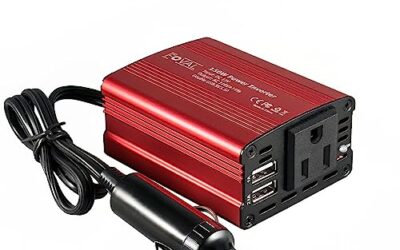
Pros
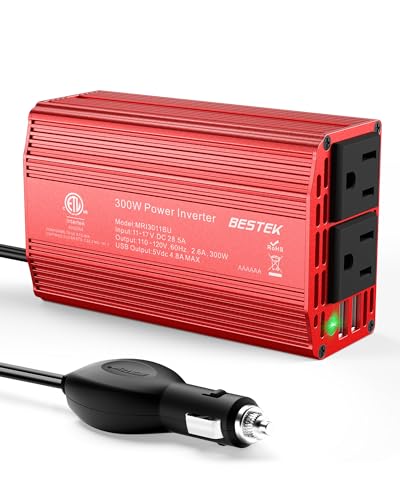
- Two AC outlets and two USB ports provide multiple charging options
- 300W continuous output supports larger devices such as laptops and tablets
- Built-in 40-amp fuse and multiple listed protection features
- Compact, iPhone-sized design with a 32-inch vehicle power cable
Cons
- Continuous output is limited to 300W; 700W is listed as instantaneous power
- Vehicle compatibility is specified for 11-17V input, with no broader vehicle list provided
Specifications
| Color | Red |
|---|---|
| Size | 1 - Power Inverter |
| Dimensions | 4.8 x 3.1 x 1.9 Inches |
| Weight | 0.9 Pounds |
| Product Group | Automotive Parts and Accessories |
| Binding | Electronics |
Best For / Avoid If
Best for buyers prioritizing
- Two AC outlets and two USB ports provide multiple charging options
- 300W continuous output supports larger devices such as laptops and tablets
- Built-in 40-amp fuse and multiple listed protection features
Consider another option if
- Continuous output is limited to 300W; 700W is listed as instantaneous power
- Vehicle compatibility is specified for 11-17V input, with no broader vehicle list provided
FAQ
What does the beep on my car inverter mean?
It typically means the inverter has detected a fault condition such as overheating or low voltage to protect the system.
How can I stop my car inverter from beeping?
Address the underlying cause by checking battery voltage, ensuring good ventilation, and reducing load if overloaded.
Is it safe to ignore the beeping?
No, it is not safe. Continuing to operate a faulty inverter can lead to further damage, fire hazards, or reduced vehicle performance.
Does vehicle model year affect inverter beeping?
Yes, newer model years often have improved inverter designs with better fault detection and cooling, but compatibility with modifications must be verified.
Can firmware updates fix the issue?
In vehicle-integrated systems, yes, but this should be done by a professional to avoid complications.