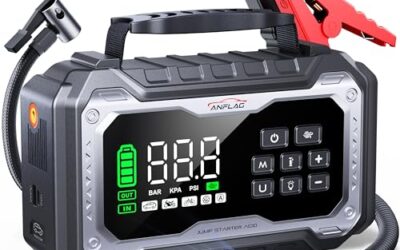
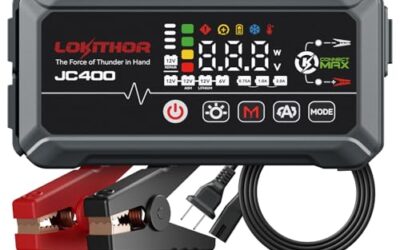
If your jump starter says reverse polarity, stop and do not crank the engine; the clamps may be reversed, poorly connected, or seeing a battery condition the unit cannot read safely. Turn the jump starter off if its instructions call for that, then check the connection against the vehicle and jump-starter manuals.
- Red clamp belongs on the vehicle’s positive jump point; black clamp belongs on the specified negative point or ground point.
- A warning can also appear with loose clamps, dirty or painted contact points, a deeply discharged battery, or a faulty connection.
- Do not bypass the warning or use an override unless the jump-starter manual specifically permits it for your situation.
- Stop if battery case is swollen, cracked, leaking, hot, or smells unusual.
Quick symptom-to-cause checklist
| What you see | Possible cause | Safe first check |
|---|---|---|
| Alert appears as soon as clamps touch | Clamps may be reversed, or one clamp may not have a sound connection. | Check positive and negative markings, then inspect clamp placement and contact. |
| Alert appears only after connecting both clamps | Clamp order, grounding point, or battery condition may be confusing the unit’s protection circuit. | Follow the vehicle’s jump-start points and the starter’s connection sequence. |
| Polarity alert remains after correcting clamp placement | Corrosion, paint, a loose battery terminal, damaged cable, or a very low battery may interfere with detection. | Stop and inspect accessible connections without forcing or twisting them. |
| Alert appears with clamps on marked terminals, but readings seem reversed | Battery, wiring, or terminal identification may be incorrect or faulty. | Do not attempt a jump. Ask a qualified technician to test the circuit. |
| Warning comes with heat, sparks, smoke, swelling, or leakage | Possible short circuit, damaged battery, or other electrical fault. | Stop immediately. Keep clear and arrange professional help. |
What reverse polarity means on a jump starter
Reverse polarity means the device detects an electrical connection that appears opposite to its expected positive and negative orientation. Most portable jump starters use clamp leads and electronic protection to detect connection problems and block or limit output. Exact warning labels and protection behavior vary by model.
The alert does not prove that you physically swapped the clamps. The unit may be reacting to poor contact, damaged cables, battery voltage outside its operating range, or a vehicle connection that differs from a conventional battery-terminal setup. Treat the alert as a stop signal, not as a diagnosis.
What to do when the alert appears
- Stop the start attempt. Do not turn the key or press the start button while the warning is active. Do not keep reconnecting clamps to see if the message clears.
- Switch off and disconnect as directed. Follow the jump starter’s shutdown and clamp-removal instructions. If the manual gives a specific order, use that order. Avoid letting the metal jaws touch each other or vehicle metal while connected.
- Check polarity markings. Find the battery’s plus and minus marks, or the vehicle’s labeled jump-start points. Red usually connects to positive, but some vehicles require connection at designated remote terminals rather than directly at the battery.
- Check the grounding point. Some vehicle manuals direct the negative clamp to a designated chassis ground instead of the battery’s negative post. Use the point specified for your model year and powertrain.
- Inspect clamp contact. Clamps need secure contact on an appropriate conductive surface. Dirt, corrosion, paint, or a clamp gripping a plastic cover can prevent a reliable connection. Do not scrape, bend, or force a terminal if access is unclear.
- Try again only if manuals allow it. Reconnect using the stated sequence and correct points. If the warning returns, stop and seek help instead of using an override or repeated attempts.
Why a jump starter may report reverse polarity
Clamps are on the wrong terminals
This is the most direct possibility. Check the battery symbols rather than relying on cable color, terminal position, or memory. Battery layouts differ, and previous repairs can change cable routing. If markings are hidden or unclear, do not guess.
Clamp contact is weak
A clamp on corrosion, paint, a loose terminal, or a surface that is not a proper connection point may produce an unstable reading. Battery posts and terminals can also be difficult to reach. Do not move a clamp around exposed wiring or nearby metal in search of a better spot. Use vehicle-approved points.
Battery charge is extremely low or battery is damaged
Some jump starters need to detect a minimum battery voltage before they enable output. A deeply discharged or failed battery may fall outside that range, and device behavior differs by model. A battery with a damaged case, leakage, unusual heat, or swelling should not be jump-started.
Do not assume that a reverse-polarity alert means the battery only needs more charge. A battery can be discharged because of an electrical fault, age, or a charging problem. Repeated boosting may leave the underlying cause unresolved.
Vehicle uses a different jump-start arrangement
Model year, engine, hybrid system, and battery location can change the correct connection points. Some vehicles put the battery in the trunk or under a seat and provide remote jump terminals in the engine bay. A hybrid may have a low-voltage battery and separate high-voltage components. Never connect a portable starter to orange high-voltage cables or terminals.
Use the owner’s manual for the exact vehicle, not a generic diagram. If you need a starter for a specific engine or vehicle type, see our guide to jump starters for diesel trucks or our overview of jump starters for SUVs. Those buying guides do not replace the vehicle’s connection instructions.
Compatibility checks before another attempt
- Voltage: Match the jump starter to the vehicle’s low-voltage system. A 12-volt starter is not a substitute for equipment specified for a different system.
- Vehicle connection points: Use terminals and ground points approved for that vehicle and model year. Battery location alone does not establish the right connection.
- Battery chemistry and condition: Follow the jump-starter manual for supported battery types and conditions. Do not use a unit on a damaged battery.
- Vehicle type: Hybrids, start-stop vehicles, and vehicles with battery sensors may have special procedures. Follow the vehicle manual, including any required sequence or post-start steps.
- Starter condition: Check its charge state, cables, clamp insulation, and error-message guidance. A damaged lead or clamp calls for service or replacement, not a workaround.
Common mistakes
- Trying to crank through the warning: Protection alerts exist to stop unsafe output. Do not assume the starter will block every possible mistake.
- Using an override without checking its purpose: Some models offer a manual override for limited situations, but its risks and steps are model-specific. Use it only when the manual says it applies and you can verify the terminals.
- Connecting to a convenient metal part: Not every bolt or body panel is an approved ground. Follow the vehicle’s designated point.
- Repeatedly clamping onto corroded terminals: Poor contact can cause sparks or heat and may not fix the alert. Stop if connection surfaces are damaged or inaccessible.
- Assuming a successful start means the problem is fixed: A jump can start the engine without correcting a weak battery, charging-system fault, or electrical drain.
When to get professional help
Call roadside assistance or a qualified technician if polarity markings are unclear, the warning persists after a careful manual-based check, or the vehicle’s battery and wiring show damage. Get help immediately for smoke, sparks, unusual heat, leaking fluid, a swollen battery, or a strong sulfur-like odor. Do not handle a damaged battery or continue testing it with a portable starter.
Professional testing can separate a discharged battery from a failed battery, poor connection, charging fault, or vehicle electrical problem. If the vehicle starts after a jump but later fails again, arrange testing rather than relying on another boost. Battery storage and handling also matter; see our instructions on storing a car battery safely.
Frequently asked questions
Can I jump-start the car if the warning remains?
No. Stop while the alert is active. Correct the connection only by following both manuals; if the warning remains, use roadside assistance or professional diagnosis.
Does reverse polarity always mean I reversed the clamps?
No. Reversed clamps are one cause, but weak contact, a very low or damaged battery, and vehicle-specific connection points can also trigger an alert.
Can I use override mode to bypass the alert?
Only if the jump-starter manual specifically describes an override and the exact situation fits its instructions. It can remove a protection check, so do not use it to guess at polarity or connection points.
Why does the warning appear even though red is on positive?
The clamp may not have a sound connection, the black clamp may be on an unapproved point, or the battery or wiring may be faulty. Check the vehicle’s jump-start diagram, then stop if the alert persists.
Sources and further reading
- Battery Council International: Battery industry information and resources for drivers.