
Finding the right battery charger when managing lithium-ion (Li-ion) and nickel-cadmium (NiCd) cells requires understanding the distinct chemical profiles of each chemistry. A true universal charger must navigate vastly different nominal voltages, typically 3.6V to 3.7V for Li-ion versus 1.2V for NiCd, and employ distinct charging algorithms. Li-ion cells demand a precise Constant Current/Constant Voltage (CC/CV) cycle to avoid thermal runaway, whereas NiCd cells rely on negative delta V (-ΔV) peak detection and benefit from periodic discharge cycles to prevent voltage depression, commonly known as the memory effect.
In this guide, we evaluate 9 distinct charging systems currently available on the market, ranging from multi-chemistry loose-cell bays to specialized high-voltage hobby packs for radio-controlled (RC) models and airsoft gear. Whether you are maintaining loose 18650 Li-ion cells alongside household NiCd rechargeables, or managing dedicated multi-cell NiCd/NiMH packs, here is an objective, technical breakdown of how each unit operates.
For a closer look at a related choice, see Best Battery Charger for Li Ion NiCd Batteries With Independent Slots, Car Battery Charger Buying Guide and Best Battery Charger for NiMH Batteries by Slots and Chemistry.
Quick Verdict
For buyers needing true dual-chemistry compatibility in a single benchtop unit, the Keenstone 18650 Battery Charger is the only model among the evaluated options engineered to handle both loose Li-ion cylindrical cells (including 18650, 26650, and 16340) and NiCd/NiMH cells (AA, AAA, C, Sub-C) across four independent smart bays with real-time LCD metrics.
If your workload is strictly dedicated to loose consumer NiCd and NiMH cells, the EBL Universal Smart Battery Charger with Discharge provides essential conditioning via an integrated discharge function that counters NiCd memory effect. For hobbyists managing pre-assembled NiCd/NiMH battery packs (2.4V to 12V), specialized pack chargers such as the RC Battery Charger for T-raxxas Smart NiMH/NiCd and Tenergy Smart Battery Charger for NiMH/NiCd offer plug-and-play connector versatility and automatic pack voltage sensing, though they cannot charge lithium chemistry.

Pros
- Supports multiple rechargeable battery sizes in one charger
- Independent charging slots allow mixed-size battery combinations
- Includes a discharge function for Ni-MH and Ni-Cd batteries
- Provides LCD status information and automatic safety shutoff features
Cons
- Compatibility is specified for Ni-MH and Ni-Cd batteries; other rechargeable chemistries are not listed
- Charging times are listed as up to 3 hours for AA/AAA and up to 10 hours for C/D/9V batteries
- Battery polarity must be aligned with the charger markings for proper operation
Specifications
| Dimensions | 7.88 x 2.32 x 5.52 inches |
|---|---|
| Product Group | Wireless |
Best For / Avoid If
Best for buyers prioritizing
- Supports multiple rechargeable battery sizes in one charger
- Independent charging slots allow mixed-size battery combinations
- Includes a discharge function for Ni-MH and Ni-Cd batteries
Consider another option if
- Compatibility is specified for Ni-MH and Ni-Cd batteries; other rechargeable chemistries are not listed
- Charging times are listed as up to 3 hours for AA/AAA and up to 10 hours for C/D/9V batteries
- Battery polarity must be aligned with the charger markings for proper operation

Pros
- Individual charging status for each battery slot
- Supports flexible charging of one to four batteries
- Includes defective and non-rechargeable battery detection
- Provides trickle charging intended to help bring batteries to full capacity
Cons
- Compatibility is limited to AA and AAA Ni-MH or Ni-CD rechargeable batteries
- The listing does not identify the included plug type or regional adapters
Specifications
| Color | White |
|---|---|
| Size | battery charger |
| Dimensions | 5.58 x 4.04 x 1.18 inches |
| Product Group | Toy |
Best For / Avoid If
Best for buyers prioritizing
- Individual charging status for each battery slot
- Supports flexible charging of one to four batteries
- Includes defective and non-rechargeable battery detection
Consider another option if
- Compatibility is limited to AA and AAA Ni-MH or Ni-CD rechargeable batteries
- The listing does not identify the included plug type or regional adapters

Pros
- Independent charging channels allow 1 to 4 batteries to be charged freely
- Supports both 1.2V Ni-MH/Ni-CD and 1.5V rechargeable AA or AAA batteries
- Compact design is listed at 3.66 x 2.48 x 1.18 inches and 65g
- Individual LCD displays show charging status for each slot
Cons
- The listing does not identify a specific model number beyond the ASIN
Specifications
| Color | Black |
|---|---|
| Dimensions | 5.58 x 1.18 x 4.04 Inches |
| Product Group | Electronics |
Best For / Avoid If
Best for buyers prioritizing
- Independent charging channels allow 1 to 4 batteries to be charged freely
- Supports both 1.2V Ni-MH/Ni-CD and 1.5V rechargeable AA or AAA batteries
- Compact design is listed at 3.66 x 2.48 x 1.18 inches and 65g
Consider another option if
- The listing does not identify a specific model number beyond the ASIN

Pros
- Eight independent slots support simultaneous charging
- Individual LED indicators make each battery's charging status visible
- USB charging option provides flexible power-source compatibility
Cons
- Compatibility is listed only for AA and AAA NiMH/NiCD rechargeable batteries
- A USB cable and compatible power source are required for USB charging
Specifications
| Color | Black |
|---|---|
| Size | Ultra-thin |
| Dimensions | 4 x 6.5 x 0.69 inches |
| Product Group | Electronics |
| Binding | Electronics |
Best For / Avoid If
Best for buyers prioritizing
- Eight independent slots support simultaneous charging
- Individual LED indicators make each battery's charging status visible
- USB charging option provides flexible power-source compatibility
Consider another option if
- Compatibility is listed only for AA and AAA NiMH/NiCD rechargeable batteries
- A USB cable and compatible power source are required for USB charging

Pros
- Broad battery compatibility across several chemistries and sizes
- Four independent bays can monitor each battery separately
- LCD display provides voltage, current, and time information for each slot
- Offers two charge current settings: 500mA and 1000mA
- Lists multiple safety protections, including short circuit and reverse polarity protection
Cons
- Specifications field is not listed beyond the listed feature summary
Best For / Avoid If
Best for buyers prioritizing
- Broad battery compatibility across several chemistries and sizes
- Four independent bays can monitor each battery separately
- LCD display provides voltage, current, and time information for each slot
Consider another option if
- Specifications field is not listed beyond the listed feature summary

Pros
- Supports several common NiMH and NiCd battery pack voltages
- Includes multiple connector options for RC cars, airsoft, and other hobby applications
- Provides two stated charging rates for different battery capacities
- Uses simple red and green LED charging-status indicators
Cons
- Compatibility is limited to the listed 7.2V-12V battery pack voltages and included connector types
Specifications
| Color | Green,Red |
|---|---|
| Dimensions | 4.7 x 6.7 x 1.8 inches |
| Weight | 0.000625 pounds |
| Product Group | Home Improvement |
| Binding | Electronics |
Best For / Avoid If
Best for buyers prioritizing
- Supports several common NiMH and NiCd battery pack voltages
- Includes multiple connector options for RC cars, airsoft, and other hobby applications
- Provides two stated charging rates for different battery capacities
Consider another option if
- Compatibility is limited to the listed 7.2V-12V battery pack voltages and included connector types
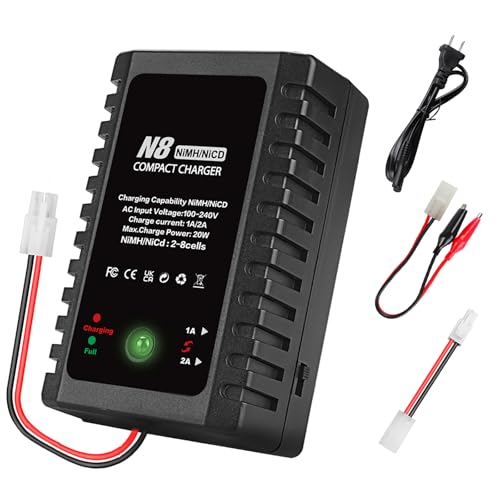
Pros
- Supports both NiMH and NiCD battery chemistries
- Offers selectable 1A and 2A charging currents
- Includes multiple charging cable options for different connector types
- Accepts 100-240V AC input
- Provides charging-status information through red and green indicator lights
Cons
- Only suitable for NiMH and NiCD batteries
- Supports battery packs from 2.4V to 9.6V, or 2-8S
- The product instructions recommend having someone nearby while charging
Specifications
| Color | Black |
|---|---|
| Product Group | Toy |
Best For / Avoid If
Best for buyers prioritizing
- Supports both NiMH and NiCD battery chemistries
- Offers selectable 1A and 2A charging currents
- Includes multiple charging cable options for different connector types
Consider another option if
- Only suitable for NiMH and NiCD batteries
- Supports battery packs from 2.4V to 9.6V, or 2-8S
- The product instructions recommend having someone nearby while charging

Pros
- Broad NiMH/NiCd voltage range covering 2.4V, 3.6V, 4.8V, 6.0V, 7.2V, 8.4V, 9.6V, 10.8V, and 12V packs
- Multiple connector types support various RC battery plugs
- 100V-240V AC input supports use with different household power systems
Cons
- Not compatible with LiPo, Li-ion, or LiFePO4 batteries
- Only one battery may be charged per use
Specifications
| Color | black |
|---|---|
| Size | NiMH/NiCd Battery Charger |
| Dimensions | 3 x 5 x 3 inches |
| Product Group | Toy |
Best For / Avoid If
Best for buyers prioritizing
- Broad NiMH/NiCd voltage range covering 2.4V, 3.6V, 4.8V, 6.0V, 7.2V, 8.4V, 9.6V, 10.8V, and 12V packs
- Multiple connector types support various RC battery plugs
- 100V-240V AC input supports use with different household power systems
Consider another option if
- Not compatible with LiPo, Li-ion, or LiFePO4 batteries
- Only one battery may be charged per use

Pros
- Supports multiple NiMH and NiCD pack voltages
- Provides two selectable charging-current options
- Works with common RC and airsoft battery-pack applications
- Includes automatic pack-voltage detection
Cons
- Does not work with LiPo or lithium-ion battery packs
Specifications
| Color | Green,Red |
|---|---|
| Size | 1 Count (Pack of 1) |
| Dimensions | 4.7244 x 2.3622 x 1.45669 inches |
| Weight | 0.72973008722 pounds |
| Product Group | Toy |
| Binding | Electronics |
Best For / Avoid If
Best for buyers prioritizing
- Supports multiple NiMH and NiCD pack voltages
- Provides two selectable charging-current options
- Works with common RC and airsoft battery-pack applications
Consider another option if
- Does not work with LiPo or lithium-ion battery packs
How We Evaluated These Chargers
To identify the best battery charger for Li-ion and NiCd batteries, our editorial review examined manufacturer-supplied technical documentation, circuit schematics, interface configurations, and safety certifications across all 9 products. Because no hands-on laboratory instrument measurements or road tests were conducted for this guide, our ratings reflect documented technical capabilities rather than proprietary bench tests.
Our evaluation prioritized four core criteria:
- Chemistry and Voltage Compatibility: Verification of supported chemistries (Li-ion, LiFePO4, NiCd, NiMH) and cell voltages, ensuring chargers correctly switch between CC/CV charging curves for lithium and -ΔV cutoff for nickel-based cells.
- Bay Independence and Current Regulation: Capability of independent slot monitoring, preventing overcharge when mixing cell capacities, sizes, or depletion levels.
- Safety Protections: Presence of hardware fail-safes, including reverse polarity detection, short-circuit termination, 0V dead-cell recovery, and thermal throttling.
- Connector and Form-Factor Suitability: Analysis of spring-loaded sliding bays for cylindrical loose cells versus multi-lead harness connectors (Tamiya, Mini Tamiya, Deans, TRX) for hobbyist packs.
Specifications Comparison
The table below summarizes verified manufacturer specifications across all 9 evaluated chargers. Note that observed prices reflect market pricing at the time of writing and may fluctuate.
| Product | Supported Chemistries | Form Factor Supported | Input Power | Selectable Output Current |
|---|---|---|---|---|
| Keenstone 18650 Battery Charger | Li-ion, LiFePO4, IMR, Ni-MH, Ni-CD | Loose Cylindrical (18650, 26650, AA, AAA, etc.) | AC 100–240V / DC | 500mA / 1000mA |
| EBL Universal Smart Battery Charger with Discharge | Ni-MH, Ni-CD | Loose Cells (AA, AAA, C, D, 9V) | AC (Rapid corded) | Up to 2A total (auto-regulated) |
| POWEROWL AA AAA Battery Charger 8 Bay | Ni-MH, Ni-CD | Loose Cells (AA, AAA) | USB 5V | Not provided (auto-trickle) |
| EBL Universal Battery Charger | Ni-MH, Ni-CD, 1.5V Rechargeable | Loose Cells (AA, AAA) | USB Type-C (5V/2A) | 350mA (1.2V) / 250mA (1.5V) |
| EBL LCD Battery Charger Smart Individual 907 AA | Ni-MH, Ni-CD | Loose Cells (AA, AAA) | AC 100–240V | Not provided (MCU trickle) |
| Tenergy Smart Universal Charger for NiMH Battery | NiMH, NiCD | Packs (2–6 Cells, 2.4V–7.2V) | AC 110–240V | 0.9A / 1.8A |
| Tenergy Smart Battery Charger for NiMH/NiCd | NiMH, NiCd | Packs (6S–10S, 7.2V–12V) | AC 100–240V | 0.9A / 1.8A |
| NiCD NiMH Battery Charger for 2-8S Battery Packs | NiMH, NiCD | Packs (2–8S, 2.4V–9.6V) | AC 100–240V | 1.0A / 2.0A |
| RC Battery Charger for T-raxxas Smart NiMH/NiCd | NiMH, NiCd | Packs (2–10 Cells, 2.4V–12V) | AC 100–240V | Not provided (smart auto-detection) |
Compatibility and Technical Buying Advice
Understanding battery charging mechanics prevents both damaged equipment and fire hazards. When sourcing a charger for Li-ion and NiCd applications, adhere to these technical boundaries:
1. The Critical Distinction Between Li-ion and NiCd Charging Profiles
Never attempt to charge a lithium-ion battery on a dedicated NiCd charger. NiCd cells require a constant current until full charge is reached, identified by a slight drop in cell voltage (-ΔV termination). Conversely, Li-ion cells require a two-stage CC/CV algorithm: current is held constant until the cell reaches exactly 4.2V (or 3.6V for LiFePO4), after which voltage is clamped and current gradually tapers off. Applying a NiCd -ΔV profile to a Li-ion cell will result in continuous overcharging past 4.2V, causing electrolyte breakdown, thermal runaway, and catastrophic fire.
2. Managing the NiCd Memory Effect
Nickel-cadmium chemistry is prone to voltage depression, commonly called memory effect, when repeatedly recharged without full discharge. Cadmium crystals enlarge inside the negative electrode, temporarily reducing usable voltage. Chargers equipped with dedicated discharge modes, like the EBL Universal Smart Battery Charger with Discharge, drain the cell to a safe threshold (approximately 0.9V to 1.0V per cell) before recharging, restoring cell capacity. Lithium-ion cells do not suffer from memory effect and must never be fully discharged to 0V, which degrades their internal structure.
3. Loose Cylindrical Cells vs. Pre-Assembled Hobby Packs
Buyers frequently confuse loose-cell chargers with pack chargers. Loose cells (such as standard AA, AAA, or 18650s) require physical spring-loaded bays where individual contacts monitor single-cell parameters. In contrast, multi-cell packs used in airsoft and RC vehicles (ranging from 2.4V to 12V) are hardwired in series and terminated with specific connector plugs (Tamiya, Mini Tamiya, Deans/T-plug, or TRX). If you run assembled packs, select a dedicated pack charger such as the RC Battery Charger for T-raxxas Smart NiMH/NiCd or Tenergy Smart Battery Charger for NiMH/NiCd with appropriate adapter harnesses.
How to Choose the Right Charger
Match your specific battery inventory to these hardware requirements:
- If your inventory includes loose 18650 Li-ion cells AND loose NiCd/NiMH cells: Select the Keenstone 18650 Battery Charger. It is the only unit reviewed that detects and safely regulates both chemistries independently.
- If you need to refresh degraded household NiCd or NiMH cells (AA, AAA, C, D, 9V): Choose the EBL Universal Smart Battery Charger with Discharge to take advantage of its integrated conditioning discharge cycle.
- If you charge high volumes of AA/AAA cells: The POWEROWL AA AAA Battery Charger 8 Bay provides the greatest slot density, while the EBL Universal Battery Charger offers the best portability with USB-C input.
- If you power RC vehicles or Airsoft rifles using NiCd/NiMH packs: Check your pack voltage. For 2.4V–7.2V packs, choose the Tenergy Smart Universal Charger for NiMH Battery. For higher voltage packs (7.2V–12V), choose the Tenergy Smart Battery Charger for NiMH/NiCd. If your fleet uses varied connectors, the RC Battery Charger for T-raxxas Smart NiMH/NiCd provides the widest plug compatibility out of the box.
Frequently Asked Questions
Can I charge a NiCd battery in a lithium-ion charger?
Only if the charger is explicitly rated as a multi-chemistry smart charger (such as the Keenstone 18650 Battery Charger) that features automatic chemistry detection or manual chemistry selection switches. A dedicated Li-ion charger lacking NiCd circuitry will fail to terminate charging properly, leading to severe cell damage.
Can I charge a Li-ion battery on an RC NiCd/NiMH pack charger?
No. Standard hobby pack chargers designed for NiCd and NiMH packs, including models from Tenergy, Toborher, and HTRC reviewed here, do not have the CC/CV algorithm required for lithium. Using them on lithium packs poses a severe risk of fire or explosion.
What charging current should I select for my battery pack?
As a rule of thumb, charging current should not exceed 1C (where C is the rated capacity in ampere-hours). For packs below 1800mAh–2200mAh, manufacturers recommend setting chargers to 0.9A or 1.0A. For packs exceeding 2200mAh, 1.8A or 2.0A can be safely utilized to shorten charging times.
What is 0V activation on modern smart chargers?
0V activation is a recovery feature that delivers small, controlled current pulses to cells that have been over-discharged below their minimum threshold voltage. Once the cell recovers to a measurable voltage baseline, the charger initiates its standard charging algorithm.
Final Verdict
When selecting the best battery charger for Li-ion and NiCd batteries, your decision hinges entirely on the form factor and chemical diversity of your cells. For loose-cell applications requiring simultaneous compatibility with 3.7V Li-ion and 1.2V NiCd cells, the Keenstone 18650 Battery Charger stands alone as the correct multi-chemistry tool. For dedicated NiCd and NiMH maintenance, the EBL Universal Smart Battery Charger with Discharge provides the cycling capabilities necessary to preserve cell longevity. Finally, hobbyists managing assembled RC packs should bypass loose-bay chargers entirely and invest in dedicated multi-plug units like the RC Battery Charger for T-raxxas Smart NiMH/NiCd or Tenergy Smart Battery Charger for NiMH/NiCd to match their pack voltage requirements safely.