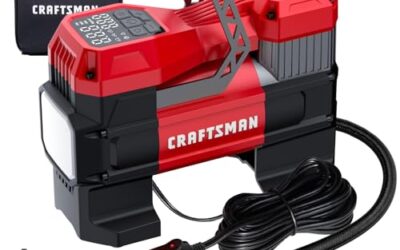
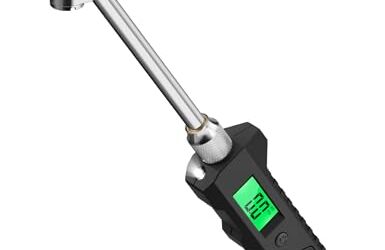
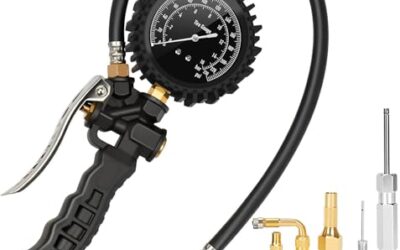
For most truck owners, the VIAIR 88P is the strongest portable tire inflator for trucks because it connects to the vehicle battery, includes a 16-foot air hose and 10-foot power cord, and is rated for tires up to 33 inches. If you want cordless operation or need to inflate several tires between charges, a battery-powered model such as the ETENWOLF VORTEX S7 may fit better, but its higher capacity and premium positioning are not necessary for every pickup.

Specifications
| Color | Yellow |
|---|---|
| Size | Large |
| Dimensions | 8.93 x 4.8 x 6.88 inches |
| Weight | 1.1 Grams |
| Product Group | Automotive Parts and Accessories |
Pros
- Offers both cordless battery operation and 12V DC vehicle power
- Supports up to 20 minutes of continuous operation
- Can inflate up to four standard vehicle tires on a full battery charge
- Includes a storage bag and multiple nozzle adapters
Cons
- The package does not include a charger, although it includes a USB-C charging cord
- Battery capacity is described as up to four standard vehicle tires per full charge
- Continuous operation is limited to up to 20 minutes
Specifications
| Color | Yellow |
|---|---|
| Size | Large |
| Dimensions | 6.692913379 x 3.149606296 x 9.448818888 inches |
| Weight | 2.535316013 Pounds |
| Product Group | Automotive Parts and Accessories |
| Binding | Tools & Home Improvement |
Best For / Avoid If
Best for buyers prioritizing
- Offers both cordless battery operation and 12V DC vehicle power
- Supports up to 20 minutes of continuous operation
- Can inflate up to four standard vehicle tires on a full battery charge
Consider another option if
- The package does not include a charger, although it includes a USB-C charging cord
- Battery capacity is described as up to four standard vehicle tires per full charge
- Continuous operation is limited to up to 20 minutes

Specifications
| Color | Orange |
|---|---|
| Dimensions | 2.9527559025 x 5.511811018 x 3.149606296 inches |
| Weight | 0.96 Pounds |
| Product Group | Automotive Parts and Accessories |
| Binding | Sports |

Specifications
| Color | Silver |
|---|---|
| Size | Stock |
| Dimensions | 9.8 x 3.2 x 5.6 inches |
| Weight | 4.75 pounds |
| Product Group | Automotive Parts and Accessories |
| Binding | Automotive |

Specifications
| Color | Yellow, Black |
|---|---|
| Dimensions | 3.7 x 7.1 x 4.1 inches |
| Product Group | Tools |

Specifications
| Color | Orange |
|---|---|
| Size | Small |
| Dimensions | 8.66 x 3.15 x 7.1 Inches |
| Weight | 6.61386786 pounds |
| Product Group | Automotive Parts and Accessories |
| Binding | Tools & Home Improvement |

Specifications
| Color | Silver |
|---|---|
| Size | 8.7*7*3.1 inch |
| Dimensions | 8.7007873927 x 6.99999999286 x 3.09842519369 inches |
| Weight | 6 Pounds |
| Product Group | Automotive Parts and Accessories |
| Binding | Automotive |

Specifications
| Color | Yellow |
|---|---|
| Size | 12000 |
| Dimensions | 7.3 x 3.8 x 2.5 inches |
| Weight | 3.2 Pounds |
| Product Group | Automotive Parts and Accessories |

Specifications
| Color | Olive Green |
|---|---|
| Size | 38400 mAh |
| Dimensions | 11.8 x 9.4 x 5.5 inches |
| Weight | 6.3 pounds |
| Product Group | Automotive Parts and Accessories |

Specifications
| Color | Red |
|---|---|
| Size | 6.49 x 2.79 x 4.92 inch |
| Dimensions | 6.49 x 2.79 x 4.92 Inches |
| Weight | 2.16 Pounds |
| Product Group | Automotive Parts and Accessories |
| Binding | Tools & Home Improvement |
Truck tire inflators: match the power source to the job
CarTechTalk may earn a commission from qualifying purchases through links in this article. That does not change the main decision: for a truck, tire size and the way the inflator gets power matter more than a high maximum-pressure figure alone.
A compressor that reaches 150 or 160 PSI is not automatically a good choice for larger truck tires. Maximum pressure does not tell you how quickly a unit will add air at your tire’s current pressure, how long it can run before cooling, or whether it can handle all four tires in one session. The useful details here are intended tire size, airflow where given, duty cycle, power connection, hose reach, and battery capacity.
Battery-clamp models draw power directly from the vehicle battery, while 12V accessory-plug units depend on the vehicle outlet and its limits. Cordless models trade that connection for a rechargeable battery, which needs to be charged and kept ready. For repeated off-road pressure changes, a corded compressor with a stated duty cycle or a high-capacity cordless unit is a more sensible starting point than a pocket-size pump meant for passenger-car top-offs.
Use the cold tire pressure on the vehicle’s tire placard or owner’s manual, not the maximum pressure molded into the tire sidewall. NHTSA’s tire safety guidance covers tire care and pressure checks. An inflator is for adding air, not repairing a damaged tire; follow the vehicle and tire maker’s instructions if a tire is losing pressure or appears damaged.
Best portable tire inflators for trucks
VIAIR 88P: best fit for off-road pickups
The VIAIR 88P is the clearest match for a truck owner who wants a battery-powered compressor for trail use. VIAIR rates it for tires up to 33 inches and gives it a 25-minute duty cycle at 30 PSI. Its 10-foot power cord and 16-foot hose give useful reach around a vehicle, while the carry case helps keep the unit and accessories together.
The tradeoff is that it is not cordless: the user must connect the alligator clamps to the vehicle battery and run the engine as the instructions specify. Its 120 PSI maximum is lower than many options here, and the stated 33-inch limit means owners of larger tires should look for a compressor rated for their tire size. Skip it if you need a battery-powered unit or your tires exceed its stated size limit.
ETENWOLF VORTEX S7: best for repeated inflation without engine power
The ETENWOLF VORTEX S7 pairs a 38,400 mAh battery with dual motors and a cooling system. Its manufacturer says the compressor can inflate four F-150 tires from zero to 35 PSI continuously, and rates the unit for a 100% duty cycle. That makes it a compelling cordless option for a pickup owner who regularly airs up multiple tires or wants to avoid a cable to the truck battery.
This is the premium choice, and its large battery makes it less appealing if the truck only needs occasional small top-offs. The manufacturer’s stated battery capacity and inflation count are product claims, not a guarantee for every tire, temperature, or starting pressure. Skip it if you do not need sustained cordless use and would rather carry a less costly, simpler compressor.
GSPSCN 12V Heavy Duty Tire Inflator Metal: best for fast battery-clamp inflation
The GSPSCN uses twin cylinders and connects to the battery with clamps. Its listed airflow is 70 liters per minute, and the company says it can inflate a 200/70/R18 tire from zero to 35 PSI in about a minute. For a pickup owner who wants a direct-battery setup and a quick way to add air, those specifications are more relevant than a high PSI ceiling by itself.
The supplied cord and hose are each 11.5 feet, which may limit placement on a long truck or when reaching tires on a trailer. Its advertised timing is for a particular tire size and pressure range, so do not assume the same result on larger truck tires. Skip it if cable reach or cordless convenience is a priority.
UUP Portable 12V Air Compressor: best budget dual-cylinder option
The UUP is a lower-cost battery-clamp compressor with dual metal cylinders and stated airflow of 70 liters per minute. The maker says it can inflate a 200/70/R18 tire from zero to 40 PSI in three minutes. It also includes a storage bag, adapters, a valve extender, and an LED light, which may suit a driver who wants a basic truck-oriented kit rather than a cordless pump.
Its power cord and air hose lengths are not given in the product details, so it is harder to judge reach on a full-size pickup before purchase. The stated inflation time is tied to one tire size and pressure range. Skip it if you need known cable reach, a rechargeable battery, or a stated duty-cycle figure for repeated use.
OlarHike 12000mAh: best hybrid option for cordless use and backup power
The OlarHike combines a 12,000 mAh battery with a 12V car power connection. Its dual-cylinder setup, onboard storage, twist-lock hose connection, and supplied second hose give it useful flexibility for a truck owner who wants cordless operation but also a vehicle-powered fallback. The product details describe a battery management system with over-current, temperature, and other protections.
The manufacturer’s claim of up to 44 tire inflations is based on a stated 195/65R15 tire and a narrow pressure change, not a full-size truck tire. That makes the number a poor guide to truck capacity. Skip it if you need a clear truck-tire capacity estimate or if you prefer the simpler direct-battery connection of the VIAIR, GSPSCN, or UUP.
AstroAI H2 Pro: best compact hybrid for mixed vehicle use
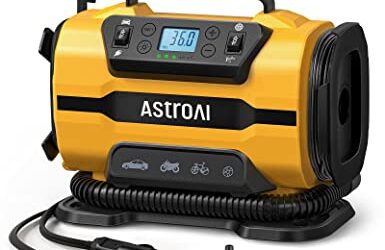
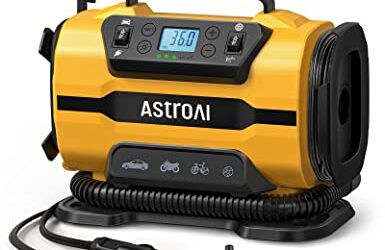
The AstroAI H2 Pro can run from its rechargeable battery or a 12V DC supply. The maker gives a cordless runtime of up to 18 minutes and up to 60 minutes on vehicle power. Its display shows current and target pressure, and the auto-stop feature can halt inflation at a preset pressure. Those options suit a driver who wants one compact unit for routine maintenance and occasional roadside use.
The product’s stated inflation example is for a standard car tire, not a truck tire, and its 150 PSI maximum does not establish capacity for large tires. Skip it if you regularly air down and refill large off-road tires or need a truck-specific duty-cycle rating.
AstroAI Cordless Tire Inflator Portable Air: best for cordless top-offs with backup power
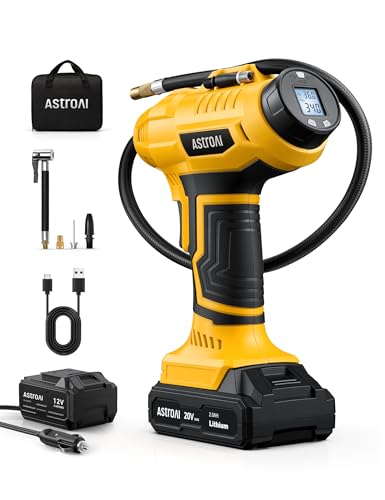
This AstroAI unit offers a rechargeable 20V battery plus a 12V DC vehicle adapter. The manufacturer says a full battery can inflate up to four standard vehicle tires, and the compressor can run continuously for up to 20 minutes. That combination is convenient for a truck owner who mainly corrects small pressure losses and wants a corded fallback when the battery is depleted.
The package includes a USB-C charging cord but no charger, so the buyer needs a compatible charging source. Its stated battery capacity is tied to standard tires, and its advertised 20-minute runtime is not a promise of a full set of large truck tires. Skip it if you need repeated high-volume inflation or want a charger included.
ROCGORLD R8: best simple 12V option for occasional use
The ROCGORLD R8 plugs into a 12V vehicle outlet and has a dual digital display for current and target pressure. It is a practical, compact choice for a truck that needs occasional tire-pressure correction, and the memory function can retain a prior setting. The maker describes a 10-foot power cord and 2-foot air hose.
This model has no built-in battery and cannot plug into a household AC outlet. The instructions call for a 12V DC supply in the stated range, so the truck’s outlet must be suitable for its power draw. Skip it if you want to inflate away from the vehicle, need a battery-clamp connection, or plan frequent off-road pressure changes.
DEWALT Tire Inflator: best for drivers already using its battery system
The DEWALT inflator supports a built-in rechargeable battery and a 12V vehicle connection. It includes a 10-foot 12V cord, preset modes, auto shutoff, and a three-year limited warranty according to the product details. For a truck owner who values a compact dual-power tool and wants a stated warranty term, it covers routine inflation needs without relying on one power source.
The supplied performance example is for a 195/65 R15 tire, and the product details do not establish an inflation capacity for larger truck tires. Its cordless battery is built in, rather than a removable truck-tool battery. Skip it if you need documented performance on large tires or want to swap in batteries from an existing tool platform.
AstroAI L7: compact, but not a heavy-duty truck pick
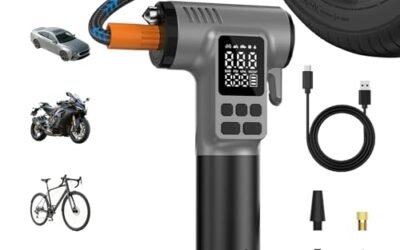
The AstroAI L7 weighs less than one pound and is meant for car, motorcycle, and bicycle tires. Its product details explicitly say it is incompatible with heavy-duty tires. That makes it a handy compact pump for a truck owner’s bicycle or other small inflatables, but not a sound choice for inflating the truck’s tires.
Do not buy the L7 as your primary truck compressor. Choose a unit with a stated truck or SUV use case and a power source that fits your intended inflation routine instead.
Which truck inflator should you choose?
| Use case | Product | Power source | Truck-specific detail |
|---|---|---|---|
| Off-road pickup use | VIAIR 88P | 12V battery clamps | Rated for tires up to 33 inches |
| Repeated cordless inflation | ETENWOLF VORTEX S7 | Built-in battery | Manufacturer cites continuous inflation across four F-150 tires |
| Battery-clamp value | GSPSCN 12V Heavy Duty | 12V battery clamps | 70 liters per minute stated airflow |
| Hybrid power | OlarHike 12000mAh | Built-in battery and 12V | Dual-cylinder configuration |
| Occasional top-offs | ROCGORLD R8 | 12V accessory outlet | Compact, vehicle-powered unit |
For occasional pressure corrections on a stock pickup, a 12V plug-in or hybrid model may be enough. For off-road use, start with tire diameter and how often you will refill after airing down. A stated maximum pressure cannot replace a size rating or duty-cycle information. If you expect to refill several large tires in one session, favor a compressor with a truck-specific capacity claim, a direct battery connection, or substantial cordless capacity.
One important boundary: none of the compact cordless car-oriented examples here should be assumed capable of repeated full inflation of large truck tires simply because the screen reaches a high PSI number. The L7 is explicitly ruled out for heavy-duty tires. For larger-than-33-inch tires or frequent trail use, compare compressors with a rating for your exact tire size and a stated duty cycle. A dedicated higher-volume off-road compressor may be a better buy than a small emergency inflator.
Who should skip these portable inflators?
Skip this group if you run very large tires, routinely service several vehicles, or need to inflate commercial-truck tires. Look instead for a compressor whose manufacturer specifies your tire diameter and intended workload, with enough hose and power-cord reach for your vehicle. Drivers who need only a roadside emergency tool should also consider whether a tire repair kit or roadside assistance is more appropriate; an air compressor cannot seal a puncture or make a damaged tire safe to drive.
Related reading: Best Heavy Duty Tire Inflator for Trucks, How To Maintain A Portable Tire Inflator and Tire Inflator Size Guide for Cars and Trucks.
Final recommendation
The VIAIR 88P is the most defensible first choice for a truck owner who wants a dedicated portable compressor and has tires within its stated 33-inch limit. Pick the ETENWOLF VORTEX S7 if cordless operation and repeated inflation matter enough to justify its premium position. The GSPSCN offers a more budget-conscious battery-clamp route, while the UUP is a lower-cost alternative with less documented cable reach. For a basic outlet-powered top-off tool, the ROCGORLD R8 keeps the setup simple. Match the compressor to the truck’s tire size and your real workload, not the highest pressure figure on the box.
Sources and further reading
- Tire Safety (NHTSA): Guidance on tire pressure, maintenance, and safe tire use.
- Keeping Your Vehicle in Shape (fueleconomy.gov): Practical vehicle maintenance information, including tire care.