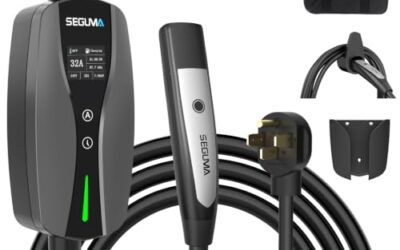
This WOLFBOX WE40 review points to a clear fit: drivers who want a 40-amp Level 2 charger with a NEMA 14-50 plug, J1772 connector, and 25-foot cable. WOLFBOX lists adjustable amperage, app scheduling, RFID access, and weather protection, but the unit needs a suitable 50-amp-or-greater circuit and a compatible receptacle.

Pros
- Long 25-foot cable can reach around obstacles and tight parking spots
- App supports charging schedules, amperage adjustment, and rate-based cost calculations
- RFID card and plug-and-charge options provide alternatives to app control
- NEMA 4X housing is described as waterproof and dustproof
Cons
- Requires a circuit breaker rated at 50A or greater
- Tesla EVs require a NACS adapter
WOLFBOX WE40 is a 40A, 240V Level 2 EV charger rated at 9.6 kW. It has a J1772 connector, NEMA 14-50 plug, and 25-foot cable. The source describes the housing as NEMA 4X waterproof and dustproof.
Charging options include app control, RFID card access, and plug-and-charge. The app supports scheduled charging sessions, amperage adjustment, and rate-based cost calculations. The source states that the charger requires a circuit breaker rated at 50A or greater. Tesla EVs require a NACS adapter.
The source lists CSA and FCC certification and states compliance with UL2594 standards.
Specifications
| Color | 40A/J1772 |
|---|---|
| Product Group | Automotive Parts and Accessories |
Detailed Review
Key features:
- 40A charging with 9.6 kW output
- J1772 connector and NEMA 14-50 plug
- 25-foot charging cable
- Adjustable amperage set manually using the dial code
- App control, RFID card access, or plug-and-charge operation
- App scheduling for up to four groups of charging sessions
Best For / Avoid If
Best for buyers prioritizing
- Long 25-foot cable can reach around obstacles and tight parking spots
- App supports charging schedules, amperage adjustment, and rate-based cost calculations
- RFID card and plug-and-charge options provide alternatives to app control
Consider another option if
- Requires a circuit breaker rated at 50A or greater
- Tesla EVs require a NACS adapter
The WOLFBOX WE40 40-amp plug-in charger suits a home setup where a properly installed NEMA 14-50 outlet is already available or planned. Its plug-in format can be a practical alternative to a hardwired charger, but the plug does not remove the need for a correctly rated circuit. The product information calls for a circuit breaker rated at 50 amps or greater.
That circuit requirement is the first purchase check, not a detail to sort out after delivery. A 40-amp charging load generally calls for a branch circuit sized for continuous use; follow applicable electrical rules and have a licensed electrician assess the home installation. The charger’s adjustable current can help match its setting to the available circuit, but it cannot make an undersized circuit safe. Its dial code must be set to match the home distribution panel, according to WOLFBOX.
CarTechTalk may earn a commission from qualifying purchases through links in this article. That does not change the electrical or vehicle compatibility requirements discussed here.
WOLFBOX lists output up to 9.6 kW and advertises up to 38 miles of range added per charging hour. Treat the miles-per-hour figure as a manufacturer estimate, not a promise for every vehicle. Actual range added depends on the vehicle and its energy use, while charging speed is also limited by the vehicle’s onboard charging system. The charger cannot make a vehicle accept more AC power than its onboard equipment supports.
For a closer estimate based on a particular vehicle and charging setup, see how to estimate home ev charging time. That distinction matters when comparing advertised charger output with the time a driver will see in daily use.
Outlet, circuit, and installation fit
The WE40’s NEMA 14-50 plug makes it relevant to a dedicated 240-volt receptacle of that type. It is not a universal plug for any outlet that happens to supply 240 volts. The receptacle, wiring, breaker, and installation must suit the charger’s load. A familiar outlet shape alone does not establish that a circuit is correctly wired or rated for sustained EV charging.
If the garage has no suitable receptacle, installation cost and feasibility become part of the buying decision. An electrician can assess panel capacity, circuit routing, outlet condition, and local code requirements. Do not use an extension cord or an adapter as a substitute for an appropriate installation unless the charger and electrical professionals explicitly permit that arrangement. The available product information does not establish support for every adapter or extension setup.
Its adjustable current is useful only within the limits of the circuit and the vehicle. The product information says the user should match the dial code to the home distribution panel. That setting is not a way to estimate safe capacity by guesswork. Ask the electrician to identify the allowable charger setting for the installed circuit, then follow the charger instructions.
Buyers deciding between plug-in and hardwired equipment should compare installation conditions, not assume one format always costs less. A suitable existing receptacle may make plug-in installation simpler. A home that needs new wiring or panel work may have different costs and constraints. WOLFBOX also sells a hardwired WE50 covered in the WOLFBOX WE50 review, but it is a different model and installation format.
J1772 compatibility and Tesla adapter needs
The WE40 uses a J1772 connector. WOLFBOX lists compatibility with J1772 electric vehicles and names models including the Chevrolet Bolt, Ford Mustang Mach-E, Kia EV6, Hyundai IONIQ 5, BMW i3, and Mercedes EQS. Those examples show the connector scope; they do not establish identical charging rates across those vehicles. Vehicle equipment determines the maximum AC charging rate.
For Tesla vehicles, WOLFBOX says a NACS adapter is required. That adapter is a separate compatibility step. Confirm the correct adapter for the specific vehicle and charging use, and check the vehicle manual for supported AC charging connections. Do not assume that an adapter changes the charger’s output or enables DC fast charging. This is a home AC Level 2 charger.
Connector compatibility should be checked against the car’s inlet and model-year guidance, especially for vehicles with market-specific equipment or adapters. If a household has more than one EV, the J1772 connector may suit one vehicle directly while another needs an adapter. That can be workable, but the adapter becomes an added part to keep track of and another point to confirm before charging.
App scheduling, RFID, and daily use
The WE40 supports app control, Wi-Fi, RFID cards, and plug-and-charge operation, according to the product description. These options let a household choose between access control and a simpler start method. RFID may suit a shared garage where drivers want to control who starts a session; plug-and-charge may suit a private space where that distinction is unnecessary.
WOLFBOX says its app can set up to four groups of charging sessions, with three time slots per group, adjust amperage, and calculate costs using custom electricity rates. Scheduled charging can help drivers target utility off-peak periods, but savings depend on the local rate plan and whether the vehicle or charger controls the schedule. Avoid setting overlapping schedules in multiple systems unless their behavior is understood; the car, charger, and utility plan can each affect when charging begins.
The app’s rate calculation depends on the electricity price entered by the user. It should be treated as an estimate based on that input, not as a utility bill. Drivers with a time-of-use plan should use the applicable rate periods and account for any fixed or tiered charges the app may not model.
WOLFBOX advertises charging control by app, RFID, or plug-and-charge. Those modes give households a choice, but they also create a setup decision: choose one routine and make sure other users know how to start a session. App functions rely on network access and the manufacturer’s software environment; the listing does not establish how every network configuration performs. Buyers who want a charger that works without app setup can favor plug-and-charge or RFID, while those seeking detailed remote scheduling may place more value on the app.
Cable reach and outdoor placement
The 25-foot cable gives more reach than a short lead, which can help when the vehicle’s charge port sits far from the outlet or when parking position varies. It does not guarantee reach in every garage: the route from outlet to vehicle matters, and the cable should not create a trip hazard or be pinched by a door. Measure the intended path before choosing an outlet location.
The product description identifies NEMA 4X housing and IP66 protection, and describes the charger as weatherproof and dustproof. Those ratings are useful when considering exposure, but they do not remove the need to follow installation and storage instructions. Keep the plug and receptacle in suitable condition, and avoid placing connections where water can pool or where vehicles can strike them. WOLFBOX also describes the unit as CSA and FCC certified and says it meets UL 2594 standards. These are manufacturer claims in the product information, not a substitute for checking the actual unit documentation and local installation requirements.
For outdoor charging, installation location matters as much as enclosure claims. Choose a position that allows the cable to reach without tension and keeps the connector from resting in standing water or being driven over. Follow the manual’s guidance on mounting, handling, and weather exposure.
Safety claims and limits of the product information
WOLFBOX describes eight electrical protections, including leakage current, overcurrent, and short-circuit protection. The listing also mentions internal temperature monitoring and a flame-retardant design. Those features are relevant, but protection electronics are not a substitute for correct wiring, a sound receptacle, or following the user manual. Stop using any charger or outlet that shows heat damage, unusual odor, cracking, or other signs of electrical trouble, and have the installation assessed by a qualified professional.
The description says key components undergo reliability checks and cites a flame-retardant design to 950°C. Those claims do not establish a service life or guarantee how the charger will perform in every environment. Likewise, a stated support commitment does not answer every question about repair, replacement, or long-term ownership. Buyers who prioritize support should review the current warranty and service terms before purchase rather than infer coverage from a support phrase.
The Alternative Fuels Data Center explains home EV charging and installation considerations in its guidance on charging electric vehicles at home and procurement and installation for EV charging infrastructure. Use those resources for general context, then apply local electrical rules and professional advice to the actual home.
Who should buy the WOLFBOX WE40?
Buy the WE40 if your vehicle accepts J1772 charging, or you have the correct Tesla NACS adapter, and your home can support a NEMA 14-50 setup on a properly rated circuit. It is a stronger fit for drivers who value a long cable, adjustable current, and choices between scheduled app use, RFID, and plug-and-charge. Its enclosure ratings may also matter to buyers considering a location with outdoor exposure, provided installation follows the manual.
Skip it if you need a charger that connects directly to a Tesla without an adapter, if your home cannot support the required circuit, or if you want a hardwired unit rather than a plug-in model. It is also a poor fit if you do not want to use Wi-Fi or app functions and would rather buy a simpler charger without those controls. The plug-in design does not avoid electrical work when a suitable receptacle is absent.
Do not buy anything in this guide if you need DC fast charging, a different connector without an adapter, or a charger that matches a circuit your electrician has not approved. Look instead for equipment that matches the vehicle inlet and the home’s verified electrical capacity. If installation needs are the main question, get an electrician’s assessment before choosing between plug-in and hardwired equipment.
Verdict
The WOLFBOX WE40 is a conditional pick for a home with the right 240-volt NEMA 14-50 installation and a compatible J1772 vehicle. Its 40-amp rating, 25-foot cable, adjustable setting, and app or RFID controls make a capable feature set on paper. The decision turns on circuit readiness and connector fit, not the advertised miles-per-hour figure alone. For drivers who need a different amperage or hardwired installation, compare the specific electrical requirements before choosing another model.
Sources and further reading
- Charging Electric Vehicles at Home (Alternative Fuels Data Center): General information on home charging options and installation.
- Procurement and Installation for EV Charging Infrastructure (Alternative Fuels Data Center): Guidance on planning and installing charging infrastructure.