The best professional battery tester for shops in this group is the TOPDON BT600: it covers 12V and 24V lead-acid batteries, checks battery, cranking, and charging systems, and prints results for shop records. Choose it when printed documentation matters; the FOXWELL BT705 costs less in product positioning and adds a long cable for one-person cranking checks, but lacks the BT600’s built-in printer.

Pros
- Supports several common household battery sizes
- Two testers are included in the package
- Does not require a battery to operate
- Small and lightweight design is suitable for portability
Cons
- The source data does not identify the tester's measurement range or accuracy details
Specifications
| Color | Black |
|---|---|
| Product Group | BISS |
Best For / Avoid If
Best for buyers prioritizing
- Supports several common household battery sizes
- Two testers are included in the package
- Does not require a battery to operate
Consider another option if
- The source data does not identify the tester's measurement range or accuracy details

Pros
- Supports multiple common battery sizes and types
- Includes separate voltage ranges for alkaline, rechargeable, and lithium button cell batteries
- Provides voltage and strength indications through an LED display
- Uses a three-step operating process
Cons
- The battery must be removed after testing
Specifications
| Color | Black |
|---|---|
| Size | Compact |
| Dimensions | 3.53 x 1 x 0.98 inches |
| Product Group | Automotive Parts and Accessories |
| Binding | Unknown Binding |
Best For / Avoid If
Best for buyers prioritizing
- Supports multiple common battery sizes and types
- Includes separate voltage ranges for alkaline, rechargeable, and lithium button cell batteries
- Provides voltage and strength indications through an LED display
Consider another option if
- The battery must be removed after testing

Pros
- Covers both 12V and 24V batteries across a 100-2000 CCA range
- Combines battery, starting-system, and charging-system diagnostics
- Lists compatibility with several battery types and vehicles or equipment, including cars, trucks, RVs, boats, motorcycles, lawn mowers, and golf carts
- Includes a color display, memory function, and copper clamps
Cons
- The listing does not include dimensions, weight, or connector specifications
Best For / Avoid If
Best for buyers prioritizing
- Covers both 12V and 24V batteries across a 100-2000 CCA range
- Combines battery, starting-system, and charging-system diagnostics
- Lists compatibility with several battery types and vehicles or equipment, including cars, trucks, RVs, boats, motorcycles, lawn mowers, and golf carts
Consider another option if
- The listing does not include dimensions, weight, or connector specifications

Pros
- Broad compatibility with several 12V battery types
- Displays multiple battery parameters, including voltage, internal resistance, CCA, and AH capacity
- Includes battery, starter, alternator, cranking, and charging system tests
- Can be used on batteries installed in a vehicle or removed from one
Cons
- The listing does not include detailed testing procedures or measurement conditions
Specifications
| Color | KW208 |
|---|---|
| Size | 7.8 x 2 x 12.7 inches |
| Dimensions | 0.787401574 x 3.0708661386 x 4.9999999949 inches |
| Weight | 0.5070632026 pounds |
| Product Group | BISS |
| Binding | Unknown Binding |
Best For / Avoid If
Best for buyers prioritizing
- Broad compatibility with several 12V battery types
- Displays multiple battery parameters, including voltage, internal resistance, CCA, and AH capacity
- Includes battery, starter, alternator, cranking, and charging system tests
Consider another option if
- The listing does not include detailed testing procedures or measurement conditions

Pros
- Covers multiple battery condition and vehicle charging-system checks
- Supports several battery types and global rating standards
- Backlit black-and-white display has adjustable contrast
- Compatible with cars, trucks, boats, RVs, ATVs, lawnmowers, golf carts, and motorbikes over 30Ah
Cons
- Not compatible with lithium or non-12V batteries
- Not intended for motorcycles below 30Ah
Specifications
| Color | Red |
|---|---|
| Size | BA101 |
| Dimensions | 9.5 x 7 x 2 inches |
| Weight | 0.3125 Pounds |
| Product Group | Automotive Parts and Accessories |
| Binding | Automotive |
Best For / Avoid If
Best for buyers prioritizing
- Covers multiple battery condition and vehicle charging-system checks
- Supports several battery types and global rating standards
- Backlit black-and-white display has adjustable contrast
Consider another option if
- Not compatible with lithium or non-12V batteries
- Not intended for motorcycles below 30Ah

Pros
- Combines battery, charging system, and starter motor tests in one device
- Supports both 6V and 12V batteries across a range of vehicle types
- Tests batteries up to 1000 cranking amps
- Heavy-duty construction includes a steel case and durable clamps
Cons
- The product information states that a little smoke or burning smell may occur during the initial burn-in period
- The package includes the tester and user manual, with no additional accessories listed
Specifications
| Color | Black |
|---|---|
| Size | Analog / BT-100 |
| Dimensions | 37.6 x 17.3 x 9.4 inches |
| Weight | 2 pounds |
| Product Group | BISS |
| Binding | Automotive |
Best For / Avoid If
Best for buyers prioritizing
- Combines battery, charging system, and starter motor tests in one device
- Supports both 6V and 12V batteries across a range of vehicle types
- Tests batteries up to 1000 cranking amps
Consider another option if
- The product information states that a little smoke or burning smell may occur during the initial burn-in period
- The package includes the tester and user manual, with no additional accessories listed

Pros
- Covers several common 12V lead-acid battery types
- Combines battery, cranking, and charging-system testing
- Compact design can be stored in a glove box or center console
- Does not require charging the tester before use
Cons
- Limited to 12V batteries
- The listing does not list detailed specifications beyond the stated battery compatibility and testing functions
- The tester powers on only after it is properly attached to a battery
Best For / Avoid If
Best for buyers prioritizing
- Covers several common 12V lead-acid battery types
- Combines battery, cranking, and charging-system testing
- Compact design can be stored in a glove box or center console
Consider another option if
- Limited to 12V batteries
- The listing does not list detailed specifications beyond the stated battery compatibility and testing functions
- The tester powers on only after it is properly attached to a battery
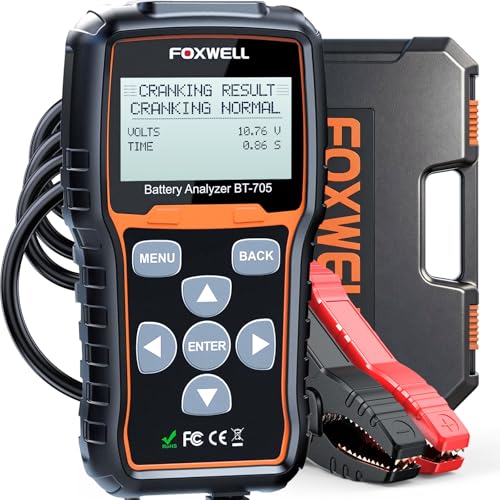
Pros
- Covers battery health, cranking performance and alternator output
- Supports cars, pickups, trucks, RVs, boats and commercial vehicles
- 2.8-inch screen provides step-by-step testing prompts
- Works with start-stop applications
Specifications
| Color | BT705 auto battery load alternator testers |
|---|---|
| Size | car battery tester |
| Dimensions | 13 x 3.2 x 9.1 inches |
| Weight | 0.7165023515 Pounds |
| Product Group | Automotive Parts and Accessories |
| Binding | Misc. |
Best For / Avoid If
Best for buyers prioritizing
- Covers battery health, cranking performance and alternator output
- Supports cars, pickups, trucks, RVs, boats and commercial vehicles
- 2.8-inch screen provides step-by-step testing prompts

Specifications
| Color | black,grey |
|---|---|
| Weight | 2.83955393456 pounds |
| Product Group | Automotive Parts and Accessories |
| Binding | Misc. |

Pros
- Covers several common household battery types
- Simple status display with green, yellow, and red zones
- Does not require a separate power source
Cons
- Tests battery voltage and does not directly measure capacity precisely
- Test times should be kept short to avoid unnecessary battery drain
Specifications
| Color | 2Pcs |
|---|---|
| Dimensions | 4.13 x 1.57 x 0.78 Inches |
| Weight | 0.000625 pounds |
| Product Group | BISS |
| Binding | Misc. |
Best For / Avoid If
Best for buyers prioritizing
- Covers several common household battery types
- Simple status display with green, yellow, and red zones
- Does not require a separate power source
Consider another option if
- Tests battery voltage and does not directly measure capacity precisely
- Test times should be kept short to avoid unnecessary battery drain
Professional battery tester picks by shop need
CarTechTalk may earn a commission from qualifying purchases made through links on this page. The products below are automotive battery analyzers, not household cell checkers. Their shop value depends on voltage coverage, supported battery chemistry, system checks, workflow, and the kind of record a technician needs.
TOPDON BT600: Best for printed customer records
The TOPDON BT600 suits shops that want a printed report at the vehicle. It covers 12V and 24V lead-acid batteries from 100 to 2,000 CCA, including flooded, AGM flat, AGM spiral, GEL, and EFB types. That range makes it suitable for work spanning passenger vehicles, motorcycles, pickups, heavy-duty trucks, and boats.
Its battery, cranking, and charging checks help separate a weak battery from a starting or charging-system concern. The 3.5-inch color display and built-in thermal printer let a technician show results without relying on a separate computer or handwritten notes. Playback can recall the last recorded session. The mini-USB software feature is limited to Windows systems, a relevant boundary for shops using other computer platforms.
Skip the BT600 if printed results will not be used or if your shop needs a battery analyzer for lithium batteries. Its listed compatibility is lead-acid only, and the built-in printer adds little value when digital records are the preferred workflow.
FOXWELL BT705: Best for one-person cranking checks
The FOXWELL BT705 pairs 12V and 24V coverage with a 5.9-foot cable. That reach lets a technician position the display near the driver’s seat while observing a cranking event, reducing the need for a second person. It covers 100 to 2,000 CCA and flooded, AGM, GEL, and EFB lead-acid batteries, including start-stop applications.
Guided prompts summarize results as GOOD, RECHARGE, or REPLACE, while the unit also reports CCA, voltage, internal resistance, and state of health. A carrying case helps keep the analyzer and accessories together between jobs. The tradeoff is that it has no listed built-in printer, so shops that need customer handouts should favor the BT600.
Skip the BT705 if printed documentation is central to your service process. Its 12V and 24V range also does not make it a lithium-battery analyzer; the stated chemistry support is lead-acid.
TOPDON BT200: Best for broad vehicle coverage at a mid-range level
The TOPDON BT200 handles 12V and 24V batteries rated from 100 to 2,000 CCA. Its listed chemistries include flooded, AGM, GEL, and deep-cycle types, and its vehicle coverage includes cars, trucks, RVs, boats, motorcycles, lawn mowers, and golf carts. Shops serving mixed vehicle types can use one handheld device across several common service categories.
Battery health, cranking, and charging functions give it broader diagnostic use than a voltage-only checker. It has a color display, copper clamps, memory for the last result, and a stated operating range from -4°F to 140°F. TOPDON lists a one-year warranty and lifetime technical support.
Skip the BT200 if you require EFB coverage, a printed report, or a long cable for observing cranking from the driver’s seat. Those features are not part of its listed specification. Its cold-weather operating range is a stated product claim, not a substitute for following shop procedures in extreme conditions.
ANCEL BA101: Best budget choice for 12V service
The ANCEL BA101 is a lower-cost option for shops that work on 12V lead-acid batteries and do not need 24V coverage. It supports 100 to 2,000 CCA and flooded, AGM, GEL, and EFB batteries. The listed functions cover battery health, charge state, voltage, current, CCA, cranking, and charging systems.
Its support for standards including JIS, EN, DIN, SAE, BCI, GB, CA, MCA, and IEC gives technicians several rating formats to select from. For useful results, the manufacturer says to enter the battery type, rating, and temperature accurately. The unit draws power from the vehicle battery, so it does not need internal batteries or a separate charge.
Skip the BA101 for 24V work, lithium batteries, or motorcycles below 30Ah. Its stated minimum application boundary is 12V batteries over 30Ah, and the maker directs buyers needing 24V to the BA101 PRO.
KONNWEI KW208: Best low-cost 12V analyzer
The KONNWEI KW208 covers 12V batteries from 100 to 2,000 CCA, with flooded, AGM flat, AGM spiral, and gel chemistry support. It reports voltage, internal resistance, CCA, amp-hour capacity, battery health, and charge status, and includes cranking and charging-system functions. A shop that mainly handles standard 12V service can get several useful readings in a compact unit.
The KW208 can be connected to a battery in or out of a vehicle, according to its product description. Its display offers eight languages. However, its stated chemistry list does not include EFB, and it has no stated 24V capability.
Skip it if your workload includes 24V systems or EFB batteries. The maker’s accuracy figures are promotional claims, not independent evidence, so use the displayed readings alongside the correct battery rating and your shop’s diagnostic process.
TOPDON BT100: Best compact analyzer for routine 12V checks
The TOPDON BT100 is a compact 12V unit for lead-acid batteries rated from 100 to 2,000 CCA. Its supported types include flooded, AGM flat and spiral, EFB, and GEL. It reports state of health, state of charge, voltage, current, and rating, with battery health, cranking, and charging functions.
The analyzer powers on after connection to the battery, so it does not need a separate charged battery. Its small form suits a service cart or glove box, and copper clamps include reverse-polarity prevention and spark-proof features, as described by the manufacturer. Those features do not remove the need to connect clamps carefully.
Skip the BT100 if you need 24V capability, printed customer records, or a display that shows numeric readings rather than three-color LEDs. Its product description emphasizes colored indicators, so it may be less suitable for a shop that needs a report-oriented workflow.
Schumacher Electric BT-100: Best for traditional load testing
The Schumacher Electric BT-100 uses a different approach from the conductance analyzers above. It applies a listed 50-amp load for 6V batteries and a 100-amp load for 12V batteries, with capacity up to 1,000 cranking amps. The steel case, heavy-duty clamps, and analog meter suit a shop that prefers a conventional load instrument.
It covers battery analysis, charging-system checks, and starter-motor checks. Support for 6V and 12V systems can serve motorcycles, lawn tractors, cars, boats, light trucks, and RVs. This makes it a distinct option for shops whose work includes older or small-engine equipment requiring 6V service.
Skip it if your shop needs 24V coverage, ratings above 1,000 cranking amps, or the broader chemistry support stated for several conductance models. Its load-based method also calls for following the maker’s operating directions and applicable battery precautions.
How to choose a battery analyzer for a shop
Start with the vehicles, not the display. A shop that handles only passenger cars with 12V batteries can consider the BA101, KW208, or BT100. Commercial truck, RV, or mixed-fleet work may justify 24V coverage, narrowing the shortlist to the BT600, BT705, or BT200. The Schumacher unit is the unusual choice for a shop that needs 6V capability.
Next, match battery chemistry and rating range. A listed voltage range alone does not confirm support for every battery type. For example, the BA101 and BT705 list EFB support, while the KW208’s stated types omit it. Enter the rating shown on the battery label in the unit’s required standard. An incorrect rating selection can undermine the usefulness of a conductance reading.
Decide which system functions matter. Battery condition, cranking behavior, and charging output address different parts of a no-start complaint. A weak battery reading does not by itself establish that the battery caused every starting issue. Charging and starter checks can help direct diagnosis, but results still need interpretation with vehicle symptoms and service information.
Finally, consider shop workflow. A printer can support a customer-facing paper record; a long cable can make a solo cranking observation easier. Memory or playback can help revisit a recent result. If those workflow features do not solve a real shop need, a simpler 12V model may be the more sensible purchase.
Which professional battery tester should you buy?
Choose the TOPDON BT600 when your shop needs 12V and 24V lead-acid coverage plus printed reports. Pick the FOXWELL BT705 for similar voltage and CCA reach when one-person cranking checks matter more than printing. The BT200 is a middle-ground option for mixed 12V and 24V vehicle work, while the BA101, KW208, and BT100 fit narrower 12V workflows.
Choose the Schumacher BT-100 only when its 6V and 12V load capability matches your work and its 1,000-CCA ceiling is sufficient. Do not buy anything in this guide if your shop primarily services lithium batteries or needs a specialty battery analyzer for a chemistry not listed here. Look instead for a unit whose manufacturer explicitly supports that chemistry and your required voltage range.
Sources and further reading
- Battery Council International: Find battery industry resources and general battery information.
For a closer look at a related choice, see Battery Tester Buying Guide for Beginners, Best Battery Tester for All Batteries Across Household and 12V Formats and Best Battery Tester For Household Batteries.