The practical answer to “how to find an ev charger compatible with your car” is to match the car’s model year, charging port, and charging capabilities to the station. Check the owner’s manual or automaker’s charging information before choosing a home unit or relying on a public charger; connector appearance alone does not tell you every limit.
- Start with your exact make, model, model year, and market region.
- Identify the vehicle’s AC and DC charging connectors. They may differ.
- Match charger type and available power to what the vehicle accepts.
- Check adapter approval and limits before using one.
- For home charging, check electrical supply and installation requirements as well as vehicle fit.
How to check EV charger compatibility
Use these steps in order. They separate physical connection from charging speed and from the home electrical work needed to run a charger.
- Record the exact vehicle details. Write down make, model, model year, trim if relevant, and country or region of sale. Charging ports and supported equipment can change between years, trims, and markets. A used import may differ from a locally sold version.
- Look up both charging ports. Check the owner’s manual, automaker website, or charging label for the AC connector and DC fast-charging connector. Some cars accept AC charging but cannot use DC fast charging. Others have different ports for AC and DC charging.
- Check charging type. A home Level 1 or Level 2 unit supplies AC power. The car’s onboard charger converts that AC power for the battery. A DC fast charger supplies DC power to the vehicle’s battery system, subject to vehicle and station limits. A connector that fits does not make an AC charger interchangeable with a DC fast charger.
- Compare the vehicle’s accepted power with the charger output. A vehicle charges only within its own limits, even if a station can supply more power. The actual rate can also change with battery temperature, battery state of charge, and other vehicle or station controls. Treat advertised maximum output as a capability, not a promise of a steady charging rate.
- Check the station’s plug and access rules. Public chargers can have different connectors, power levels, and account or payment steps. Check the station details in its network app or vehicle navigation before driving there. A compatible plug does not guarantee that a station is open or working.
- For home charging, check the electrical setup. Confirm that the unit works with the available supply and installation plan. Have a qualified electrician assess the circuit and any needed work. Vehicle compatibility does not establish that a home circuit can safely support a particular charger.
Which connector does your EV use?
Connector standards depend on vehicle model year and market. In the United States, J1772 has commonly served AC charging on many non-Tesla vehicles, while CCS1 has been used for DC fast charging. Tesla vehicles have used the North American Charging Standard (NACS). Automakers have also been changing connector plans, so older and newer vehicles from one brand may not share the same setup.
Do not identify a connector from brand name alone. Check the actual port and the vehicle’s manual. A car can have one inlet that supports both AC and DC through different portions of the connector, or separate charging arrangements depending on model and year.
Charging standards also vary outside North America. A vehicle imported from another region may have a connector that does not match local public equipment. A plug adapter addresses physical connection only; it cannot add a charging method or power level the vehicle does not support.
AC charging versus DC fast charging
| Charging type | What it does | What to check |
|---|---|---|
| Level 1 AC | Uses a suitable household outlet and the vehicle’s onboard charger. | Check the car’s included or approved charging equipment and the outlet’s condition. Charging is generally slower than Level 2. |
| Level 2 AC | Supplies AC power through a home or public charging unit. The car’s onboard charger sets a limit on how much AC power it can use. | Match connector and voltage, then check the vehicle’s AC charging limit and the home circuit or station output. |
| DC fast charging | Supplies DC power at compatible public stations, subject to vehicle and station limits. | Check that the car supports DC fast charging and that its DC connector matches the station or an approved adapter. |
For example, a car that accepts Level 2 AC charging but lacks DC fast-charging capability can use a compatible public AC charger. It cannot use a DC fast charger merely because the plug looks close or an adapter can join the connectors. Check the vehicle manual for its supported charging methods.
Does a higher-power charger charge your car faster?
Not necessarily. For AC charging, the onboard charger limits how much power the vehicle can take from the station. For DC fast charging, the car and station control the charging rate together. Battery temperature and state of charge can also affect the rate, so maximum station output alone cannot predict a particular charging session.
For home use, compare the unit’s electrical requirements with the vehicle’s AC charging capability and the home’s available circuit. A more powerful unit may leave your car charging at its own lower limit, while still requiring more electrical capacity from the home. Have an electrician review the installation rather than assuming an outlet or breaker is suitable.
When can an adapter work?
An adapter can make a compatible vehicle connector physically connect to a different charger connector. Whether charging works depends on the adapter’s intended direction, vehicle, charger, charging type, and power limits. Some adapters support AC charging only; others are intended for DC fast charging. These uses are not interchangeable.
Use an adapter only when its manufacturer and vehicle maker approve it for the specific combination. Follow stated power limits and instructions. Do not use a damaged adapter, force a connector, or rely on a passive plug converter to change AC into DC or add a charging feature to the car.
Before a trip, check whether the adapter is approved for the station network you plan to use and whether the station actually offers the needed connector. If the car’s manual excludes the combination, use a different compatible charger.
What to check before installing a home EV charger
Vehicle fit is only one part of a home charging decision. The unit must also suit the home’s electrical service, wiring, location, and intended use. Installation needs depend on the equipment and property, so a general online guide cannot determine whether an existing circuit is suitable.
- Check the car’s accepted AC voltage and charging limit in its manual.
- Check the charging unit’s connector, electrical requirements, and installation instructions.
- Ask a qualified electrician to assess circuit capacity and installation needs.
- Consider whether the cable reaches the parked vehicle without crossing a walkway or creating a trip hazard.
- Review how the unit handles outdoor installation if it will be exposed to weather.
The U.S. Department of Energy’s home EV charging overview explains home charging options. Its EV charging infrastructure procurement and installation resource covers planning and installation considerations. For related site coverage, see our EV Charging & Automotive Power section.
Common mistakes
- Assuming every vehicle from one brand uses the same port. Connector plans change over time, and model year and region matter.
- Confusing a matching plug with full compatibility. The vehicle must support the charger’s charging type and electrical limits.
- Assuming a high-output charger forces a faster rate. The vehicle’s own charging limits still apply.
- Buying an adapter based on connector shape alone. Check charging type, direction, approval, and power limits.
- Treating a public charging map as a guarantee. Station availability and equipment status can change; check current station details.
- Assuming a home outlet is suitable because its plug fits. Circuit condition and electrical capacity require a proper assessment.
- Using a plug adapter to change charging technology. A connector adapter cannot add DC fast charging to a car that does not support it.
When to get professional help
Ask a qualified electrician to review home charger wiring, circuit capacity, or installation concerns. Stop using equipment if a cable, plug, outlet, or adapter is damaged, unusually hot, or shows signs of electrical trouble. Follow the vehicle and charger manuals, and contact the automaker or charger maker if their compatibility instructions conflict or remain unclear.
For a public charging problem, do not force the connector or keep retrying a damaged station. Follow the station’s support instructions and move to another compatible charger if needed. If a vehicle warning appears during charging, follow the vehicle manual and contact service when it directs you to do so.
Gear that can help
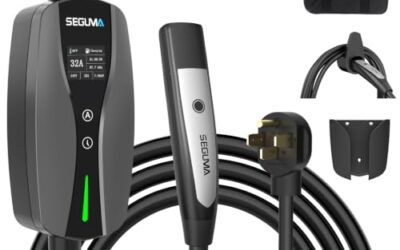
If you need EV chargers for this job, these picks already appear in our EV chargers guides. Check the full guide for fit and who should skip each one.

Pros
- Supports SAE-J1772 electric vehicles and plug-in hybrids
- Offers adjustable charging current for different charging requirements
- Includes a long 25-foot cable and delay timer
- Provides multiple listed electrical safety protections
Cons
- Tesla adapter is sold separately
- The product is recommended for use only in a dry environment with a properly grounded outlet
Specifications
| Size | 25FT |
|---|---|
| Product Group | Automotive Parts and Accessories |
Best For / Avoid If
Best for buyers prioritizing
- Supports SAE-J1772 electric vehicles and plug-in hybrids
- Offers adjustable charging current for different charging requirements
- Includes a long 25-foot cable and delay timer
Consider another option if
- Tesla adapter is sold separately
- The product is recommended for use only in a dry environment with a properly grounded outlet

Pros
- Supports charging up to 40A and 9.6 kW
- Long 25-foot cable provides extended reach
- Compatible with listed PHEV and BEV models using a J1772 connection
- IP67 rating and stated operating temperature range support outdoor use
Cons
- Requires a 240V NEMA 14-50 outlet
- Tesla vehicles require a separate NACS adapter
Specifications
| Color | Black |
|---|---|
| Size | 40A 25FT |
| Dimensions | 144 x 134 x 47 Inches |
| Weight | 13.2 Pounds |
| Product Group | Automotive Parts and Accessories |
| Binding | Automotive |
Best For / Avoid If
Best for buyers prioritizing
- Supports charging up to 40A and 9.6 kW
- Long 25-foot cable provides extended reach
- Compatible with listed PHEV and BEV models using a J1772 connection
Consider another option if
- Requires a 240V NEMA 14-50 outlet
- Tesla vehicles require a separate NACS adapter

Pros
- Supports multiple current settings: 10A, 16A, 20A, 24A, 32A, and 40A
- Compatible with EVs and hybrids that use a standard J1772 connector
- Lists protection against leakage, grounding issues, overvoltage, undervoltage, overcurrent, overcharging, overheating, and short circuits
- Automatically shuts off when the vehicle is fully charged, according to the listing
Cons
- A J1772-to-Tesla adapter is required for Tesla vehicles and is not included
- The listing does not identify a specific vehicle make or model compatibility list
Specifications
| Color | Black |
|---|---|
| Size | 40A ev charger |
| Product Group | Automotive Parts and Accessories |
Best For / Avoid If
Best for buyers prioritizing
- Supports multiple current settings: 10A, 16A, 20A, 24A, 32A, and 40A
- Compatible with EVs and hybrids that use a standard J1772 connector
- Lists protection against leakage, grounding issues, overvoltage, undervoltage, overcurrent, overcharging, overheating, and short circuits
Consider another option if
- A J1772-to-Tesla adapter is required for Tesla vehicles and is not included
- The listing does not identify a specific vehicle make or model compatibility list
Readers weighing these picks also look at Portable EV Charger Buying Guide, How to Protect an Outdoor EV Charger From Weather and How To Check Public EV Charger Availability Before You Go.
Frequently asked questions
Can I charge my EV at any public charging station?
No. The vehicle must support the station’s charging type and connector, directly or through an approved adapter. Check the station’s current details and the vehicle manual.
Can I use a Level 2 charger if my car has a lower AC charging limit?
Usually, the vehicle limits how much AC power it accepts. A higher-output unit does not raise the car’s onboard charging limit. The unit must still meet the vehicle and home installation requirements.
Can an adapter make an EV compatible with DC fast charging?
No. An adapter can connect compatible charging equipment, but it cannot add DC fast-charging capability that the vehicle lacks. Use only approved adapters for the stated vehicle, charger type, and power limits.
Where can I find my car’s charging limits?
Check the owner’s manual, automaker’s charging information, or the vehicle’s charging screen. Use the exact model year and regional version because specifications can change.
Sources and further reading
- Charging Electric Vehicles at Home (Alternative Fuels Data Center): Explains home charging equipment and common charging levels.
- Procurement and Installation for EV Charging Infrastructure (Alternative Fuels Data Center): Covers planning and installation for charging infrastructure.