To calculate home EV charging electricity use, measure the kilowatt-hours (kWh) your home uses during a charging session, or estimate them from charging power and time. For a useful cost estimate, use energy drawn from the home rather than assuming every kWh reaches the battery.
- Most direct method: compare a dedicated charger or utility meter reading before and after charging.
- Estimate method: multiply average charging power in kilowatts by charging time in hours.
- Multiply the kWh used at home by your applicable electricity rate to estimate charging cost.
- Vehicle display figures may show energy added to the battery, which can differ from energy drawn from the home.
What you need before calculating
Have a way to identify the charging session’s energy use, its duration, and the electricity rate that applies during that period. A home EV charger with an energy reading can provide session data. A separate meter may also help, if it measures the circuit or charger used for the vehicle.
Your utility bill supplies the rate, but the relevant number can be more than the headline energy charge. Depending on your plan, time of use, delivery charges, taxes, or other fees may affect the amount attributable to charging. A flat rate makes a basic estimate easier. A time-of-use plan may require separate rates for different charging hours.
Check what each display measures. A charger or meter reading may represent electricity delivered from the home. A vehicle app may report energy added to the battery, estimated range, or another figure. Those numbers are not automatically interchangeable. Vehicle model year, software, charger equipment, and utility meter setup can affect which readings are available and how they are labeled.
How to calculate home EV charging electricity use
1. Choose the measurement you trust
Use a session kWh reading from a charger or meter when available. Record its starting and ending values if it shows a cumulative total, then subtract the starting value from the ending value. For example, a meter that moves from 1,240 kWh to 1,258 kWh recorded 18 kWh during that interval.
Make sure the interval covers only the charging session you want to count. If the meter also tracks other household loads, its change cannot isolate EV charging unless you can separate those loads. A whole-home utility meter usually includes appliances, heating, cooling, and other electricity use.
2. Estimate kWh from charging power and time
If you do not have session energy data, use this estimate:
Estimated electricity use (kWh) = average charging power (kW) × charging time (hours)
Use average power over the full session, not automatically the charger’s maximum rating. Charging power can vary with the vehicle, charger, electrical supply, battery state, temperature, and charging settings. A vehicle may reduce power as charging continues, so multiplying the maximum power by the full duration can overstate use.
For a hypothetical example, assume average power is 7 kW for 3 hours. The estimate is 7 × 3 = 21 kWh drawn during that period, if 7 kW describes power coming from the home. If the figure describes energy going into the battery, home electricity use can be higher because charging has losses.
3. Separate home electricity from battery energy
Energy measured at the home and energy stored in the battery are different points in the process. Some electricity is used by charging equipment and vehicle systems or lost as heat. The amount varies by vehicle, charger, conditions, and charging behavior, so do not apply one assumed loss percentage to every setup.
If you know battery energy added and want to estimate home use, you need a measured or otherwise supported charging-efficiency figure for that situation. Without it, report the battery figure as battery energy, not as an exact utility-meter total. For bills and household energy tracking, a home-side kWh reading is more directly relevant.
4. Calculate the cost
For a single-rate plan, use:
Estimated charging cost = home electricity use (kWh) × applicable rate per kWh
For example, if a session uses 21 kWh at a hypothetical energy rate of 16 cents per kWh, the energy-charge estimate is $3.36. This example excludes any additional bill components. Use your actual rate and account for other charges only as your utility plan requires.
For time-of-use pricing, divide the session into periods with different rates. Multiply the kWh used in each period by that period’s rate, then add the results. If you only know total session kWh and the session crossed rate periods, you need period-by-period usage data for a more accurate calculation. Splitting energy evenly by clock time is only an estimate if charging power changes.
5. Scale the result to a week or month
To estimate a longer period, add measured sessions or multiply a representative session by the number of similar sessions. Do not treat one unusually short or long session as a reliable monthly average. Charging needs change with driving distance, weather, trip patterns, and how much energy the vehicle already has when plugged in.
If you want to compare EV charging with fuel costs, use a consistent driving period and include the same type of cost in each figure. A home charging estimate does not include public charging, and an electricity-only calculation may exclude fixed bill charges that would remain even without the vehicle.
Calculation methods compared
| Method | What to calculate | Best use | Main limit |
|---|---|---|---|
| Charger or dedicated meter | Session ending reading minus starting reading | Tracking home-side kWh | Reading must cover the EV session alone |
| Power and time | Average kW × hours | Quick estimate without a kWh reading | Power may change during session |
| Vehicle battery report | Use reported battery energy added | Understanding energy stored by vehicle | May not equal home electricity drawn |
| Utility bill comparison | Compare household usage across periods | Broad monthly tracking | Other household use can obscure EV share |
Worked example with clear assumptions
Suppose a driver records 24 kWh on a dedicated home charging meter. The applicable energy rate is 17 cents per kWh. The session’s energy-charge estimate is 24 × $0.17, or $4.08. This calculation uses the home-side meter reading, so it does not need a separate loss adjustment.
Now suppose the vehicle app reports 24 kWh added to the battery, but no home-side reading is available. Multiplying 24 by the utility rate would treat battery energy as though it were the home’s full electricity use. That could understate the bill impact. The exact difference cannot be calculated without suitable home-side data or a relevant efficiency measurement.
Common mistakes
- Using charger maximum power for every hour: Maximum rating is not proof of average session power. Use a kWh reading or a measured average when possible.
- Confusing kW and kWh: kW describes power at a moment or over a period; kWh measures energy. Multiply kW by hours to estimate kWh.
- Treating battery energy as utility energy: The battery and home meter measure different sides of the charging process.
- Using the wrong utility rate: Time-of-use plans may charge different rates by hour. Use the rate that matches the session period.
- Reading the whole-house meter as EV-only use: Household appliances and climate control also change the meter total.
- Projecting one session across a whole month: Driving and charging patterns vary. Add actual sessions for a better monthly estimate.
When to get professional help
Contact a licensed electrician if you need a new charging circuit, suspect an electrical fault, or find that charging equipment or wiring becomes unusually hot, damaged, or repeatedly trips a breaker. Do not open electrical panels or alter wiring to obtain a measurement. Follow vehicle and charger instructions, and stop using equipment that shows damage or other warning signs.
If your bill changes sharply and the arithmetic does not explain it, ask your utility to clarify the rate plan and bill components. For general home charging basics and installation considerations, see the Alternative Fuels Data Center’s home EV charging overview. For setup context, CarTechTalk also covers home EV charger options and charging setups.
Gear that can help
If you need EV chargers for this job, these picks already appear in our EV chargers guides. Check the full guide for fit and who should skip each one.

Pros
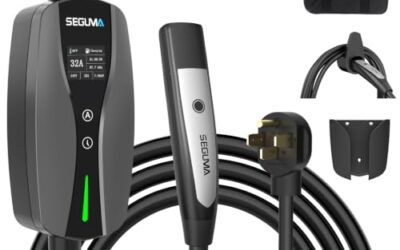
- Offers both Level 1 and Level 2 charging options
- Includes NEMA 6-20 and NEMA 5-15 connection options
- Provides up to 3.84kW output in Level 2 mode
- Includes automatic temperature-related power reduction and charging resumption
Cons
- Level 2 charging requires a dedicated NEMA 6-20 outlet
- The NEMA 5-15 connection must be manually adjusted to 12A
- Charging an 87kWh battery is listed as approximately 22.4 hours at Level 2 and over 60 hours at Level 1; actual time depends on the vehicle and circuit
Specifications
| Color | Black |
|---|---|
| Size | 16A J1772 Connector |
| Dimensions | 12 x 16 x 5 inches |
| Product Group | Automotive Parts and Accessories |
| Binding | Electronics |
Best For / Avoid If
Best for buyers prioritizing
- Offers both Level 1 and Level 2 charging options
- Includes NEMA 6-20 and NEMA 5-15 connection options
- Provides up to 3.84kW output in Level 2 mode
Consider another option if
- Level 2 charging requires a dedicated NEMA 6-20 outlet
- The NEMA 5-15 connection must be manually adjusted to 12A
- Charging an 87kWh battery is listed as approximately 22.4 hours at Level 2 and over 60 hours at Level 1; actual time depends on the vehicle and circuit
Pros
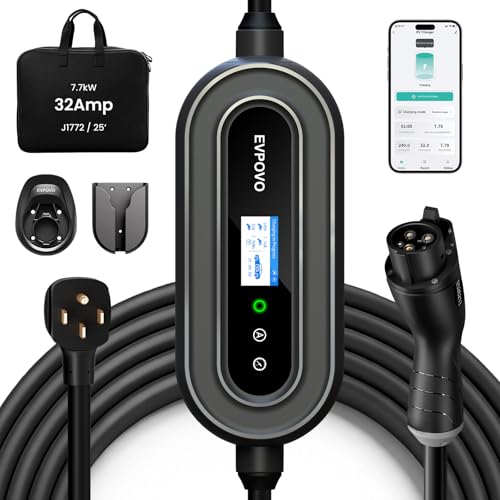
- Supports both Level 2 charging through a NEMA 14-50 connection and 120V emergency use
- Offers adjustable amperage settings for different breaker capacities
- Provides a long 25-foot cable and weatherproof NEMA Type 4 enclosure
- Lists compatibility with J1772 vehicles, including numerous Ford, Jeep, Toyota, Hyundai, Kia, Chevrolet, Volkswagen, Honda, Acura, BMW, and Rivian models
Cons
- The 120V 5-15 connector is described for emergency use rather than primary high-speed charging
- The source data does not identify a specific model number beyond the EVPOVO product name
Specifications
| Color | 32A Stone Blue J1772 |
|---|---|
| Dimensions | 15 x 10 x 6 inches |
| Product Group | Automotive Parts and Accessories |
Best For / Avoid If
Best for buyers prioritizing
- Supports both Level 2 charging through a NEMA 14-50 connection and 120V emergency use
- Offers adjustable amperage settings for different breaker capacities
- Provides a long 25-foot cable and weatherproof NEMA Type 4 enclosure
Consider another option if
- The 120V 5-15 connector is described for emergency use rather than primary high-speed charging
- The source data does not identify a specific model number beyond the EVPOVO product name

Pros
- Dual-voltage operation supports both 120V and 240V outlets
- Long 25-foot cable can reach vehicles in garages, driveways, and outdoor parking areas
- Adjustable current settings help match charging and electrical requirements
- Compatible with most North American J1772 EVs and PHEVs
Cons
- Tesla and other NACS-equipped vehicles require a compatible J1772 adapter
- The maximum 32A and 7.68kW charging specification applies to 240V NEMA 14-50 operation
- Charging controls use onboard buttons, with no Wi-Fi or mobile app specified
Specifications
| Color | black |
|---|---|
| Size | 32A |
| Weight | 10.3 Pounds |
| Product Group | Automotive Parts and Accessories |
| Binding | Tools & Home Improvement |
Best For / Avoid If
Best for buyers prioritizing
- Dual-voltage operation supports both 120V and 240V outlets
- Long 25-foot cable can reach vehicles in garages, driveways, and outdoor parking areas
- Adjustable current settings help match charging and electrical requirements
Consider another option if
- Tesla and other NACS-equipped vehicles require a compatible J1772 adapter
- The maximum 32A and 7.68kW charging specification applies to 240V NEMA 14-50 operation
- Charging controls use onboard buttons, with no Wi-Fi or mobile app specified
Next step: How to Check EV Charging Adapter Compatibility and How to Inspect an EV Charging Cable Safely.
Frequently asked questions
Can I calculate EV charging use from miles driven?
Miles alone do not give an exact home electricity total. You also need a vehicle-specific energy-use figure and must account for the difference between battery energy and electricity drawn from the home. A meter reading during charging is more direct.
Why does my vehicle show less energy than my charger?
The readings may cover different points in the process, and equipment or vehicle systems can use energy during charging. Check whether each display reports home-side delivery or battery energy. Their difference can vary by conditions and equipment.
Does a Level 2 charger always use the same kWh per hour?
No. Charging power depends on the vehicle’s onboard charging limits, the charger and electrical supply, and session conditions. Charging may also slow during a session. Treat rated power as a limit, not a guaranteed average.
Should I include fixed monthly utility charges?
For the extra cost caused by one charging session, start with charges that change with electricity use. Fixed charges may remain regardless of charging. Use your utility bill’s terms if you need a full household cost allocation.
Sources and further reading
- Charging Electric Vehicles at Home (Alternative Fuels Data Center): Explains home charging options and related considerations.
- Procurement and Installation for EV Charging Infrastructure (Alternative Fuels Data Center): Covers planning and installation considerations for charging infrastructure.