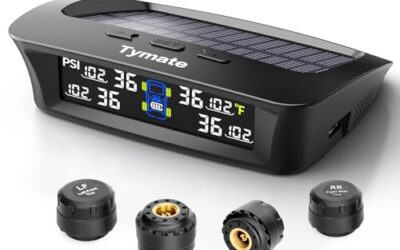
For cold-weather RV travel, the Tymate TM12 RV Tire Pressure Monitoring System stands out as the most balanced option because its dedicated USB-C hardwire capability eliminates reliance on weak winter sunlight while supporting a high 144 PSI ceiling across up to 12 monitoring zones. Cold ambient air causes tire pressure to drop significantly before travel, making accurate real-time data and reliable display power mandatory. Towing setups exposed to sub-freezing temperatures demand durable external sensors, dependable signal transmission through winter road grime, and flexible alert thresholds that accommodate thermal expansion once rolling.

Pros
- Supports multiple power options including solar, USB-C, and cigarette lighter port
- Factory-paired external sensors eliminate initial manual calibration setup
- Operates across wide 0 to 144 PSI pressure detection range
- Color LCD screen auto-adjusts backlight based on ambient lighting conditions
Cons
- Cigarette lighter charging adapter not included in package
- Rigs 36 feet or longer require separate repeater purchase for stable signal
- Manufacturer recommends metal valve stems for proper sensor installation
Specifications
| Color | Color Display |
|---|---|
| Size | 4-Sensors |
| Dimensions | 4.0157480274 x 3.20866141405 x 1.181102361 inches |
| Product Group | Automotive Parts and Accessories |
Best For / Avoid If
Best for buyers prioritizing
- Supports multiple power options including solar, USB-C, and cigarette lighter port
- Factory-paired external sensors eliminate initial manual calibration setup
- Operates across wide 0 to 144 PSI pressure detection range
Consider another option if
- Cigarette lighter charging adapter not included in package
- Rigs 36 feet or longer require separate repeater purchase for stable signal
- Manufacturer recommends metal valve stems for proper sensor installation

Pros
- Solar plus Type-C dual charging provide continuous operation
- Rapid 0.3-second data transmission during pressure loss
- Preset alerts cover extreme pressure limit up to 142 PSI and heat above 92C
- Included hex nuts lock sensors onto valve stems
Cons
- Zero customer reviews available to verify performance
- Sensor battery model and replacement details omitted
Specifications
| Size | 4 inches-6 Sensors |
|---|---|
| Dimensions | 2.362204722 x 0.5905511805 x 0.5905511805 inches |
| Weight | 0.4188782978 pounds |
| Product Group | Automotive Parts and Accessories |
Best For / Avoid If
Best for buyers prioritizing
- Solar plus Type-C dual charging provide continuous operation
- Rapid 0.3-second data transmission during pressure loss
- Preset alerts cover extreme pressure limit up to 142 PSI and heat above 92C
Consider another option if
- Zero customer reviews available to verify performance
- Sensor battery model and replacement details omitted

Pros
- Factory-paired sensors eliminate manual pairing during setup
- Dual power system uses solar charging or wired USB connection
- Monitors six specific fault conditions with reference pressure baselines
- Supports vehicle expansion up to 10 total tire sensors
Cons
- Cigarette lighter adapter not included in package
- Trailers 36 feet or longer require separate repeater purchase
- Sensor installation requires metal valve stems for optimal stability
Specifications
| Size | 4-Sensors |
|---|---|
| Dimensions | 3.4251968469 x 2.8346456664 x 0.9842519675 inches |
| Weight | 0.6 pounds |
| Product Group | Automotive Parts and Accessories |
| Binding | Misc. |
Best For / Avoid If
Best for buyers prioritizing
- Factory-paired sensors eliminate manual pairing during setup
- Dual power system uses solar charging or wired USB connection
- Monitors six specific fault conditions with reference pressure baselines
Consider another option if
- Cigarette lighter adapter not included in package
- Trailers 36 feet or longer require separate repeater purchase
- Sensor installation requires metal valve stems for optimal stability

Pros
- Wide 0–144 PSI range cover cars, SUVs, pickups, RVs, and tow trailers.
- Dual solar and USB-C power option maintain receiver battery.
- IP67 sensor rating protect against water and dust intrusion.
- Expandable system handle up to 12 total tire positions.
Cons
- Distances over 50 feet require separate repeater purchase.
- Display power-off switch only work when disconnected from charging cable.
- Metal valve stems recommended for secure sensor installation.
Specifications
| Size | 4 Sensors |
|---|---|
| Dimensions | 3.84251968112 x 3.2283464534 x 1.1417322823 inches |
| Product Group | Automotive Parts and Accessories |
Best For / Avoid If
Best for buyers prioritizing
- Wide 0–144 PSI range cover cars, SUVs, pickups, RVs, and tow trailers.
- Dual solar and USB-C power option maintain receiver battery.
- IP67 sensor rating protect against water and dust intrusion.
Consider another option if
- Distances over 50 feet require separate repeater purchase.
- Display power-off switch only work when disconnected from charging cable.
- Metal valve stems recommended for secure sensor installation.

Pros
- High pressure capacity supports heavy RV and trailer applications
- Sensors use standard user-replaceable CR2032 coin batteries
- Monitor includes motion sensor sleep mode to preserve internal battery
- Sensors program prior to tire installation
Cons
- Manufacturer specifies metal valve stems; rubber stems not recommended
- Optional signal booster for long distance interference not included
- Provided listing contains zero reviews for field evaluation
Best For / Avoid If
Best for buyers prioritizing
- High pressure capacity supports heavy RV and trailer applications
- Sensors use standard user-replaceable CR2032 coin batteries
- Monitor includes motion sensor sleep mode to preserve internal battery
Consider another option if
- Manufacturer specifies metal valve stems; rubber stems not recommended
- Optional signal booster for long distance interference not included
- Provided listing contains zero reviews for field evaluation

Pros
- Dual solar panel and USB charging eliminate constant cord use
- IP67 ingress rating protect sensors in wet conditions
- Fast one-second data refresh rate while driving
- Support single to four-wheel vehicle layouts
Cons
- Native 26-foot range exclude large RVs and towing setups without optional signal booster
- Valve stems release brief air hiss during sensor installation until tightened
Specifications
| Color | Black |
|---|---|
| Size | 4-Sensor |
| Dimensions | 4 x 4 x 1.3 inches |
| Product Group | Automotive Parts and Accessories |
Best For / Avoid If
Best for buyers prioritizing
- Dual solar panel and USB charging eliminate constant cord use
- IP67 ingress rating protect sensors in wet conditions
- Fast one-second data refresh rate while driving
Consider another option if
- Native 26-foot range exclude large RVs and towing setups without optional signal booster
- Valve stems release brief air hiss during sensor installation until tightened

Pros
- Customizable pressure alert thresholds across full 0-144 PSI range
- Color LCD display adjust brightness automatically for day and night conditions
- Pre-coded sensors screw on external valve stems with hex nuts
Cons
- Display screen resolution and battery capacity not detailed
Specifications
| Size | 2.5 inches-6 Sensors |
|---|---|
| Dimensions | 3.93700787 x 2.755905509 x 1.181102361 inches |
| Product Group | Automotive Parts and Accessories |
Best For / Avoid If
Best for buyers prioritizing
- Customizable pressure alert thresholds across full 0-144 PSI range
- Color LCD display adjust brightness automatically for day and night conditions
- Pre-coded sensors screw on external valve stems with hex nuts
Consider another option if
- Display screen resolution and battery capacity not detailed
Cold Weather Challenges for RV Tire Pressure Monitoring Systems
Sub-freezing temperatures directly impact pneumatic tire physics and electronic monitoring hardware. Understanding how winter conditions alter baseline readings and hardware performance ensures your rig stays safe on icy highways.
The Physics of Pressure Drop in Freezing Air
According to the ideal gas law, air volume and pressure decrease proportionally with ambient temperature drops. For every 10-degree Fahrenheit drop in ambient air temperature, an RV tire typically sheds approximately 1 to 2 PSI of cold inflation pressure. An RV parked in a heated garage or resting in 60-degree weather that transitions to a 20-degree mountain pass can experience an unprompted pressure deficit of 4 to 8 PSI. Without a continuous monitor, this underinflated state increases rolling resistance, stresses the tire sidewalls, and generates localized internal friction once rolling at highway speeds.
Sensor Battery Chemistry in Low Temperatures
External valve stem sensors rely primarily on coin-cell lithium chemistry, typically CR1632 or CR2032 cells. Sub-zero temperatures slow internal chemical reactions, leading to transient voltage drops. Under extreme cold, a sensor battery may trigger false low-voltage warnings on the receiver console. Systems featuring larger battery capacities or easily replaceable external coin cells mitigate the risk of sensor failure during winter travel.
Monitor Display Endurance and Low-Light Solar Limits
Many modern TPMS receiver units feature integrated solar charging panels mounted to the top casing. During winter, shorter daylight hours, cloud cover, and low sun angles reduce solar harvest efficiency. A TPMS relying purely on solar recharging can deplete its internal battery mid-journey. Winter RV operators require displays equipped with physical Type-C or auxiliary DC power ports to guarantee continuous operation regardless of sky conditions.
Detailed Reviews: RV TPMS Hardware for Winter Conditions
Tymate TM12 RV Tire Pressure Monitoring System: Best Multi-Zone Cold Weather Setup
The Tymate TM12 RV Tire Pressure Monitoring System provides comprehensive coverage for complex tow rigs operating in winter weather. Its receiver display simultaneously shows up to six tires on a single screen while offering cycling capability for up to 12 total tire positions across four dedicated vehicle zones. The manufacturer lists an operational range between 0 and 144 PSI with IP67 waterproof-rated external sensors, protecting sensitive electronics against winter slush and road de-icers.
Power management is robust for cold climates. The monitor features dual-mode recharging via USB-C and solar power, allowing drivers to keep the unit plugged directly into a 12V auxiliary source when winter cloud cover restricts solar generation. Pre-programmed factory positions streamline setup in low temperatures without prolonged outdoor pairing sessions. Automatic calibration alerts trigger if pressures fall 15 percent below the established baseline reference point.
Drawback: The manufacturer notes that the receiver cannot be powered off manually while connected to an active charging cable, requiring physical disconnection when parking.
Avoid if: You tow an oversized fifth-wheel or toy hauler exceeding 36 feet without purchasing a separate signal repeater, as metal siding and cold ambient interference can degrade signal reach past 50 feet.
GUTA GT30 Trailer Tire Pressure Monitoring System: Best High-Pressure Rig Solution
Heavy fifth wheels, Class A motorhomes, and commercial-grade toy haulers operating in freezing environments demand high-pressure ratings. The GUTA GT30 Trailer Tire Pressure Monitoring System handles pressures up to 188 PSI and features 10 included external cap sensors. The display can monitor up to 46 tire positions across alternating pages, making it suitable for multi-axle configurations.
Sensor hardware utilizes replaceable CR2032 batteries, which offer a larger physical capacity than smaller coin cells, helping sustain voltage stability in sub-freezing temperatures. The manufacturer claims sensor battery life up to four years, with continuous update intervals sent every five minutes under pressure. The display unit houses an internal rechargeable lithium battery providing 12 to 14 days of run time per charge cycle, avoiding total dependence on daytime solar input.
Drawback: The GUTA GT30 carries the highest observed price in this category, which represents a steep investment for casual seasonal campers.
Avoid if: Your vehicle uses standard rubber valve stems; the manufacturer explicitly states these cap sensors should only be installed on rigid metal stems to prevent high-speed structural fatigue.
Flydew 6-Wheel RV TPMS with Custom Pressure Alerts: Best Customizable Cold Thresholds
Fixed-percentage low-pressure alerts often cause nuisance warnings during extreme morning temperature drops. The Flydew 6-Wheel RV TPMS with Custom Pressure Alerts solves this with fully customizable alarm parameters spanning 0 to 144 PSI. RVers can adjust their lower threshold to accommodate anticipated cold contraction without silencing vital leak warnings.
The manufacturer lists high accuracy within plus or minus 1.5 PSI and a rapid 0.3-second sensor transmission response time during abrupt pressure drops. The auto-dimming color LCD screen maintains visibility in shifting winter light, while USB-C and solar dual charging ensure constant readiness. Sensors use standard replaceable CR1632 batteries and secure via vibration-proof counter-tightening hex nuts.
Drawback: The included kit contains only six sensors, leaving no provisions for spare tires without buying supplemental hardware.
Avoid if: You require multi-trailer memory profiles, as this unit is dedicated solely to a unified six-wheel footprint.
Flydew 6-Wheel RV TPMS Tire Pressure Monitoring: Best High-Visibility Cockpit Monitor
Operating an RV in poor winter weather requires quick cockpit scans. The Flydew 6-Wheel RV TPMS Tire Pressure Monitoring unit features a generous 4-inch LCD panel designed for high-contrast viewing under overcast skies or during night driving. It monitors six dedicated positions and provides updates with a manufacturer-stated accuracy of 2 PSI (0.1 BAR).
Five pre-configured safety alerts track rapid leaks, low pressure (fixed floor at 26 PSI), high pressure (up to 142 PSI), high temperatures above 92 degrees Celsius, and hardware battery warnings. The monitor enters power-saving sleep after three minutes of inactivity and awakens upon detecting vehicle movement. Solar charging is augmented by a physical Type-C port, providing reliable operation on cloudy winter days.
Drawback: The pre-set low-pressure alarm threshold of 26 PSI is hardcoded, preventing fine-tuning for lightweight trailer applications that run lower operational pressures.
Avoid if: You operate an eight-wheel tandem dual setup or tow a trailer behind a six-wheel coach, as the monitor hardware cannot expand past six simultaneous wheel positions.
Tymate TM3 RV Tire Pressure Monitoring System: Best Balanced 4-Sensor Travel Trailer Pick
The Tymate TM3 RV Tire Pressure Monitoring System is tailored for single-axle or dual-axle travel trailers requiring high-pressure support up to 144 PSI. The system includes four pre-labeled, factory-paired IP67 waterproof sensors operating on the 433.92 MHz frequency. Power conservation circuitry allows sensor operation for up to six months on a CR1632 cell, backed by an overall two-year service design life.
The receiver features solar charging alongside USB-C and cigarette-lighter power options, ensuring display continuity when winter sun is absent. Its dynamic alarming logic sets baseline reference points automatically upon pairing, alerting drivers when pressures fluctuate beyond plus 25 percent or minus 15 percent. The system can expand to monitor up to 10 tire positions, allowing users to add sensors for tow vehicles or extra axles later.
Drawback: The baseline 15 percent drop threshold cannot be individually set by PSI value, which may trigger early cold-morning alerts if the trailer was calibrated in warm weather.
Avoid if: You operate an extended towing combination measuring 36 feet or longer without adding the optional signal repeater, as winter atmospheric conditions can weaken wireless transmission.
Tymate TM2 RV Tire Pressure Monitoring System: Best Entry-Level Mid-Pressure Option
For smaller teardrop trailers, lightweight pop-ups, and mid-sized camper vans, high-pressure commercial ratings are unnecessary. The Tymate TM2 RV Tire Pressure Monitoring System monitors pressures from 0 to 87 PSI across four included external sensors. Like its higher-pressure siblings, it utilizes a 433.92 MHz transmission frequency and IP67 waterproof sensor shells to withstand winter road spray.
The color LCD screen includes an automatic adaptive backlight that dims for glare-free night towing on icy roads. The display charges via solar power or an auxiliary USB input. Six alert modes monitor fast leakage, baseline deviation (plus 25 percent to minus 15 percent), extreme temperature, and sensor battery levels. The monitor supports up to 10 total tire positions with optional supplementary hardware.
Drawback: The 87 PSI upper limit makes this system incompatible with heavy-duty E-load, G-load, or commercial RV tires requiring 90 to 110 cold PSI.
Avoid if: You pull a heavy fifth wheel or run high-load dual-rear-wheel trucks that operate above standard passenger-vehicle pressures.
Marcala Tire Pressure Monitoring System: Best Budget Camper Solution
The Marcala Tire Pressure Monitoring System provides basic, accessible tire monitoring for budget-conscious RVers towing small cargo trailers or compact campers.
The monitor offers dual solar and USB charging, auto-dimming screen backlighting, and real-time second-by-second updates while in motion. When parked, it enters a battery-saving sleep mode to conserve internal charge during cold weather storage. Installation requires no specialized tools, and pre-paired sensor assignments allow rapid cold-weather deployment.
Drawback: The manufacturer explicitly notes a limited base transmission range of 26 feet, requiring an optional range extender for longer setups.
Avoid if: You pull a standard full-size travel trailer, fifth wheel, or large toy hauler, as the short wireless reach is intended strictly for standard passenger vehicles and small pull-behind setups.
Direct Comparison: Cold Weather RV TPMS Specifications
The following table compiles verified manufacturer specifications across all seven monitoring systems. Confirm your rig’s cold tire inflation pressure and total length before choosing a system.
| Product Name | Brand | Stated Max Pressure | Sensors Included | Monitor Power Source | Sensor Battery |
|---|---|---|---|---|---|
| Tymate TM12 RV Tire Pressure Monitoring System | Tymate | 144 PSI | 4 | Solar and USB-C | CR1632 |
| GUTA GT30 Trailer Tire Pressure Monitoring System | GUTA | 188 PSI | 10 | Internal Battery (DC Charge) | CR2032 |
| Flydew 6-Wheel RV TPMS with Custom Pressure | Flydew | 144 PSI | 6 | Solar and USB-C | CR1632 |
| Flydew 6-Wheel RV TPMS Tire Pressure Monitoring | Flydew | 142 PSI | 6 | Solar and Type-C | – |
| Tymate TM3 RV Tire Pressure Monitoring System | Tymate | 144 PSI | 4 | Solar and USB-C | CR1632 |
| Tymate TM2 RV Tire Pressure Monitoring System | Tymate | 87 PSI | 4 | Solar and USB | CR1632 |
| Marcala Tire Pressure Monitoring System | Marcala | 98 PSI | 4 | Solar and USB | – |
Who Should Not Buy an Aftermarket Wireless TPMS
While external aftermarket systems provide essential visibility for most towable setups, they are not universally appropriate. You should skip every product in this guide if your RV or towing vehicle already includes an integrated, factory-calibrated internal valve stem system displayed on your digital dashboard (such as newer OEM heavy-duty truck trailer-TPMS packages). In those scenarios, purchasing proprietary OEM wheel sensors linked directly to your truck’s CAN-bus network provides seamless integration without cockpit suction cups or extra dashboard displays.
Additionally, operators running severe commercial routes over rough, unpaved logging roads in sub-zero climates should avoid screw-on external cap sensors entirely. Heavy ice accumulation, deep snow pack, and flying frozen gravel can shear off valve stems carrying external cap weight. These commercial use cases require internally mounted, band-clamped, or valve-integrated internal sensors installed by a commercial tire center.
Cold Weather Installation and Maintenance Guidelines
Cold temperatures make rubber fragile, stiffen brass threads, and compromise seals. Follow these operational procedures to prevent roadside failures during winter expeditions.
1. Require Metal Valve Stems
Most manufacturers in this evaluation explicitly recommend installing cap sensors on rigid metal valve stems. In cold weather, standard rubber valve stems harden and lose elasticity. The continuous rotational centrifugal force of a screw-on sensor, combined with brittle cold rubber, can cause premature stem fatigue and sudden air loss at highway speeds.
2. The Soapy Water Leak Test in Freezing Climates
Whenever you mount external sensors, applying a soapy water solution around the valve seat verifies an airtight seal. When operating in freezing temperatures, do not use standard water, as it will freeze around the valve threads and mask small air leaks. Use a winter-rated windshield washer fluid mixed with a small amount of liquid dish soap to perform your bubble test down to sub-zero temperatures.
3. Baseline Calibration Strategy
Always calibrate your TPMS reference pressure outdoors under cold ambient conditions before driving. If you program baseline pressures inside a heated garage, your TPMS will trigger false low-pressure alarms within thirty minutes of hitting winter highway temperatures. Adjust your tire pressures to the tire manufacturer cold inflation placard outside, then pair or reset the monitor reference point.
For a closer look at a related choice, see Best Tire Pressure Monitoring System Under $150, Best Tire Pressure Gauge Under $50 for Accurate Vehicle Maintenance and Best Tire Pressure Gauge for Motorcycles.
Final Verdict and Selection Advice
Selecting the right RV tire pressure monitoring system for cold weather comes down to your rig’s specific layout, axle count, and operating pressure. For multi-axle trailers and tow rigs operating up to 144 PSI, the Tymate TM12 provides the most versatile monitoring architecture, pairing 12-tire split-screen capability with reliable USB-C auxiliary power. For heavy-duty fifth wheels, Class A motorhomes, and multi-wheel configurations demanding extreme high-pressure support up to 188 PSI, the GUTA GT30 stands out with durable CR2032 sensor cells and multi-page viewing. If your RV setup features a standard six-wheel configuration and you require adjustable baseline alert thresholds to prevent false cold-weather alarms, the Flydew 6-Wheel RV TPMS with Custom Pressure Alerts delivers optimal flexibility.