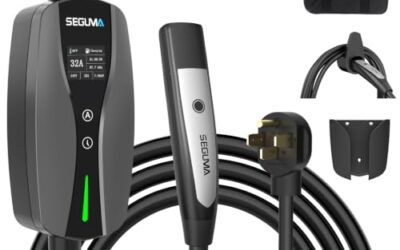
What is level 2 EV charging? In the United States, it is AC charging that typically uses a 208- or 240-volt electrical supply instead of a standard 120-volt household outlet. It is commonly installed at homes, workplaces, parking facilities, hotels, and public destinations because it can add energy substantially faster than Level 1 charging without using a commercial DC fast charger.
A Level 2 charging station does not usually charge the battery directly. It supplies controlled AC power to the vehicle, whose onboard charger converts that power into the DC electricity stored in the high-voltage battery.
Key takeaways
- Level 2 charging generally operates from a 208- or 240-volt AC supply in North America.
- The vehicle’s onboard charger, not only the charging station, determines the maximum AC charging rate.
- Common North American connectors include J1772 and the SAE J3400 connector, often called NACS.
- A more powerful charging station will not force an incompatible vehicle to accept additional power.
- Home installation may require a dedicated circuit, electrical panel evaluation, permits, and professional electrical work.
- Level 2 is usually suited to charging over several hours, while DC fast charging is intended for shorter charging stops when the vehicle supports it.
How Level 2 EV charging works
The wall-mounted or pedestal-mounted device commonly called a charger is technically electric vehicle supply equipment, or EVSE. It communicates with the vehicle, verifies that a safe connection is present, and controls when electricity can flow. In normal AC charging, the actual charger is built into the vehicle.
After the connector is inserted, the EVSE and vehicle exchange basic electrical signals. The EVSE tells the vehicle how much current is available, and the vehicle requests power within that limit. The vehicle’s onboard charger then converts AC electricity to DC electricity and manages battery charging in cooperation with the battery management system.
This arrangement means charging power is constrained by the weakest relevant link. Those limits can include the branch circuit, EVSE output, charging cable, connector or adapter, vehicle inlet, onboard charger, battery temperature, battery state of charge, and vehicle software.
Voltage, amperage, and charging power
Charging power is commonly expressed in kilowatts. As a simplified calculation, power equals voltage multiplied by current. For example, a nominal 240-volt supply delivering 32 amps represents about 7.7 kilowatts before conversion losses and other operating limits. A commercial building may supply 208 volts, so the same current can produce less power than it would on a 240-volt residential supply.
The nameplate output is not a guarantee that a vehicle will continuously receive that amount. An EVSE capable of supplying more current than the vehicle can use will normally advertise its available limit, after which the vehicle draws only what it supports. Charging may also slow because of cold or hot battery conditions, thermal management, scheduled charging settings, power sharing, or a nearly full battery.
Level 1, Level 2, and DC fast charging compared
| Charging type | Typical North American supply | Where conversion occurs | Common use | Main limitation |
|---|---|---|---|---|
| Level 1 | 120-volt AC | Vehicle’s onboard charger | Overnight or low-daily-mileage home charging | Slow energy delivery |
| Level 2 | 208- or 240-volt AC | Vehicle’s onboard charger | Home, workplace, fleet, and destination charging | Limited by AC circuit and onboard charger |
| DC fast charging | High-power commercial electrical service | Charging equipment supplies DC to the vehicle | Road trips and time-sensitive charging stops | Vehicle compatibility, battery conditions, site power, and charging curve |
These categories describe electrical delivery, not a guaranteed number of miles added per hour. Vehicle efficiency varies, and usable charging speed can change throughout a session. A large, less-efficient vehicle receiving a given amount of energy will generally gain fewer miles of estimated range than a smaller, more-efficient vehicle receiving the same energy.
How long does Level 2 charging take?
There is no single Level 2 charging time. A useful estimate requires the energy that must be added and the power the vehicle can actually accept. Dividing required kilowatt-hours by charging power gives a rough number of hours, but real sessions take longer because AC-to-DC conversion is not perfectly efficient and charging power may vary.
For example, adding a modest amount of energy after a typical commute takes much less time than charging a nearly depleted large battery. It is often more practical to think about replenishing daily energy use overnight than to focus on repeatedly charging from empty to full.
The dashboard’s estimated completion time is usually more useful than a generic charging-rate figure because the vehicle can account for its present battery level and current operating conditions. Even that estimate can change if the battery heats or cools, the site shares power among several vehicles, or charging schedules interrupt the session.
Connectors and vehicle compatibility
Level 2 identifies a charging category, not one universal connector. In North America, many vehicles use the SAE J1772 connector for AC charging. Other vehicles use the SAE J3400 connector, widely known as the North American Charging Standard or NACS. Connector adoption varies by manufacturer, model year, region, and production date.
Some vehicles can use a different AC connector through an approved adapter, but physical fit alone does not prove compatibility. The adapter must support AC charging in the intended direction, carry the required electrical ratings, and be permitted by the vehicle and charging-equipment manufacturers. An adapter designed for a DC fast-charging configuration may not provide Level 2 AC compatibility, and the reverse is also true.
Before buying or using charging equipment, verify:
- The vehicle’s model year, inlet type, and maximum AC charging rate.
- The EVSE connector and maximum output.
- Whether an adapter is required and explicitly approved for that vehicle and use.
- The electrical supply voltage and available circuit capacity.
- Indoor or outdoor equipment ratings for the installation location.
- Any firmware, mobile app, Wi-Fi, or phone operating-system requirements for optional connected features.
Network access is not inherently required for basic Level 2 charging, but some public stations require an app, account, access card, or payment method. At home, smart features such as scheduling, energy reports, and utility integration may depend on internet service or compatible software. The vehicle itself may also provide charging schedules without requiring a connected EVSE.
What is Level 2 EV charging at home?
At home, Level 2 charging generally means connecting a compatible EVSE to a dedicated 208- or 240-volt branch circuit. Depending on the equipment and installation plan, the EVSE may be hardwired or connected through an appropriate receptacle. Hardwiring can reduce the number of plug-and-socket connections, while plug-in equipment may be easier to remove, but neither approach is automatically correct for every property.
The electrical panel must have adequate capacity for the proposed load. Available breaker spaces do not by themselves establish that capacity. An electrician may need to perform a load calculation and assess the service, panel, wiring route, grounding, equipment location, and local requirements.
EV charging is generally treated as a continuous electrical load in US electrical design, which affects circuit and equipment sizing. Do not select a breaker or wire size solely by matching it to the EVSE’s advertised output. Conductor material, wire gauge, temperature ratings, installation method, run length, terminals, and applicable electrical codes all matter.
Choosing an appropriate output
The highest available output is not always necessary. Start with the vehicle’s maximum AC acceptance rate, typical daily energy use, parking duration, electrical capacity, and possible future vehicles. A lower-current installation can still replace a normal day’s driving during a long overnight window, depending on vehicle efficiency and mileage.
Some EVSE units can be configured for a lower circuit capacity. Configuration may require hardware switches, installer settings, software, or commissioning procedures. Treat these settings as part of the electrical installation rather than as a casual way to exceed the circuit’s safe capacity.
Public and workplace Level 2 charging
Public Level 2 stations are common where vehicles remain parked for extended periods. Examples include workplaces, hotels, garages, shopping areas, apartment properties, and municipal parking. They are generally better matched to destination charging than to a brief highway stop.
The available output may be lower than the station’s maximum if multiple ports share one electrical supply. Pricing and access rules also vary by network and property. A site may bill for energy, time, a session fee, parking, or a combination, so review the station information before connecting. Station listings in an app may be outdated, and connector availability does not guarantee that a port is functional or unoccupied.
Common mistakes
Assuming the EVSE rating equals the vehicle’s charging rate
The EVSE states the maximum power it can offer under current conditions. The vehicle decides how much it will accept within that limit. Installing higher-output equipment does not increase the charging rate of an onboard charger with a lower limit.
Confusing Level 2 with DC fast charging
Both can use connectors that look similar or share part of an inlet, but the electrical process is different. Level 2 supplies AC power through the vehicle’s onboard charger. DC fast charging bypasses that onboard AC charger and delivers controlled DC power through compatible high-voltage connections.
Using an ordinary extension cord or travel adapter
Household extension cords, improvised adapters, and worn receptacles can overheat under sustained charging loads. Use only equipment and connection methods explicitly approved for the charging application. Stop using any connection that is damaged, loose, discolored, unusually hot, or producing an odor.
Ignoring the receptacle and wiring
A receptacle that physically accepts a plug is not proof that the circuit is suitable. Improper terminals, deteriorated wiring, repeated plugging cycles, or a mismatched circuit can create heat and fire hazards. Existing outlets should be evaluated for the intended continuous load rather than assumed safe because another appliance once used them.
Buying by connector shape alone
Confirm AC charging support, current rating, model-year compatibility, and adapter direction. Connector standards and manufacturer transitions can differ even among vehicles sold under the same brand.
When to get professional help
Use a qualified electrician for a new circuit, hardwired EVSE, service or panel changes, load calculations, receptacle replacement, or investigation of electrical heating and repeated breaker trips. Permit and inspection requirements vary by jurisdiction, property type, and scope of work.
Disconnect charging and seek professional evaluation if you notice a burning smell, smoke, sparking, melted plastic, persistent fault indicators, a loose connector, or excessive heat at the plug, receptacle, cable, or electrical panel. Do not repeatedly reset a breaker without identifying why it is opening. A tripped breaker is a protective response, not a repair.
Contact the vehicle manufacturer or an appropriately qualified repair facility if the car rejects multiple known-working stations, reports a charging-system fault, or shows damage at the inlet. Contact the EVSE manufacturer or network operator if one station fails while the vehicle charges normally elsewhere. These comparisons can help isolate the problem, but they do not replace electrical diagnosis.
Frequently asked questions
Can every EV use Level 2 charging?
Most battery-electric vehicles and plug-in hybrids sold in North America support some form of AC charging, but connector type and maximum input vary. Check the owner’s manual and specifications for the exact model year. Some vehicles require an approved adapter for a particular station connector.
Does Level 2 charging damage an EV battery?
Level 2 charging is a normal charging method supported by compatible vehicles. Battery aging depends on many factors, including temperature, time, charging habits, battery chemistry, and vehicle management. Follow the manufacturer’s guidance for routine charge limits and long-term storage rather than assuming one rule applies to every model.
Can a Level 2 charger be installed outdoors?
Yes, if the EVSE and all associated electrical components are rated and installed for the environment. Weather exposure, mounting, cable management, impact protection, drainage, and local electrical requirements should be considered. An indoor-only unit should not be installed outside.
Do I need a 240-volt outlet in my garage?
Not necessarily. A Level 2 EVSE can be hardwired, and the best connection method depends on the equipment, circuit, location, and local requirements. An electrician can determine whether the existing service and panel can support the planned installation.
Is a higher-amp Level 2 station always better?
No. Additional capacity is useful only if the vehicle can accept it, the electrical system can safely supply it, and the charging window requires it. A properly sized lower-output system may meet daily needs at lower installation complexity, while a larger circuit may offer value for future vehicles if the property can support it.