To maintain a car battery during winter storage, fully charge it, reduce electrical drain, and use a suitable battery maintainer when power is available. Check battery type, vehicle voltage, charger mode, and storage conditions first because AGM, flooded lead-acid, lithium, hybrid, and EV systems need different procedures.
A stored vehicle can lose charge even with ignition off. Alarm systems, keyless-entry receivers, computers, and other memory circuits draw small amounts of power. Cold weather also reduces available starting power. A weak battery may freeze, crack, or fail after several weeks.
Key takeaways
- Read vehicle and battery manuals before connecting a charger.
- Charge a conventional 12-volt battery fully before storage.
- Use a smart maintainer with the correct battery chemistry and voltage.
- Disconnecting the negative cable cuts parasitic drain but can erase settings or affect security systems.
- Keep batteries clean, dry, and well ventilated.
- Do not charge a frozen, swollen, cracked, leaking, or damaged battery.
- EV traction batteries follow different storage rules than 12-volt accessory batteries.
What happens to a car battery during winter storage?
A parked vehicle still uses electricity. The body control module, alarm, remote-entry receiver, clock, and other systems can remain active at low current. This drain may take weeks or months to discharge a healthy battery, but battery age, temperature, accessories, and vehicle condition change the timeline.
Low temperature slows the chemical reaction inside a lead-acid battery. That reduces cranking power when the engine needs to start. A partially discharged battery also has less protection against freezing. A fully charged lead-acid battery tolerates cold better than one left at low charge.
Storage temperature matters, but heat before storage can matter more. High under-hood temperatures speed battery aging. A battery that already has weak capacity may show normal voltage after charging but still fail a load or conductance test.
Prepare the vehicle before storage
Check battery type and voltage
Most gasoline and diesel vehicles use a 12-volt starting battery. Some vehicles use AGM batteries for start-stop systems, high electrical loads, or specific installation locations. Flooded lead-acid and AGM batteries are both lead-acid designs, but charger modes and installation instructions can differ.
Some vehicles use a 48-volt mild-hybrid system alongside a 12-volt battery. Hybrid and EV vehicles also contain high-voltage traction batteries. Do not treat those systems like a normal 12-volt battery. Use the vehicle manual and manufacturer service information.
Battery labels often show terms such as flooded, AGM, EFB, lithium, or LiFePO4. A charger for one chemistry may be unsuitable for another. Lithium batteries may need a battery-management system and a charger with a matching profile.
Inspect the battery
Turn the vehicle off and remove the key or keep the key fob away from the vehicle. Look for case cracks, swelling, leaks, loose posts, corrosion, damaged cables, and poor terminal connections.
Do not charge a damaged battery. Lead-acid batteries can release hydrogen gas during charging. Keep sparks, flames, cigarettes, and hot work away from the battery. Wear eye protection when cleaning corrosion.
Clean light corrosion from accessible terminals with a suitable battery-terminal brush. Follow battery and vehicle instructions for cleaner use. Do not allow cleaning fluid or debris to enter vents. A loose terminal can mimic a dead battery and can create heat under load.
Remove avoidable electrical loads
Unplug dash cams, USB adapters, aftermarket alarms, GPS trackers, fridges, amplifiers, and other accessories. Some devices keep drawing current after the vehicle is locked. Check hard-wired accessories separately because unplugging another device may not stop their drain.
Confirm that lights, hatch doors, glovebox doors, and interior switches turn off. A storage location with poor ventilation may make repeated access difficult, so inspect these items before closing the vehicle.
How to maintain a car battery during winter storage
- Charge the battery before storage. Use a charger or maintainer matched to battery chemistry and vehicle voltage. Connect it in a dry, ventilated area. Follow the charger sequence in its manual.
- Choose a storage connection method. Keep the battery connected to a suitable smart maintainer, disconnect the negative cable, or remove the battery if the vehicle and battery instructions allow removal.
- Position the charger safely. Keep the charger dry and away from moving parts, fuel vapors, water, and heat. Route cables so doors, hoods, and sharp edges cannot pinch them.
- Check charging status. A smart maintainer normally switches between charging and monitoring. Confirm that its indicator shows normal operation rather than an error, reverse-polarity condition, or battery fault.
- Inspect periodically. Check for corrosion, case damage, cable strain, moisture, unusual odor, and charger alarms. Disconnect power before changing battery connections.
- Test before returning the vehicle to service. Remove the charger, reconnect any cable removed for storage, and inspect terminals. Start the vehicle only after all cables and covers are clear of belts, fans, and hot parts.
Which storage method fits your situation?
| Storage method | Useful when | Limits |
|---|---|---|
| Smart battery maintainer | Vehicle sits near a safe electrical outlet and charger supports battery chemistry | Requires correct setup, dry placement, and periodic inspection |
| Negative cable disconnected | No outlet exists and vehicle can lose stored settings | Alarm, remote entry, clock, radio memory, and some control functions may change |
| Battery removed | Vehicle manual permits removal and battery can be stored safely | Some vehicles need reset procedures, battery registration, or anti-theft codes afterward |
| Periodic manual charging | Owner can check battery condition on a regular schedule | Missed checks can allow deep discharge |
A maintainer usually suits a garage with a safe outlet. It supplies a controlled maintenance charge instead of running a basic charger continuously. A basic charger may continue charging after the battery reaches full charge, which can cause overheating or battery damage if left connected.
Disconnecting the negative cable reduces parasitic drain. The tradeoff depends on vehicle model-year and equipment. Some vehicles lose window indexing, steering-angle data, radio presets, clock settings, or learned idle behavior. Some may require battery registration after replacement or reconnection. Check the owner manual before using this method.
How to connect a battery maintainer
Use the connection order printed in the charger manual. On many vehicles, the positive clamp connects to the positive battery post or approved positive jump point. The negative clamp may connect to the negative post or an approved chassis ground. Some vehicles specify a remote ground point so the battery-management sensor can measure current correctly.
Modern vehicles may have a battery monitoring sensor attached to the negative terminal. Do not bypass, remove, or reposition that sensor without vehicle-specific instructions. Incorrect connection can affect charging control and battery monitoring.
For a battery removed from the vehicle, place it on a stable, nonconductive surface in a dry, ventilated location. Follow the battery maker’s instructions for terminal access and charger connection. Keep children and animals away from exposed terminals.
Use a maintainer with a voltage profile that matches the battery. A 12-volt charger does not belong on a 24-volt commercial vehicle system. A standard lead-acid mode may not suit AGM, EFB, or lithium batteries. Some start-stop vehicles use EFB or AGM batteries that require specific replacement and charging settings.
Should you remove the battery for winter storage?
Removal can work when the vehicle manual permits it and storage conditions are safe. It reduces vehicle electrical drain and lets you inspect the battery directly. It also creates extra work during spring startup.
Disconnecting a battery can erase learned settings. The vehicle may need a clock reset, window calibration, steering calibration, radio security code, or battery-management registration. Certain vehicles may lock out features after power loss. Model-year changes can alter these requirements even within one vehicle nameplate.
Do not store a lead-acid battery on a damp concrete floor as a substitute for proper storage. Modern battery cases are not harmed by ordinary floor contact in the way older advice suggests, but moisture, dirt, freezing temperatures, and accidental short circuits remain concerns. A stable shelf or tray gives better protection.
How to check battery condition before and after storage
Visual inspection comes first. A battery with swelling, cracks, leaks, severe corrosion, or a hot case needs attention before charging.
A voltmeter can show resting voltage, but voltage alone does not prove starting capacity. Let the battery rest after charging, then measure according to the meter instructions. Surface charge can produce a temporarily high reading.
A battery tester can estimate state of charge and starting condition through load or conductance testing. Testers use different methods and ratings. Enter the battery’s correct cold-cranking amp rating when the tester asks for it. A wrong rating can distort the result.
A low reading after charging may point to a worn battery, a charging problem, a parasitic drain, or a poor connection. Repeated discharge needs diagnosis rather than repeated charging. Charging restores energy; it does not repair an internal fault or a vehicle drain.
For more charger selection context, see best battery maintainer for winter car storage. Battery chemistry and charging profile differences are covered in best battery charger for cold weather. For a charger comparison, read NOCO GENIUS vs battery tender.
Common mistakes
- Using a trickle charger without checking its mode. Some older chargers can overcharge a battery during long storage.
- Choosing the wrong chemistry setting. AGM, EFB, flooded lead-acid, and lithium batteries may require different voltage behavior.
- Charging a frozen battery. Allow it to thaw safely and inspect it first. Do not apply heat or charge a damaged case.
- Leaving accessories connected. A dash cam or tracker can discharge a battery despite a maintainer being available.
- Ignoring battery age. Charging cannot restore normal capacity to every worn battery.
- Connecting through an unsuitable accessory socket. Some sockets turn off with ignition, while others remain live. The vehicle manual controls this question.
- Leaving charger cables near moving parts. Belts, fans, hinges, and hood edges can damage insulation.
- Disconnecting power without planning for vehicle resets. Check model-year procedures before removing a cable.
When to get professional help
Ask a qualified technician for help when the battery is swollen, leaking, cracked, hot, frozen, or heavily corroded. Professional diagnosis also fits repeated overnight discharge, charging-system warnings, unexplained battery failure, or a vehicle that needs battery registration after replacement.
Hybrid and EV systems need extra caution. Their 12-volt battery may power control modules, but it is separate from the high-voltage traction battery. Do not open high-voltage covers or connect a charger to traction-system wiring. Follow the vehicle maker’s storage procedure.
Professional help also makes sense when a vehicle has an aftermarket alarm, remote starter, air suspension, tracking system, or custom audio installation. These systems can change normal parasitic draw and may require an installed-current test.
Gear that can help
If you need battery chargers and maintainers or battery testers for this job, these picks already appear in our battery chargers and maintainers guides. Check the full guide for fit and who should skip each one.

Pros
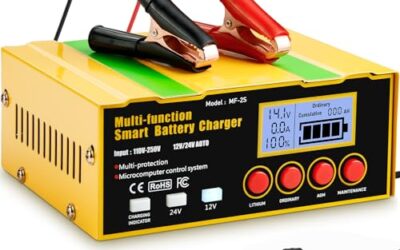
- Adjustable charging current supports different charging needs
- Broad compatibility with listed 12V sealed lead-acid battery types
- Includes dedicated desulfation and repair functions
- Offers engine-start assistance and a winter charging mode
- ETL certification is listed in the listing
Cons
- The repair mode cannot repair completely drained batteries
- Only 12V battery applications are specified
Specifications
| Color | 25A |
|---|---|
| Dimensions | 7.68110235437 x 10.0393700685 x 4.9212598375 inches |
| Weight | 5.00008410216 Pounds |
| Product Group | Automotive Parts and Accessories |
| Binding | Electronics |
Best For / Avoid If
Best for buyers prioritizing
- Adjustable charging current supports different charging needs
- Broad compatibility with listed 12V sealed lead-acid battery types
- Includes dedicated desulfation and repair functions
Consider another option if
- The repair mode cannot repair completely drained batteries
- Only 12V battery applications are specified

Pros
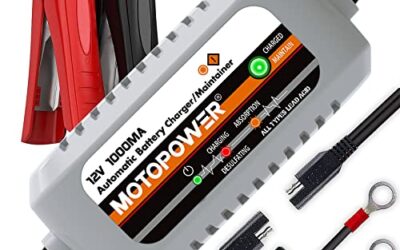
- Supports multiple lead-acid battery types, including AGM, Gel, SLA, VRLA, flooded, maintenance-free, and deep-cycle batteries
- Designed for a wide range of vehicles and equipment, including cars, motorcycles, boats, ATVs, tractors, trucks, SUVs, RVs, and lawn mowers
- Includes both battery clamps and integrated eyelet terminals
- Provides automatic maintenance charging with overcharge protection
Cons
- The listing lists support for LiFePO4 batteries specifically, rather than all lithium-ion battery types
- The charger is specified for 6V and 12V batteries only
Specifications
| Color | Black |
|---|---|
| Size | 10A |
| Dimensions | 4.41 x 4.48 x 9.1 inches |
| Weight | 3.99 Pounds |
| Product Group | Automotive Parts and Accessories |
| Binding | Electronics |
Best For / Avoid If
Best for buyers prioritizing
- Supports multiple lead-acid battery types, including AGM, Gel, SLA, VRLA, flooded, maintenance-free, and deep-cycle batteries
- Designed for a wide range of vehicles and equipment, including cars, motorcycles, boats, ATVs, tractors, trucks, SUVs, RVs, and lawn mowers
- Includes both battery clamps and integrated eyelet terminals
Consider another option if
- The listing lists support for LiFePO4 batteries specifically, rather than all lithium-ion battery types
- The charger is specified for 6V and 12V batteries only

Pros
- Combines engine-code scanning with a built-in battery diagnostic feature
- Provides live data and freeze frame information for diagnostic reference
- Does not require batteries and uses plug-and-play operation
- Supports most 1996 and newer US cars and listed 2000 and newer EU and Asian vehicles
Cons
- Does not support new energy or hybrid vehicles
- Limited to engine fault codes and does not support ABS, SRS, or transmission systems
- Vehicle compatibility may vary because the source lists general model-year and protocol support rather than a specific vehicle list
Specifications
| Color | Orange |
|---|---|
| Dimensions | 2.95 x 0.9 x 5.35 inches |
| Weight | 0.4 pounds |
| Product Group | Automotive Parts and Accessories |
Best For / Avoid If
Best for buyers prioritizing
- Combines engine-code scanning with a built-in battery diagnostic feature
- Provides live data and freeze frame information for diagnostic reference
- Does not require batteries and uses plug-and-play operation
Consider another option if
- Does not support new energy or hybrid vehicles
- Limited to engine fault codes and does not support ABS, SRS, or transmission systems
- Vehicle compatibility may vary because the source lists general model-year and protocol support rather than a specific vehicle list
FAQ
Can I leave my car battery connected all winter?
Yes, when a suitable smart maintainer supports the battery type and remains connected according to its instructions. Keep the setup dry, ventilated, protected from damage, and checked during storage.
How often should I charge a stored car battery?
A smart maintainer can monitor charge continuously. Without one, check battery condition on a regular schedule based on battery age, temperature, vehicle drain, and manual guidance. Do not wait until the starter only clicks.
Should I disconnect the positive or negative cable?
The negative cable is commonly disconnected first because it reduces short-circuit risk if a tool touches the vehicle body. Follow the vehicle manual, especially when a battery sensor is attached to the negative terminal.
Can cold weather damage a fully charged battery?
Cold reduces available starting power, but a fully charged battery handles cold better than a discharged one. Battery age, condition, electrolyte state, and storage temperature still affect performance.
Does a battery maintainer charge a dead battery?
Some maintainers can recover a deeply discharged battery, while others need minimum voltage before charging begins. A damaged or failed battery may reject charging. Test and replace it when condition remains poor.
Sources and further reading
- Battery Council International (Battery Council International): Battery industry resources cover lead-acid battery use, care, and safety.