To estimate runtime for a car power inverter, divide usable battery energy by the inverter’s total DC power draw. You need battery capacity, appliance wattage, inverter efficiency, and a realistic limit on how much battery capacity you can use.
- Use watt-hours for battery energy and watts for load power.
- Account for inverter losses and idle draw, if known.
- Treat the result as an estimate, not a guaranteed run time.
- Engine-off use can leave a vehicle unable to start; do not assume the inverter will protect the starter battery.
What information do you need?
Start with the battery’s usable energy, the appliance’s actual input power, and the inverter’s efficiency at that load. Battery voltage alone does not tell you how long an appliance will run. A 12-volt battery’s capacity in amp-hours must be combined with voltage to estimate energy.
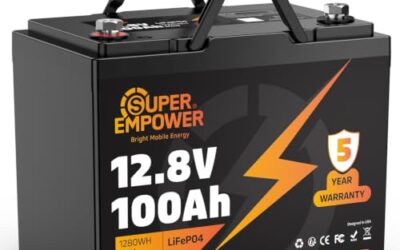
- Battery capacity: Use the battery’s amp-hour rating, if available, or its watt-hour rating. Check which battery powers the inverter: the vehicle’s starting battery, a separate auxiliary battery, or a portable power station.
- Usable capacity: The full rated capacity may not be available for the inverter. Battery chemistry, age, temperature, discharge rate, and the vehicle’s electrical system can all affect usable energy.
- Load power: Use the appliance’s input watts, not its output rating or a marketing description. Some devices draw different power during startup or as their operating cycle changes.
- Inverter losses: The inverter draws more DC power than the appliance receives as AC power. Its efficiency varies with load and operating conditions.
- Idle draw: An inverter can use power even when the connected appliance draws little or no power. Include its idle consumption when that figure is available.
Use these steps for a first estimate. They work best with a separate battery whose capacity and usable discharge limit you know. A vehicle’s starting battery and charging system add limits that simple arithmetic cannot capture.
- Find battery energy. If capacity is in amp-hours, multiply amp-hours by nominal battery voltage to get watt-hours. For example, 100 amp-hours at 12 volts equals 1,200 watt-hours of rated energy. This is not the same as usable energy.
- Apply a usable-capacity limit. Multiply rated watt-hours by the fraction you plan to use. If the example battery has 600 usable watt-hours, use 600, not its full 1,200-watt-hour rating. Choose this limit based on battery type and its manufacturer’s instructions.
- Find the appliance’s AC draw. Add the wattage of appliances that will run at the same time. For a device with cycling or variable demand, use a realistic average for the intended use, then separately consider its peak or startup demand.
- Account for inverter efficiency. Divide AC load watts by inverter efficiency written as a decimal. At 85% efficiency, divide by 0.85. The result estimates DC watts needed for the appliance, before adding idle draw.
- Add inverter idle consumption. If idle draw is given in watts, add it to the estimated DC watts. If it is given in amps, convert it to watts using the inverter’s DC input voltage.
- Divide usable battery watt-hours by total DC watts. The result is estimated hours. Round down for planning, since real loads and batteries do not behave like perfectly fixed values.
Runtime formula and worked example
Estimated runtime in hours = usable battery watt-hours ÷ total inverter DC input watts.
For a rough estimate when idle draw is ignored, use:
Total inverter DC watts ≈ AC appliance watts ÷ inverter efficiency.
Hypothetical example: A battery has 600 usable watt-hours. An appliance uses 120 AC watts, and the inverter operates at an assumed 85% efficiency at that load. The estimated DC demand is 120 ÷ 0.85, or about 141 watts. Estimated runtime is 600 ÷ 141, or about 4.3 hours. This example is arithmetic, not a prediction for a particular vehicle, battery, inverter, or appliance.
If inverter idle draw is 8 watts, include it in the total: 141 + 8 = 149 watts. The revised estimate is 600 ÷ 149, or about 4 hours. Actual runtime can be shorter if the appliance draws more power, the battery cannot supply its rated capacity, or the inverter shuts down at its low-voltage limit.
How to calculate from amp-hours
When only amp-hours are available, estimate rated energy first: watt-hours = amp-hours × nominal battery volts. Then apply a usable-capacity limit and divide by total DC watts. Keep units consistent. Do not divide amp-hours directly by appliance watts.
For a current-based estimate, DC current is approximately AC watts divided by DC voltage and inverter efficiency. For example, a 120-watt AC load at 12 volts and 85% efficiency draws about 11.8 amps, before idle current. The battery’s actual voltage changes during use, so this current estimate is not constant.
Amp-hour ratings also depend on how the battery was rated and on discharge conditions. A rating measured over a long period may overstate energy available to a high-power inverter load. Follow the battery maker’s specifications rather than treating amp-hours as a universal measure of runtime.
Engine off or engine running: why it matters
With the engine off, an inverter connected to the starting battery draws energy that the vehicle may need to start. A low-voltage cutoff can stop inverter output, but its threshold may not preserve enough charge for every vehicle to start. Do not treat the cutoff as a battery-management system or a guarantee against a no-start condition.
With the engine running, the alternator may supply some or most of the inverter’s DC demand. That does not mean every vehicle can support every inverter load. Available charging current depends on vehicle design, engine speed, electrical loads, wiring, and the inverter connection. A vehicle’s accessory outlet may have a lower current limit than a direct battery connection, and its fuse and wiring set practical limits.
Vehicle model year and powertrain matter. Some vehicles limit outlet power, change charging behavior, or shut down outlets under specific conditions. Hybrid and electric vehicles may use a low-voltage battery supplied by a DC-to-DC converter rather than a conventional alternator. Follow the vehicle manual for permitted loads and connection points. Do not assume an inverter can safely draw its full rated power from any 12-volt outlet.
Check inverter and appliance compatibility
Runtime math does not show whether the setup can start or safely operate an appliance. Compare the appliance’s continuous and startup demand with the inverter’s continuous and surge ratings. Motors, compressors, and some power supplies can draw more power during startup than during normal operation.
Check the inverter’s input voltage, output voltage, waveform requirements, and connection method against the appliance and vehicle. A modified-sine-wave inverter may not suit every electronic device or motor. The appliance maker’s instructions can identify restrictions. The inverter’s AC outlets also have limits; dividing its headline watt rating across several devices does not make those outlets or the vehicle wiring unlimited.
For a broader look at matching inverter capacity to a setup, see our guide to matching inverter power to outdoor lights. If your load is a vehicle refrigerator, our articles on car refrigerator capacity and power and refrigerators with a separate battery cover related power-planning questions.
Why real runtime differs from the estimate
The formula assumes stable load, known usable battery energy, and steady inverter efficiency. Real systems vary. A refrigerator compressor cycles. A laptop charger may draw less after its battery fills. A heating appliance may run continuously. Those patterns change average power and runtime.
Battery condition and temperature also affect available energy. An older battery may hold less charge than its original rating. A high load can cause voltage to sag, which may trigger inverter shutdown while energy remains in the battery. Longer or thinner cables, poor connections, and excess heat can add voltage drop or create unsafe operating conditions.
For a more useful estimate, calculate a low-load and high-load case using plausible power values, then plan around the shorter result. If the appliance cycles, estimate energy use over the period you care about rather than relying only on its maximum wattage. Do not use a guessed average as a guarantee.
Common mistakes
- Using the battery’s full rated capacity. Rated energy and usable energy are not always equal. Apply the battery maker’s discharge guidance.
- Ignoring inverter losses. AC appliance watts are not the same as DC watts drawn from the battery.
- Using surge watts as continuous load, or the reverse. Check both ratings and the appliance’s startup needs.
- Assuming a 12-volt outlet supports the inverter’s full rating. Outlet, fuse, and wiring limits may be lower.
- Assuming engine-on use means unlimited power. The charging system and vehicle wiring still have limits.
- Treating the answer as exact. Battery state, temperature, load cycles, and voltage cutoff can change the result.
When to get professional help
Ask a qualified automotive technician or vehicle upfitter to assess a hardwired inverter installation, high-current loads, charging-system capacity, cable sizing, or battery isolation. Stop using the setup if cables or connections become hot, insulation is damaged, the battery swells or leaks, or the inverter repeatedly trips or shuts down. Follow the vehicle and equipment manuals; incorrect wiring can cause fire, battery damage, or vehicle electrical faults.
Gear that can help
If you need power inverters for this job, these picks already appear in our power inverters guides. Check the full guide for fit and who should skip each one.

Pros
- Combines two AC outlets with four USB charging ports
- Supports 12V DC to 110V AC power conversion
- Lists multiple electrical protection features
- Compact design is intended to save space and simplify carrying
Cons
- The listing does not identify the USB charging protocols or output specifications
- The listing field and product description are empty
Best For / Avoid If
Best for buyers prioritizing
- Combines two AC outlets with four USB charging ports
- Supports 12V DC to 110V AC power conversion
- Lists multiple electrical protection features
Consider another option if
- The listing does not identify the USB charging protocols or output specifications
- The listing field and product description are empty

Pros
- Combines AC outlets with USB-C and USB-A charging ports
- 65W USB-C PD output supports charging compatible devices
- 30-inch power cord provides additional reach inside a vehicle
- Automatic cooling fan activates at an internal temperature of 113°F (45°C)
Cons
- The product advises connecting only one high-power device at a time
- Using the 65W USB-C PD port together with an AC socket may exceed the vehicle socket's limit
Specifications
| Color | Red |
|---|---|
| Product Group | Electronics |
Best For / Avoid If
Best for buyers prioritizing
- Combines AC outlets with USB-C and USB-A charging ports
- 65W USB-C PD output supports charging compatible devices
- 30-inch power cord provides additional reach inside a vehicle
Consider another option if
- The product advises connecting only one high-power device at a time
- Using the 65W USB-C PD port together with an AC socket may exceed the vehicle socket's limit
Pros
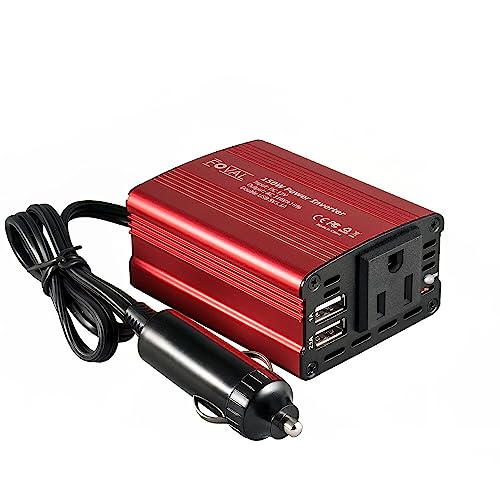
- Combines one AC outlet with two USB charging ports
- Supports simultaneous charging of most phones and tablets through the USB ports
- Compact and lightweight design at 8 oz+
- Includes multiple stated protection features and a cooling fan
Cons
- The 150W continuous output limits use with devices requiring more power
- Requires a vehicle cigarette lighter or 12V DC power connection
Specifications
| Color | Classic Red |
|---|---|
| Dimensions | 3.7 x 2.5 x 1.5 inches |
| Weight | 0.49824471212 pounds |
| Product Group | Automotive Parts and Accessories |
| Binding | Electronics |
Best For / Avoid If
Best for buyers prioritizing
- Combines one AC outlet with two USB charging ports
- Supports simultaneous charging of most phones and tablets through the USB ports
- Compact and lightweight design at 8 oz+
Consider another option if
- The 150W continuous output limits use with devices requiring more power
- Requires a vehicle cigarette lighter or 12V DC power connection
FAQ
Can I run a car inverter with the engine off?
Often an inverter can draw from a battery with the engine off, but runtime depends on usable battery capacity and load. A starting battery may lose enough charge that the vehicle will not start. Use a separate battery system for sustained loads when appropriate, installed and operated according to its instructions.
Does a higher-wattage inverter make an appliance run longer?
No. The inverter’s watt rating describes its power capacity, not stored energy. Runtime mainly depends on battery energy, appliance demand, inverter efficiency, and idle draw.
Can I estimate runtime using only inverter wattage?
No. The inverter rating does not tell you battery capacity or the appliance’s actual draw. You need battery energy and load information, plus a reasonable efficiency estimate.
Why does my inverter shut off before the calculated runtime?
Possible causes include battery voltage sag, low battery charge, high startup demand, overheating, an overload, poor connections, or a low-voltage cutoff. Check the inverter and vehicle manuals. Stop if wiring, battery, or connection damage is possible.