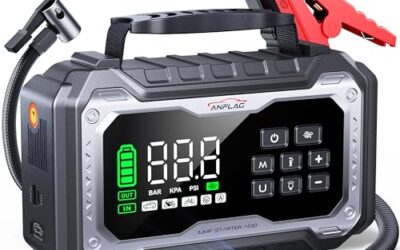
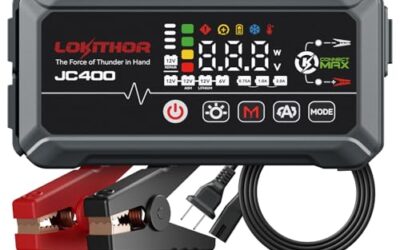
Can a jump starter charge a car battery? Usually, no. A jump starter supplies short-term electrical power for engine cranking, while a battery charger sends controlled current into the battery for a longer period. Some jump starters include a low-current charging mode, but that feature does not exist on every model.
Use a jump starter to start a vehicle with a weak or discharged 12-volt battery. Use a battery charger or maintainer to restore and maintain battery charge. The vehicle alternator may recharge the battery after the engine starts, but driving cannot repair a failing battery or charging system.
Key takeaways
- Most jump starters boost engine cranking power without fully charging the car battery.
- A jump starter with USB or vehicle-output ports may power accessories, but those ports do not prove battery-charging ability.
- Charging time depends on battery condition, charger output, battery type, temperature, and vehicle system design.
- A jump-started vehicle may stop again if its battery, alternator, cables, or starter has a fault.
- Check voltage, connector type, battery chemistry, and vehicle requirements before connecting equipment.
What does a jump starter do?
A jump starter stores energy in an internal battery. When connected to a vehicle battery, it supplies high current for a short period. That current helps the starter motor turn the engine when the vehicle battery cannot provide enough cranking power.
The jump starter does not normally replace the vehicle battery. It adds temporary power to the starting circuit. Once the engine runs, the vehicle charging system may replenish some energy in the battery and power the vehicle electronics.
Many portable units use lithium-ion cells. Larger packs may use lead-acid batteries. Both types can start vehicles, but operating limits differ. Cold weather, battery age, engine size, diesel compression, and cable condition all affect starting success.
What does a car battery charger do?
A battery charger controls current and voltage over time. It can refill a discharged battery gradually and may switch to a maintenance mode after reaching its target voltage. Smart chargers may select different charging stages for flooded lead-acid, AGM, or other supported battery types.
A charger normally connects to household AC power or another approved power source. Its output is lower and more controlled than the short burst from a jump starter. Charging may take hours, especially when a battery has very little remaining capacity.
A maintainer serves a narrower purpose. It keeps a healthy battery near full charge during storage. It cannot restore capacity lost through age, internal damage, sulfation, or a shorted cell.
Can a jump starter charge a car battery after starting?
A standard jump starter usually cannot recharge the vehicle battery after the engine starts. Its internal battery may have enough stored energy for one or more starting attempts, but its output circuit normally supports cranking rather than controlled battery charging.
Some models include a battery-charging mode, alternator-test function, or dedicated charging output. Read the unit manual for that specific feature. A USB-C input may recharge the jump starter itself. A 12-volt outlet may power an accessory. Neither feature automatically means the unit can charge a vehicle battery.
Even a jump starter with charging capability may need many hours to refill a deeply discharged battery. Output voltage and current must match the battery and the device’s charging design. A jump starter is not a universal replacement for a 12-volt smart charger.
Jump starter versus battery charger
| Device | Main job | Typical use | Limit |
|---|---|---|---|
| Jump starter | Provide high current briefly | Start an engine with a weak battery | Usually does not refill battery capacity |
| Battery charger | Send controlled current over time | Recharge a discharged battery | Usually needs AC power or a suitable power source |
| Battery maintainer | Hold a charged battery near full | Long-term vehicle storage | Not a fix for a damaged battery |
| Alternator | Power vehicle loads and recharge battery while running | Normal operation after engine start | Cannot fix a failed alternator or worn battery |
How to use a jump starter safely
Read both vehicle and jump-starter manuals first. Vehicle model-year differences can change battery location, jump points, ground points, and shutdown procedures. Some vehicles use battery-monitoring sensors or remote terminals that require a specific connection method.
- Park both vehicles or position the jump starter away from moving parts. Turn off lights, audio, climate controls, and other loads.
- Confirm voltage. Most passenger vehicles use 12-volt systems. Do not connect a 12-volt jump starter to a 24-volt truck or equipment system.
- Inspect the battery. Stop if the case is cracked, swollen, leaking, frozen, or visibly damaged.
- Turn off the jump starter before connecting clamps unless its instructions say otherwise.
- Connect the positive clamp to the positive battery terminal or approved positive jump point.
- Connect the negative clamp to the approved negative point or vehicle ground. Follow the vehicle manual because some vehicles prohibit direct connection to the negative battery post.
- Activate the jump starter when required. Wait for its ready indicator or alarm to show a valid connection.
- Start the vehicle using short attempts. Allow the starter and cables to cool between attempts.
- After the engine starts, remove clamps in the order listed by the device or vehicle manual. Keep clamps from touching each other or metal parts.
- Let the jump starter cool, then recharge its internal battery using its approved input and cable.
Do not crank repeatedly when the engine does not respond. A no-start condition may come from fuel delivery, ignition, immobilizer, starter, wiring, or a mechanical fault. More jump-start attempts will not fix those problems.
Will driving recharge a dead car battery?
The alternator can recharge some energy after a successful jump-start, but driving time and route do not guarantee a full recharge. Modern vehicles use electrical systems that vary alternator output based on load, battery state, temperature, and control strategy.
A short drive may leave the battery undercharged. Idling may provide less charging current than driving, depending on vehicle design and electrical demand. A battery that repeatedly needs a jump may have low capacity, poor cable connections, parasitic drain, or a charging-system fault.
Use a battery charger when the goal is a full recharge. Test the battery and charging system if the problem returns. A charger can refill a healthy battery, but it cannot restore a battery with internal failure.
Compatibility limits that matter
Voltage
Match the jump starter to the vehicle system. Passenger cars and light trucks commonly use 12 volts, while some commercial trucks and equipment use 24 volts. Using the wrong voltage can damage electronic modules and create a fire risk.
Battery chemistry
Lead-acid, AGM, gel, lithium, and other battery types have different charging needs. A charger mode made for one chemistry may be wrong for another. Start-stop vehicles often use AGM or another battery type that needs the correct replacement and charging profile.
Vehicle access
The battery may sit under a seat, in a trunk, or inside an engine compartment. A vehicle may provide remote jump points under the hood. Cable reach and clamp size matter, especially on trucks, diesel vehicles, and vehicles with crowded battery compartments.
Low-voltage protection
Some jump starters refuse to activate when they detect very low battery voltage. Manual override modes may bypass that protection. Use override only as the manual permits because reverse polarity or a damaged battery can cause severe damage.
Common mistakes
- Confusing USB charging with vehicle-battery charging: USB ports normally recharge phones or the jump starter, not a 12-volt car battery.
- Leaving clamps connected too long: Follow the operating time and pause rules in the manual.
- Using a jump starter as a permanent battery maintainer: Its output may not support continuous connection.
- Ignoring polarity: Reversed clamps can damage fuses, modules, cables, or the jump starter.
- Jump-starting a damaged battery: Swelling, leaks, cracks, and freezing call for replacement or professional handling.
- Assuming a running engine proves the repair: The vehicle may start once and fail again after shutdown.
- Choosing by peak amps alone: Engine size, temperature, battery condition, cable quality, and diesel requirements also affect performance.
When to get professional help
Call for professional service when the battery is damaged, the vehicle has high-voltage hybrid or electric systems, or the correct jump points are unclear. Do not connect a portable jump starter to a high-voltage traction battery. Hybrid vehicles may still use a separate low-voltage battery for control systems, but the owner’s manual controls the jump procedure.
Professional diagnosis also makes sense after a jump-start fails. A technician can check battery condition, charging voltage, starter current, cable voltage drop, and parasitic drain. These tests separate a weak battery from an alternator, starter, wiring, or control-system fault.
For storage and cold-weather planning, see CarTechTalk’s guides to jump starters for stored vehicles and cold-weather battery boosters. Truck owners may need different cable reach and output considerations covered in the truck battery jump starter guide.
Gear that can help
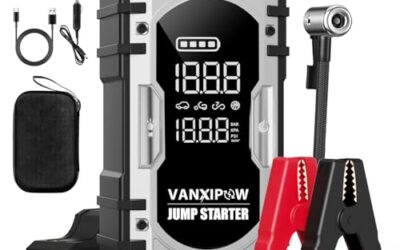
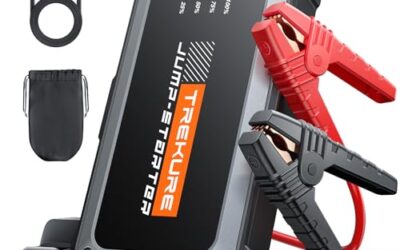
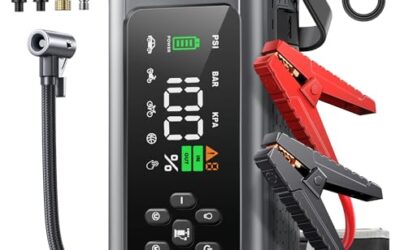
If you need jump starters for this job, these picks already appear in our jump starters guides. Check the full guide for fit and who should skip each one.
Pros
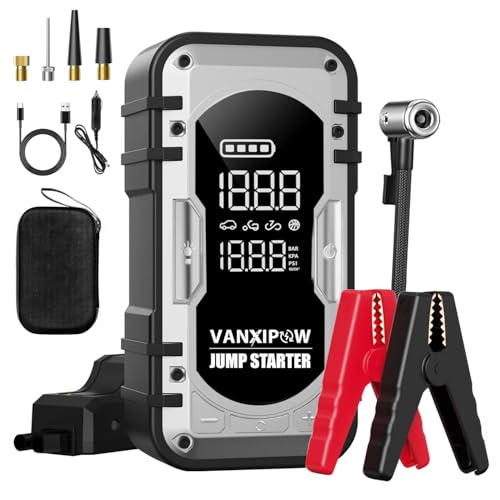
- Combines jump-starting, tire inflation, emergency lighting, and USB charging in one device
- Listed compatibility covers a broad range of 12V vehicles and engines up to 9.0L gas or 8.0L diesel
- Stated weight of 615 grams supports portable use
- LCD screen displays battery level, inflation mode, and real-time tire pressure
Cons
- The air pump should not be used continuously and requires cooling when it becomes seriously hot
- The product has one USB output port
Specifications
| Color | black silver |
|---|---|
| Dimensions | 6.9 x 2.3 x 3.5 Inches |
| Weight | 1.873929227 pounds |
| Product Group | Automotive Parts and Accessories |
Best For / Avoid If
Best for buyers prioritizing
- Combines jump-starting, tire inflation, emergency lighting, and USB charging in one device
- Listed compatibility covers a broad range of 12V vehicles and engines up to 9.0L gas or 8.0L diesel
- Stated weight of 615 grams supports portable use
Consider another option if
- The air pump should not be used continuously and requires cooling when it becomes seriously hot
- The product has one USB output port

Pros
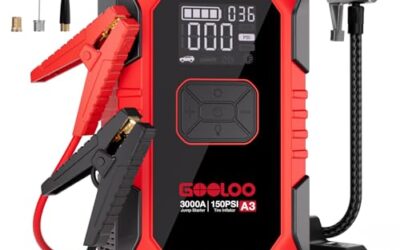
- Combines jump-starting, tire inflation, high-volume air movement, device charging, and emergency lighting in one unit
- Supports a wide stated range of vehicle applications, including gas engines and diesel engines up to 14.0L
- Includes automatic tire-pressure shut-off and five inflation presets
- Comes with jumper cables, an extended air hose, four air nozzles, a USB-A to USB-C cable, instructions, and a carrying case
Cons
- The unit weighs 4.85 lb
- The manufacturer recommends charging the device every 4-5 months if it remains idle
Specifications
| Color | Black |
|---|---|
| Dimensions | 9.1338582584 x 2.7952755877 x 5.4330708606 inches |
| Weight | 2.8439631798 pounds |
| Product Group | Automotive Parts and Accessories |
Best For / Avoid If
Best for buyers prioritizing
- Combines jump-starting, tire inflation, high-volume air movement, device charging, and emergency lighting in one unit
- Supports a wide stated range of vehicle applications, including gas engines and diesel engines up to 14.0L
- Includes automatic tire-pressure shut-off and five inflation presets
Consider another option if
- The unit weighs 4.85 lb
- The manufacturer recommends charging the device every 4-5 months if it remains idle
FAQ
How long should a jump starter charge a car battery?
Most jump starters should not charge a car battery at all. If a model has a dedicated charging mode, follow its manual for connection, output, and time limits. A standard smart battery charger is the better tool for a full recharge.
Can I leave a jump starter connected while the car runs?
Only if the jump-starter manual and vehicle manual permit it. Many units should be disconnected soon after the engine starts. Continuous connection can expose the device to heat, voltage changes, and vibration.
Can a jump starter damage a car?
Damage can occur through reverse polarity, wrong system voltage, poor connections, forced override operation, or use on a damaged battery. Correct clamps and the correct 12-volt or 24-volt setting reduce risk.
Why does my car need another jump after driving?
The battery may have lost capacity, the alternator may not recharge it, or the vehicle may draw power while parked. Corroded terminals and loose grounds can also block current flow.
Is a jump starter better than a battery charger?
Neither replaces the other. A jump starter helps start a vehicle without outside power. A battery charger restores battery charge over time. Many drivers keep both because they solve different problems.
Sources and further reading
- Battery Council International (Battery Council International): Battery care and charging information for vehicle owners.