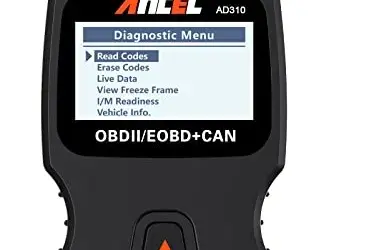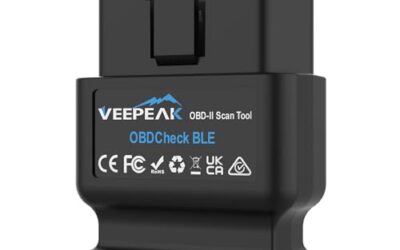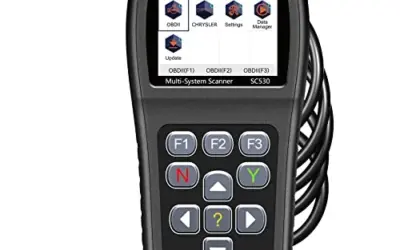

Best obd 2 software depend on diagnostic depth, operating system, and hardware adapter chipset. Generic programs retrieve standardized emissions trouble codes across all post-1996 passenger vehicles. Advanced platforms access proprietary control modules, run bidirectional component tests, and alter electronic control unit (ECU) parameters.
- Standard protocol support: Baseline software read SAE J1979 modes ($01 through $0A) for emissions-related faults.
- Hardware dependency: Software speed depends on adapter interface; genuine STN or FTDI chips outperform clone ELM327 hardware.
- Operating system split: Mobile apps excel at live dashboard metrics; Windows programs handle complex configuration and high-frequency data logging.
- Diagnostic boundary: Erasing trouble code clears ECU fault memory, resets readiness monitors, but fix zero physical mechanical defects.
Understanding OBD-II Software Architecture
Diagnostic software function as interpreter between user interface and vehicle serial bus. Vehicle Controller Area Network (CAN) or legacy ISO protocols transmit raw hex bytes. Software send request frames, parse response frames, convert raw data to human-readable engineering units.
Software stack split into three distinct layers:
- User Interface Layer: Graph engine speeds, calculate fuel economy, present diagnostic trouble codes (DTCs), display Freeze Frame records.
- Translation Core: Map raw parameter identification (PID) hex responses via mathematical transfer functions to standard units (Celsius, kPa, RPM).
- Hardware Communication Layer: Transmit AT/ST command strings via serial port, USB virtual COM port, Bluetooth SPP, or Wi-Fi TCP/UDP sockets to scanner interface.
Selecting the Best OBD 2 Software for Specific Diagnostic Work
Generic diagnostic software read standardized parameters mandated by EPA and international bodies. These cover engine control module (ECM) and transmission control module (TCM) emissions faults. Generic tools cannot poll anti-lock brake systems (ABS), supplemental restraint systems (SRS), body control modules (BCM), or climate control modules.
Manufacturer-specific programs implement proprietary diagnostic modes. Ford, Mazda, General Motors, Toyota, and VAG vehicles utilize unique command frames outside standard SAE J1979 regulations. Enhanced diagnostic packages access these internal buses to query manufacturer-specific PIDs, trigger sensor self-tests, and perform system actuations.
Key Diagnostic Modes Defined by SAE J1979
Capable software execute core diagnostic functions designated by hexadecimal service IDs:
- Mode $01: Request current powertrain diagnostic data. Software query real-time sensor metrics like coolant temperature, manifold absolute pressure, short-term fuel trim.
- Mode $02: Request freeze frame data. Software capture operating parameter snapshots recorded at exact instant DTC triggered.
- Mode $03: Request confirmed emission-related diagnostic trouble codes. Identifies stored faults that turned on Malfunction Indicator Lamp (MIL).
- Mode $04: Clear/reset emission-related diagnostic information. Erases stored codes, freeze frame snapshots, oxygen sensor test records, diagnostic readiness status.
- Mode $06: Request on-board monitoring test results for specific monitored systems. Crucial for pinpointing intermittent misfires before MIL illumination.
- Mode $07: Request pending diagnostic trouble codes. Reveals fault conditions detected during current or last driving cycle not yet meeting confirmation threshold.
- Mode $09: Request vehicle information. Accesses vehicle identification number (VIN), calibration IDs (CALID), calibration verification numbers (CVN).
- Mode $0A: Request permanent diagnostic trouble codes. Accesses faults preserved through Mode $04 clear commands, resettable only by vehicle internal validation drive cycle.
Hardware Interface Requirements: ELM327 vs. STN vs. J2534
Software performance bottleneck link directly to physical adapter processor. Software send instructions; microchip execute bus timing.
ELM327 Command Interpreters
ELM327 microchip translate standard RS-232 serial commands into automotive protocols (CAN, ISO 9141-2, ISO 14230-4 KWP2000, SAE J1850 PWM, SAE J1850 VPW). Genuine chips utilize PIC18F2480 microcontrollers. Market flood with low-cost Asian clones labeled firmware v2.1. Most clone hardware contain defective PIC16F84 clones, drop CAN frames, lack support for extended PID addressing, fail variable-length byte commands. Choose software matching verified hardware interfaces.
STN Chipsets
STN11xx and STN22xx processors run modern 16-bit and 32-bit cores. Processing speeds exceed legacy ELM327 tenfold. Processors include large memory buffers, prevent buffer overrun when tracking high-speed CAN traffic, support Medium-Speed CAN (MS-CAN) alongside High-Speed CAN (HS-CAN) without manual external toggle switch wiring.
SAE J2534 Pass-Thru Devices
J2534 standard mandate hardware-independent driver interface. Software communicate via standardized dynamic link library (DLL). Necessary for original equipment manufacturer (OEM) level diagnostics, factory module re-flashing, deep bidirectional subsystem overrides. Protocol required when using dealership-equivalent diagnostic suites on Windows systems.
Diagnostic Software Comparison Matrix
| Diagnostic Scope | Protocol / Standard | Interface Standard | Typical OS | Primary Function |
|---|---|---|---|---|
| Entry-Level Generic | SAE J1979 | ELM327, Bluetooth OBD | Android, iOS | Basic code reads, live telemetry, clear MIL |
| Intermediate Enthusiast | Extended PIDs, Mode $06 | STN chipsets, OBDLink | Android, Windows | Misfire tracing, DPF status, track telemetry |
| Brand-Specific Diagnostic | Proprietary UDS / KWP | OBDLink, ELS27, ENET | Windows, iOS | Module coding, ABS bleeding, service resets |
| Professional / OEM | SAE J2534, DoIP | J2534 Pass-thru tool | Windows 10 / 11 64-bit | ECU flashing, calibration, security programming |
Operating System Trade-offs
Diagnostic software architecture diverge across mobile and desktop environments:
Android Platforms
Android support Bluetooth Serial Port Profile (SPP), USB On-The-Go (OTG), direct Wi-Fi links. Highly flexible connection framework. Excellent platform for dashboard gauge cluster emulation, constant background sensor polling, quick road-trip status checks. Low latency when paired with Bluetooth 4.0 or Bluetooth Low Energy (BLE) transceivers.
Apple iOS Platforms
iOS historically restrict classic Bluetooth SPP connection unless accessory join Apple MFi licensing program. Modern iOS diagnostic software require BLE or Wi-Fi communication protocols. Background process limits inside iOS interrupt continuous log capture if screen lock engage or user switch apps.
Windows Systems
Preferred choice for deep vehicle configuration. Direct access to raw FTDI USB drivers eliminate wireless packet loss and transmission latency. Windows environment host full OEM-grade engineering suites, open-source python-OBD libraries, heavy-duty software capable of plotting hundred simultaneous CAN bus parameters without sampling drops.
Step-by-Step Guide: Establishing Diagnostic Connection
- Inspect vehicle diagnostic port. Locate 16-pin DLC (Data Link Connector) under driver side dashboard. Inspect pin 16 for battery positive voltage (minimum 12.0V) and pins 4 and 5 for chassis and signal ground continuity.
- Ensure vehicle ignition remains completely OFF. Plug OBD-II adapter firmly into 16-pin DLC.
- Turn ignition switch to ON/RUN position. Do not crank engine if testing stationary electrical parameters. Confirm adapter LED indicators show stable power connection.
- Launch diagnostic software on host device (PC, tablet, or phone). Configure connection settings to match hardware: select correct COM port and baud rate (commonly 38400 or 115200 for USB, default auto-detect for Bluetooth).
- Initiate connection sequence within software. Allow software to auto-negotiate correct bus protocol (e.g., ISO 15765-4 11-bit/500k CAN, SAE J1850 PWM).
- Confirm successful handshake before reading codes or querying live sensor PIDs. Verify battery voltage indicator within software interface.
Safety Warnings and Diagnostic Precautions
Improper software commands create system failure risks:
CRITICAL SAFETY WARNING: Never initiate ECU reprogramming, calibration adaptation, or bidirectional actuator testing if vehicle system voltage drops below 12.4 volts. Voltage drop during flash cycle permanently corrupts ECU memory, bricking the module. Always connect clean external automotive battery support power supply during active configuration sessions.
Diagnostic safety realities to observe:
- Clearing codes fixes nothing: Mode $04 clear code command wipe volatile memory storage inside ECU. Command does not fix physical sensor drift, vacuum line break, wiring corrosion, or mechanical wear. Problem triggers code again once trip cycle test monitor completes.
- Emissions readiness wipe: Erasing codes reset internal inspection and maintenance (I/M) readiness flags to “Not Ready”. Vehicle fail statutory state emissions test immediately until comprehensive drive cycle complete.
- Active actuator hazards: Triggering radiator fan relays, EVAP solenoid valves, or ABS pump cycling via bidirectional software mode while hands work engine bay cause mechanical pinch injury.
Common Diagnostic Mistakes to Avoid
Users introduce diagnostic errors via simple operational oversights:
- Ignoring Freeze Frame metrics: Clearing fault without recording freeze frame data destroy vital contextual evidence: engine load, throttle angle, short/long term fuel trims, exact vehicle speed when fault registered.
- Using ultra-cheap adapter clones: Microchip clones generate electrical bus noise, drop CAN packets, cause instrument cluster flickering, inject invalid communication frames onto vehicle network.
- Confusing generic DTCs with OEM codes: Generic code P0300 indicate general random misfire. Manufacturer-level scan tool software extract proprietary sub-codes identifying cylinder-specific breakdown factors like primary ignition circuit vs fuel injector circuit failure.
- Over-polling live data parameters: Requesting sixty live PIDs simultaneously via slow 10.4 kbps ISO 9141 bus reduce sample frequency to one update every three seconds. Limit active logging display to essential diagnostic PIDs (e.g., RPM, fuel trim, MAF voltage) to maintain rapid sample rates.
When to Seek Professional Diagnostic Support
Standard OBD-II software meet hard operational boundaries when vehicle faults move beyond standard sensor drift:
- Intermittent CAN bus communication loss: U-codes (Network Communications) paired with multiple module dropouts require lab oscilloscope to trace physical layer signal corruption, twisted pair termination resistance failure (60-ohm normal), or physical short circuits.
- Security / Immobilizer locks: Key transponder programming, steering column lock synchronization, engine control unit module pairing require secure gateway access (SGW), dealer credentials, dynamic security token authorizations.
- Internal ECU hardware fault: Persistent internal processor memory checksum errors (P0606 or similar) demand physical bench diagnostics, component-level circuit board inspection, specialized micro-soldering bench tools.
For related guidance on this topic, see OBD2 Scanner Buying Guide for Beginners, Best Rated OBD2 Scanner and Best OBD 2 Hardware, Adapters, and Port Accessories.
Frequently Asked Questions
Can OBD-II software detect mechanical engine problems?
OBD-II software read outputs from electronic sensors. Software detect mechanical problems indirectly when issue alter sensor data. Blown head gasket show as misfire codes (P030X) alongside erratic coolant temperature and oxygen sensor readings. Low cylinder compression present as crank-speed fluctuations or misfires, but software cannot measure physical cylinder compression directly without specialized pressure transducers connected to vehicle scope.
Why does my software fail to connect to the vehicle ECU?
Connection failure typically stem from three causes: blown vehicle auxiliary fuse powering Pin 16 of DLC (often shared with cigarette lighter circuit), incompatible communication protocol settings between adapter and software, or defective low-cost adapter clone microchips failing to negotiate correct CAN bus speed.
Will OBD-II diagnostic software void a vehicle warranty?
Reading fault codes, tracking live telemetry data, and checking readiness monitors via standard SAE J1979 protocols do not alter vehicle firmware or void manufacturer warranty. Performing ECU tuning, writing modified calibration parameters, changing manufacturer feature bytes, or disabling emissions monitoring systems leave digital footprints, trigger calibration verification number (CVN) mismatches, risk warranty claim denials.
What is the difference between open-source and commercial diagnostic software?
Open-source software (like python-OBD libraries or PyOBD) give developers transparent access to source code, direct serial command execution, customizable logging pipelines. Commercial diagnostic suites provide curated databases of manufacturer-specific trouble code definitions, pre-mapped sensor scale factors, graphical user interfaces, automated system tests, technical support infrastructures.

Pros
- Supports multiple BMW coding and diagnostic software options
- Provides a 6.6-foot cable for connecting a vehicle to a computer or diagnostic tool
- Listed compatibility includes many F Series and newer G Series BMW models
- Warranty and return coverage are provided by the seller
Cons
- Not compatible with all BMW models
- The cable only carries data and requires compatible BMW coding software
- Exact vehicle compatibility and operating-system requirements are not provided
The Autel ENET OBD2 Ethernet Cable is designed for data transmission between supported BMW F and G Series vehicles and a computer or diagnostic tool. The listing identifies compatibility with many BMW F Series models from 2010 onward and newer G Series models, while noting that it is not compatible with all BMW vehicles.
- Connector type: Ethernet to OBD2
- Length: 6.6 ft (2 m)
- Supported software: ECOM, ICOM, INPA, ISIS, and ISTA Rheingold
- Color: Black
- Function: Data transmission for supported coding and programming software
- Warranty: 1 year
- Return policy: 30-day no-reason return and replacement policy
Programming success depends on the selected coding software and vehicle compatibility. The listing does not provide exact vehicle fitment details or operating-system requirements.
Specifications
| Color | Black |
|---|---|
| Product Group | Automotive Parts and Accessories |
| Binding | Unknown Binding |
Verify the current product variation before purchase; specifications may change.
Detailed Review
What stands out in the currently available product data:
- Supports BMW Ethernet-to-OBD2 data transmission
- Listed for many BMW F Series models from 2010 onward and newer G Series models
- Compatible with software including ECOM, ICOM, INPA, ISIS, and ISTA Rheingold
- 6.6-foot (2-meter) total cable length
- Tight connections on both sides of the port are specified
- Includes a 1-year warranty
Best For / Avoid If
Best for buyers prioritizing
- Supports multiple BMW coding and diagnostic software options
- Provides a 6.6-foot cable for connecting a vehicle to a computer or diagnostic tool
- Listed compatibility includes many F Series and newer G Series BMW models
Consider another option if
- Not compatible with all BMW models
- The cable only carries data and requires compatible BMW coding software
- Exact vehicle compatibility and operating-system requirements are not provided

Pros
- Adds two OBD2 outlets from a single vehicle port
- Full 16-pin design supports standard OBD2 protocols
- Compact design can remain connected while changing diagnostic devices
- Compatible with most OBD2-compliant vehicles
Cons
- This version is intended for OBD ports with the widest part at the top
- Compatibility is stated for most OBD2-compliant vehicles, not all vehicles
- The published data does not identify specific vehicle makes or models
The iKKEGOL Pocket OBD2 Splitter Cable is a 1-to-2 adapter with one male OBD2 connector and two female OBD2 outlets. It is designed to connect two OBD2 devices simultaneously, including diagnostic scanners, dash cams, and code readers.
The cable uses a full 16-pin connection and supports all standard OBD2 protocols. Installation is described as plug and play. This is the Top Widest version, so the vehicle's OBD2 port should be checked to confirm that its widest section is at the top.
- Dimensions: 1.7 x 1.6 x 1.8 inches
- Weight: 0.08125 pounds
- Color: Top Widest
- Compatibility: Most OBD2-compliant vehicles
Specifications
| Color | Top Widest |
|---|---|
| Size | Packet |
| Dimensions | 1.7 x 1.6 x 1.8 inches |
| Weight | 0.08125 pounds |
| Product Group | Automotive Parts and Accessories |
| Binding | Automotive |
Verify the current product variation before purchase; specifications may change.
Detailed Review
What stands out in the currently available product data:
- Connects two OBD2 devices simultaneously
- Provides one male connector and two female OBD2 outlets
- Uses a full 16-pin connection
- Supports all standard OBD2 protocols
- Compact pocket design
- Can help reduce wear on the vehicle's OBD2 socket
Best For / Avoid If
Best for buyers prioritizing
- Adds two OBD2 outlets from a single vehicle port
- Full 16-pin design supports standard OBD2 protocols
- Compact design can remain connected while changing diagnostic devices
Consider another option if
- This version is intended for OBD ports with the widest part at the top
- Compatibility is stated for most OBD2-compliant vehicles, not all vehicles
- The published data does not identify specific vehicle makes or models
Pros
- Combines Mercedes-Benz full-system diagnostics with standard OBDII code-reading functions
- Includes multiple maintenance and reset functions in one handheld scanner
- Lifetime free software updates are provided without a stated subscription fee
- Supports graphic live data, automatic VIN recognition, and seven languages
Cons
- Reset and diagnostic feature availability varies by vehicle year, make, and model
- Compatibility is limited to vehicles using supported OBDII protocols with a 12V, 16-pin DLC
- The published product data does not specify iOS or Android compatibility
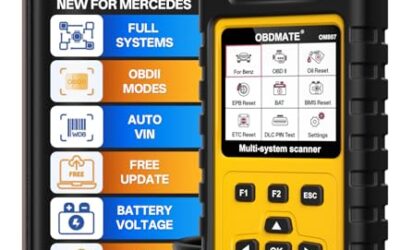
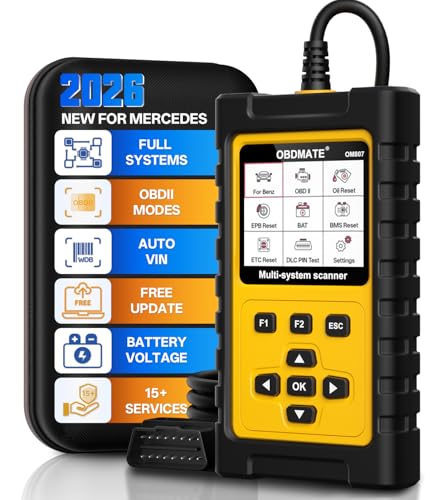
The OBDMATE OM807 is an OBD2 code reader and full-system diagnostic tool designed for compatible Mercedes-Benz vehicles. It supports diagnostics for systems such as the engine, transmission, ABS, and SRS, along with reading and erasing fault codes, graphic live data, VIN information, and other standard OBDII functions.
The scanner lists 15 service and reset functions, including oil reset, throttle adaptation, EPB reset, battery reset, ABS bleeding, TCM adaptation, SAS reset, TPMS reset, EGR adaptation, DPF regeneration, AdBlue reset, fuel pump AdBlue reset, pressure sensor replacement, and pressure valve replacement. Availability varies by vehicle year, make, and model.
Compatibility is listed for most Mercedes-Benz vehicles from 2000-2021 that use OBDII protocols, 12V power, and a 16-pin DLC. It also supports standard OBD2 functions for compatible vehicles from 1996 onward. Features include a 2.8-inch HD color screen, automatic VIN recognition, Wi-Fi or USB software updates, a one-year warranty, 24/7 after-sales service, and seven language options: English, French, German, Italian, Spanish, Portuguese, and Czech.
Specifications
| Dimensions | 6.5 x 3.5 x 1.06 inches |
|---|---|
| Product Group | Automotive Parts and Accessories |
Verify the current product variation before purchase; specifications may change.
Detailed Review
What stands out in the currently available product data:
- Performs full-system diagnostics on compatible Mercedes-Benz vehicles, including engine, transmission, ABS, and SRS systems
- Offers 15 listed reset and service functions, including oil, EPB, battery, ABS bleeding, SAS, TPMS, and DPF-related services
- Supports standard OBDII functions such as reading and erasing fault codes, viewing live data, freeze frames, VIN information, and I/M readiness
- Works with Mercedes-Benz vehicles using OBDII protocols, 12V power, and a 16-pin DLC, with compatibility listed for most models from 2000-2021
- Provides lifetime free software updates through Wi-Fi or USB, with no subscription fee stated
- Includes a 2.8-inch HD color screen, automatic VIN recognition, and seven supported languages
Best For / Avoid If
Best for buyers prioritizing
- Combines Mercedes-Benz full-system diagnostics with standard OBDII code-reading functions
- Includes multiple maintenance and reset functions in one handheld scanner
- Lifetime free software updates are provided without a stated subscription fee
Consider another option if
- Reset and diagnostic feature availability varies by vehicle year, make, and model
- Compatibility is limited to vehicles using supported OBDII protocols with a 12V, 16-pin DLC
- The published product data does not specify iOS or Android compatibility

Pros
- Combines one OBD2 male connector with two female ports
- Supports all standard OBD2 protocols including CAN
- Right-angle design can direct the branches toward the center console or passenger side in American/left-hand-drive vehicles
- Red cable color is specified
Cons
- Specific vehicle compatibility is not provided
- Operating-system requirements are not provided
- The published data lists an Amazon rating of 4.6 from 0 reviews
The iKKEGOL B09QX9TSQ2 is a red, 30 cm (12-inch) right-angle OBD2 Y-splitter cable with one male and two female J1962 connectors. It provides direct pass-through on all 16 pins and supports standard OBD2 protocols including CAN.
- Connector configuration: 1 male and 2 female J1962 ports
- Cable length: 30 cm (12 inches)
- Color: Red
- Use case listed: GPS trackers, auto scanner adapters, and parallel operation of two devices
- Dimensions listed: 6.4960629855 x 5.1968503884 x 1.1023622036 inches
- Specific vehicle compatibility and operating-system requirements are not provided.
Specifications
| Color | Red |
|---|---|
| Dimensions | 6.4960629855 x 5.1968503884 x 1.1023622036 inches |
| Product Group | Automotive Parts and Accessories |
| Binding | Automotive |
Verify the current product variation before purchase; specifications may change.
Detailed Review
What stands out in the currently available product data:
- Provides one male and two female J1962 connectors
- Uses a 30 cm (12-inch) cable length
- Offers direct pass-through on all 16 pins
- Supports standard vehicle OBD2 protocols including CAN
- Allows two connected devices to work in parallel
- Right-angle primary connector directs the cable branches toward the center console or passenger side in American/left-hand-drive vehicles
Best For / Avoid If
Best for buyers prioritizing
- Combines one OBD2 male connector with two female ports
- Supports all standard OBD2 protocols including CAN
- Right-angle design can direct the branches toward the center console or passenger side in American/left-hand-drive vehicles
Consider another option if
- Specific vehicle compatibility is not provided
- Operating-system requirements are not provided
- The published data lists an Amazon rating of 4.6 from 0 reviews
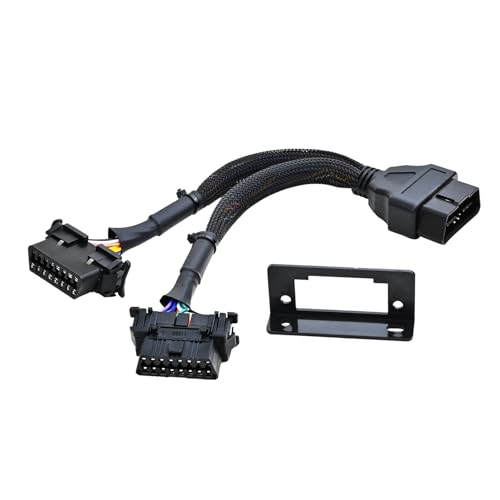
Pros
- Adds a second female OBD2 connection
- Compact 12-inch design is intended for concealed under-dash routing
- Braided cable construction is designed for durability and flexibility
- Listed as compatible with standard OBD2 devices
Cons
- The published data does not specify vehicle models or years
- The published data does not provide electrical ratings or detailed protocol coverage
- No customer review excerpts were provided
The iKKEGOL Underdash OBD2 Splitter Y Cable is a 1-male-to-2-female harness with 16-pin OBDII J1962 connectors. Its 12-inch length and braided exterior are intended for under-dash installation and cable routing. The cable uses 22AWG wire and fully connected 16-pin stitching, and the product is listed as supporting CAN and other OBDII protocols. It is designed for use with standard OBD2 devices such as diagnostic tools, code readers, GPS trackers, and performance monitors.
- Size: 12 inch
- Dimensions: 6.3 x 1.2 x 0.98 inches
- Weight: 0.25 pounds
- Product group: Automotive Parts and Accessories
- Includes a mounting bracket
Specifications
| Size | 12 inch |
|---|---|
| Dimensions | 6.3 x 1.2 x 0.98 inches |
| Weight | 0.25 pounds |
| Product Group | Automotive Parts and Accessories |
| Binding | Misc. |
Verify the current product variation before purchase; specifications may change.
Detailed Review
What stands out in the currently available product data:
- Provides one male OBD2 connector and two female OBD2 ports
- Allows two OBD2 devices to be connected simultaneously
- 12-inch length supports under-dash mounting
- Braided exterior helps protect the wiring from wear and tear
- Uses 22AWG wire with fully connected 16-pin stitching
- Supports CAN and other OBDII protocols
Best For / Avoid If
Best for buyers prioritizing
- Adds a second female OBD2 connection
- Compact 12-inch design is intended for concealed under-dash routing
- Braided cable construction is designed for durability and flexibility
Consider another option if
- The published data does not specify vehicle models or years
- The published data does not provide electrical ratings or detailed protocol coverage
- No customer review excerpts were provided

Pros
- Straight-through connection for all 16 pins
- No shared ground wires
- 2 ft/60 cm length with a low-profile design
- Flexible construction intended for repeated handling
Cons
- Supported protocols and vehicle compatibility are not provided
- Only black color and a one-pack quantity are listed
- Warranty information is not provided
The bbfly-A9 is a black OBD2 16-pin splitter extension cable measuring 2 ft/60 cm. The published product information states that it passes all 16 pins straight through without shared ground wires. Its ultra-flat, low-profile design is described as easy to carry and use, while the cable materials are intended to provide flexibility and durability. The extension is also intended to help reduce wear on a scan tool's OBD connector. The listed package quantity is one, and supported protocols and vehicle compatibility are not provided.
Specifications
| Color | Black |
|---|---|
| Size | 1 Pack |
| Product Group | Automotive Parts and Accessories |
| Binding | Tools & Home Improvement |
Verify the current product variation before purchase; specifications may change.
Detailed Review
What stands out in the currently available product data:
- Passes all 16 OBD2 pins straight through
- Uses no shared ground wires
- 2 ft/60 cm extension length
- Low-profile, ultra-flat design
- Flexible and durable cable construction
- Designed to help reduce wear on a scan tool's OBD connector
Best For / Avoid If
Best for buyers prioritizing
- Straight-through connection for all 16 pins
- No shared ground wires
- 2 ft/60 cm length with a low-profile design
Consider another option if
- Supported protocols and vehicle compatibility are not provided
- Only black color and a one-pack quantity are listed
- Warranty information is not provided

Pros
- Two-piece scanner set
- Bluetooth pairing with a smartphone through the Torque application
- Supports fault-code reading and clearing
- Listed compatibility with most 12V vehicles
Cons
- Not listed as compatible with hybrid or electric vehicles
- Supported mobile and computer operating systems are not specified
- Requires the Torque application and Bluetooth pairing for mobile-device use
The KVAEY 2 PCS OBDII Car Auto Diagnostic Scanner is an ELM327 Bluetooth code reader set with two blue units. The listing states that it can read and clear fault codes and provides 17 diagnostic functions, including load-value calculations and monitoring for engine speed, coolant temperature, and fuel system status.
Setup involves connecting a scanner to the vehicle's OBD II port, starting the vehicle, downloading the Torque application, and pairing through Bluetooth with PIN 1234. Compatibility is listed for most 12V vehicles, excluding hybrid and electric vehicles. The source data does not specify supported operating systems.
Specifications
| Color | Blue |
|---|---|
| Size | 2 PCS |
| Product Group | Automotive Parts and Accessories |
Verify the current product variation before purchase; specifications may change.
Detailed Review
What stands out in the currently available product data:
- Reads and clears automotive fault codes
- Provides 17 listed diagnostic functions
- Monitors engine speed, coolant temperature, fuel system status, and load values
- Connects to a mobile device through Bluetooth
- Works with the Torque application
- Includes two scanner units
Best For / Avoid If
Best for buyers prioritizing
- Two-piece scanner set
- Bluetooth pairing with a smartphone through the Torque application
- Supports fault-code reading and clearing
Consider another option if
- Not listed as compatible with hybrid or electric vehicles
- Supported mobile and computer operating systems are not specified
- Requires the Torque application and Bluetooth pairing for mobile-device use

Pros
- Supports basic code reading and clearing functions
- Offers real-time vehicle status monitoring through the app
- Includes two scanner units
- Designed for use with mobile phones and computers
Cons
- Specific supported vehicle makes, models, and years are not provided
- The app name and operating-system requirements are not provided
- Detailed supported protocols beyond ELM327 compliance are not listed
The VCYOPN 2-pack ELM327 OBD2 Bluetooth scanner is designed for basic vehicle diagnostics. It can read and clear trouble codes, provide real-time sensor data, and help identify the cause of a check engine light.
- Connection: Bluetooth through the vehicle's OBD2 port
- Compatibility: Most vehicles equipped with an OBD2 interface
- App support: Downloadable free software for compatible mobile phones and computers
- Construction: ABS plastic housing with insulating and flame-retardant properties
- Design: Compact, lightweight, and full-pin for the OBD interface
- Included configuration: 2 PCS
Specific supported vehicle makes, models, years, app name, and operating-system requirements are not provided.
Specifications
| Color | 2 PCS |
|---|---|
| Product Group | Automotive Parts and Accessories |
Verify the current product variation before purchase; specifications may change.
Detailed Review
What stands out in the currently available product data:
- Reads and clears vehicle trouble codes
- Provides real-time sensor data
- Uses Bluetooth pairing with a downloadable app
- Compatible with most vehicles equipped with an OBD2 interface
- Compact, lightweight design for portable use
- ABS plastic housing with insulating and flame-retardant properties
Best For / Avoid If
Best for buyers prioritizing
- Supports basic code reading and clearing functions
- Offers real-time vehicle status monitoring through the app
- Includes two scanner units
Consider another option if
- Specific supported vehicle makes, models, and years are not provided
- The app name and operating-system requirements are not provided
- Detailed supported protocols beyond ELM327 compliance are not listed

Pros
- Adds two female OBD2 connection points
- The 60cm/24-inch length supports more flexible device placement
- Right-angle, low-profile design is suited to under-dash routing
- Can reduce repeated handling of a vehicle's original OBD2 port
Cons
- The listing covered does not provide vehicle-specific compatibility details
- The source data does not specify supported protocols or electrical ratings
- The listing does not provide details about simultaneous operation of multiple connected devices
The iKKEGOL OBD2 splitter extension cable is a low-profile, right-angle adapter with one male OBD2 connector and two female ports. Its 60cm/24-inch length is designed to extend OBD2 devices and provide more flexible positioning under the dashboard.
The listing identifies compatibility with OBD2 scanners, GPS devices, Wi-Fi and Bluetooth code readers, HUDs, and OBD2 dongles. Listed dimensions are 4.7 x 3.9 x 0.8 inches, and listed weight is 0.1875 pounds.
Specifications
| Dimensions | 4.7 x 3.9 x 0.8 Inches |
|---|---|
| Weight | 0.1875 pounds |
| Product Group | Automotive Parts and Accessories |
Verify the current product variation before purchase; specifications may change.
Detailed Review
What stands out in the currently available product data:
- Provides one male connector and two female OBD2 ports
- Uses a right-angle connector for under-dash installation
- 60cm/24-inch cable length helps reach OBD2 ports positioned farther away
- Low-profile ribbon-style cable is designed to tuck under the dashboard
- Compatible with OBD2 scanners, GPS devices, Wi-Fi and Bluetooth code readers, HUDs, and OBD2 dongles
- Allows extension of OBD-II devices and easier swapping between devices
Best For / Avoid If
Best for buyers prioritizing
- Adds two female OBD2 connection points
- The 60cm/24-inch length supports more flexible device placement
- Right-angle, low-profile design is suited to under-dash routing
Consider another option if
- The listing covered does not provide vehicle-specific compatibility details
- The source data does not specify supported protocols or electrical ratings
- The listing does not provide details about simultaneous operation of multiple connected devices
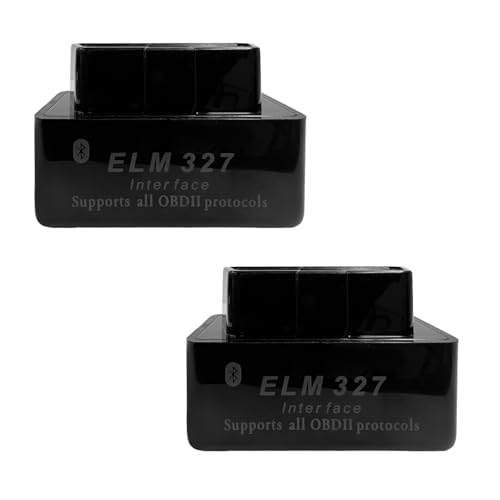
Pros
- Two-piece configuration provides two scanners
- Supports fault-code reading and clearing
- Offers multiple vehicle data-monitoring functions
- Uses ABS material described as insulated and flame retardant
Cons
- Not compatible with hybrid or electric vehicles
- Specific supported operating systems are not provided
- The product description does not identify supported vehicle makes, models, or years
The KVAEY 2 PCS OBDII Car Auto Diagnostic Scanner is a Bluetooth ELM327 code reader designed for most 12V vehicles, excluding hybrid and electric vehicles. It reads and clears fault codes and lists 17 functions, including monitoring engine speed, coolant temperature, load values, and fuel system status.
The scanner connects to a vehicle's OBD II port and pairs with the Torque application through Bluetooth. The listed pairing PIN is 1234. The application is described as free and suitable for smartphones and computers, but specific operating-system requirements are not provided. The scanner is black, supplied as a two-piece set, and uses ABS material described as insulated and flame retardant.
Specifications
| Color | Black |
|---|---|
| Size | 2 PCS |
| Product Group | Automotive Parts and Accessories |
Verify the current product variation before purchase; specifications may change.
Detailed Review
What stands out in the currently available product data:
- Includes two Bluetooth OBDII diagnostic scanners
- Reads and clears automotive fault codes
- Lists 17 diagnostic functions
- Monitors engine speed, coolant temperature, load values, and fuel system status
- Pairs with the Torque application using Bluetooth
- Uses PIN 1234 for pairing
Best For / Avoid If
Best for buyers prioritizing
- Two-piece configuration provides two scanners
- Supports fault-code reading and clearing
- Offers multiple vehicle data-monitoring functions
Consider another option if
- Not compatible with hybrid or electric vehicles
- Specific supported operating systems are not provided
- The product description does not identify supported vehicle makes, models, or years