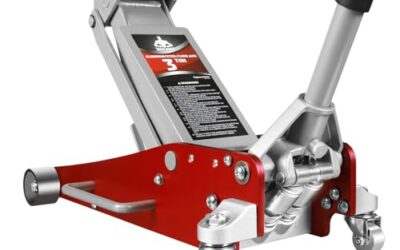
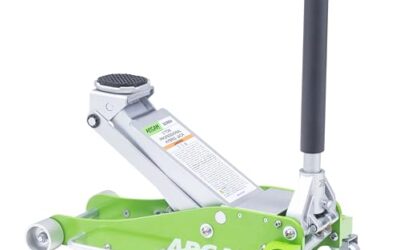
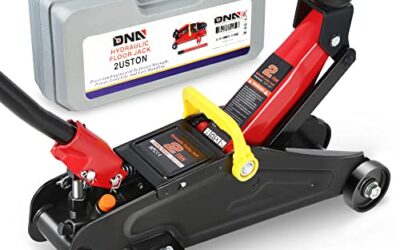
The best floor jack for low profile cars is the SATA 3-Ton (6,600 lb) Heavy-Duty Steel Floor Jack because its listed 2-11/16-inch entry height reaches lower cars while its 19-1/8-inch maximum height suits more than basic tire changes. Its steel frame favors garage work over easy carrying, so lighter aluminum and hybrid options make more sense for mobile repairs or limited storage.

Pros
- Low-profile design supports access under vehicles with limited ground clearance
- Extended reach is intended for sports cars, lowered vehicles, and modified vehicles
- Steel construction and 3-ton capacity are suited to home and workshop vehicle maintenance
- Dual-piston RAPID PUMP technology is designed to reduce the number of pump strokes
Cons
- Color is provided randomly
Specifications
| Color | Random Color |
|---|---|
| Size | 3 Ton |
| Product Group | Automotive Parts and Accessories |
Best For / Avoid If
Best for buyers prioritizing
- Low-profile design supports access under vehicles with limited ground clearance
- Extended reach is intended for sports cars, lowered vehicles, and modified vehicles
- Steel construction and 3-ton capacity are suited to home and workshop vehicle maintenance
Consider another option if
- Color is provided randomly

Specifications
| Color | Red |
|---|---|
| Size | 3 Ton Aluminum |
| Dimensions | 23.6 x 11.8 x 6.3 inches |
| Weight | 58.5 pounds |
| Product Group | Automotive Parts and Accessories |

Pros
- The 3-ton capacity and 6,600-pound rating support a range of vehicle-lifting applications
- The low minimum height is intended for vehicles with limited ground clearance
- Dual pistons are designed to reduce the number of handle strokes needed for lifting
- The jack is listed as meeting ANSI/ASME PASE safety standards
Cons
- The listed Amazon rating is shown as 4 from 0 reviews, so no review count is available to provide context
Best For / Avoid If
Best for buyers prioritizing
- The 3-ton capacity and 6,600-pound rating support a range of vehicle-lifting applications
- The low minimum height is intended for vehicles with limited ground clearance
- Dual pistons are designed to reduce the number of handle strokes needed for lifting
Consider another option if
- The listed Amazon rating is shown as 4 from 0 reviews, so no review count is available to provide context

Specifications
| Color | Multi-color |
|---|---|
| Dimensions | 23.38 x 9.21 x 6.26 inches |
| Weight | 30 pounds |
| Product Group | Automotive Parts and Accessories |
| Binding | Automotive |
Specifications
| Color | yellow |
|---|---|
| Size | 2.5T |
| Dimensions | 22.2 x 8.7 x 5.2 Inches |
| Weight | 29.982867632 pounds |
| Product Group | Automotive Parts and Accessories |
| Binding | Automotive |

Pros
- High 3-ton lifting capacity for home, repair-shop, and fleet-maintenance use
- Low-profile lifting range covers the listed sedan, SUV, and light-truck compatibility claims
- Includes dual-piston lifting, overload protection, and controlled lowering features
- Steel frame is described as resistant to deformation under pressure
Specifications
| Color | GREEN |
|---|---|
| Dimensions | 28.3464 x 13.58265 x 6.2992 inches |
| Weight | 70 Pounds |
| Product Group | Automotive Parts and Accessories |
Best For / Avoid If
Best for buyers prioritizing
- High 3-ton lifting capacity for home, repair-shop, and fleet-maintenance use
- Low-profile lifting range covers the listed sedan, SUV, and light-truck compatibility claims
- Includes dual-piston lifting, overload protection, and controlled lowering features
Pros
- Wide 3.3- to 20.3-inch lifting range
- 3-ton capacity covers sports cars, sedans, SUVs, and pickups
- Dual-piston pump and extended handle support quicker, more controlled lifting
- Low-profile design is suitable for sliding under sedans
Cons
- Jack stands are required for long-term vehicle support
Specifications
| Color | Red |
|---|---|
| Size | 27 x 12.8 x 50.6 in |
| Dimensions | 26.97 x 12.8 x 50.59 inches |
| Weight | 65.83 pounds |
| Product Group | Automotive Parts and Accessories |
| Binding | Automotive |
Best For / Avoid If
Best for buyers prioritizing
- Wide 3.3- to 20.3-inch lifting range
- 3-ton capacity covers sports cars, sedans, SUVs, and pickups
- Dual-piston pump and extended handle support quicker, more controlled lifting
Consider another option if
- Jack stands are required for long-term vehicle support
CarTechTalk may earn a commission from qualifying purchases. Product features and prices can change, so use the vehicle manual and jack manual before lifting.
What low profile car owners should check first
Minimum height decides whether a jack reaches your vehicle’s approved lift point. Measure from the garage floor to that point, not only to the lowest bumper or side skirt. A jack that fits under the front lip may still fail to reach a safe structural point.
Maximum height matters after entry clearance. A low jack with limited travel may lift a wheel clear of the floor but leave little room for tire removal, suspension work, or jack stand placement. Sedans often need less height than SUVs, but vehicle design varies.
Capacity also needs context. A jack’s rated capacity applies to the load carried by the jack, not automatically to the vehicle’s full curb weight. Use only approved lift points, keep the floor firm and level, and support the vehicle with correctly rated jack stands before working underneath. Never use a hydraulic jack as long-term support.
Reach, saddle shape, wheel layout, handle length, and storage weight affect ownership. Dual-piston pumps may reduce strokes according to manufacturer claims, but they do not change minimum clearance or make an unsafe lift point acceptable.
Best low profile floor jacks for cars
Best overall clearance and working height: SATA 3-Ton (6,600 lb) Heavy-Duty Steel Floor Jack
The SATA 3-Ton (6,600 lb) Heavy-Duty Steel Floor Jack offers the lowest listed entry height in this group at 2-11/16 inches. Its stated 3-3/4 to 19-1/8-inch lifting range covers lowered sedans through many SUV and light-truck jobs. The dual-piston pump is listed as reducing handle effort by 40 percent and lifting time by half, which may matter during repeated wheel changes.
Its steel construction favors repeated garage use, while the overload valve and slow-release system address two key risks: excess load and uncontrolled lowering. SATA also says each unit is subjected to a 1.5X overload check before shipment. That claim describes factory procedure, not permission to exceed the rated 6,600-pound capacity.
Skip it if you need a light jack for roadside carrying. The heavy-duty steel design is better suited to a fixed garage than a compact trunk kit.
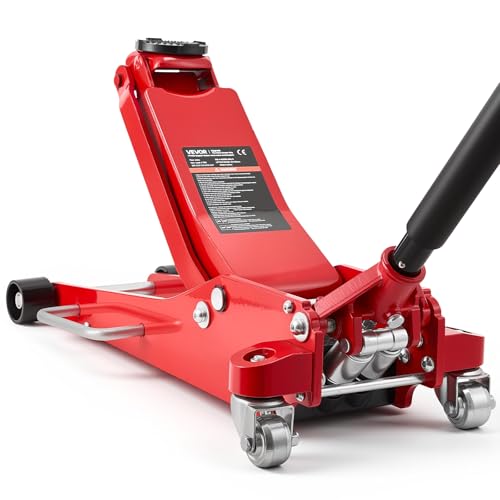
Best for maximum lift range: VEVOR Low Profile Floor Jack 3 Ton Aluminum
VEVOR Low Profile Floor Jack 3 Ton Aluminum starts at 3.3 inches and reaches 20.3 inches, the tallest maximum height among these picks. That extra travel helps owners who need more clearance for stands or underbody access, provided the vehicle’s approved lift point and the jack’s saddle alignment allow it.
The aluminum and steel frame balances portability with load support. A dual-piston pump, rotating saddle, rubber pad, and four-wheel layout support the manufacturer’s intended use for sports cars, sedans, SUVs, and pickups. Its 3-ton rating covers a broad range of common vehicles, but vehicle weight and lift-point limits still control fit.
Skip it if your priority is the lowest possible entry height. Its 3.3-inch minimum is higher than SATA’s 2-11/16-inch figure, so especially lowered cars may need a clearance check or approach ramp.
Best for a steel 3-ton alternative: AV Steel Low Profile Floor Jack 3 Ton (6600 lbs)
AV Steel Low Profile Floor Jack 3 Ton (6600 lbs) enters at 3-1/8 inches and rises to 19-7/8 inches. That range gives low sedans useful access while retaining enough travel for broader maintenance work. Its 3-ton capacity and steel build suit home garages that want one jack for cars and larger vehicles.
The dual-piston pump aims to reduce handle strokes, while the 360-degree saddle can help align the lifting pad with the vehicle point. AV Steel lists ANSI/ASME PASE compliance, a 12-month warranty, and an overload protection feature. Those claims should be read alongside the manual and local safety requirements, not as a substitute for proper support.
Skip it if you need the absolute lowest approach height. At 3-1/8 inches, it may not reach a heavily lowered car without additional clearance.
Best for long reach on lowered cars: Maxority 3-Ton (6600lbs) Low Profile Hydraulic
Maxority 3-Ton (6600lbs) Low Profile Hydraulic focuses on extended reach for low-clearance and modified vehicles. Its steel construction and 3-ton rating make it a garage-oriented choice for owners who need more than occasional tire changes. The listing also names RAPID PUMP technology and a saddle safety valve.
Long reach can help the saddle reach approved points farther under a low nose, but reach alone does not prove fitment. Front bumper shape, pinch weld location, and underbody panels can block a jack even when the minimum height looks suitable.
Skip it if you need a published lift range before buying. The product information emphasizes low clearance and reach but does not give a complete minimum-to-maximum range here. A buyer with a very specific lift-point measurement should choose a model with a stated range instead.
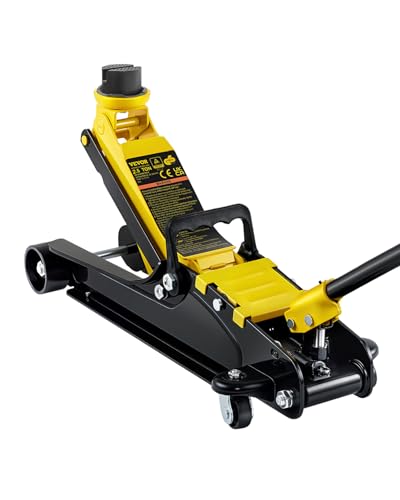
Best budget choice for many sedans: VEVOR 2.5 Ton Low Profile
VEVOR 2.5 Ton Low Profile starts at 3.35 inches and reaches 14.96 inches. Its 2.5-ton rating and steel frame fit many passenger-car jobs, while the lower maximum height keeps the design focused on tire, brake, and basic service work.
The single-piston pump is simpler than the dual-piston systems elsewhere in this group. A long 31.5-inch handle, rubber saddle, detachable saddle, and built-in load protection add practical garage features. VEVOR lists CE, UKCA, and ASME PALD-2014 claims for this model.
Skip it if you work on taller vehicles or need substantial underbody clearance. Its 14.96-inch maximum height is the main limitation, and the single-piston design may require more strokes than a dual-piston alternative.
Best for a compact sedan and coupe fit: AV Steel Low Profile Floor Jack 2.5 Ton
AV Steel Low Profile Floor Jack 2.5 Ton enters at 3.4 inches and lifts to 14.6 inches. The manufacturer specifically positions it for passenger cars, coupes, hatchbacks, and sedans. That narrow vehicle focus makes the buying decision clearer than a jack marketed for cars and trucks alike.
Its 5,000-pound rating, steel frame, single-piston pump, rotating saddle, and overload valve cover common wheel and brake tasks after the lift point is confirmed. A 12-month warranty is also listed.
Skip it for trucks, SUVs, lifted vehicles, or work requiring more than 14.6 inches of lift. The listing expressly excludes those vehicle types, so a larger 3-ton jack is the better direction.
Best portable hybrid for sedan owners: SATA 1.5-Ton (3,300 lb) Aluminum & Steel Hybrid
SATA 1.5-Ton (3,300 lb) Aluminum & Steel Hybrid weighs its portability advantage against lower capacity and lift height. Its 3-1/2 to 14-inch range suits many sedans and compact SUVs, while the aluminum and steel frame is intended for home garages or mobile repairs.
The dual-piston pump is listed as cutting lifting time in half and handle effort by 40 percent. SATA also states that each unit undergoes a 1.5X overload check. Treat the 1.5-ton rating as the operating limit, regardless of that factory claim.
Skip it for heavy SUVs, pickups, repeated shop work, or suspension jobs needing more height. Its lower capacity and 14-inch maximum make it less flexible than the 3-ton models.
Best for mixed portability and capacity: Jack Boss 3 Ton Low Profile
Jack Boss 3 Ton Low Profile combines an aluminum and steel frame with a 3-ton capacity. Its 3-15/16 to 18-5/16-inch range covers many sedans and SUVs. The listed 58.5-pound net weight gives buyers a clear warning: hybrid construction does not make this a lightweight roadside jack.
A dual-piston pump, rubber saddle, two-piece handle, and swivel front casters support storage and movement around a garage. Jack Boss lists ANSI/ASME PASE compliance and a limited one-year manufacturer warranty.
Skip it if your car sits below 3-15/16 inches at its approved lift point. That minimum height is the highest entry figure among these 3-ton picks, so heavily lowered cars may need another option.
Comparison by clearance, height, and vehicle fit
| Floor jack | Capacity | Minimum height | Maximum height | Best fit |
|---|---|---|---|---|
| SATA 3-Ton (6,600 lb) Heavy-Duty Steel Floor Jack | 3 tons | 2-11/16 in | 19-1/8 in | Low cars and repeated garage work |
| VEVOR Low Profile Floor Jack 3 Ton Aluminum | 3 tons | 3.3 in | 20.3 in | Cars, SUVs, pickups, greater lift height |
| AV Steel Low Profile Floor Jack 3 Ton (6600 lbs) | 3 tons | 3-1/8 in | 19-7/8 in | Low cars and larger vehicles |
| Maxority 3-Ton (6600lbs) Low Profile Hydraulic | 3 tons | Low profile | Not stated here | Lowered and modified vehicles |
| VEVOR 2.5 Ton Low Profile | 2.5 tons | 3.35 in | 14.96 in | Passenger cars and basic service |
| AV Steel Low Profile Floor Jack 2.5 Ton | 2.5 tons | 3.4 in | 14.6 in | Cars, coupes, hatchbacks, sedans |
| SATA 1.5-Ton (3,300 lb) Aluminum & Steel Hybrid | 1.5 tons | 3-1/2 in | 14 in | Sedans, compact SUVs, mobile repairs |
| Jack Boss 3 Ton Low Profile | 3 tons | 3-15/16 in | 18-5/16 in | Sedans and SUVs |
How to choose the right jack for your car
Start with the lowest approved lift point. A lowered sports car owner should favor the SATA 3-Ton model or another jack below the measured clearance. Do not use a bumper, suspension arm, or pinch weld unless the vehicle manual identifies it as a lifting point.
Next, decide whether you need wheel clearance or working height. The two AV Steel 2.5-ton and SATA 1.5-ton models top out near 14 inches, which suits many wheel and brake jobs. The 3-ton models reach higher, giving more room for stands and underbody access.
Choose capacity from the vehicle manual, not from the largest number on a product page. A 1.5-ton jack may suit a sedan but leaves less margin for larger vehicles. A 3-ton jack does not make an unsuitable lift point safe.
Storage and movement matter. Aluminum and hybrid frames may be easier to carry than full steel, but the listed Jack Boss weight shows that a 3-ton floor jack can still be substantial. A fixed garage can favor steel durability and long reach. A mobile repair kit needs manageable size and weight.
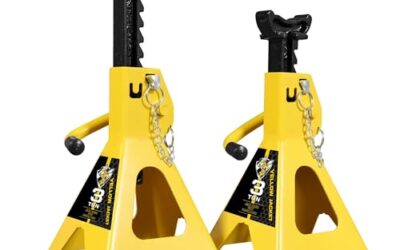
For the complete lifting process, read where to place A floor jack under A car. Pair every underbody job with properly positioned stands. Our guide to floor jack stands for cars, SUVs, and trucks covers that supporting equipment.
Who should skip these floor jacks
Skip this entire group if you need a jack for lifting a house, supporting a structure, replacing a transmission without stands, or carrying in a small emergency kit. These are vehicle floor jacks, not permanent supports or structural lifting equipment. Buyers with trucks, lifted vehicles, or unusual chassis points should seek a model whose height, capacity, saddle, and reach match that vehicle’s manual.
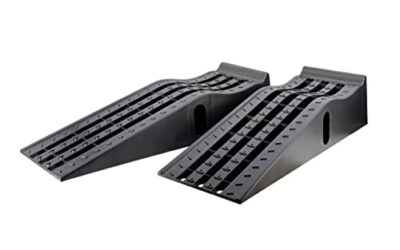
Owners of very low sports cars should also consider a dedicated low-profile ramp or a jack with reach and entry dimensions confirmed against the car. The low profile floor jack guide for sports cars addresses that narrower use case.
Final verdict
Choose SATA 3-Ton (6,600 lb) Heavy-Duty Steel Floor Jack for the strongest combination of very low entry height and useful maximum lift. Pick VEVOR Low Profile Floor Jack 3 Ton Aluminum when 20.3 inches of travel matters more than the lowest entry point. Choose VEVOR 2.5 Ton Low Profile or AV Steel Low Profile Floor Jack 2.5 Ton for sedan-focused maintenance with shorter lift requirements.
Every recommendation depends on the same final check: the jack must fit beneath the vehicle, reach an approved lift point, stay within its rated capacity, and work on a firm, level surface. Lower the vehicle onto stands before any work beneath it.