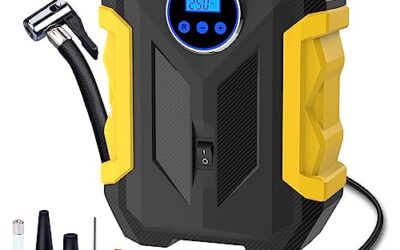
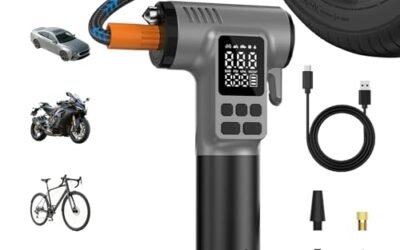
The best battery-powered tire inflator for most drivers is the AVID POWER Cordless Tire Inflator Portable Air, because it pairs a rechargeable 20V battery with a 12V car-power backup. Its maker also gives inflation examples for common passenger-car tire sizes, which helps set expectations for roadside top-ups.

Specifications
| Color | 1-red |
|---|---|
| Dimensions | 7.480314953 x 2.90944881593 x 10.236220462 inches |
| Weight | 3.968320716 Pounds |
| Product Group | Automotive Parts and Accessories |
| Binding | Sports |

Specifications
| Color | Red |
|---|---|
| Dimensions | 5 x 3 x 8 inches |
| Weight | 1.28 Pounds |
| Product Group | Tools |
| Binding | Tools & Home Improvement |

Specifications
| Color | Yellow |
|---|---|
| Size | Large |
| Dimensions | 8.93 x 4.8 x 6.88 inches |
| Weight | 1.1 Grams |
| Product Group | Automotive Parts and Accessories |

Specifications
| Color | Yellow, Black |
|---|---|
| Dimensions | 3.7 x 7.1 x 4.1 inches |
| Product Group | Tools |
Pros
- Supports cordless and 12V power options
- Preset modes and automatic shut-off simplify pressure setting
- Includes accessories for tires, bikes, and sports gear
- Compact carrying case is stated to fit in a glove box
Cons
- Listed cordless runtime is 20 minutes
Specifications
| Product Group | Tools |
|---|
Best For / Avoid If
Best for buyers prioritizing
- Supports cordless and 12V power options
- Preset modes and automatic shut-off simplify pressure setting
- Includes accessories for tires, bikes, and sports gear
Consider another option if
- Listed cordless runtime is 20 minutes
Pros
- Combines jump-starting, tire inflation, lighting, and mobile-device charging in one unit
- Supports a broad range of vehicle types and engine sizes within the listed compatibility limits
- Automatic inflation shutoff helps limit the need for continuous monitoring
- Operating and storage range is listed as -4°F to 140°F
Cons
- The air compressor should rest for at least 10 minutes after 10 minutes of continuous operation
- The air tube may become hot after inflation and should cool before removal
- The unit should be recharged every 2–3 months during extended storage to maintain battery health
Specifications
| Color | 3000A-Orange |
|---|---|
| Size | Large standard |
| Dimensions | 2.5 x 5.12 x 8.67 Inches |
| Weight | 2.43 Pounds |
| Product Group | Automotive Parts and Accessories |
Best For / Avoid If
Best for buyers prioritizing
- Combines jump-starting, tire inflation, lighting, and mobile-device charging in one unit
- Supports a broad range of vehicle types and engine sizes within the listed compatibility limits
- Automatic inflation shutoff helps limit the need for continuous monitoring
Consider another option if
- The air compressor should rest for at least 10 minutes after 10 minutes of continuous operation
- The air tube may become hot after inflation and should cool before removal
- The unit should be recharged every 2–3 months during extended storage to maintain battery health

Pros
- Combines jump starting, tire inflation, power bank, and emergency lighting
- Supports cars, SUVs, trucks, motorcycles, boats, and other 12V vehicles
- Includes safety protections for reverse polarity, short circuit, over-current, over-voltage, and overheating
- Includes heavy-duty jumper cables, air nozzles, and detachable extended hose
Cons
- Requires recharging every 2–3 months during extended storage
- Instructions recommend keeping battery level above 50% before jump starting
Specifications
| Color | Gray-blue |
|---|---|
| Dimensions | 8.07 x 2.09 x 4.37 Inches |
| Weight | 1.433004703 Pounds |
| Product Group | Automotive Parts and Accessories |
Best For / Avoid If
Best for buyers prioritizing
- Combines jump starting, tire inflation, power bank, and emergency lighting
- Supports cars, SUVs, trucks, motorcycles, boats, and other 12V vehicles
- Includes safety protections for reverse polarity, short circuit, over-current, over-voltage, and overheating
Consider another option if
- Requires recharging every 2–3 months during extended storage
- Instructions recommend keeping battery level above 50% before jump starting
CarTechTalk may earn a commission from qualifying purchases through product links. Recommendations below focus on cordless operation, stated backup power, vehicle use, and practical limitations. Manufacturer performance figures are claims, not independent measurements.
- Best balance for a car: AVID POWER, with removable 20V battery and 12V backup.
- Lowest-cost pick: CRAFTSMAN, with a 6,000mAh battery and 12V cord.
- Compact premium pick: DEWALT, with built-in battery and 12V power.
- Longer-use flexibility: AstroAI H2 Pro, with a stated 60-minute 12V runtime.
- Emergency kit combination: AstroAI S8, an inflator and jump starter in one unit.
- Higher-pressure option: Torhawk, rated by its maker to 160 PSI.
- High-output jump pack combination: NACKEO, a 160 PSI inflator and jump starter.
What matters in a cordless tire inflator
A battery-powered pump can reach a tire without parking near a working 12V outlet. That convenience depends on keeping its battery charged. A 12V cord offers a backup only when your vehicle has a compatible accessory outlet and the cord reaches the tire.
For ordinary car maintenance, prioritize the pressure range, battery runtime, and duty-cycle instructions over a headline PSI figure. Maximum pressure alone does not say how quickly a pump tops off your tire or how many tires it can fill before needing a rest. Where a maker gives a tire size and starting pressure, treat that example as a product claim under those stated conditions, not a promise for every vehicle.
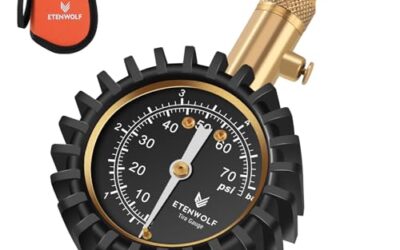
Automatic shutoff can stop inflation at a preset target, but it does not select the correct pressure for your vehicle. Use the cold tire pressure on the vehicle’s tire placard or owner’s manual, not the maximum molded into the tire sidewall. Check pressure with a reliable gauge if the reading matters. NHTSA’s tire safety guidance covers tire pressure and maintenance basics.
Most picks here are for passenger cars, motorcycles, bicycles, and small inflatables, with product-specific exceptions. Do not assume a compact inflator is suitable for truck, trailer, or heavy-duty tires simply because a marketing claim mentions a high PSI. Follow the inflator manual’s limits, and stop if the unit becomes unusually hot or behaves abnormally.
Detailed picks
AVID POWER Cordless Tire Inflator Portable Air: Best balance for a car
AVID POWER suits drivers who want cordless use but do not want battery power to be the only option. It includes a 20V rechargeable pack and a 9.8-foot 12V adapter. The maker quotes 30 LPM airflow and says a 195/60 R14 tire can go from flat to 36 PSI in under three minutes, while a 215/60 R16 tire takes under five minutes. Those are specific manufacturer examples, not universal fill times.
Four pressure units, an automatic shutoff, an LED light, and included adapters support routine car and bicycle use. Its stated battery capacity is about four 195/60 R14 tires from flat to 36 PSI, or three 215/60 R16 tires under the same stated conditions. The maker says to let it cool for three minutes after 10 to 15 minutes of continuous operation.
Pros: Removable battery, 12V backup, and clear maker examples for common passenger-car tires. Cons: The maker excludes truck, trailer, and heavy-duty tires, plus high-volume items such as air mattresses and paddleboards. Who should skip it: Drivers who need to inflate large tires or high-volume gear should choose a compressor rated for that work.
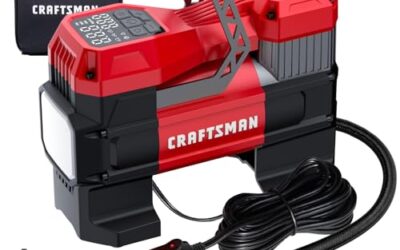
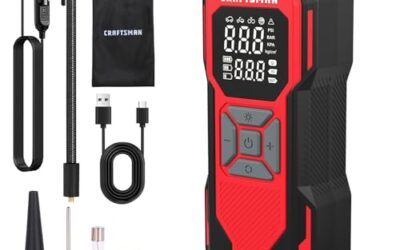
CRAFTSMAN Tire Inflator Portable Air Compressor: Budget pick
CRAFTSMAN offers a 6,000mAh rechargeable battery alongside a 10-foot 12V cord. Its maker says the battery can top up four 195/55 R15 tires from 30 to 36 PSI, with each stated top-up taking 45 seconds. That example is useful for maintenance, but it does not describe filling a flat tire.
The unit weighs 1.28 pounds and includes four inflation modes, a custom setting, auto shutoff, and three LED modes. A USB-C charging port and USB output add phone charging, although the output is rated at 5V/1A. The 12V cord gives a fallback when the internal battery runs down.
Pros: Low-cost positioning, a stated tire-top-up example, and both battery and corded operation. Cons: The listed inflation example covers a small pressure increase, not a full tire refill; its phone output is modest at 5V/1A. Who should skip it: Drivers who expect repeated flat-to-full inflation should favor a pump with a stated flat-tire example and runtime guidance.
DEWALT Tire Inflator, Portable Air Compressor: Compact premium pick
DEWALT fits buyers who value a small, light package. The maker gives its weight as 0.63 kg and dimensions as 3.6 by 2.1 by 6.8 inches. It runs from an internal rechargeable battery, a 5V USB power adapter, or a 12V car accessory plug, so it offers more charging and operating routes than a battery-only pump.
Its maker lists a 150 PSI maximum and says a 195/65 R15 tire can rise from 30 to 36 PSI in under one minute. Presets cover car, motorcycle, bike, ball, and custom use. A built-in cooling fan and three-year limited warranty are also stated. Read warranty terms and operating limits before relying on the unit for frequent use.
Pros: Compact dimensions, three power routes, automatic shutoff, and a stated car-tire top-up time. Cons: It has a built-in battery rather than a removable pack, so a depleted battery cannot be swapped for a charged spare. Who should skip it: Drivers who want replaceable batteries or a dedicated high-volume compressor should select a different format.
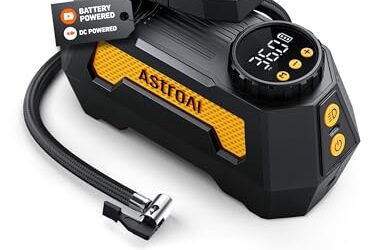
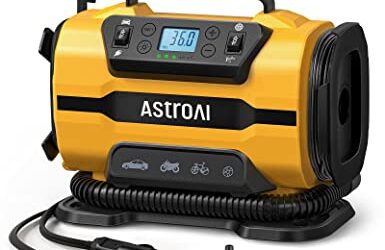
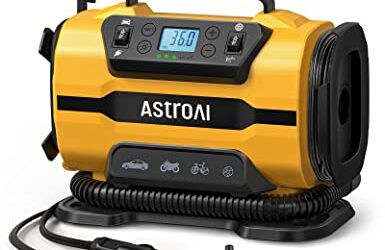
AstroAI H2 Pro: Best for extended 12V operation
AstroAI H2 Pro is a fit for drivers who want cordless convenience with a longer corded operating window. Its maker claims up to 18 minutes of battery runtime and up to 60 minutes on 12V power. It also says the pump can inflate a standard car tire from zero to 36 PSI in about four minutes and 30 seconds, or top up from 30 to 36 PSI in under one minute.
The pump has a 150 PSI maximum, a digital display showing current and target pressure, automatic shutoff, and storage for accessories. Those features make setup more orderly, but they do not remove the need to use the vehicle’s specified pressure. The maker also makes a durability claim tied to its ToughUltra construction; treat that as a manufacturer claim rather than a service-life guarantee.
Pros: Battery and 12V operation, stated runtime for both sources, and a built-in accessory compartment. Cons: Its cordless runtime is shorter than its stated 12V runtime, so extended work depends on access to the vehicle outlet. Who should skip it: Drivers who need to work away from a vehicle for a long stretch should consider a separate battery pack or a pump with a longer stated cordless run time.
AstroAI S8: Best when you also need a jump starter
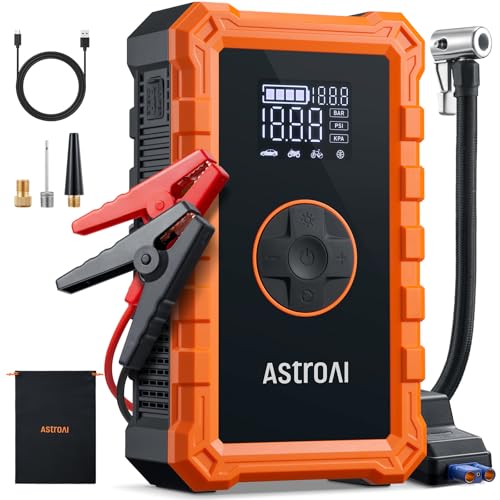
AstroAI S8 combines a 150 PSI inflator with a 3,000A peak jump starter. The maker rates the jump function for 12V batteries and claims compatibility up to 9L gasoline and 6.5L diesel engines. Those limits matter: check your engine size and follow the clamp and charging instructions in the manual.
For inflation, the maker lists 25 L/min airflow and says a tire can rise from 32 to 36 PSI in one minute. It advises a 10-minute rest after 10 minutes of continuous compressor use. A screen shows pressure and device status, while integrated storage keeps accessories and power leads together. The product requires regular battery care: its maker advises recharging every two to three months during extended storage.
Pros: One device combines tire inflation, jump starting, lighting, and a power bank. Cons: The maker’s compressor guidance requires a 10-minute rest after each 10-minute run, and the battery needs periodic charging in storage. Who should skip it: Drivers who already own a dependable jump pack or prefer a simple inflator should avoid paying for functions they will not use.
Torhawk Portable Tire Inflator for Car: Higher-pressure option
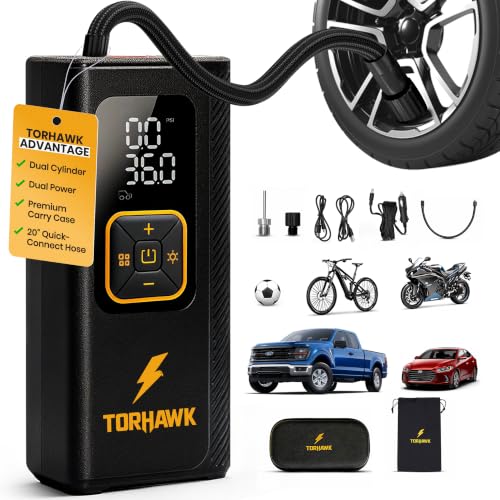
Torhawk is the only standalone inflator here with a maker-claimed 160 PSI maximum and dual-cylinder motor. It also offers a rechargeable battery and 12V backup, with up to 20 minutes of cordless runtime claimed. Presets cover car, motorcycle, bike, ball, and manual settings. A 20-inch hose and carrying case may help with storage and reach.
The maker markets it for cars, trucks, SUVs, and RV tires. That broad claim does not establish fit for every tire size or inflation workload, and no specific tire-size fill example is supplied. Check the manual’s tire and duty-cycle limits before using it on larger vehicles.
Pros: Battery and 12V power, a 160 PSI stated ceiling, and a longer hose than several compact designs. Cons: Its 20-minute cordless runtime places a limit on work away from a power outlet, and its broad vehicle claim lacks a specific inflation example. Who should skip it: Owners of heavy-duty or RV tires should select equipment with explicit capacity and duty-cycle guidance for their exact tires.
NACKEO Car Battery Jump Starter with Air: High-output combination
NACKEO combines a claimed 8,000A peak jump starter with a 160 PSI inflator, lights, and a USB power bank. The maker claims the jump function supports 12V vehicles, including engines up to 12L gasoline or 6L diesel. Match those claims against your vehicle and use the supplied instructions; peak current alone does not guarantee a successful start.
For tire use, the unit has automatic shutoff, multiple modes, a detachable extended hose, and a display. Its larger feature set can make sense in an emergency kit, but it also means more battery functions to keep charged. The maker advises recharging every two to three months in storage and keeping the charge above 50% before jump starting.
Pros: Combines inflation, jump starting, emergency lighting, and device charging. Cons: The recommendation depends on maintaining the pack’s charge, and the product is a bulkier multi-function choice than a dedicated pump. Who should skip it: Anyone who wants a compact inflator and has no need for a jump starter should choose a simpler unit.
Which type fits your vehicle routine?
Choose a dual-power inflator if you want cordless setup but also expect to have a vehicle outlet nearby. AVID POWER, CRAFTSMAN, AstroAI H2 Pro, and Torhawk state both battery and 12V operation. That backup reduces dependence on a charged internal battery, but it does not help if your vehicle lacks a compatible outlet or the cord cannot reach.
Choose an all-in-one jump starter only if you will maintain its battery and value both functions. AstroAI S8 and NACKEO combine inflation with jump starting, but their makers specify periodic charging. A dedicated inflator may be the cleaner choice if you already have a jump pack.
For broader context, compare this cordless category with our handheld tire inflator guide and our picks for a 12V tire inflator with an LED light. Drivers focused on gauge features can also read our car tire inflator pressure gauge guide.
Who should skip these inflators
Skip compact battery-powered pumps if you routinely service commercial vehicles, large truck or trailer tires, or high-volume inflatables. Several products have no detailed capacity claim for those jobs, and AVID POWER explicitly excludes truck, trailer, and heavy-duty tires. Look instead for a compressor whose manual names your tire size, required pressure, airflow, and duty cycle. Tire shops or roadside assistance may be safer options for a damaged or severely underinflated tire.
Verdict
For everyday passenger-car top-ups, AVID POWER offers the clearest balance of battery convenience and 12V backup, plus concrete maker examples for two common tire sizes. CRAFTSMAN is the budget choice for modest pressure corrections, while DEWALT prioritizes compact storage. AstroAI H2 Pro makes more sense for drivers who may use a vehicle outlet for longer operation. Choose AstroAI S8 or NACKEO only if jump-starting capability justifies the added battery-maintenance task. Torhawk’s pressure ceiling may appeal to some buyers, but larger-tire suitability still depends on its manual and your tire’s requirements.
Set the pump to the vehicle’s cold-pressure specification, secure the hose connection, and keep clear of hot components after operation. For safe tire-pressure maintenance and vehicle guidance, consult the owner’s manual and NHTSA’s tire resources.
Sources and further reading
- Tire Safety (NHTSA): Tire pressure, maintenance, and basic tire safety information.
- Keeping Your Vehicle in Shape (fueleconomy.gov): General vehicle maintenance guidance, including tire care.