
The best hardwired level 2 EV charger for most homes is the EVIQO Level 2 EV Charger J1772 48A, with up to 48 amps, a 25-foot cable, app scheduling, and an IP66/NEMA 4 enclosure. It suits J1772 vehicles on a dedicated 60-amp, 240-volt circuit; Tesla drivers need a compatible adapter, and installation requires an electrician.

Pros
- Offers high-power Level 2 charging at up to 48A and 11.5kW
- Provides adjustable charging current and app-based scheduling and energy controls
- Includes connector overheat protection with automatic charging shutdown
- Compatible with J1772 EVs and PHEVs in North America; Tesla models require a separate NACS adapter
Cons
- Hardwired installation requires a 60A breaker and a licensed electrician
- The app supports 2.4GHz Wi-Fi only; 5GHz Wi-Fi is not supported
- A NACS adapter for Tesla models is not included
Specifications
| Color | Black |
|---|---|
| Size | Hardwired-Compact Design |
| Dimensions | 9.8 x 8.7 x 4.4 inches |
| Weight | 13.45 Pounds |
| Product Group | Automotive Parts and Accessories |
Best For / Avoid If
Best for buyers prioritizing
- Offers high-power Level 2 charging at up to 48A and 11.5kW
- Provides adjustable charging current and app-based scheduling and energy controls
- Includes connector overheat protection with automatic charging shutdown
Consider another option if
- Hardwired installation requires a 60A breaker and a licensed electrician
- The app supports 2.4GHz Wi-Fi only; 5GHz Wi-Fi is not supported
- A NACS adapter for Tesla models is not included

Pros
- NACS connector connects directly to compatible Tesla and other NACS-equipped EVs without an adapter
- Long 25-foot charging cable provides added reach
- App-based scheduling and energy tracking can support off-peak charging
- Side reset button and automatic over-the-air Wi-Fi updates are included
Cons
- Hardwired installation requires a licensed electrician and a dedicated electrical circuit
- A NACS-to-J1772 adapter is required for non-Tesla J1772 vehicles and is not included
- App functionality requires a 2.4 GHz home Wi-Fi network
Specifications
| Color | Gray |
|---|---|
| Size | 48 |
| Dimensions | 4 x 9.45 x 9.45 inches |
| Product Group | Automotive Parts and Accessories |
| Binding | Automotive |
Best For / Avoid If
Best for buyers prioritizing
- NACS connector connects directly to compatible Tesla and other NACS-equipped EVs without an adapter
- Long 25-foot charging cable provides added reach
- App-based scheduling and energy tracking can support off-peak charging
Consider another option if
- Hardwired installation requires a licensed electrician and a dedicated electrical circuit
- A NACS-to-J1772 adapter is required for non-Tesla J1772 vehicles and is not included
- App functionality requires a 2.4 GHz home Wi-Fi network

Pros
- Supports multiple current settings: 10A, 16A, 20A, 24A, 32A, and 40A
- Compatible with EVs and hybrids that use a standard J1772 connector
- Lists protection against leakage, grounding issues, overvoltage, undervoltage, overcurrent, overcharging, overheating, and short circuits
- Automatically shuts off when the vehicle is fully charged, according to the listing
Cons
- A J1772-to-Tesla adapter is required for Tesla vehicles and is not included
- The listing does not identify a specific vehicle make or model compatibility list
Specifications
| Color | Black |
|---|---|
| Size | 40A ev charger |
| Product Group | Automotive Parts and Accessories |
Best For / Avoid If
Best for buyers prioritizing
- Supports multiple current settings: 10A, 16A, 20A, 24A, 32A, and 40A
- Compatible with EVs and hybrids that use a standard J1772 connector
- Lists protection against leakage, grounding issues, overvoltage, undervoltage, overcurrent, overcharging, overheating, and short circuits
Consider another option if
- A J1772-to-Tesla adapter is required for Tesla vehicles and is not included
- The listing does not identify a specific vehicle make or model compatibility list
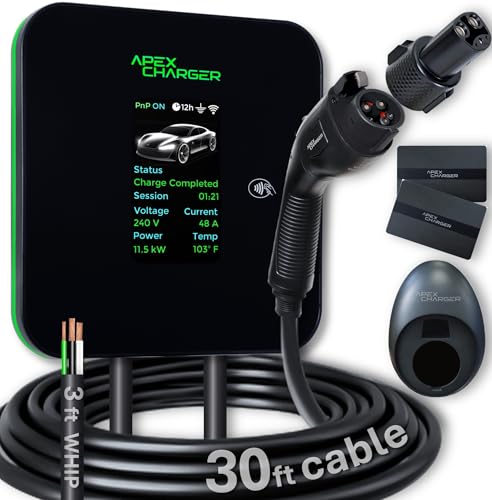
Pros
- Supports J1772 vehicles and includes a NACS adapter
- Long 30ft cable supports flexible charger placement
- Includes cable holder, connectors holder, and anti-theft bolt and fittings
- Includes 5-year coverage
Cons
- Hardwired installation requires a compatible 240V electrical setup
- 48-amp charging requires electrical capacity suitable for the listed power rating
- Product uses a J1772 connector and requires the included adapter for NACS vehicles
Specifications
| Color | Hardwire Midnight Black |
|---|---|
| Dimensions | 3.5 x 9.84 x 9.84 inches |
| Weight | 14.98 pounds |
| Product Group | Automotive Parts and Accessories |
Best For / Avoid If
Best for buyers prioritizing
- Supports J1772 vehicles and includes a NACS adapter
- Long 30ft cable supports flexible charger placement
- Includes cable holder, connectors holder, and anti-theft bolt and fittings
Consider another option if
- Hardwired installation requires a compatible 240V electrical setup
- 48-amp charging requires electrical capacity suitable for the listed power rating
- Product uses a J1772 connector and requires the included adapter for NACS vehicles

Pros
- PowerSmart load balancing can work with an existing electrical panel
- App supports charging schedules and real-time usage tracking
- NEMA 14-50 and hardwired installation options
- Includes Emporia Vue energy monitor
- 25-foot J1772 charging cable
Cons
- Installation requires either a NEMA 14-50 connection or hardwiring
- Product measures 3 x 8.25 x 12.25 inches
- Current listed price is 599
Specifications
| Color | Black |
|---|---|
| Size | Hardwired J1772 (BLK) |
| Dimensions | 3 x 8.25 x 12.25 inches |
| Product Group | Automotive Parts and Accessories |
Best For / Avoid If
Best for buyers prioritizing
- PowerSmart load balancing can work with an existing electrical panel
- App supports charging schedules and real-time usage tracking
- NEMA 14-50 and hardwired installation options
Consider another option if
- Installation requires either a NEMA 14-50 connection or hardwiring
- Product measures 3 x 8.25 x 12.25 inches
- Current listed price is 599

Pros
- High 48-amp output with up to 11.5kW charging
- WiFi app and scheduled charging support
- Long 25-foot cable
- NEMA Type 4 and IP66 weather-resistant enclosure
Cons
- Requires hardwired installation by a professional electrician
- Tesla and other NACS vehicles require an adapter, which is not included
- Actual charging time depends on vehicle onboard charger capacity and settings
Specifications
| Color | gray |
|---|---|
| Size | 48 |
| Dimensions | 14.48 x 4.97 x 10 inches |
| Product Group | Automotive Parts and Accessories |
Best For / Avoid If
Best for buyers prioritizing
- High 48-amp output with up to 11.5kW charging
- WiFi app and scheduled charging support
- Long 25-foot cable
Consider another option if
- Requires hardwired installation by a professional electrician
- Tesla and other NACS vehicles require an adapter, which is not included
- Actual charging time depends on vehicle onboard charger capacity and settings

Pros
- High-output hardwired design supports up to 48A, with a 50A selectable setting
- Smartphone app offers current adjustment, scheduling, remote controls and consumption tracking
- Long 25-foot cable and fluorescent holster support flexible, low-light charging access
- Weatherproof IP66/NEMA 4 enclosure is specified for outdoor exposure
- Three-year manufacturer warranty and U.S.-based support are included
Cons
- Hardwired installation requires a licensed electrician and a dedicated 60A or 70A circuit, depending on the output setting
- The charger uses a J1772 connector; Tesla vehicles require a separate J1772-to-NACS adapter
- App features require a 2.4 GHz Wi-Fi network with internet access
Specifications
| Color | Black |
|---|---|
| Size | 48 |
| Dimensions | 4 x 9.45 x 9.45 Inches |
| Product Group | Automotive Parts and Accessories |
| Binding | Automotive |
Best For / Avoid If
Best for buyers prioritizing
- High-output hardwired design supports up to 48A, with a 50A selectable setting
- Smartphone app offers current adjustment, scheduling, remote controls and consumption tracking
- Long 25-foot cable and fluorescent holster support flexible, low-light charging access
Consider another option if
- Hardwired installation requires a licensed electrician and a dedicated 60A or 70A circuit, depending on the output setting
- The charger uses a J1772 connector; Tesla vehicles require a separate J1772-to-NACS adapter
- App features require a 2.4 GHz Wi-Fi network with internet access

Specifications
| Size | 48A Hardwired |
|---|---|
| Product Group | Automotive Parts and Accessories |

Pros
- High charging capacity of up to 50 amps and 12kW
- Long 25-foot cable is included
- Offers app controls, scheduled charging, and OTA firmware updates
- Designed for indoor or outdoor use with a NEMA Type 4 enclosure
Cons
- Hardwired installation requires an electrician
Specifications
| Color | Dark Gray |
|---|---|
| Size | Hardwired J1772(DK) |
| Dimensions | 6.4173228281 x 4.8425196801 x 3.64173227975 Inches |
| Product Group | Automotive Parts and Accessories |
| Binding | Electronics |
Best For / Avoid If
Best for buyers prioritizing
- High charging capacity of up to 50 amps and 12kW
- Long 25-foot cable is included
- Offers app controls, scheduled charging, and OTA firmware updates
Consider another option if
- Hardwired installation requires an electrician

Pros
- PowerSmart technology manages charging load without a panel upgrade
- App provides charging controls and real-time usage tracking
- Supports both NEMA 14-50 and hardwired installation
- Weather-resistant design with a 25-foot cable
Cons
- Installation requires either a NEMA 14-50 connection or hardwiring
- Uses a J1772 connector
Specifications
| Color | White |
|---|---|
| Size | Hardwired J1772 (WH) |
| Product Group | Automotive Parts and Accessories |
| Binding | Electronics |
Best For / Avoid If
Best for buyers prioritizing
- PowerSmart technology manages charging load without a panel upgrade
- App provides charging controls and real-time usage tracking
- Supports both NEMA 14-50 and hardwired installation
Consider another option if
- Installation requires either a NEMA 14-50 connection or hardwiring
- Uses a J1772 connector
Hardwired charger picks by home setup
- Best fit for many J1772 homes: EVIQO Level 2 EV Charger J1772 48A, with app controls, weather-resistant housing, and a 25-foot cable.
- Best for direct NACS connection: EVIQO Level 2 EV Charger NACS 48A, for Tesla and other vehicles with NACS ports.
- Best for a lower-cost 48-amp option: Romaa Level 2 EV Charger 48 Amp Hardwired J1772, with app scheduling and a display.
- Best for home energy management: EMPORIA Pro Level 2 EV Charger with PowerSmart, which pairs charging control with an included Emporia Vue.
- Best for a longer listed warranty: MACH 2:Fast Hardwired Level 2 EV Charger J1772 car, which lists five-year coverage and includes a NACS adapter.
- Best for a 50-amp circuit: Autel Level 2 EV Charger up to 50Amp, 240V, with Wi-Fi, Bluetooth, and Ethernet access.
- Best for a temperature-monitored connector: IYILO Level 2 EV Charger, 48Amp/11.5KW/240V, with an NTC connector sensor and adjustable current.
- Best for a safety-certification-focused listing: Lectron J1772 Level 2 EV Charger, with UL 2594, UL 2231, and UL 2251 certifications stated in its product details.
- Also consider for PowerSmart: EMPORIA Pro Level 2 EV Charger with PowerSmart, listed under a second ASIN with the same core features.
What to check before choosing a hardwired EVSE
Start with the vehicle’s charge port, then the electrical circuit. A J1772 station fits most non-Tesla North American EVs and plug-in hybrids with J1772 inlets. A vehicle with a NACS inlet needs a charger with a matching NACS connector or a compatible adapter. Adapters are not included with several J1772 options here, so account for that extra purchase and make sure it supports AC charging for your vehicle.
Next, match charger output to the circuit and the vehicle’s onboard AC charger. The EVIQO J1772 and NACS models list up to 48 amps on a dedicated 60-amp, 240-volt circuit. The Autel lists up to 50 amps, while its circuit requirements should be settled with the electrician before installation. A higher charger rating cannot make a vehicle accept more AC power than its onboard charger allows.
Hardwired equipment is not a do-it-yourself shortcut around electrical requirements. Have a licensed electrician assess the panel, circuit capacity, cable route, and installation location, then install the station according to its instructions and applicable code. A panel with limited available capacity may need a different plan. EMPORIA’s PowerSmart is notable because its listing describes automatic load balancing with the included Vue, but an electrician should confirm that setup fits the home.
Charging speed claims are estimates, not guaranteed range added per hour. Vehicle efficiency, battery state, temperature, and onboard charging limits affect results. For the reasons a vehicle can charge below an advertised rate, see why an EV may not reach its charger’s advertised speed. Cold conditions can also affect charging, as explained in this guide to cold-weather EV charging.
Recommended hardwired Level 2 chargers
EVIQO Level 2 EV Charger J1772 48A
This is the straightforward choice for a J1772 vehicle and a home ready for a 60-amp circuit. Its app supports current adjustment, scheduling, and energy tracking over 2.4 GHz Wi-Fi. The 25-foot cable gives more parking flexibility, while the IP66/NEMA 4 enclosure suits indoor or outdoor mounting. The listing states UL, ETL, FCC, and Energy Star certifications and a three-year warranty.
The J1772 connector means a Tesla or NACS vehicle needs a separately purchased adapter. Skip this model if you want a native NACS plug or cannot support its specified circuit. Its 50-amp setting requires a dedicated 70-amp circuit, so that higher setting is not a simple software upgrade.
EVIQO Level 2 EV Charger NACS 48A
This version makes more sense for a Tesla or another vehicle with a NACS inlet. Its connector attaches directly without an adapter, and the 25-foot cable and app scheduling suit routine home charging. The listing gives the same 48-amp, 60-amp-circuit baseline and three-year warranty as the J1772 version.
Non-Tesla J1772 vehicles need a NACS-to-J1772 adapter, sold separately. Skip it if the household’s vehicles use J1772 and you do not want to manage an adapter. The advertised 50-amp option also calls for a dedicated 70-amp circuit.
Romaa Level 2 EV Charger 48 Amp Hardwired J1772
Romaa offers a lower-cost path to a hardwired 48-amp J1772 station, with a 25-foot cable, Wi-Fi app, scheduling, and a color display. The display can show session power, energy, time, and error codes without opening the app. Its NEMA Type 4 and IP66 ratings make it a candidate for outdoor placement when installation follows the product instructions.
The listing does not identify a required breaker size, so have an electrician establish the correct circuit before purchase. Tesla and other NACS vehicles need an adapter, which is not included. Skip Romaa if you want a native NACS connector or require a confirmed circuit specification before selecting equipment.
EMPORIA Pro Level 2 EV Charger with PowerSmart
PowerSmart targets a home where other electrical loads compete for panel capacity. The listing says the charger works with the included Emporia Vue to balance household load, and the app supports schedules and energy tracking. It can be hardwired or installed with a NEMA 14-50 plug, though this guide’s recommendation is for the hardwired configuration.
The higher price position is easier to justify when home energy monitoring and load management matter. The listing does not give a specific maximum output in its feature summary, so do not assume a particular charging rate from the 48-amp wording in the title alone. Skip it if you only need a basic charger and do not need the Vue or PowerSmart features. A second product row uses a separate ASIN for the same named model and core features, not a distinct charger recommendation.
MACH 2:Fast Hardwired Level 2 EV Charger J1772 car
This ApexCharger model pairs a J1772 connector with an included NACS adapter, a 30-foot cable, display, app, Wi-Fi, Bluetooth, and RFID cards. That combination may suit a household with different connector needs or a parking area where extra reach matters. Its listing states 11.5 kW output and five-year coverage.
The product details make broad claims about compatibility and weather protection but do not identify a specific IP rating or circuit size. Ask the electrician to confirm installation requirements and check adapter fit for the vehicle. Skip it if you need a clearly stated enclosure rating or a documented circuit requirement before choosing a unit.
Autel Level 2 EV Charger up to 50Amp, 240V
Autel is the option to investigate when a 50-amp charger output is useful and the electrical plan supports it. Its listed connections include Wi-Fi, Bluetooth, and Ethernet, while the app handles schedules and charging management. The 25-foot cable and NEMA Type 4 enclosure support flexible indoor or outdoor placement. The product listing states a three-year warranty and around-the-clock support.
The vehicle still has to accept the charger’s available AC power, and the listing’s range-per-hour claim should not be treated as a promise for every model. Its connector is J1772, so NACS vehicles need an adapter. Skip it if you want a native NACS plug or if the electrician determines the home cannot support the required circuit.
IYILO Level 2 EV Charger, 48Amp/11.5KW/240V
IYILO gives J1772 owners current adjustment from 6 to 48 amps and a connector temperature sensor that reports through its app. The listing says charging stops if the connector temperature exceeds 221°F. It also describes power sharing between two chargers on one circuit, while dynamic load balancing requires a separately sold energy-meter bundle. The stated warranty is three years.
The 2.4 GHz Wi-Fi requirement rules out homes relying only on 5 GHz Wi-Fi for app connectivity. Tesla and NACS vehicles need an adapter, which is not included. Skip this option if its app network requirement or separate meter cost conflicts with your setup. Its 48-amp hardwired installation calls for a 60-amp breaker and an electrician.
Lectron J1772 Level 2 EV Charger
Lectron is a hardwired J1772 option with a 23-foot cable and a three-year limited warranty. Its listing names UL 2594, UL 2231, and UL 2251 certifications, plus an IP66 enclosure and built-in fault protections. Those details can help buyers compare listed safety and installation features, while the shorter cable may work well in a compact garage.
The cable is two feet shorter than the 25-foot options described here, which can matter if the vehicle parks far from the mounting point. NACS vehicles need a compatible adapter. Skip Lectron if the cable cannot reach your charge port or you need native NACS charging.
Who should skip a hardwired charger
Drivers who rent, move often, or cannot get permission for electrical work may be better served by a listed plug-in EVSE, if their home has a suitable circuit and the vehicle’s charging needs fit. The EVDANCE Level 2 EV Charger 40Amp uses a NEMA 14-50 plug, so it is not a hardwired recommendation here. Do not treat a standard outlet or an existing receptacle as suitable without an electrician confirming its rating and condition.
Also skip a 48- or 50-amp purchase if your vehicle charges slowly on AC, your parking spot cannot be reached by the cable, or your panel cannot support the circuit and load-management plan. A lower-output unit may meet overnight needs with less electrical work. Ask the electrician to compare installation cost and circuit options before paying for unused capacity.
Before you buy, it is worth reading Best Portable Level 2 EV Charger and Best Level 2 EV Charger Under $700.
Final choice
For a typical J1772 home setup that can support a dedicated 60-amp circuit, the EVIQO Level 2 EV Charger J1772 48A has the clearest mix of stated output, cable reach, app scheduling, enclosure rating, and warranty. Choose its NACS version instead for a vehicle with a NACS port. Pick EMPORIA when panel load management is the main problem, or consider Autel when a 50-amp option fits the electrical plan. Have the electrician confirm circuit capacity, connector fit, cable reach, and mounting location before installation.
Sources and further reading
- Charging Electric Vehicles at Home (Alternative Fuels Data Center): Learn about home charging equipment and installation considerations.
- Procurement and Installation for EV Charging Infrastructure (Alternative Fuels Data Center): Review planning and installation guidance for charging infrastructure.