Can you jump start a hybrid car 12v battery? Yes, in many hybrids, a drained 12-volt battery can receive a jump start much like one in a gasoline car. The jump starts the vehicle electronics, not the high-voltage traction battery, and the correct connection points vary by model.
Hybrid systems add important limits. Some use a small 12-volt battery in the cargo area, while a remote positive terminal sits under the hood. Others use a lithium-ion 12-volt battery instead of a conventional lead-acid unit. Read the owner manual before connecting power.
Key takeaways
- A hybrid can often receive a 12-volt jump start.
- Jump power wakes computers, relays, locks, displays, and the system that enables READY mode.
- Never connect a portable booster or donor vehicle to high-voltage hybrid cables.
- Use the marked 12-volt positive terminal and body ground point when the vehicle provides them.
- READY mode can make a hybrid move even when its gasoline engine stays silent.
- A jump start does not repair a failed battery, charging system, interlock, or hybrid fault.
What a jump start does in a hybrid
A hybrid normally has two separate electrical systems. The high-voltage battery powers the traction motor and receives charge through regenerative braking or the gasoline engine. The 12-volt battery powers low-voltage equipment, including control modules, lights, locks, relays, displays, and startup logic.
When the 12-volt battery loses charge, the hybrid may show no response or display strange warning messages. It may unlock slowly, click without starting, or power the dashboard without entering READY mode. A jump source can restore enough low-voltage power for computers and relays to operate.
The vehicle then uses a DC-to-DC converter to maintain the 12-volt system from the high-voltage battery after READY mode becomes active. This differs from a conventional car, where an alternator normally charges the 12-volt battery.
The gasoline engine may remain off after a successful start. That is normal. Look for the READY indicator or the exact operating signal named in the manual. Do not judge success only by engine noise.
Can you jump start every hybrid car?
No. Many hybrids support an external 12-volt jump procedure, but vehicle design differs by model year, trim, battery type, and market. Some vehicles place the 12-volt battery under the hood. Others place it in the trunk or rear cargo area and provide remote terminals near the fuse box.
Some hybrids use a conventional 12-volt lead-acid battery. Others use an absorbed glass mat or lithium-ion battery. The battery chemistry affects replacement parts and charging methods. A standard jump may still work, but the manual controls the safe connection and charging procedure.
Plug-in hybrids add another variable. Their larger traction battery can sit at a high state of charge while the 12-volt battery is too weak to wake the vehicle. A charged traction battery does not remove the need for a working 12-volt system.
Model-year changes can move jump points or alter the startup sequence. A procedure for one Toyota Prius, Ford Escape Hybrid, Hyundai Ioniq Hybrid, or Honda Accord Hybrid may not apply to another year or trim. Use the manual for that exact vehicle.
Safe hybrid jump-start checklist
| Check | Why it matters |
|---|---|
| Vehicle manual | Shows approved terminals, ground points, and startup steps. |
| 12-volt rating | The booster must match the vehicle’s low-voltage system. Most passenger hybrids use 12 volts, but identification still matters. |
| Polarity | Positive and negative connections must go to the correct points. |
| High-voltage cables | Orange cables and marked hybrid components are off limits. |
| Transmission position | The vehicle needs Park, parking brake, and a clear area before READY mode. |
| Booster condition | Damaged cables, swollen batteries, or wet equipment can create a fire or shock hazard. |
How to jump start a hybrid 12-volt battery
Follow this general sequence only when it matches the vehicle manual. Some models use different connection points or require a different order.
- Park safely. Put the hybrid in Park, apply the parking brake, switch off accessories, and keep the vehicle away from traffic. A hybrid can become ready to move without starting its gasoline engine.
- Locate the 12-volt jump points. Open the hood or cargo area and find the marked positive terminal. Many hybrids provide a remote positive post under a protective cover. Find the approved body ground point, not an orange high-voltage cable or random painted bracket.
- Check both vehicles or devices. Use a 12-volt jump pack or a donor vehicle with a 12-volt system. Do not use a 24-volt commercial vehicle system. Keep the donor vehicle off unless the manual permits it.
- Connect positive first. Attach the red clamp to the hybrid’s positive jump terminal. Attach the other red clamp to the donor battery positive terminal or the booster positive output.
- Connect negative at the approved ground. Attach the black clamp to the hybrid’s specified ground point. Attach the other black clamp to the donor battery negative terminal or booster negative output, following the manual.
- Allow a short power-up period. Some hybrids need time for dashboard electronics to wake. Do not crank a hybrid in the normal sense. Press the brake and use the vehicle’s normal POWER or start control.
- Confirm READY mode. The READY indicator matters more than engine sound. Keep the vehicle stationary because it may become drive-ready immediately.
- Remove cables in reverse order. Follow the manual’s order. Keep clamps from touching each other or vehicle metal during removal.
- Inspect the cause. A weak battery may fail again after the jump. Test the 12-volt battery and charging function, and check for lights or accessories that drained it.
Portable jump starter or donor car?
Both can provide 12-volt power, but each has limits. A portable jump starter avoids positioning another car and may help in a garage or parking lot. It still needs the correct voltage, sound clamps, enough charge, and access to the approved jump points.
A donor car can supply power through jumper cables. The donor vehicle must use a compatible 12-volt electrical system. Heavy trucks, commercial vehicles, and vehicles with unusual electrical layouts can create a mismatch. Follow both vehicle manuals, especially if either manual bans donor charging.
Do not assume a high peak-current label makes a device suitable for every hybrid. Clamp reach, polarity protection, battery chemistry, and the actual connection method matter more than a single marketing number. For general pack selection, CarTechTalk covers jump starters for stored vehicles and jump starters for winter emergencies.
Why a hybrid may not start after a jump
The 12-volt battery remains too weak
A jump source may power the dashboard but fail to maintain voltage while computers initialize. The battery may have an internal failure, severe sulfation, or a frozen case. Disconnect the equipment only after the manual permits it, then test the battery.
The vehicle never reaches READY mode
Low voltage can create stored fault messages or prevent a control module from completing its startup checks. Other causes include an open door, an unrecognized key, a brake-pedal switch problem, a blown fuse, or a hybrid interlock fault.
The wrong connection point was used
Some models use a remote terminal with a fuse link. Connecting to the wrong stud can damage a fuse or fail to supply the needed circuit. Stop if sparks, heat, smoke, or unusual smells appear.
The traction battery is discharged or faulty
A 12-volt jump does not charge or bypass the high-voltage battery. A hybrid may need factory service or a qualified hybrid technician if its traction battery, inverter, isolation monitor, or interlock has a fault.
Common mistakes
- Connecting to orange cables: Orange usually identifies high-voltage hybrid wiring. Do not touch, probe, or jump those cables.
- Using a random metal ground: A painted bracket may provide poor contact or sit near sensitive electronics. Use the manual’s ground point.
- Assuming silence means failure: The gasoline engine may remain off while the hybrid is in READY mode.
- Pressing the accelerator during the jump: Keep the vehicle in Park and follow the normal startup process.
- Leaving a booster connected for a long drive: Remove equipment after the vehicle reaches READY mode and the manual allows removal.
- Clearing warning codes and stopping there: Clearing codes does not repair the condition that triggered them. The fault may return or affect safe operation.
- Jumping a damaged battery: A cracked, leaking, swollen, or frozen battery needs professional handling.
What to do after the hybrid starts
Keep the hybrid in READY mode only in an open, safe area. Never leave a running or READY vehicle in an enclosed garage because the gasoline engine can start without warning and produce carbon monoxide.
The DC-to-DC converter may restore 12-volt power while the vehicle remains READY, but that does not prove the battery is healthy. A short drive may not replace a deeply discharged battery. Some models specify a charging period, and others require a battery charger or replacement.
Check whether the 12-volt battery is the correct type for the vehicle. A battery with the wrong venting arrangement, capacity, terminal layout, or chemistry can create future problems. Vehicle model year and trim can change the required part.
If the 12-volt battery repeatedly dies, inspect parasitic draw, charging voltage, battery age, doors and hatch switches, aftermarket accessories, and software-related wake events. A jump start treats the immediate low-voltage condition, not its cause.
When to get professional help
Stop and call roadside assistance or a hybrid-qualified repair shop when the vehicle has smoke, heat, melted insulation, acid leakage, a damaged battery case, repeated sparks, or exposed high-voltage parts.
Professional help also fits a hybrid that will not reach READY mode after a correct 12-volt jump, shows a red hybrid-system warning, loses power while driving, or stores repeated isolation and inverter faults. Use a technician with equipment for that vehicle’s model year and hybrid system.
Roadside services may know conventional jump procedures but lack model-specific hybrid training. Ask whether the technician will use the manufacturer’s jump points and avoid high-voltage components. For battery chargers and testers, see CarTechTalk’s Battery Chargers & Testers category.
Gear that can help
If you need jump starters for this job, these picks already appear in our jump starters guides. Check the full guide for fit and who should skip each one.
Pros
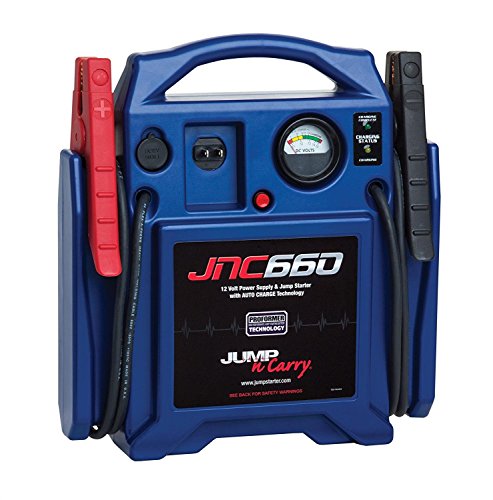
- High 1700-amp peak rating
- Long 46-inch cables with heavy-duty #2 AWG construction
- Built-in voltmeter provides charge-status information
- DC outlet supports powering 12V accessories
Specifications
| Color | Blue |
|---|---|
| Size | One Size |
| Dimensions | 16.3 x 14.1 x 5.1 inches |
| Weight | 18 Pounds |
| Product Group | Automotive Parts and Accessories |
| Binding | Automotive |
Best For / Avoid If
Best for buyers prioritizing
- High 1700-amp peak rating
- Long 46-inch cables with heavy-duty #2 AWG construction
- Built-in voltmeter provides charge-status information
Pros
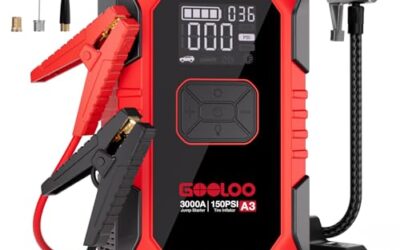
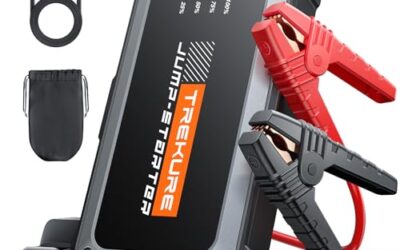
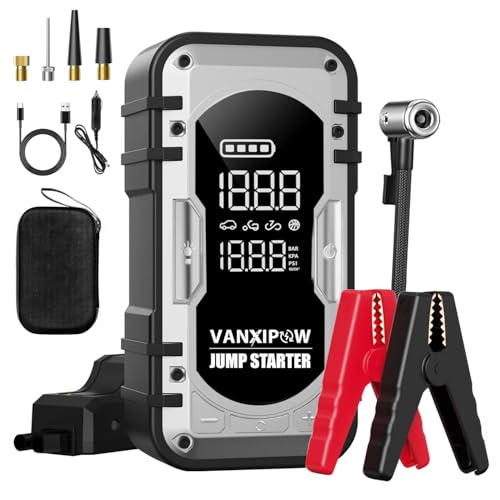
- Combines jump-starting, tire inflation, emergency lighting, and USB charging in one device
- Listed compatibility covers a broad range of 12V vehicles and engines up to 9.0L gas or 8.0L diesel
- Stated weight of 615 grams supports portable use
- LCD screen displays battery level, inflation mode, and real-time tire pressure
Cons
- The air pump should not be used continuously and requires cooling when it becomes seriously hot
- The product has one USB output port
Specifications
| Color | black silver |
|---|---|
| Dimensions | 6.9 x 2.3 x 3.5 Inches |
| Weight | 1.873929227 pounds |
| Product Group | Automotive Parts and Accessories |
Best For / Avoid If
Best for buyers prioritizing
- Combines jump-starting, tire inflation, emergency lighting, and USB charging in one device
- Listed compatibility covers a broad range of 12V vehicles and engines up to 9.0L gas or 8.0L diesel
- Stated weight of 615 grams supports portable use
Consider another option if
- The air pump should not be used continuously and requires cooling when it becomes seriously hot
- The product has one USB output port

Pros
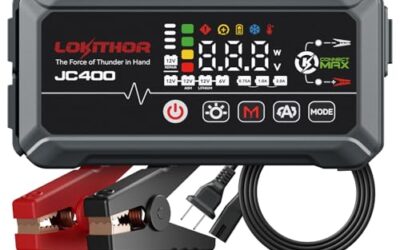
- Combines jump-starting, tire inflation, high-volume air movement, device charging, and emergency lighting in one unit
- Supports a wide stated range of vehicle applications, including gas engines and diesel engines up to 14.0L
- Includes automatic tire-pressure shut-off and five inflation presets
- Comes with jumper cables, an extended air hose, four air nozzles, a USB-A to USB-C cable, instructions, and a carrying case
Cons
- The unit weighs 4.85 lb
- The manufacturer recommends charging the device every 4-5 months if it remains idle
Specifications
| Color | Black |
|---|---|
| Dimensions | 9.1338582584 x 2.7952755877 x 5.4330708606 inches |
| Weight | 2.8439631798 pounds |
| Product Group | Automotive Parts and Accessories |
Best For / Avoid If
Best for buyers prioritizing
- Combines jump-starting, tire inflation, high-volume air movement, device charging, and emergency lighting in one unit
- Supports a wide stated range of vehicle applications, including gas engines and diesel engines up to 14.0L
- Includes automatic tire-pressure shut-off and five inflation presets
Consider another option if
- The unit weighs 4.85 lb
- The manufacturer recommends charging the device every 4-5 months if it remains idle
Frequently asked questions
Can a hybrid jump another car?
Usually, no. The hybrid’s 12-volt system and DC-to-DC converter may not support the current demand or procedure. Some manuals allow limited assistance, but many do not. Use a separate booster or donor vehicle approved for that job.
Will driving recharge a hybrid’s 12-volt battery?
READY mode lets the DC-to-DC converter supply the 12-volt system, but charging time depends on the battery condition and vehicle design. A badly failed battery may need replacement rather than more driving.
Can you jump start a hybrid with a regular jump starter?
Often, yes, if it supplies the vehicle’s 12-volt system and connects to approved terminals. The manual controls the connection method. Never use a 24-volt device or connect to high-voltage wiring.
Why does the hybrid engine not start after the jump?
The engine may stay off because the traction battery has enough energy and the vehicle is operating normally. Check the READY indicator. If READY does not appear, diagnose the 12-volt supply and hybrid fault system.
Can a dead hybrid battery be jump started?
A dead 12-volt battery often can receive a jump. A dead or failed high-voltage traction battery needs a model-specific service procedure. A portable 12-volt booster cannot replace that repair.
Sources and further reading
- Battery Council International (Battery Council International): Battery safety and service information for automotive batteries.
- Check for Recalls (NHTSA): Search vehicle recalls by VIN or vehicle details.