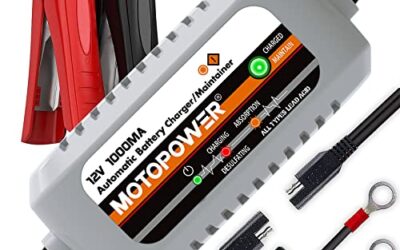
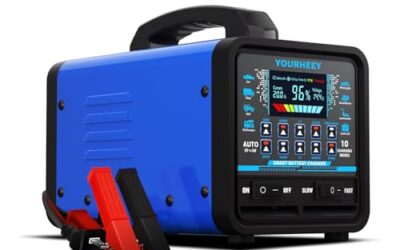
To check battery charger polarity, use a DC-voltage multimeter and compare charger positive output with charger negative output before connecting it to a battery. A positive reading usually identifies the probe touching the charger positive lead, while a negative reading means the probes are reversed or the charger output polarity differs from the expected arrangement.
Polarity matters because positive and negative terminals are not interchangeable. Reversed polarity can blow a fuse, damage charger electronics, harm a battery, or create sparks. Voltage must also match the battery. Correct polarity cannot make a 6-volt charger safe for a 12-volt battery.
Key takeaways
- Set multimeter to DC volts before testing charger output.
- Red probe on one charger contact and black probe on the other reveals polarity.
- Positive voltage means red probe is on the positive side. Negative voltage means probe positions are reversed.
- Check charger voltage, battery chemistry, connector type, and current rating separately.
- Never test an unknown charger by touching leads together or connecting it directly to a vehicle battery.
- Stop if output voltage is far above the battery rating, fluctuates sharply, or produces heat, smoke, or sparks.
What charger polarity means
Polarity identifies which charger output is positive and which is negative. Direct-current chargers have two electrical sides. The positive side supplies voltage relative to the negative side, which serves as the reference point.
Most automotive batteries use a positive terminal marked with a plus sign and a negative terminal marked with a minus sign. A charger positive lead normally connects to the battery positive terminal. Charger negative connects to battery negative, chassis ground, or another approved ground point when the vehicle manual allows it.
Polarity can appear at bare wires, alligator clips, barrel connectors, SAE-style plugs, USB leads, or proprietary connectors. Wire colors help, but color alone does not prove polarity. Red often means positive and black often means negative, yet repairs, adapters, and low-cost cables can use different colors.
What you need before testing
- Digital multimeter with a DC-voltage setting.
- Charger disconnected from the battery.
- Access to both charger output contacts.
- Eye protection when testing automotive batteries or exposed metal contacts.
- Charger label, battery label, or vehicle manual for voltage and chemistry information.
Use a meter rated for the voltage being tested. Most vehicle battery chargers operate below the range of common handheld meters, but an unknown power supply may not. Inspect insulation and probes first. Do not use damaged leads.
Work in a dry, ventilated area. Keep metal tools away from battery terminals. Lead-acid batteries can release flammable gas, especially during charging. Do not smoke or create sparks near the battery.
How to check battery charger polarity with a multimeter
- Disconnect charger power. Unplug the charger from the wall or switch off its input. Separate charger leads from any battery. Polarity testing should start with no battery connected.
- Inspect charger output. Identify positive and negative wires, clips, pins, or connector contacts. Look for plus and minus symbols, molded marks, a wiring label, or a wiring diagram. Treat these markings as clues until meter testing confirms them.
- Set the meter to DC volts. Select the VDC setting. Use a range higher than the charger’s expected output if the meter is not autoranging. Do not use resistance, continuity, current, or AC-voltage mode.
- Connect the black probe to one output contact. Touch only the metal contact being tested. Keep the probe tip away from the other contact.
- Connect the red probe to the other output contact. Apply light contact. Do not bridge the two contacts with the probe tips.
- Power the charger. Turn on or plug in the charger only after probes are positioned safely. Read the meter display.
- Interpret the sign. A positive number means the contact touched by the red probe is positive relative to the contact touched by the black probe. A negative number means the contact touched by the black probe is positive relative to the red probe.
- Mark the leads or contacts. Disconnect charger power before labeling them. Mark positive and negative only after the reading remains stable and fits the charger label.
- Turn off and unplug the charger. Remove probes after power is off. Connect the charger to a battery only after voltage and battery chemistry also match.
Example meter readings
| Meter reading | Meaning | Next action |
|---|---|---|
| +14.4 VDC | Red probe contact is positive relative to black probe contact. | Compare 14.4 volts with charger and battery specifications before connection. |
| -14.4 VDC | Black probe contact is positive relative to red probe contact. | Swap probe positions or relabel the output contacts. |
| 0 VDC | No active output, poor probe contact, protection mode, or faulty charger. | Check power, contact points, charger mode, and meter setting. |
| Unstable reading | Charger may use pulsed output, detect load, enter protection, or have a fault. | Use the charger manual and avoid connecting an unknown output. |
How to test barrel and coaxial connectors
Barrel connectors often place positive voltage on the center pin and negative voltage on the outer sleeve, but this is not universal. The charger label or wiring diagram may specify center-positive or center-negative operation.
Place the black probe on the outer sleeve and the red probe on the center contact. A positive reading supports center-positive polarity. A negative reading supports center-negative polarity. Do not force a large probe into a small connector. A slip can short the contacts.
Some barrel plugs have recessed contacts that are difficult to reach. Use suitable thin probe tips or an approved breakout adapter. Do not insert loose wire strands into the connector. They can break off, short the supply, or become difficult to remove.
How to test alligator clips and loose wires
Test between the metal jaw of each clip or the exposed end of each output wire. Keep insulation away from the probe tip only as much as needed. Do not pierce insulation unless the wire can be repaired safely afterward.
Red and black clip colors usually indicate positive and negative. The meter decides. If the reading is negative, the red probe is touching the negative side or the charger has reversed output relative to the expected color coding.
Some chargers use a temperature sensor, communication lead, or electronic control circuit in addition to positive and negative output. A connector with three or more contacts may not expose simple two-wire polarity. Do not guess. Use the charger wiring diagram or service instructions.
Polarity is only one compatibility check
A correct positive and negative connection does not prove charger compatibility. Check these points before charging:
| Check | Why it matters |
|---|---|
| Battery voltage | A 6-volt, 12-volt, or 24-volt system needs a charger that supports that voltage. |
| Battery chemistry | Flooded lead-acid, AGM, gel, lithium iron phosphate, and other batteries use different charging limits and profiles. |
| Charger output voltage | Charging voltage can be higher than the battery’s resting voltage. Compare the charger mode with the battery maker’s limits. |
| Current rating | Excessive current can overheat a battery or charger. A very low current may charge slowly or fail to start an automatic charger. |
| Connector fit | A plug can fit physically while carrying the wrong polarity, voltage, or current. |
| Vehicle electronics | Some vehicles have battery sensors, managed charging systems, or special jump and charge connection points. |
Vehicle model year can change charging instructions, battery location, and approved connection points. Start-stop vehicles may use AGM or EFB batteries instead of a conventional flooded battery. Hybrid and electric vehicles can have separate 12-volt systems and high-voltage battery systems. Do not use a standard 12-volt charger on high-voltage EV battery circuits.
Battery chargers for winter storage may use maintenance modes. A charger suitable for one battery chemistry may be unsafe for another. Read both charger and battery instructions. A charger’s “automatic” label does not make every battery type compatible.
Polarity check decision tree
- Does charger output have clear positive and negative markings? Test with a meter anyway if a repaired, adapted, or unfamiliar connector is involved.
- Does the meter show a stable DC reading? If yes, interpret the sign and compare voltage. If no, inspect power, mode, contacts, and charger condition.
- Does polarity match battery terminals? If no, stop. Do not reverse the battery leads to make an uncertain charger fit.
- Does charger voltage and chemistry match the battery? If no, stop and use a compatible charger.
- Does the connector include extra contacts? If yes, follow the wiring diagram rather than guessing from color or shape.
Common mistakes
Using AC mode
AC mode can show a confusing value or fail to show charger polarity. Automotive battery chargers provide DC output, so use the DC-voltage setting.
Reading wire color as proof
Color coding can be wrong after repairs or adapter installation. Confirm unfamiliar output with a meter.
Testing resistance while charger is powered
Resistance mode sends a small test current through a circuit. It is not a polarity test. Applying it to a powered charger can damage the meter.
Measuring current across the output
Current mode often creates a near-short circuit through the meter. This can blow the meter fuse, trigger charger protection, or damage the charger. Measure voltage across the two output contacts instead.
Touching probe tips together
Probe contact can short charger output. Keep tips separated and touch one contact at a time.
Ignoring a negative sign
A negative reading is not a failed test. It means probe orientation is opposite to the charger’s polarity. Reverse the probes to identify the positive contact.
Assuming physical fit means electrical fit
Connectors can share the same size while using different voltage, polarity, or pin layouts. Fit alone proves little.
When to get professional help
Stop testing and seek qualified help if the charger becomes hot, smells burnt, sparks, trips a breaker, or shows voltage far above its label. Also stop if the battery swells, leaks, hisses, or becomes hot during charging.
Professional diagnosis makes sense when a vehicle has a battery management sensor, dual-battery system, lithium battery, hybrid drivetrain, or difficult-to-access battery. Model-year differences can affect ground points and charge procedures. Follow the vehicle service manual.
Replace damaged chargers instead of opening sealed units unless qualified service instructions support repair. Internal capacitors can retain dangerous voltage after unplugging. A polarity mistake that damages a charger or battery may not be visible immediately.
Related CarTechTalk reading
For charger selection and charging methods, see NOCO GENIUS vs battery tender. Cold-weather charging needs different attention, covered in battery charger thermal regulation and voltage profiles. For storage use, compare guidance in battery maintainers for winter car storage.
Gear that can help
If you need battery chargers and maintainers or battery testers for this job, these picks already appear in our battery chargers and maintainers guides. Check the full guide for fit and who should skip each one.

Pros
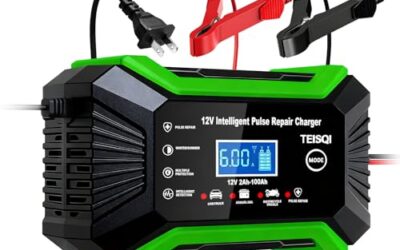
- Supports multiple 6V and 12V battery types
- Combines 15A charging with a maintain/float function
- Provides digital voltage and charge-status information
- Includes reverse hook-up protection
Cons
- The listing does not include dimensions, warranty information, or included accessories
Specifications
| Color | Black |
|---|---|
| Size | Battery Charger and Maintainer |
| Dimensions | 9.96 x 4.29 x 10.03 Inches |
| Weight | 2.7 Pounds |
| Product Group | Automotive Parts and Accessories |
| Binding | Automotive |
Best For / Avoid If
Best for buyers prioritizing
- Supports multiple 6V and 12V battery types
- Combines 15A charging with a maintain/float function
- Provides digital voltage and charge-status information
Consider another option if
- The listing does not include dimensions, warranty information, or included accessories

Pros
- Supports multiple lead-acid battery types, including AGM, Gel, SLA, VRLA, flooded, maintenance-free, deep-cycle, marine, and powersport batteries
- Compatible with LiFePO4 lithium-ion batteries
- Designed for use with cars, motorcycles, lawn mowers, ATVs, UTVs, tractors, trucks, SUVs, RVs, boats, and other listed vehicles
Cons
- Only 6V and 12V battery support is specified
- Force Mode is required to charge batteries that have reached zero volts
Specifications
| Color | Black |
|---|---|
| Size | 5A |
| Dimensions | 4.61 x 3.43 x 7.95 inches |
| Weight | 1.59 pounds |
| Product Group | Automotive Parts and Accessories |
| Binding | Electronics |
Best For / Avoid If
Best for buyers prioritizing
- Supports multiple lead-acid battery types, including AGM, Gel, SLA, VRLA, flooded, maintenance-free, deep-cycle, marine, and powersport batteries
- Compatible with LiFePO4 lithium-ion batteries
- Designed for use with cars, motorcycles, lawn mowers, ATVs, UTVs, tractors, trucks, SUVs, RVs, boats, and other listed vehicles
Consider another option if
- Only 6V and 12V battery support is specified
- Force Mode is required to charge batteries that have reached zero volts

Pros
- Covers several common 12V lead-acid battery types
- Combines battery, cranking, and charging-system testing
- Compact design can be stored in a glove box or center console
- Does not require charging the tester before use
Cons
- Limited to 12V batteries
- The listing does not list detailed specifications beyond the stated battery compatibility and testing functions
- The tester powers on only after it is properly attached to a battery
Best For / Avoid If
Best for buyers prioritizing
- Covers several common 12V lead-acid battery types
- Combines battery, cranking, and charging-system testing
- Compact design can be stored in a glove box or center console
Consider another option if
- Limited to 12V batteries
- The listing does not list detailed specifications beyond the stated battery compatibility and testing functions
- The tester powers on only after it is properly attached to a battery
Frequently asked questions
Can a multimeter identify charger polarity?
Yes. Set the meter to DC volts and measure across the two charger output contacts. A positive reading identifies the red-probe contact as positive relative to the black-probe contact.
What does a negative voltage reading mean?
It means probe orientation is reversed relative to the charger output. Swap the probes. If the value becomes positive, the contact touched by the red probe is positive.
Can I check polarity without a multimeter?
Visual markings may suggest polarity, but they do not prove it. A suitable DC-voltage meter is the safer method for an unfamiliar charger or connector.
Can reversed polarity damage a car battery?
Yes. It can cause sparks, blow fuses, damage charger circuits, harm vehicle electronics, or damage the battery. Disconnect power immediately if leads are connected incorrectly.
Does correct polarity mean the charger is safe?
No. Voltage, current, battery chemistry, charging profile, connector pinout, and vehicle charging instructions must also match.
Sources and further reading
- Battery Council International (Battery Council International): Battery safety and battery technology information for vehicle owners.