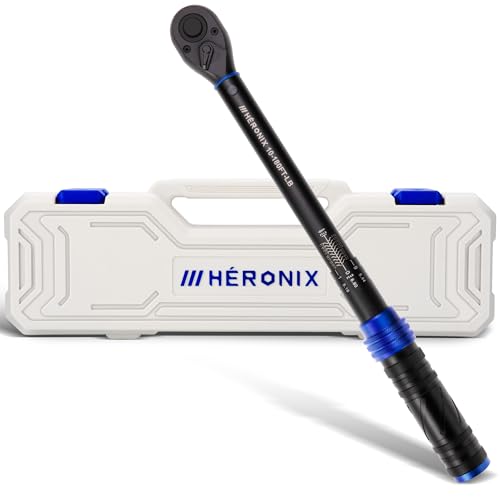
Best torque wrench under $25 is the HERONIX 1/2 Inch Drive Click Torque Wrench for most car and motorcycle repairs because its 10 to 180 ft-lb range covers larger fasteners while its 1/2-inch drive fits common heavy-duty sockets. Choose the HERONIX 3/8-Inch Drive Click Torque Wrench instead for spark plugs, bicycles, and smaller fasteners that stay within its 5 to 50 ft-lb range.
Pros
- Bidirectional drive allow torque application in both directions
- Low 5-degree swing arc ease use in tight engine compartments
- Dual Ft-Lb and Nm scales eliminate manual unit conversion
- Traceable calibration certificate include in package
Cons
- Spec field list color as white while text describe black-blue handle
Specifications
| Color | White |
|---|---|
| Size | 1/2" DR.『10-180 FT.LB』 |
| Weight | 2.3 pounds |
| Product Group | Automotive Parts and Accessories |
Best For / Avoid If
Best for buyers prioritizing
- Bidirectional drive allow torque application in both directions
- Low 5-degree swing arc ease use in tight engine compartments
- Dual Ft-Lb and Nm scales eliminate manual unit conversion
Consider another option if
- Spec field list color as white while text describe black-blue handle

Pros
- 72-tooth drive enables work in tight clearances
- Dual-scale markings provide direct Ft-Lb and Nm readings
- Both tactile and audible feedback prevent over-torquing
- Supports bi-directional operation
Cons
- Calibration certificate documentation details omitted
Best For / Avoid If
Best for buyers prioritizing
- 72-tooth drive enables work in tight clearances
- Dual-scale markings provide direct Ft-Lb and Nm readings
- Both tactile and audible feedback prevent over-torquing
Consider another option if
- Calibration certificate documentation details omitted
Both choices use a click-style mechanism, dual Ft-Lb and Nm scales, reversible 72-tooth ratchets, and a stated accuracy of plus or minus 3 percent. The main buying decision is not brand or appearance. It is drive size and torque range.
| Product | Drive | Torque range | Best fit | Price position |
|---|---|---|---|---|
| HERONIX 1/2 Inch Drive Click Torque Wrench | 1/2 inch | 10 to 180 Ft-Lb, 13.6 to 244 Nm | Cars, motorcycles, larger fasteners | Higher of these two budget options |
| HERONIX 3/8-Inch Drive Click Torque Wrench | 3/8 inch | 5 to 50 Ft-Lb, 6.8 to 67.8 Nm | Bikes, spark plugs, smaller automotive work | Lower of these two budget options |
Affiliate disclosure: CarTechTalk may earn a commission from qualifying purchases. This does not change product selection or raise your purchase cost.
HERONIX 1/2 Inch Drive Click Torque Wrench: Best for General Car Repairs
The HERONIX 1/2 Inch Drive Click Torque Wrench fits readers who need one budget torque wrench for common vehicle work. Its range begins at 10 Ft-Lb and reaches 180 Ft-Lb, so it covers more high-torque jobs than the smaller model. The 13.6 to 244 Nm scale also helps readers who follow metric service information.
A 1/2-inch drive matches the socket size often used for larger automotive fasteners. That makes this model the stronger first purchase for a garage that handles cars, motorcycles, and general mechanical work. It does not replace every smaller drive tool, but its range gives it wider reach for wheel, suspension, and engine-bay tasks that call for higher torque settings.
What the HERONIX 1/2 Inch model offers
- The manufacturer lists plus or minus 3 percent accuracy. Treat that figure as a product claim, not a guarantee for every use or future adjustment.
- Its 72-tooth ratchet needs a stated 5-degree swing arc. That can help in tighter spaces where a coarse ratchet forces repeated repositioning.
- Clockwise and counterclockwise operation supports more fastening layouts. Follow the vehicle or component manual because torque direction and procedure can vary.
- The quick-release button holds sockets during work and helps remove them after use.
- Laser-etched Ft-Lb and Nm scales reduce unit conversion work. Read the scale at eye level and align the setting carefully.
- A lock ring holds the selected setting. The listed setup process involves pulling down the ring, rotating to the desired value, and releasing it.
- The listing says each adjustment produces audible and tactile click feedback at the selected setting.
- A molded storage case protects the tool during transport and storage.
Best for and skip condition
Best for: Car owners, motorcycle owners, and DIY mechanics who need a broad range with 1/2-inch sockets.
Skip it if: Your work centers on spark plugs, bicycle components, or other fasteners below 10 Ft-Lb. The 1/2-inch head and higher minimum range are a poor match for delicate low-torque work. Select the 3/8-inch model or a purpose-built tool with a lower range.
This model also costs more than its smaller sibling within this budget group. The difference buys range and drive size, not a different brand or a different stated accuracy figure. Buyers should choose it for application fit rather than appearance or the storage case.
HERONIX 3/8-Inch Drive Click Torque Wrench: Best for Low-Torque Work
The HERONIX 3/8-Inch Drive Click Torque Wrench suits jobs that stay between 5 and 50 Ft-Lb. That range reaches lower than the 1/2-inch model, which matters for bicycle parts, spark plugs, motorcycle components, and smaller automotive fasteners. Its metric range runs from 6.8 to 67.8 Nm.
A 3/8-inch drive also fits smaller sockets than a 1/2-inch drive. That can make it easier to work around engine bays, bike frames, and other spaces where a larger head adds bulk. Socket size still depends on the fastener and the socket set, so this tool should not be treated as a substitute for a 1/2-inch wrench on high-torque work.
What the HERONIX 3/8-Inch model offers
- The manufacturer lists plus or minus 3 percent accuracy across its stated working range.
- The 5 Ft-Lb minimum gives it a better starting point for low-torque assemblies than the 1/2-inch option.
- Its 72-tooth reversible ratchet supports clockwise and counterclockwise use and needs a stated 5-degree swing arc.
- The quick-release mechanism helps retain sockets during a job.
- Dual Ft-Lb and Nm markings help readers follow either unit system without separate conversion.
- The listing describes a clear click that can be heard and felt when the selected torque is reached.
- An anti-slip handle supports grip during adjustment and fastening.
Best for and skip condition
Best for: Bicycle owners, motorcycle riders, and DIY mechanics handling spark plugs or smaller fasteners within the 5 to 50 Ft-Lb range.
Skip it if: You need torque settings above 50 Ft-Lb or already use a garage socket set built around 1/2-inch drive. This model cannot cover the 1/2-inch wrench’s upper range, so buying it first may leave a gap for larger vehicle repairs.
The smaller range is this tool’s strength and its limit. It gives low-torque work a better fit, but it cannot serve as the only torque wrench for every car repair. Buyers should match the tool to the highest and lowest torque values in their planned jobs.
1/2-Inch vs 3/8-Inch Torque Wrench
Drive size affects socket compatibility, tool size, and the fastener range the wrench can serve. It does not automatically determine accuracy. Both HERONIX models list the same plus or minus 3 percent accuracy claim, so application range should decide between them.
Choose 1/2 inch for higher torque
The 1/2-inch model reaches 180 Ft-Lb. That makes it the more practical choice for readers who work on larger automotive fasteners or want one tool for both motorcycles and cars. Its 10 Ft-Lb minimum still leaves it unsuitable for work that calls for settings below that point.
Choose 3/8 inch for smaller assemblies
The 3/8-inch model starts at 5 Ft-Lb and stops at 50 Ft-Lb. That lower starting point suits bicycle parts, spark plugs, and smaller fasteners. Its upper limit rules it out for many higher-torque vehicle tasks.
Do not select by ratchet tooth count alone
Both models list 72 teeth and a 5-degree swing arc. That feature can reduce the handle movement needed between clicks, but it does not solve a wrong drive-size or wrong-range choice. A compact ratchet head still needs the correct socket and enough room for safe hand placement.
How to Use a Budget Click Torque Wrench
Start with the service information for the exact vehicle or component. Torque values can change by fastener location, thread condition, lubrication, tightening sequence, and component design. Use the manual’s unit system or convert carefully between Ft-Lb and Nm.
- Fit the correct socket to the drive head. Do not force a loose socket onto the wrench.
- Pull down the lock ring, set the required value, and release the ring to hold the setting.
- Keep the handle at its marked grip area. Hand position changes can affect applied leverage.
- Pull smoothly rather than using a sudden jerk. Stop when the click occurs.
- Do not keep pulling after the click. Extra force can exceed the selected value.
- Return the wrench to its lowest marked setting after use, following the product instructions.
- Store it in its case and keep it dry. A torque wrench needs care if its calibration is to remain useful.
Click feedback is not a substitute for correct setup. Neither model should be used as a general breaker bar for seized fasteners. Excess force can damage the mechanism and may change future readings.
Accuracy, Calibration, and Long-Term Ownership
Both listings state plus or minus 3 percent accuracy and include a dual-scale display. That gives buyers a clear specification for comparison, but a stated accuracy figure does not remove the need for correct storage and handling.
Torque wrenches are measuring tools, not ordinary ratchets. Keep the tool away from impacts, avoid using it to loosen stuck fasteners, and protect the drive head from damage. Use the case during transport. If the wrench receives a hard drop or develops inconsistent click behavior, professional calibration or replacement may be wiser than trusting it on a critical fastener.
Calibration needs depend on use, storage, and the importance of the work. A home mechanic who uses a wrench occasionally faces different demands from a shop that uses one every day. For engine, suspension, wheel, or safety-related work, follow the vehicle manual and applicable service guidance. Do not assume a budget tool remains within its stated accuracy forever.
Who Should Skip Both Options
Skip both models if your work requires electronic torque readings, data logging, a manufacturer-specific calibration program, or a torque range outside these tools’ stated limits. They are click-style mechanical wrenches with fixed drive sizes, not digital torque analyzers.
Also look elsewhere if you need a single tool for both very low bicycle torque and high automotive torque. One wrench rarely covers every application well. A two-tool setup, such as a small 1/4-inch wrench plus a 1/2-inch wrench, may cost more but reduces the risk of using a tool near the wrong end of its range.
If you are still comparing options, see Best Torque Wrench for Automotive Work, Best Torque Wrench for Christmas and Best Torque Wrench Under $150.
Final Verdict
The HERONIX 1/2 Inch Drive Click Torque Wrench is the strongest pick for most car owners buying under $25. Its 10 to 180 Ft-Lb range covers more common automotive work, and the 1/2-inch drive matches larger sockets used for higher-torque repairs.
The HERONIX 3/8-Inch Drive Click Torque Wrench is the better choice for low-torque jobs. Its 5 to 50 Ft-Lb range reaches lower, and its smaller drive suits bicycles, spark plugs, and compact mechanical assemblies.
Choose by torque range first, drive size second, and features third. That order prevents the most expensive mistake: buying a wrench that clicks correctly but cannot serve the fastener work you actually need.