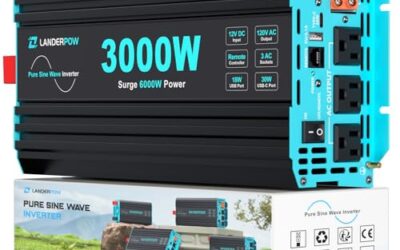
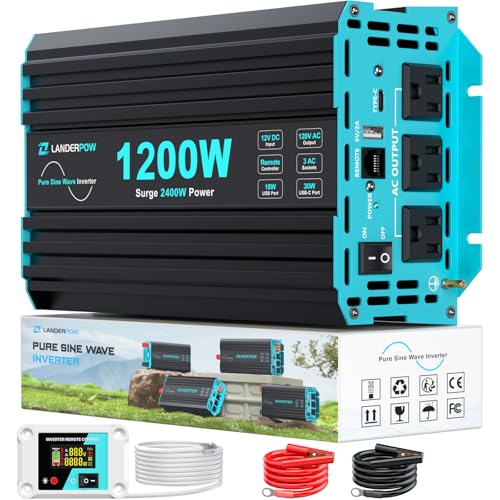
LANDERPOW 1200 Watt Pure Sine Wave Inverter represents strongest choice for most drivers seeking clean vehicle electricity under $150. Unit delivers 1200W continuous pure sine power, 2400W peak surge capability, dedicated 30W USB-C PD charging, and wired remote monitor at $98.99 manufacturer price. Clean waveform prevents operational damage to sensitive electronics while included 7AWG battery cables connect directly to standard 12V vehicle posts.

Pros
- Pure sine wave output is suitable for sensitive equipment such as televisions and home theater systems
- Multiple safety protections include undervoltage, overvoltage, overload, over-temperature, short-circuit, and reverse-connection protection
- LCD display provides real-time operating information
Specifications
| Size | 1000W |
|---|---|
| Dimensions | 11 x 6.36 x 3.49 inches |
| Weight | 4.37 pounds |
| Product Group | Lawn & Patio |
| Binding | Electronics |
Best For / Avoid If
Best for buyers prioritizing
- Pure sine wave output is suitable for sensitive equipment such as televisions and home theater systems
- Multiple safety protections include undervoltage, overvoltage, overload, over-temperature, short-circuit, and reverse-connection protection
- LCD display provides real-time operating information

Pros
- High stated continuous and surge power capacity
- Multiple AC and USB ports support charging several devices
- LCD display provides operating information and abnormal-state codes
- Includes a 12-month warranty and multiple listed protection functions
Cons
- Uses modified sine wave output rather than pure sine wave output
- The remote control requires a separate 12V 23A battery, which is not included
Specifications
| Color | Red |
|---|---|
| Size | 3000W-12V |
| Dimensions | 14.17 x 6.3 x 3.94 Inches |
| Weight | 5.732018812 pounds |
| Product Group | Electronics |
Best For / Avoid If
Best for buyers prioritizing
- High stated continuous and surge power capacity
- Multiple AC and USB ports support charging several devices
- LCD display provides operating information and abnormal-state codes
Consider another option if
- Uses modified sine wave output rather than pure sine wave output
- The remote control requires a separate 12V 23A battery, which is not included
Pros
- Pure sine wave output is listed for sensitive electronics and inductive or capacitive loads
- Multiple AC and USB charging connections support varied devices
- Remote control can be used from a truck cab, RV, campsite, or job site
- The listing includes several electrical and thermal protection features
Cons
- Requires a 12V DC power source
Specifications
| Color | Black+Blue |
|---|---|
| Size | 12V-1200W Pure Sine Wave Inverter |
| Dimensions | 8.54 x 5.75 x 3.15 inches |
| Weight | 3.63 pounds |
| Product Group | Automotive Parts and Accessories |
| Binding | Electronics |
Best For / Avoid If
Best for buyers prioritizing
- Pure sine wave output is listed for sensitive electronics and inductive or capacitive loads
- Multiple AC and USB charging connections support varied devices
- Remote control can be used from a truck cab, RV, campsite, or job site
Consider another option if
- Requires a 12V DC power source
CarTechTalk earns affiliate commissions through qualifying retail purchases. Pricing reflects manufacturer baseline data and fluctuates based on retail channel availability.
Electrical Limitations of Vehicle Inverters Under $150
Power inverters convert direct current (DC) from vehicle batteries into alternating current (AC) for household gear. Budget hardware operating below $150 ceiling imposes hard physical constraints. Vehicle 12V auxiliary sockets, formerly known as cigarette lighter receptacles, carry strict fuse limits. Most automotive accessory ports utilize 10A or 15A fuses. Basic electrical formula defines operational boundary: Volts multiplied by Amps equals Watts. Standard 12V circuit with 15A fuse delivers maximum theoretical power of 180W. Real-world continuous load must stay below 150W to avoid blowing internal vehicle fuses.
All three options reviewed here exceed 1000W continuous capacity. High-output operation demands direct connection to vehicle battery terminals. Heavy copper cables must bridge battery lugs to inverter input studs. Stock alternators present second critical limitation. Standard passenger car alternators produce between 90A and 140A total output. Engine idle drops alternator output by 30 to 50 percent. Running 1000W continuous inverter load draws roughly 95A to 110A DC from 12V electrical system after accounting for inverter conversion inefficiency. Drawing 1000W continuously at engine idle drains battery faster than alternator replaces charge. Running 3000W load draws over 275A DC, which quickly overwhelms stock alternator charging systems.
Pure Sine Wave vs Modified Sine Wave Technology
Waveform architecture separates sensitive electronics hardware from rough utility tools. Utility grid supplies smooth sinusoidal AC electricity. Inverters replicate utility AC using distinct circuit topologies.
Pure sine wave inverters generate smooth, continuous electromagnetic curves. Voltage alternates polarity without abrupt electrical shifts. LANDERPOW 1200 Watt Pure Sine Wave Inverter and BELTTT 1000Watt Pure Sine Wave Inverter 12V DC produce pure sine waveforms. Clean signal matches commercial grid power. Sensitive electronics require pure sine electricity. Medical equipment, CPAP machines, modern laptop chargers, variable-speed electric motors, audio amplifiers, and power tool lithium battery chargers run cooler and quieter on pure sine output. Inductive loads operate without harmonic hum or premature overheating.
Modified sine wave inverters switch direct current abruptly between positive, zero, and negative voltage stages. Output waveform resembles stair-step block pattern rather than smooth curve. Cantonape 3000W Power Inverter 12V to 110V/120V DC utilizes modified sine wave design. Stepped waveform introduces total harmonic distortion into connected loads. Resistive devices like incandescent work lights, simple heating elements, space heaters, and basic brush-type motor tools tolerate modified sine wave signals. Connecting complex electronics introduces operational problems. Audio systems develop background buzz. Laptop power bricks run hot. Variable-speed power tools suffer torque loss. Digital clocks lose timing accuracy. Selecting modified sine wave units saves purchase cost while trading appliance compatibility.
Inverter Specifications and Feature Comparison
Manufacturer technical specifications establish direct performance metrics across reviewed budget inverters. Comparison below balances continuous output, peak surge capacity, waveform class, and included hardware.
| Product Name | Continuous Power | Surge Power | Waveform | Input Voltage | AC Outlets | Stated Efficiency |
|---|---|---|---|---|---|---|
| LANDERPOW 1200 Watt Pure Sine Wave Inverter | 1200W | 2400W | Pure Sine Wave | 12V DC | 3 | >91% |
| BELTTT 1000Watt Pure Sine Wave Inverter 12V DC | 1000W | 2000W | Pure Sine Wave | 12V DC | 2 | >90% |
| Cantonape 3000W Power Inverter 12V to 110V/120V DC | 3000W | 6000W | Modified Sine Wave | 12V DC | 4 | >90% |
Detailed Product Breakdown
LANDERPOW 1200 Watt Pure Sine Wave Inverter: Clean Power Value
LANDERPOW 1200 Watt Pure Sine Wave Inverter targets users running sensitive mobile electronics during road travel or vehicle camping. Unit delivers 1200W continuous pure sine wave power alongside 2400W peak surge rating. Stated efficiency exceeds 91 percent, minimizing parasitic DC draw on starting batteries.
Port selection prioritizes modern devices. Chassis houses three 110V/120V AC outlets, one 30W Power Delivery (PD) USB-C port, and one standard 5V/3.1A USB port. Dedicated 30W USB-C port charges modern tablets, phones, and compact laptops directly without using bulky AC wall adapters. Included 15ft wired remote controller features integrated LED display screen, allowing real-time monitoring of DC battery voltage, load wattage, and error faults from vehicle cab or sleeping platform. Hardware bundle includes two 7AWG 2-foot battery jumper cables and rugged metal enclosure designed to withstand mobile vibration. Manufacturer documents undervoltage, overvoltage, overload, overheating, short circuit, and reverse polarity protections. Warranty package includes 1-year replacement coverage paired with 2-year extended support.
Concrete drawback involves included battery cabling. Manufacturer supplies 7AWG cables measuring only two feet in length. Short length severely restricts mounting placement inside engine bays or trunk battery wells, requiring custom wiring extensions for remote cabin placement. Avoid if system setup requires inverter location beyond two feet from battery posts without fabricating thicker gauge replacement wire.
BELTTT 1000Watt Pure Sine Wave Inverter 12V DC: Tunable Display Option
BELTTT 1000Watt Pure Sine Wave Inverter 12V DC suits off-grid utility setups, vehicle fieldwork, and solar power integration where fine voltage monitoring proves critical. Manufacturer lists 1000W continuous output, 2000W surge threshold, and operational efficiency exceeding 90 percent with low idle consumption.
Control interface features high-brightness intelligent LCD display showing real-time input voltage, output voltage, battery reserves, and load wattage. Manufacturer states output voltage and screen parameters can be adjusted independently within small calibration range for specialized equipment. Chassis integrates two AC outlets and single 5V/2.1A USB port. Enclosure utilizes hybrid construction combining aluminum heatsink sections with hardened plastic framing. Included accessories contain 3-foot heavy-duty battery cables and installation tools. Safety circuitry includes undervoltage shutdown, overvoltage cutoff, thermal protection, overload trip, short circuit protection, and reverse connection protection.
Primary drawback centers on connectivity limitations. Unit provides only two AC sockets and single slow 2.1A USB port, omitting modern high-speed USB-C fast charging. Hybrid plastic-and-aluminum casing also lacks structural rigidity found in all-metal enclosures. Avoid if installation demands powering more than two AC appliances simultaneously or fast-charging mobile phones without separate AC charging bricks.
Cantonape 3000W Power Inverter 12V to 110V/120V DC: High Output Workhorse
Cantonape 3000W Power Inverter 12V to 110V/120V DC addresses heavy-draw utility demands where maximum raw wattage supersedes waveform purity. Unit generates 3000W continuous power and 6000W surge capacity at $125.99 retail price. Stated conversion efficiency tops 90 percent.
Hardware layout maximizes power distribution. Chassis provides four 110V/120V AC outlets and four USB ports, accommodating eight devices simultaneously. Housing features aluminum shell with built-in temperature-controlled cooling fan and isolated ground-neutral circuit design. Integrated LCD display reports input voltage, output voltage, battery level, load percentage, and electrical frequency. Built-in diagnostics display clear numeric error codes: E-1 indicates low voltage, E-2 flags high voltage, E-3 signals over-temperature, E-4 warns of overload, E-5 identifies short circuit, and E-6 indicates repeated fault shutdown requiring restart. Unit includes wireless remote switch for remote on/off control alongside 12-month manufacturer warranty.
Major drawback involves modified sine wave architecture and extreme current draw. Modified sine waveform produces electrical buzzing across sensitive audio equipment, laptops, and medical devices. Furthermore, drawing 3000W continuous requires pulling over 250A DC through 12V cabling, which will instantly overload standard car alternators and single lead-acid starting batteries. Remote control also ships without required 12V 23A battery. Avoid if vehicle electrical system relies on stock alternator, single starting battery, or runs sensitive electronics.
Safety Warnings and Cable Gauge Requirements
High-current DC circuits present significant fire, arc flash, and chemical battery hazards. Vehicle batteries store immense chemical energy capable of welding tools and melting copper wire instantly when short-circuited.
WARNING: Never connect a high-wattage inverter to lead-acid batteries without an inline fuse or DC circuit breaker placed on the positive battery cable within 12 to 18 inches of the terminal. In the event of a chassis pinch or insulation failure, an unfused cable will glow red hot, melt surrounding vehicle harnesses, and cause an immediate vehicle fire.
Calculate minimum continuous direct current demand using standard electrical formulas. Divide continuous target wattage by nominal system voltage, then divide result by efficiency percentage. A 1000W load on 12V system operating at 90 percent efficiency draws roughly 92.6A DC. A 1200W load draws approximately 111.1A DC. A 3000W load draws 277.7A DC. Wire gauge sizes must match calculated amperage to prevent resistance-induced heat buildup and severe voltage drop:
- Up to 100A DC draw (1000W range, under 3 feet): Minimum 4AWG copper wire.
- Up to 120A DC draw (1200W range, under 3 feet): Minimum 2AWG or dual 7AWG copper wire.
- Up to 300A DC draw (3000W range, under 3 feet): Minimum 1/0AWG or 2/0AWG pure copper wire.
Lead-acid batteries emit flammable hydrogen gas during charging cycles. Mount inverters in well-ventilated passenger or cargo compartments completely isolated from unvented battery compartments to eliminate ignition risks from internal inverter relay switching sparks.
Step-by-Step Installation Protocol for High-Wattage Inverters
Follow this exact installation sequence to safely connect a high-wattage inverter directly to your vehicle battery system without damaging vehicle control modules or electrical components:
- Shut off vehicle engine completely, remove ignition keys, and set parking brake. Ensure inverter power rocker switch rests firmly in OFF position.
- Select rigid, dry mounting location providing at least 6 inches of open clearance around internal cooling fan vents. Keep mounting surface free from vehicle carpet or thermal insulation.
- Disconnect negative (black) vehicle battery terminal clamp from battery post to eliminate chassis grounding pathways during assembly.
- Install appropriately rated inline ANL fuse holder or manual reset DC circuit breaker onto positive (red) cable within 12 inches of battery post. Do not insert active fuse element yet.
- Bolt red positive cable firmly between inverter positive DC terminal stud and fused terminal lead using provided lock washers. Tighten firmly to prevent high-resistance contact points.
- Bolt black negative cable firmly between inverter negative DC terminal stud and primary chassis ground lug or negative battery post.
- Insert correct amperage fuse into inline fuse holder, or switch manual DC breaker to CLOSED position. Small initial capacitive spark during connection is normal.
- Reconnect negative vehicle battery terminal clamp to battery post and torque factory clamp securely.
- Turn inverter power switch ON to inspect LCD screen readout. Confirm input DC voltage registers between 12.4V and 12.8V on healthy resting battery before connecting AC appliances.
Who Should Skip Sub-$150 Car Inverters
Budget 12V inverters under $150 solve basic roadside utility needs but fail specific heavy-duty ownership scenarios. Buyers operating complete RV electrical systems, full-time overland rigs, or mobile trade trailers should skip this entire price bracket. Budget inverters omit automatic transfer switches (ATS) required to seamlessly transition between shore power and battery power without manual cord swapping.
Users operating high-draw heating appliances such as commercial induction cooktops, full-size domestic microwaves, rooftop air conditioners, or commercial shop compressors require 2000W to 3000W pure sine wave capacity paired with 24V or 48V battery architectures. Running high wattage over 12V architecture generates excessive current heat and demands massive copper wiring. Drivers needing continuous power without running vehicle engines should invest in dedicated portable power stations with built-in lithium iron phosphate (LiFePO4) batteries or complete secondary battery banks featuring dedicated DC-to-DC chargers.
Final Decision Framework
Select inverter hardware based directly on intended appliances and electrical supply capacity. LANDERPOW 1200 Watt Pure Sine Wave Inverter provides optimal balance of clean waveform purity, multi-port USB-C PD flexibility, and real-time remote monitoring for general automotive travel under $100. BELTTT 1000Watt Pure Sine Wave Inverter 12V DC delivers reliable pure sine wave output with fine display monitoring for users operating off-grid solar or workshop benches needing precise voltage tracking. Cantonape 3000W Power Inverter 12V to 110V/120V DC delivers maximum raw wattage for rough contractor tools, job sites, and simple heating loads, provided vehicle features secondary battery capacity to handle massive 250A+ direct current demands.