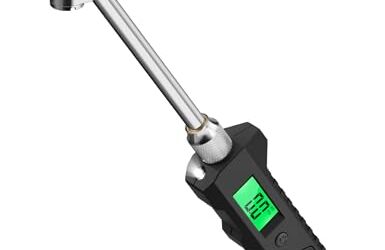
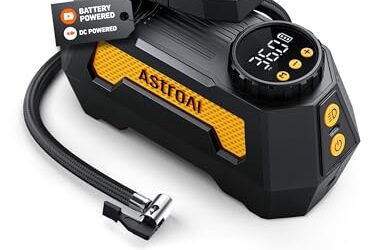
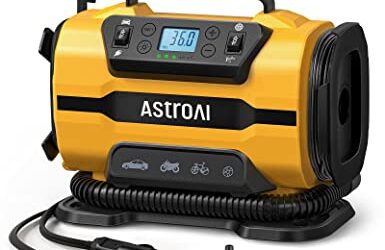
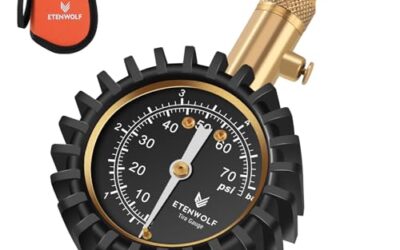
The best tire inflator for cold weather in this lineup is AstroAI Tire Pressure Gauge with Inflator because its analog gauge needs no batteries, reads up to 230 PSI, and combines pressure checking, deflation, and inflation in one tool. Its large dial and flexible hose suit drivers who want a simple winter pressure tool for cars, SUVs, trucks, motorcycles, and RVs.

Pros
- Battery-free analog gauge eliminates power failure issues
- Stated ±2% calibration accuracy across 230 PSI range
- 360-degree rotatable dial and chuck ease valve access
- Heavy-duty brass and stainless steel hardware
Cons
- Requires external air compressor for tire inflation
AstroAI Tire Pressure Gauge with Inflator handles inflation, deflation, and pressure checks up to 230 PSI without batteries.
- Accuracy: Manufacturer calibrated to ±2%
- Dial Size: 3.15 inches, 360-degree rotation
- Hose Length: 18.5 inches
- Hardware: Brass air chuck, stainless steel trigger
- Dimensions: 13.4 x 7.2 x 2.2 inches
- Weight: 1.79 pounds
- Vehicle Compatibility: Trucks, SUVs, cars, motorcycles, bicycles, RVs
Specifications
| Size | 230PSI |
|---|---|
| Dimensions | 13.4 x 7.2 x 2.2 inches |
| Weight | 1.79 pounds |
| Product Group | Automotive Parts and Accessories |
Detailed Review
Key features:
- Measures pressure up to 230 PSI with rated ±2% accuracy
- Analog 3.15-inch rotating dial needs no batteries
- Performs inflation, deflation, tire pressure checks
- Brass locking chuck stops leaks at valve stems
- Stainless steel trigger provides durable air flow control
- Flexible 18.5-inch rubber hose withstands high pressure
Best For / Avoid If
Best for buyers prioritizing
- Battery-free analog gauge eliminates power failure issues
- Stated ±2% calibration accuracy across 230 PSI range
- 360-degree rotatable dial and chuck ease valve access
Consider another option if
- Requires external air compressor for tire inflation
Why Cold Weather Changes Tire Pressure Decisions
Cold air lowers tire pressure. The tire itself does not need a puncture for the pressure reading to drop after temperatures fall. A driver may see a warning light or notice a lower gauge reading even though the tire held air normally through warmer weather.
That makes a dependable pressure gauge more useful in winter. The tool must let you check pressure before driving, add air when needed, and avoid adding too much air during a rushed roadside adjustment. A gauge that works without batteries also removes one common failure point during freezing conditions.
Pressure should be checked with tires cold, meaning before driving or after the vehicle has sat long enough for the tires to cool. Driving creates heat and raises the reading. The correct target comes from the vehicle placard or owner manual, not the maximum pressure molded into the tire sidewall.
Cold weather does not create a special tire pressure number. It creates a stronger reason to check pressure often and adjust it to the vehicle maker’s target. A tire inflator helps with the adjustment, but it cannot replace a properly functioning tire pressure monitoring system or inspection for leaks, damage, and tread problems.
AstroAI Tire Pressure Gauge with Inflator
Best for: Drivers who want a battery free analog gauge and manual inflation tool for winter pressure checks across several vehicle types.
AstroAI lists a 230 PSI maximum reading, which gives this gauge a broad display range for passenger vehicles, SUVs, trucks, motorcycles, RVs, and construction vehicles. That number describes the gauge’s scale, not a safe pressure target for every tire. Use the vehicle placard or owner manual for the correct setting.
The 3.15 inch dial gives the driver a larger analog display to read beside the tire. No batteries are required, so cold storage or a drained battery does not stop the gauge from displaying pressure. That matters for a tool kept in a vehicle during winter, although the tool still needs suitable storage and careful handling.
The manufacturer lists accuracy within plus or minus 2 percent of exact tire pressure. This is a manufacturer claim, not an independent CarTechTalk measurement. It gives the product a useful specification for routine pressure checks, but drivers should still use the same gauge consistently when setting all four tires. Switching between gauges can create different readings.
A brass air chuck locks onto the valve stem, while the 18.5 inch rubber hose gives some reach between the tire and gauge body. The listing also identifies a stainless steel inflation trigger. Together, these parts let the user connect, read, add air, and release excess air without changing tools.
The package includes accessories for inflating balls, air pillows, cushions, balloons, and mattresses. Those attachments expand household use, but they do not turn the gauge into a powered compressor. Air must come from an air source that connects to the chuck.
Skip it if: You need an electric inflator that creates air without a separate compressor or air supply. This product is an analog pressure gauge with an inflator function, not a documented battery powered or vehicle powered compressor.
Another drawback is the analog display. Drivers who prefer a digital number may find a dial slower to read, especially in poor light or while wearing gloves. The listing supports a large dial, but it does not establish a built in light, automatic shutoff, preset pressure control, or digital display.
Affiliate disclosure: CarTechTalk may earn a commission from qualifying purchases made through product links. That does not change product selection or the conditions described here.
What Makes This Tool Useful in Winter
No battery dependence
The absence of batteries is the clearest cold weather advantage. Battery powered gauges and compressors can become inconvenient when a battery is depleted or stored in low temperatures. AstroAI’s analog gauge uses a mechanical display, so the pressure reading does not depend on a battery charge.
This does not mean the tool works in every condition without limits. A frozen valve, damaged hose, blocked chuck, or unavailable air source can still prevent inflation. The no battery design solves one storage and readiness issue, not every roadside problem.
One tool for checking and adjusting
Cold weather often calls for small pressure corrections rather than a complete tire service. The gauge can show the current pressure, the trigger can add air from a connected source, and the deflation function can lower pressure if the tire receives too much air.
That combined workflow reduces tool changes. It also gives the driver control during adjustment. Add air in short bursts, pause, and read the gauge again. Pressure can shift as air moves through the hose, so a final reading should come from the tire after the tool settles.
Broad vehicle coverage
The listed vehicle range includes cars, motorcycles, SUVs, trucks, RVs, and construction vehicles. That makes the tool more useful for a household with more than one vehicle type or for a driver who maintains trailers and recreational equipment.
Compatibility with a valve stem does not prove that every included accessory fits every tire or air source. Large commercial tires may require different service equipment, and high pressure does not mean the tool can inflate them on its own. The product’s 230 PSI dial range should not be confused with compressor capacity or inflation speed.
Cold Weather Buying Criteria That Matter
Pressure reading method
Analog and digital gauges can both support winter maintenance. Analog models avoid batteries and may stay ready in a vehicle. Digital models can be easier for drivers who prefer a precise number, but their usefulness depends on power and display operation.
For this product, the large dial and battery free design are the strongest fit for cold weather. The tradeoff is a less automated experience. The driver must read the dial, control the air source, and stop inflation manually.
Air source
This distinction matters more than the pressure scale. A tire gauge measures pressure. An inflator with a trigger controls air entering or leaving the tire. Neither function proves that the product contains an electric pump.
AstroAI’s listing describes a compressor accessory and an air chuck, but it does not identify a motor, battery, 12 volt plug, wall plug, airflow rating, or inflation time. Buyers seeking a complete roadside compressor should choose a product with a documented power source and pump specification instead.
Chuck and hose reach
A locking chuck can reduce air loss at the valve stem while the reading is taken. The 18.5 inch hose gives working space around the tire, which can help when the valve sits behind a wheel spoke or near the ground.
Hose length remains a practical compromise. A short hose keeps storage easy but may force awkward positioning. This model provides a stated hose length, yet the listing does not establish reach for dual wheels, deep wheel covers, or unusual valve extensions.
Pressure target and tire condition
The tool cannot identify the correct pressure for a particular vehicle. Find that number on the driver’s door jamb placard, fuel door label, or owner manual. Front and rear tires may use different settings, and a loaded vehicle may have a separate recommendation.
Inspect each tire before adding air. Look for nails, sidewall cuts, bulges, uneven wear, and a valve stem that leaks. Repeated pressure loss points to a repair issue, not a need to keep adding air. A damaged tire should receive professional attention before normal driving.
How to Use an Analog Inflator in Freezing Conditions
- Park safely and let tires cool before taking final readings.
- Find the correct vehicle pressure on the door placard or in the owner manual.
- Remove the valve cap and attach the brass chuck firmly to the valve stem.
- Read the dial without placing your face or hands near a damaged tire.
- Add air in short bursts through the inflation trigger.
- Pause after each burst and read pressure again.
- Release small amounts through the deflation function if pressure exceeds the vehicle target.
- Replace the valve cap and repeat the check on every tire, including the spare when accessible.
Cold conditions make gloves useful, but bulky gloves can make chuck placement less precise. Keep the valve stem clean and avoid forcing the chuck at an angle. Moisture that freezes around the valve can also interfere with connection, so wipe away snow and ice before attaching the tool.
For more detailed steps, see how to use a tire inflator and how to inflate car tires at home. Those instructions pair well with this tool because the product relies on a separate air source.
AstroAI Versus a Powered Portable Compressor
| Feature | AstroAI Tire Pressure Gauge with Inflator |
|---|---|
| Display | 3.15 inch analog dial |
| Pressure scale | Up to 230 PSI |
| Power requirement | No batteries required |
| Hose | 18.5 inch rubber hose |
| Vehicle applications | Cars, motorcycles, SUVs, trucks, RVs, and construction vehicles |
| Functions | Pressure checking, inflation, and deflation |
A powered compressor remains the better choice for a driver who needs air without access to a shop compressor, tank, or other air supply. Look for a stated power source, connector type, hose length, duty cycle, and automatic pressure control. Those details determine whether a unit suits a garage, a 12 volt vehicle outlet, or roadside use.
AstroAI fits a different ownership plan. It works as a pressure gauge and controlled air tool for someone who already has compressed air available. Its simple design may also appeal to a driver who wants no charging routine and no digital display to maintain.
Who Should Buy This Tire Inflator
Buy AstroAI Tire Pressure Gauge with Inflator if winter maintenance means checking pressure regularly, making small adjustments, and using an existing air source. It fits drivers who value a large dial, a battery free design, a locking brass chuck, and coverage across several vehicle categories.
It also suits a home garage where a compressor is already available. The inflation trigger and deflation function can make pressure adjustment more controlled than carrying a separate gauge and valve tool.
Skip this guide’s product if you want a self-contained electric pump, a digital readout, an illuminated display, automatic shutoff, or documented 12 volt operation. Choose a portable compressor with those specifications instead. Drivers who need commercial tire service should also seek equipment rated and equipped for that work rather than relying on a general purpose gauge.
Final Verdict
AstroAI Tire Pressure Gauge with Inflator is the strongest cold weather choice here for simple, battery free tire pressure maintenance. Its 230 PSI scale, large analog dial, locking brass chuck, 18.5 inch hose, and inflation and deflation functions cover the core tasks of winter pressure checks.
The recommendation depends on having an air source. This is not a complete powered compressor, and its analog display will not suit every driver. Choose it for mechanical simplicity and controlled pressure adjustments. Choose a powered inflator instead when roadside independence matters more than battery free operation.
For another pressure tool topic, read the guide to tire inflators for high pressure tires. Use the vehicle maker’s pressure target, check tires cold, and treat repeated air loss as a service issue rather than a routine top up.