Why some obd2 live data is unavailable usually comes down to vehicle support, ECU access, communication protocol, or scan-tool limits. A missing PID does not automatically mean the car has a fault, and clearing trouble codes will not repair any fault.
- ECUs publish only data they support and choose to expose.
- Generic OBD2 access differs from manufacturer-specific diagnostics.
- Missing data can result from a wrong vehicle profile, weak connection, low voltage, or outdated software.
- Model year, engine, transmission, region, phone OS, firmware, and connector wiring can change results.
- Compare requested data with another supported function before replacing parts.
OBD2 live data consists of values that an electronic control unit sends while a scan tool communicates with it. Common examples include engine speed, coolant temperature, calculated load, fuel trims, oxygen sensor readings, throttle position, and vehicle speed.
Each value has a parameter identifier, often called a PID. The scan tool asks whether a PID is supported, then requests its current value. The vehicle may answer with data, reject the request, return no value, or provide a value only under certain operating conditions.
Generic OBD2 rules cover emissions-related diagnostics. They do not require every vehicle system to expose every sensor value through the generic data set. Airbag, ABS, body, transmission, battery, and driver-assistance modules often need manufacturer-specific access.
Common causes of missing OBD2 live data
The vehicle does not support that PID
Scan tools often display a long list of possible parameters. This list can include items that apply to other engines, model years, fuel systems, or markets. A parameter appearing in the menu does not prove that your vehicle supports it.
For example, one vehicle may report commanded equivalence ratio while another reports oxygen sensor voltage. Both can use different sensor strategies. A diesel, hybrid, turbocharged engine, or direct-injection engine may expose different values from a similar gasoline model.
The scan tool uses generic OBD2 access
Generic OBD2 normally focuses on emissions data from the powertrain. It may show engine and transmission information while hiding body, chassis, restraint, or advanced driver-assistance data.
Manufacturer-specific software can use different requests, security access, and data definitions. A basic scanner may connect successfully but still lack access to ABS wheel-speed data, airbag status, battery management values, injector corrections, or transmission temperatures.
See OBD2 scanners for advanced use for a broader explanation of system coverage and vehicle matching.
The ECU is not fitted or awake
Some data belongs to an ECU that your vehicle does not have. Other modules sleep until the ignition is on, the engine runs, a network message wakes them, or a test condition occurs.
A hybrid may keep its gasoline engine off while the vehicle still powers other systems. A transmission value may appear only after the module reaches operating temperature. An evaporative-emissions value may remain unavailable until the vehicle completes a specific drive condition.
The scan tool selected the wrong vehicle profile
Automatic identification can choose the wrong engine, region, or communication path. Manual selection can also fail when several engines share one model year.
Check the VIN, engine size, fuel type, transmission, and model year shown by the app or scanner. A North American vehicle can use different coding from a similar vehicle sold in Europe or Asia. Region affects emissions equipment, PID support, and module access.
Communication protocol or connector limits access
The 16-pin J1962 connector does not mean every pin carries the same signal on every vehicle. OBD2 communication can use different network protocols, including CAN and older protocols. Some vehicles need specific pins, gateway access, or ignition status.
An adapter may connect to the engine ECU but fail to reach other modules. A damaged connector pin, poor ground, aftermarket wiring, or a loose plug can produce partial access rather than a total connection failure.
Low vehicle voltage interrupts data
Weak battery voltage can cause modules to reset, refuse requests, or drop communication. This often appears during key-on testing, long diagnostic sessions, or repeated engine cranking.
Connect a suitable battery support device when the service information calls for stable voltage. Use equipment approved for diagnostic support. Do not connect a charger or power supply in a way that can exceed vehicle limits or damage electronics.
App, firmware, or phone compatibility limits the display
Bluetooth and Wi-Fi adapters depend on phone hardware, operating-system permissions, and app support. Android and iPhone devices can use different Bluetooth functions. Some adapters use Bluetooth Classic, while many iPhones require a compatible Bluetooth Low Energy or Wi-Fi connection.
Outdated adapter firmware can mishandle newer requests. An app may show a PID name but fail to decode its value. A phone may also block location, Bluetooth, local-network, or background permissions needed by the adapter.
Update the scanner firmware and app only through the maker’s supported process. Check phone OS requirements before treating a missing value as a vehicle fault.
Live data that commonly causes confusion
| Data item | Why it may be missing | What it means |
|---|---|---|
| Fuel trim | Engine not running, sensor strategy differs, or value belongs to another bank | Missing display does not prove a fuel-system failure |
| Oxygen sensor data | Sensor type, engine design, and PID support vary | Voltage, current, and equivalence-ratio data are not interchangeable |
| Transmission temperature | Generic access may exclude the transmission ECU | A powertrain scanner may need enhanced transmission coverage |
| ABS wheel speed | Data belongs to the ABS module, not always the engine ECU | Generic engine OBD2 may not reach it |
| Battery state of charge | Battery management module uses manufacturer-specific data | Charging voltage is not the same as state of charge |
| Readiness monitors | Monitor has not run or was reset after code clearing | Incomplete status can affect emissions inspection results |
How to diagnose missing live data
- Record the exact missing item. Write down the PID name, ECU menu, vehicle profile, ignition state, and engine condition. Similar names can describe different values.
- Check operating conditions. Turn the ignition on as required. Start the engine when the value needs engine speed, exhaust heat, or charging activity. Do not touch moving belts, fans, or hot exhaust parts.
- Confirm vehicle details. Select the correct model year, engine, fuel type, transmission, and region. Compare automatic VIN detection with manual selection.
- Test basic communication. Read diagnostic trouble codes, vehicle information, and a few common values such as engine speed or coolant temperature. If all data fails, inspect power, ground, connector fit, and adapter pairing.
- Check support information. Look for PID support, enhanced diagnostics, module coverage, and required software level. Generic OBD2 coverage cannot replace full manufacturer access.
- Update software carefully. Update the app, adapter firmware, and scanner software using stable power and the approved process. Do not interrupt a module programming session.
- Compare another data path. Use a second compatible scanner or a manufacturer-level tool when available. A different result helps separate tool limits from vehicle or wiring faults.
- Test related values. Compare coolant temperature with intake-air temperature after a cold soak. Compare engine speed with crankshaft position data if both are available. Related values can reveal whether one missing PID reflects a display limit or a wider communication issue.
A practical decision tree
- One PID missing, other values work: The vehicle may not support that PID, or the tool may lack its decoder.
- One ECU missing: Check module coverage, ignition state, connector wiring, gateway access, and vehicle voltage.
- All live data missing: Check pairing, app permissions, adapter power, connector pins, protocol selection, and battery voltage.
- Data appears but looks wrong: Check units, scaling, engine temperature, sensor type, and vehicle profile before replacing parts.
- Data disappears during cranking: Check battery condition and voltage stability. A voltage drop can interrupt module communication.
Generic OBD2 versus enhanced diagnostics
Generic OBD2 is useful for emissions-related engine information and standard trouble codes. It can answer basic questions such as whether the engine reports a fault, whether a monitor completed, or how selected powertrain values change.
Enhanced diagnostics add manufacturer-specific commands and module access. Depending on vehicle and tool, this can include ABS, airbag, body, transmission, battery, service resets, actuator tests, and coding. Coverage can still vary by model year and region.
A scanner can advertise enhanced functions without supporting every function on every vehicle. Read the coverage list by exact vehicle, system, and operation. A reset function may work while live data or bidirectional testing does not.
For fuel-trim interpretation, use this OBD2 live-data guide for fuel trim. For deeper system access, see the professional car diagnostic tool guide.
Common mistakes
- Assuming every listed PID belongs to every vehicle.
- Treating a generic scanner as an airbag or ABS scan tool.
- Reading fuel trims before the engine reaches normal operating conditions.
- Comparing sensor voltage from one vehicle with sensor current from another.
- Ignoring measurement units or app scaling.
- Clearing codes before recording freeze-frame data and monitor status.
- Replacing a sensor because its data is absent from one app.
- Updating firmware with unstable vehicle or phone power.
- Using a cheap adapter with unknown software behavior for safety-system diagnosis.
When to get professional help
Use professional diagnosis when multiple modules fail to communicate, the vehicle has network faults, or safety systems show warnings. Airbag, ABS, steering, high-voltage hybrid, and electric-vehicle systems can require controlled procedures and special safety equipment.
Stop testing if wiring is hot, damaged, wet, or modified near restraint or high-voltage components. Do not probe unknown connector pins. Follow the vehicle service manual for test points, voltage limits, and isolation procedures.
Professional help also makes sense when live data conflicts with symptoms. A technician can compare scan data with wiring tests, lab-scope signals, pressure readings, and module communication. Live data alone cannot prove that a sensor, wire, or ECU has failed.
Gear that can help
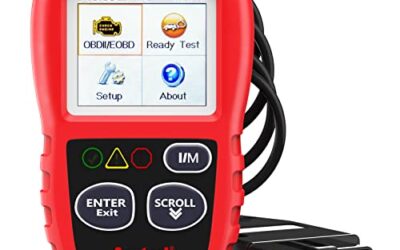
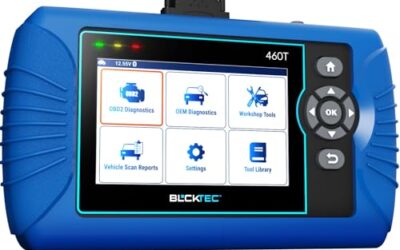
If you need OBD2 scanners for this job, these picks already appear in our OBD2 scanners guides. Check the full guide for fit and who should skip each one.
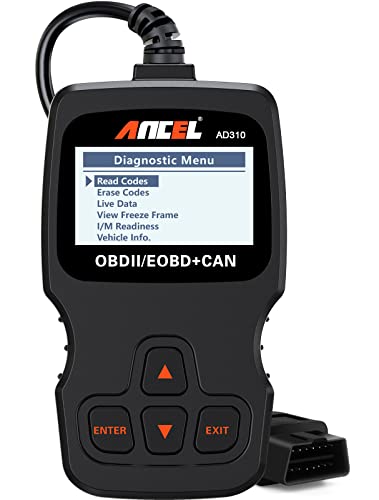
Pros
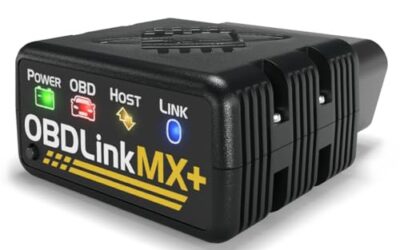
- Supports multiple common OBDII protocols, including CAN
- Provides more than basic code reading with live data, freeze-frame, and readiness information
- Powered through the vehicle, so no separate battery or charger is required
- Compact design and 12-ounce weight support portability
Cons
- Limited to emission-related diagnostics
- Requires a vehicle with an OBDII interface and does not diagnose OBDI vehicles, even with an adapter
- Vehicle compatibility should be confirmed before purchase
Specifications
| Color | Black |
|---|---|
| Dimensions | 4.9212598375 x 2.755905509 x 0.8661417314 inches |
| Product Group | Automotive Parts and Accessories |
| Binding | Automotive |
Best For / Avoid If
Best for buyers prioritizing
- Supports multiple common OBDII protocols, including CAN
- Provides more than basic code reading with live data, freeze-frame, and readiness information
- Powered through the vehicle, so no separate battery or charger is required
Consider another option if
- Limited to emission-related diagnostics
- Requires a vehicle with an OBDII interface and does not diagnose OBDI vehicles, even with an adapter
- Vehicle compatibility should be confirmed before purchase

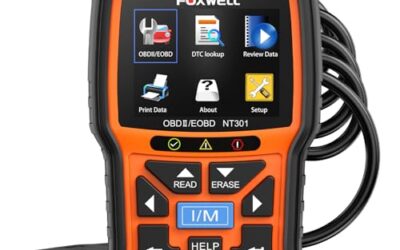
Pros
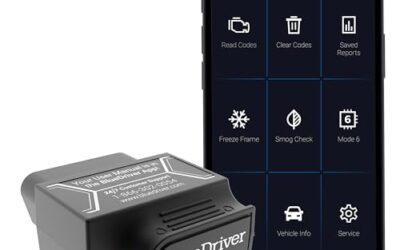
- Includes live-data graphing and logging for supported OBD2 vehicles
- Offers emissions-readiness, O-2 sensor, and EVAP monitoring functions
- Supports common OBD2 protocols and many 1996-plus US gasoline vehicles
- Does not require a separate charging setup
Cons
- Does not scan ABS, SRS, EPB, A/C, battery, or other non-engine systems
- Compatibility and available functions vary by vehicle year, make, model, and VIN
Specifications
| Color | NT301 OBD2 Scanner |
|---|---|
| Size | NT301 Code Reader |
| Dimensions | 8.66 x 3.15 x 6.69 inches |
| Weight | 0.3527396192 Pounds |
| Product Group | Automotive Parts and Accessories |
| Binding | Automotive |
Best For / Avoid If
Best for buyers prioritizing
- Includes live-data graphing and logging for supported OBD2 vehicles
- Offers emissions-readiness, O-2 sensor, and EVAP monitoring functions
- Supports common OBD2 protocols and many 1996-plus US gasoline vehicles
Consider another option if
- Does not scan ABS, SRS, EPB, A/C, battery, or other non-engine systems
- Compatibility and available functions vary by vehicle year, make, model, and VIN

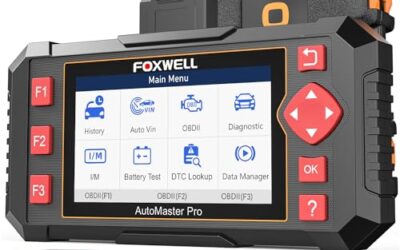
Pros
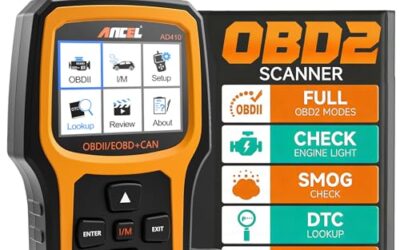
- Broad basic OBD2 diagnostic function set
- Built-in code definitions can help explain fault codes
- Supports major protocols including CAN, ISO9141, KWP2000, J1850 VPW and J1850 PWM
- Color display, multilingual support and on-screen code definitions
Cons
- Limited to engine and emission-related codes
- Does not support ABS, SRS, transmission, bidirectional control or service reset functions
- Vehicle compatibility should be checked before purchase
Specifications
| Color | yellow |
|---|---|
| Dimensions | 9 x 6.3 x 1.6 inches |
| Weight | 0.66 Pounds |
| Product Group | Automotive Parts and Accessories |
| Binding | Automotive |
Best For / Avoid If
Best for buyers prioritizing
- Broad basic OBD2 diagnostic function set
- Built-in code definitions can help explain fault codes
- Supports major protocols including CAN, ISO9141, KWP2000, J1850 VPW and J1850 PWM
Consider another option if
- Limited to engine and emission-related codes
- Does not support ABS, SRS, transmission, bidirectional control or service reset functions
- Vehicle compatibility should be checked before purchase
FAQ
Does unavailable live data mean my sensor is bad?
No. The vehicle may not support that PID, the tool may lack access, or the value may require another operating condition. Test communication and related data before condemning the sensor.
Why can my scanner read engine codes but not ABS codes?
Engine codes often use generic OBD2 access. ABS codes usually require communication with the ABS module and manufacturer-specific coverage.
Can clearing codes bring live data back?
No. Clearing codes erases stored diagnostic information and can reset readiness monitors. It does not repair wiring, restore module communication, or add unsupported PIDs.
Why does live data work on one phone but not another?
Phone OS, Bluetooth type, Wi-Fi settings, app permissions, and adapter compatibility can change results. Confirm the adapter’s supported phone platforms and connection method.
What should I check first?
Check vehicle profile, ignition state, adapter connection, battery voltage, app permissions, and PID support. These checks are safer and faster than replacing parts.
Sources and further reading
- J1962 Diagnostic Connector standard (SAE International): Connector requirements and related diagnostic access details.
- J1979 E/E Diagnostic Test Modes standard (SAE International): Standard diagnostic modes and emissions-related data requests.