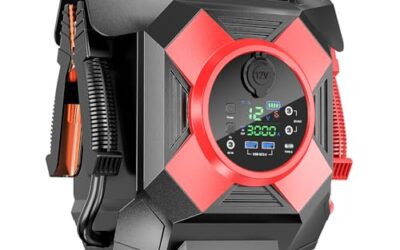
Why jump starter peak amps can be misleading: peak current shows a brief maximum, not the sustained power available at your vehicle’s battery terminals during a difficult start. A pack with a larger peak number may perform worse than another pack with lower advertised output if its battery, cables, temperature range, or protection system cannot support the load.
Peak amps still offer some information. They become useful only when read with starting current, operating temperature, battery voltage, cable design, and vehicle fitment. Treat the number as one specification, not a complete measure of jump-start capability.
Key takeaways
- Peak amps describe a short current burst, often under test conditions that differ from a real vehicle start.
- Starting amps or cranking current better describe sustained output, but labels do not always use these terms consistently.
- Cold weather reduces lithium battery output and weakens the vehicle battery at the same time.
- Engine size, diesel compression, battery condition, cable length, and clamp contact change the result.
- A 12-volt jump starter fits most passenger cars and light trucks, but voltage and vehicle design still matter.
- Electric vehicles usually do not use portable jump starters to start their traction battery. Their 12-volt system may need separate service procedures.
What peak amps mean on a jump starter
Peak amps indicate the highest current a jump starter may deliver for a very short period. The exact duration, voltage, temperature, battery state, and test load can vary by manufacturer. A peak figure therefore does not tell you how long the pack can maintain useful current.
An engine starter motor draws high current while turning the engine. The demand changes as the motor accelerates, engine oil resists movement, and cylinders build compression. The vehicle battery and booster must supply enough current while keeping voltage high enough for the starter, engine computer, fuel system, ignition, and relays.
A peak rating may capture an instant before voltage falls. That instant can look impressive on paper but may not represent the several seconds needed to crank a cold engine. A real starting event also includes resistance from clamps, cable connections, battery posts, and internal electronic switches.
Why jump starter peak amps can be misleading
Peak current lasts briefly
Peak output resembles a sprint. Starting an engine resembles a short effort that must continue while the starter motor works against compression and friction. A pack can reach a high current spike but lack the stored energy or thermal capacity needed for repeated cranking.
Manufacturers may use different test methods. One company may report a maximum electronic output. Another may measure current through a load for a defined period. Without a shared test condition, two peak numbers may not represent equal performance.
Voltage matters as much as current
Current alone cannot describe starting power. Electrical power depends on voltage and current. If voltage drops sharply under load, the starter receives less useful power even when a label shows a high peak-amp figure.
Voltage drop can also affect vehicle electronics. Some vehicles need stable voltage while modules wake up, unlock the steering system, control fuel delivery, or authorize ignition. A booster that produces a brief current surge but poor voltage stability may fail before the engine turns fast enough.
Cable and clamp resistance reduce output
Every connection adds resistance. Thin cables, long leads, corroded battery posts, loose clamps, and small clamp jaws waste voltage as heat. The current reaching the starter can be much lower than current measured inside the pack.
Clamp placement matters. Connect to clean, solid metal at the vehicle battery or the specified remote terminals. Painted brackets, dirty posts, and weak contact points can prevent a jump starter from delivering its rated output.
Temperature changes battery behavior
Cold temperatures slow chemical reactions inside both the vehicle battery and the jump starter. Engine oil also becomes thicker, increasing starter demand. A pack that works easily in mild weather may provide fewer attempts in freezing conditions.
Heat creates another limit. Repeated high-current starts can warm internal cells, cables, clamps, or protection circuits. The pack may reduce output or shut down until it cools. Look for an operating temperature range and storage guidance, especially for winter travel.
Vehicle battery condition changes the job
A mildly discharged battery may accept help from a portable booster. A battery with an internal short, severe sulfation, frozen electrolyte, or damaged terminals may not. A jump starter does not repair a failed battery.
Some packs require a minimum voltage before their automatic clamps activate. A deeply discharged battery may fall below that threshold. A manual override mode can help in some cases, but it may disable reverse-polarity protection. Use that mode only as the manual directs.
Peak amps, starting amps, and cranking amps
Marketing terms vary, so read each label carefully. Peak amps usually describe a momentary maximum. Starting amps often describe a higher current maintained for a short test period. Cranking amps traditionally relate to current available at a specified temperature and duration, but portable jump-starter labels may use the term loosely.
| Rating or term | What it suggests | Reader limitation |
|---|---|---|
| Peak amps | Brief maximum current | May say little about sustained cranking |
| Starting amps | Short-duration starting output | Test time and conditions can differ |
| Cranking amps | Current during an engine-cranking test | Portable-pack labels may not follow one uniform test |
| Battery capacity | Stored energy, often shown in watt-hours or milliamp-hours | Does not reveal maximum starting current by itself |
| 12-volt output | System voltage for common automotive applications | Does not prove fitment for every vehicle |
Capacity and starting output answer different questions. Capacity helps estimate how many devices or attempts a pack may support. Starting output indicates whether it can handle a large short-term load. A large capacity number cannot compensate for weak high-current delivery.
What affects real-world jump-start performance
Engine type and size
Large gasoline engines generally require more cranking effort than small engines. Diesel engines usually place greater demand on the starter because of higher compression. Glow-plug systems and cold oil can increase demand further.
Engine size alone cannot predict fitment. Starter condition, oil grade, battery age, ambient temperature, and vehicle electronics also matter. Use the vehicle manual and jump-starter instructions together.
Vehicle voltage
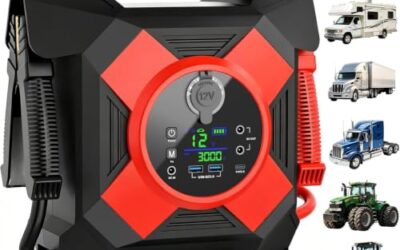
Most cars and light trucks use 12-volt starting systems. Some commercial vehicles, buses, and heavy trucks use 24 volts. A 12-volt booster is not a substitute for a 24-volt system.
Connecting the wrong voltage can damage vehicle electronics, the booster, or both. Identify system voltage before connecting clamps. Never assume a large vehicle uses the same electrical system as a passenger car.
Battery location and terminals
Some vehicles place the battery in the trunk, under a seat, or behind a panel. Remote positive and negative terminals may exist under the hood. The vehicle manual takes priority because certain cars use current sensors or specific grounding points.
Smart protection systems
Electronic clamps may block connection when they detect reverse polarity, low voltage, excessive temperature, or a short circuit. Protection improves safety, but it can also prevent operation with a battery that is extremely discharged.
Override features may bypass some protections. That can create a spark, damage electronics, or reverse polarity if the clamps are wrong. Disconnect vehicle loads and follow the stated connection order.
How to judge a jump starter beyond peak amps
- Identify vehicle requirements. Check the owner’s manual for system voltage, battery access, grounding points, and jump-start procedure.
- Match vehicle type. Consider gasoline or diesel operation, engine size, battery age, and expected weather. Diesel and large engines need more reserve than small gasoline engines.
- Read sustained-output details. Give more weight to starting or cranking figures with stated test conditions than to peak amps alone.
- Check cable construction. Longer or thinner leads create more voltage loss. Solid clamps need enough jaw opening and clean contact surfaces.
- Review temperature limits. Cold-weather use can reduce output. Storage temperature and operating temperature may differ.
- Check charging and storage needs. A pack left unused can lose charge. Follow its charging schedule and store it within the stated temperature range.
- Look for suitable protection. Reverse-polarity, short-circuit, over-temperature, and over-current controls can reduce connection errors.
- Keep reserve. Choose more capability than the minimum claimed fitment if the vehicle faces winter cold, repeated starts, or long storage periods.
Common mistakes
- Picking the largest number. Peak amps do not show voltage stability, test duration, or cold-weather output.
- Comparing labels as though tests match. Different terms and test conditions can make direct comparisons unreliable.
- Using a booster on the wrong voltage system. Confirm 12-volt or 24-volt operation before connection.
- Clamping to dirty metal. Poor contact causes voltage loss and heat.
- Cranking continuously. Long attempts can overheat the starter and booster. Use short attempts with cooling time according to both manuals.
- Assuming a jump fixes the cause. A weak alternator, failed battery, parasitic drain, damaged cable, or starter fault still needs diagnosis.
- Ignoring storage charge. A neglected pack may be empty when needed.
- Using manual override casually. Override modes can remove normal polarity or low-voltage safeguards.
For cold-weather planning, see CarTechTalk’s cold-weather jump starter guide. Drivers comparing a booster with tire inflation should read the jump starter and tire inflator guide. Stored vehicles have different battery risks, covered in the stored-vehicle jump starter guide.
When to get professional help
Stop and call for service if the battery case is swollen, cracked, leaking, frozen, or hot. Do not jump a battery with visible damage. Keep sparks, flames, and cigarettes away from batteries because charging and starting can release flammable gas.
Get professional diagnosis when a vehicle needs repeated jumps, loses power after driving, produces clicking without cranking, or shows burning odors. These symptoms can point to charging-system, cable, starter, or battery faults.
Hybrid and electric vehicles need extra care. A portable booster may support a low-voltage accessory battery on some models, but it does not charge or start the high-voltage traction battery. Follow the model-year owner’s manual or use qualified service support.
Gear that can help
If you need jump starters for this job, these picks already appear in our jump starters guides. Check the full guide for fit and who should skip each one.

Pros
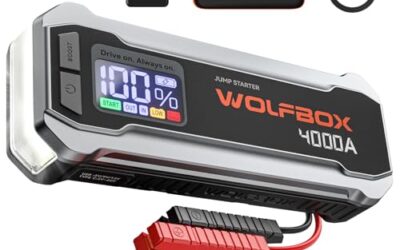
- High listed 7000A peak-current output
- Supports the stated range of gas and 12.0L diesel engines
- Includes forced-start functionality for fully drained batteries
- Combines jump-starting, USB charging, and emergency lighting in one portable unit
- Uses metal clamps and lists 14 safety protections
Cons
- The source data does not identify a separate wall charger or its specifications
Best For / Avoid If
Best for buyers prioritizing
- High listed 7000A peak-current output
- Supports the stated range of gas and 12.0L diesel engines
- Includes forced-start functionality for fully drained batteries
Consider another option if
- The source data does not identify a separate wall charger or its specifications

Pros
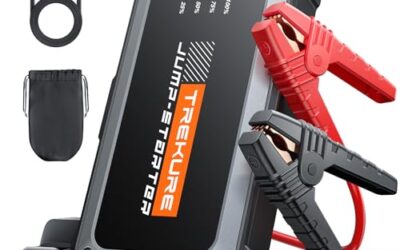
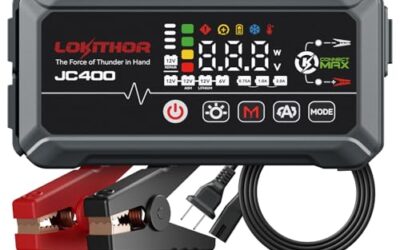
- Supports a stated range of gas and diesel engine sizes
- Combines jump-starting capability with power-bank and emergency-light functions
- Includes reverse-polarity, short-circuit, overheating, overvoltage, overload, deep-discharge, and overcurrent protections
- Provides a built-in handle for portability
Specifications
| Color | Gray-blue |
|---|---|
| Dimensions | 7.4409448743 x 3.6614173191 x 1.7716535415 inches |
| Weight | 1.4109584768 pounds |
| Product Group | Automotive Parts and Accessories |
| Binding | Automotive |
Best For / Avoid If
Best for buyers prioritizing
- Supports a stated range of gas and diesel engine sizes
- Combines jump-starting capability with power-bank and emergency-light functions
- Includes reverse-polarity, short-circuit, overheating, overvoltage, overload, deep-discharge, and overcurrent protections
Pros
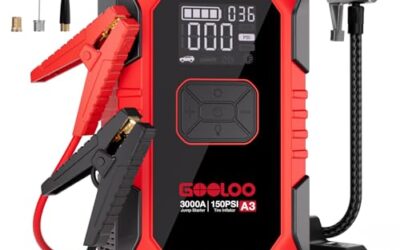
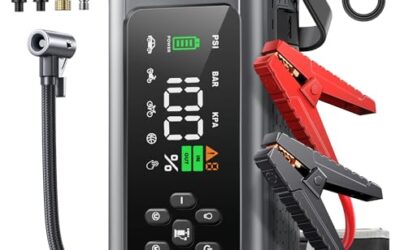
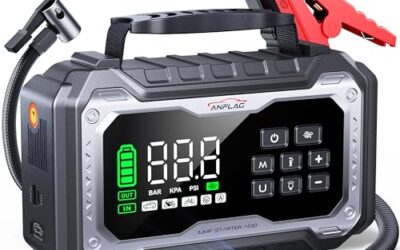
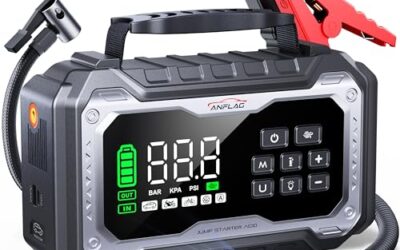
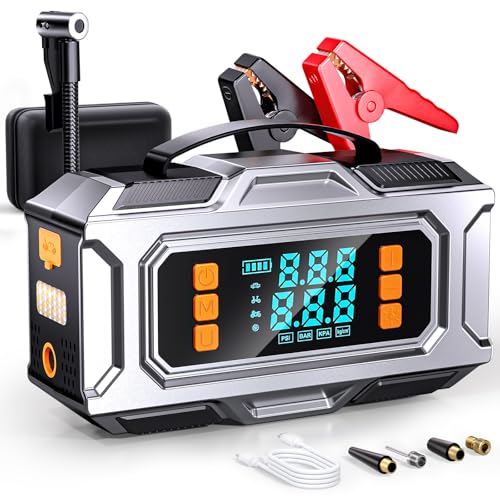
- Combines jump starting, tire inflation, device charging, and 12V accessory power in one unit
- Supports both gas and diesel vehicles within the stated engine-size limits
- Auto-shutoff inflator can be set using PSI, BAR, KPA, or KG/CM² units
- Includes a storage box, USB-C charging cable, air hose, nozzles, and user manual
Cons
- The manufacturer advises waiting two minutes between jump-start attempts and limiting attempts to three consecutively
- The compressor should cool for five minutes after 20 minutes of continuous inflation
- The unit should be recharged every two to three months during storage
Specifications
| Color | Black Silver |
|---|---|
| Dimensions | 4.3 x 7.6 x 2.5 inches |
| Weight | 2.5 Pounds |
| Product Group | Automotive Parts and Accessories |
Best For / Avoid If
Best for buyers prioritizing
- Combines jump starting, tire inflation, device charging, and 12V accessory power in one unit
- Supports both gas and diesel vehicles within the stated engine-size limits
- Auto-shutoff inflator can be set using PSI, BAR, KPA, or KG/CM² units
Consider another option if
- The manufacturer advises waiting two minutes between jump-start attempts and limiting attempts to three consecutively
- The compressor should cool for five minutes after 20 minutes of continuous inflation
- The unit should be recharged every two to three months during storage
FAQ
Are higher peak amps always better?
No. Higher peak amps may provide more short-term headroom, but sustained output, voltage control, cable quality, temperature, and vehicle condition determine actual starting performance.
What peak amps do I need for my car?
There is no single number for every car. Match the booster to the vehicle manual, engine type, battery condition, and local climate. Diesel engines and large engines usually need more reserve.
Do jump starters lose power in winter?
Yes. Cold reduces output from lithium cells and weakens the vehicle battery. Keep the booster charged, store it within its temperature limits, and expect fewer attempts in severe cold.
Can a jump starter replace a battery charger?
No. A jump starter supplies short-term starting energy. A charger restores battery charge over time and may support battery maintenance, depending on its mode and compatibility.
Can I use a 12-volt jump starter on an EV?
Only for procedures allowed by that vehicle’s manual, usually involving its low-voltage system. It cannot replace service equipment for the high-voltage traction battery.
Sources and further reading
- Battery Council International: Battery safety, care, and recycling information.