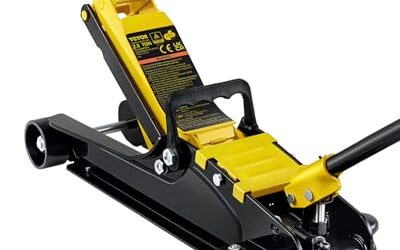
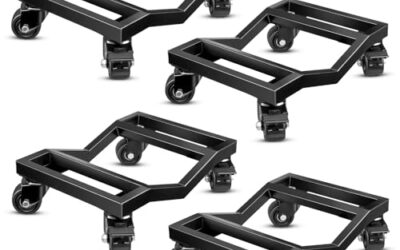
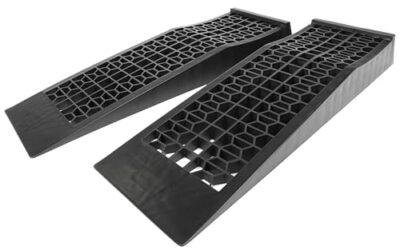
A floor jack will not fit under a car when its lowered height, handle, or saddle cannot clear the vehicle and reach an approved lift point. Low ground clearance, uneven ground, a misplaced jack, or the wrong jack design can all cause the problem. Do not force the jack under the car or lift from an unapproved spot.
Key takeaways
- Check the jack’s lowest height against the clearance at its intended approach path, not just at the bumper.
- Use the vehicle manual to identify approved lifting points and the correct lifting method.
- A low-profile jack or suitable drive-on ramps may solve an access problem, but neither is right for every vehicle or task.
- Never work under a vehicle supported only by a floor jack.
Why a floor jack will not fit under a car
The most common issue is a height mismatch: the jack’s lowest part is taller than the available space beneath the vehicle. The mismatch can occur even when the jack appears small. Its wheels, frame, lifting arm, or saddle may hit the vehicle before the saddle reaches the lifting point.
Ground clearance varies across the underside. A low bumper or front air dam may block the jack’s path, while the approved lift point farther back may have more room. Conversely, a suspension component or underbody panel can make the path narrow. Check the entire route the jack must travel, not only the first gap you see.
Other causes include a sloped or soft surface, a jack that is not fully lowered, a handle that contacts the body, or a lifting point that is difficult to reach with that jack’s shape. A jack may also appear not to fit because it is aimed at the wrong location.
| What you notice | Possible cause | Safe next check |
|---|---|---|
| Jack nose stops at bumper or body panel | Low air dam, bumper, or approach clearance | Check for an approved approach path in the vehicle manual; do not push against bodywork. |
| Jack rolls under, but saddle cannot reach the point | Jack geometry, frame obstruction, or wrong position | Identify the vehicle’s approved lift point and compare it with the jack’s reach. |
| Jack fits on one side but not the other | Uneven ground, vehicle position, or different underside clearance | Stop and check that the vehicle and jack sit on firm, level ground. |
| Handle hits the vehicle before lifting | Limited working room or incompatible handle path | Do not operate at an angle or against the car; use equipment suited to the access space. |
| Jack enters but tilts, binds, or shifts | Unstable surface, poor alignment, or unsuitable equipment | Stop. Lower the vehicle if it is raised and reposition only under manual guidance. |
How to check jack fit safely
- Park safely. Use a firm, level surface and follow the vehicle manual’s instructions for securing the vehicle. Keep people clear of the lifting area.
- Find the approved lift point. Consult the owner’s manual or service information for the vehicle’s model year. Do not assume a pinch weld, subframe, axle, or floor panel is safe just because it looks strong.
- Check the approach path. With the jack lowered, see whether its frame and wheels can travel to the specified point without touching body panels, plastic covers, or other parts.
- Check contact and movement. The saddle must align with the approved point. The jack also needs room to roll as its lifting arm rises, according to its instructions.
- Stop if anything binds or shifts. Do not use a board, brick, or improvised spacer to make the jack fit. A change in height or support can affect stability.
These checks help identify a mismatch; they do not replace the vehicle or jack instructions. If the manual does not show a safe way to reach the point with available equipment, do not guess.
Does a low-profile floor jack solve the problem?
A low-profile jack can help when the car’s clearance is lower than the entry height of a conventional jack. But entry height is only one part of fit. The jack still needs enough reach, a suitable saddle, a compatible lifting range, room for its frame to move, and a rated capacity appropriate to the job.
Vehicle type and model year matter. A lowered car, sports car, SUV, and pickup may have different clearance, lift points, and underbody layouts. Even vehicles with the same model name can differ by trim, suspension, tires, or installed accessories. For more on vehicle-specific capacity and reach, see our guides to floor jacks for SUVs and floor jacks for pickup trucks.
Some low cars may need an access method approved for the vehicle and task before a jack can reach its lift point. Ramps can raise a vehicle for certain jobs, but they do not automatically make every lift point accessible or suit work that requires a wheel to hang free. Follow the ramp and vehicle instructions, and do not combine equipment in a way its instructions do not allow.
Why a jack can fit but still be the wrong choice
Physical clearance does not prove that a jack is suitable. A jack’s rated capacity, maximum height, saddle shape, and intended use all matter. A jack that reaches the car may lack the lift range for the job, or its saddle may not contact the approved point correctly.
Never use the jack’s capacity as a reason to lift from an unapproved area. Vehicle weight is distributed across several supports, but there is no universal percentage formula that makes an arbitrary lift point safe. Use the vehicle and equipment instructions for the specific operation.
If the job requires working beneath the vehicle, raise it only by the specified method and support it with properly rated jack stands at approved support points. A hydraulic floor jack can lower or fail; it is not a substitute for stands. See our guide to jack stands and vehicle support for related safety considerations.
Common mistakes
- Pushing harder. Forcing a jack past an air dam or underbody panel can damage the car or jack. Stop when it contacts an obstruction.
- Lifting from the nearest solid-looking part. The visible part may not be an approved lift point. Check the manual first.
- Using a loose spacer. Improvised blocks can shift, split, or change how the jack supports the load. Use only accessories and methods approved for the equipment and vehicle.
- Ignoring the surface. Soft, sloped, or uneven ground can affect jack stability and rolling movement. Do not lift in those conditions.
- Assuming every low-profile jack fits every low car. Jack design and vehicle geometry differ. Low entry height alone does not establish compatibility.
- Getting under a car held by a jack alone. Use suitable stands at approved points before entering the area beneath a raised vehicle.
When to get professional help
Stop and ask a qualified technician if you cannot identify the approved lift point, the jack cannot reach it without contact or binding, or the car shifts during setup. Get help if the underside is damaged, heavily corroded, modified, or obscured by aftermarket parts. A shop can select lifting equipment for the vehicle and the specific repair.
If a vehicle has air suspension, unusual lift instructions, or a model-specific service procedure, consult its manual or service information before lifting. Procedures can vary by model year and configuration. Do not rely on a generic online diagram when the vehicle’s instructions differ.
Gear that can help
If you need floor jacks or jack stands for this job, these picks already appear in our floor jacks guides. Check the full guide for fit and who should skip each one.
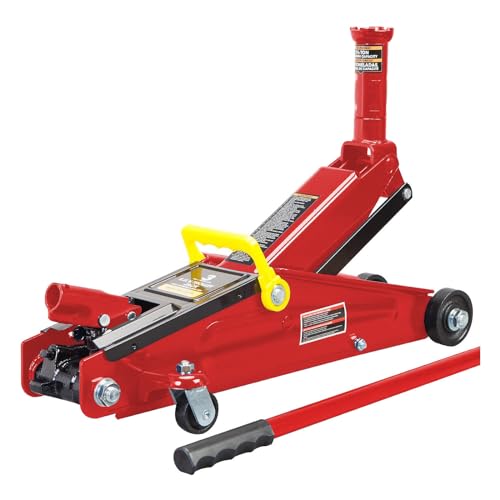
Pros
- High 20-7/8-inch maximum lift height for SUVs and extended-height trucks
- 6,000-pound capacity is listed for cars, trucks, vans, and SUVs
- 360-degree swivel casters support maneuverability
- Includes a limited one-year manufacturer warranty
Cons
- The listed minimum lifting height is 5-7/8 inches, so lower-clearance compatibility is not established
- The manufacturer warranty is limited to one year
- The listing does not include a detailed specifications array
Best For / Avoid If
Best for buyers prioritizing
- High 20-7/8-inch maximum lift height for SUVs and extended-height trucks
- 6,000-pound capacity is listed for cars, trucks, vans, and SUVs
- 360-degree swivel casters support maneuverability
Consider another option if
- The listed minimum lifting height is 5-7/8 inches, so lower-clearance compatibility is not established
- The manufacturer warranty is limited to one year
- The listing does not include a detailed specifications array

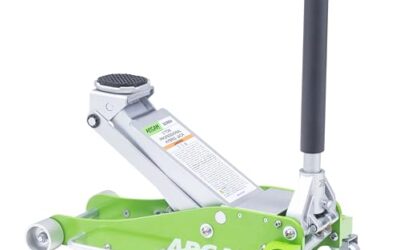
Pros
- Low-profile design supports access under vehicles with limited ground clearance
- Extended reach is intended for sports cars, lowered vehicles, and modified vehicles
- Steel construction and 3-ton capacity are suited to home and workshop vehicle maintenance
- Dual-piston RAPID PUMP technology is designed to reduce the number of pump strokes
Cons
- Color is provided randomly
Specifications
| Color | Random Color |
|---|---|
| Size | 3 Ton |
| Product Group | Automotive Parts and Accessories |
Best For / Avoid If
Best for buyers prioritizing
- Low-profile design supports access under vehicles with limited ground clearance
- Extended reach is intended for sports cars, lowered vehicles, and modified vehicles
- Steel construction and 3-ton capacity are suited to home and workshop vehicle maintenance
Consider another option if
- Color is provided randomly
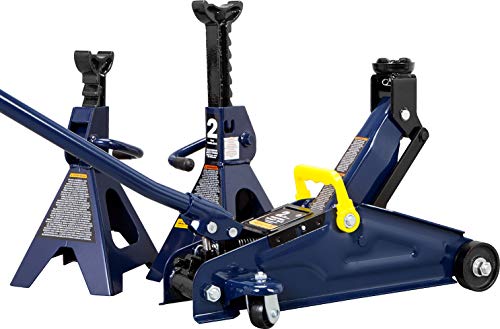
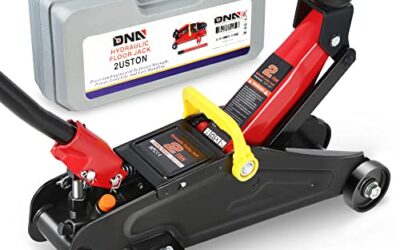
Pros
- Combines a floor jack and two jack stands in one package
- Adjustable jack stands have wide pyramidal bases and large saddle surfaces
- Heavy-duty steel construction is specified for the jack and stands
- The floor jack includes a built-in carry handle for portability
Cons
- Not recommended for SUVs or trucks
- The 2-ton capacity limits the product to vehicles within the stated load rating
- The listing does not include a detailed specifications array or product description
Best For / Avoid If
Best for buyers prioritizing
- Combines a floor jack and two jack stands in one package
- Adjustable jack stands have wide pyramidal bases and large saddle surfaces
- Heavy-duty steel construction is specified for the jack and stands
Consider another option if
- Not recommended for SUVs or trucks
- The 2-ton capacity limits the product to vehicles within the stated load rating
- The listing does not include a detailed specifications array or product description
Frequently asked questions
Can I drive onto a board to make room for the jack?
Do not use a loose board as an improvised ramp or jack spacer. It can move or fail. Use only a lifting or access method permitted by the vehicle and equipment instructions.
Can I lift the car by its pinch weld?
Only if the vehicle instructions identify that location as an approved lift point and the jack saddle is suitable for it. Some vehicles need a specific adapter or contact method.
Will a scissor jack fit where a floor jack will not?
It might fit in a tighter space, but fit does not make it suitable for every task. Use the jack supplied or specified for the vehicle as directed, and never work beneath a vehicle supported only by a jack.
Can I use ramps instead of a floor jack?
Ramps may work for some tasks when they suit the vehicle and the job. They do not provide access for every repair, and they do not replace jack stands when a raised vehicle needs separate support.
Sources and further reading
- Safety Standard for Portable Automotive Service Equipment (ASME): Background on safety standards for portable automotive lifting equipment.